
A 3D scanner with turntable can simplify object capture by keeping the subject moving at a consistent speed while the scanner records multiple angles. That makes a turntable especially useful for small to medium objects, product models, collectibles, and 3D-printing projects.
Our 2026 roundup compares ten scanner and turntable options across accuracy, scanning modes, software features, portability, object-size range, and ease of use. Use the buying guide below to narrow the choices based on your workflow and budget.
Best 10 3d Scanner with Turntable Picks for 2026
Premium Wireless Pick

- Tri-mode laser and infrared scanning
- Up to 0.04 mm accuracy
- Wireless, onboard all-in-one design
Best For: Detailed workshop, field, and reverse-engineering scans
Beginner-Friendly Choice

- Accessible medium-format scanner
- 0.07 mm stated accuracy
- AI tracking and integrated JMStudio software
Best For: Hobby 3D printing and beginner scanning projects
Portable High-Accuracy Pick

- 0.03 mm stated accuracy
- Includes turntable and wireless operation
- Blue laser and NIR scanning modes
Best For: Portable scanning from miniatures to full-body subjects
Turntable Accessory Pick
Remote Motorized Rotating Stand

- 360-degree motorized rotation
- Remote continuous and stepped modes
- Supports heavy display and scanning loads
Best For: Automated multi-angle scanning and product photography
Premium All-Weather Precision
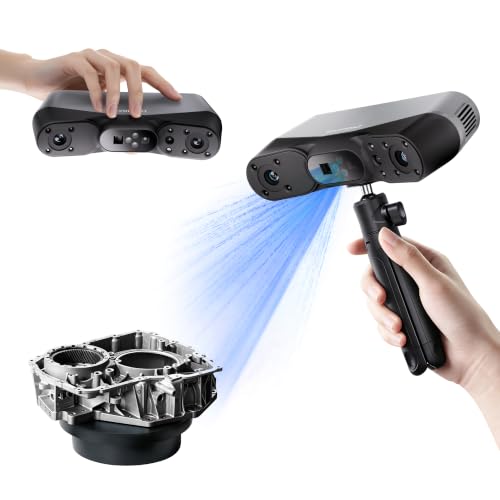
- Up to 0.03 mm single-frame accuracy
- Five modes for dark, reflective, and complex objects
- Wi-Fi 6 and up to four hours of outdoor scanning
Best For: Precision modeling, reverse engineering, and outdoor field scanning
Versatile Full-Color Scanning

- 0.05 mm accuracy at up to 30 fps
- Scans dark and metallic surfaces without spray
- 24-bit color capture with broad file-format support
Best For: Portable scanning from small objects to large components
Automated Industrial Accuracy

- Up to 0.01 mm single-frame precision
- Dual-axis turntable enables one-click automated scans
- Blue laser modes handle shiny and dark surfaces
Best For: Industrial measurement and repeatable precision scanning
Best Compact Pick
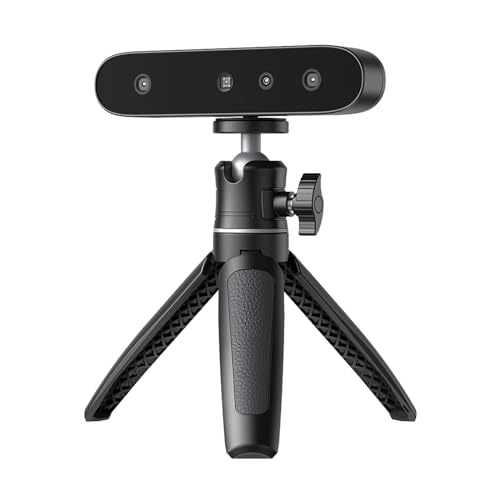
- Anti-shake scanning for steadier handheld results
- Scans black and metal without spray
- Lightweight full-color desktop scanner
Best For: Beginners and Windows desktop scanning
Best Feature-Rich Pick

- Includes a mini turntable and calibration accessories
- Dual scanning modes handle varied surfaces
- Wireless, outdoor, and full-color scanning
Best For: Detailed multi-surface scanning and professional workflows
Best Entry-Level Value

- Includes a manual turntable
- Markerless tracking simplifies setup
- Scans 40mm to 1200mm objects
Best For: DIY prototyping, STEM projects, and patient beginners
Premium Wireless Pick – EinScan Rigil
The EinScan Rigil is a versatile 3d scanner with turntable option for users who need detailed captures across different object sizes. Its hybrid laser and infrared modes, onboard computing, and wireless design make it suited to workshop and field workflows.
Best For: Reverse engineering, inspection, design, and detailed 3D scanning of small to large objects.
Pros:
- Tri-mode scanning combines blue laser, infrared, and hybrid adaptive modes.
- Up to 0.04 mm accuracy and 0.05 mm resolution support fine detail capture.
- Integrated display, storage, computing, and swappable battery enable cable-free use.
- Supports full-color texture capture and STL, OBJ, PLY, and 3MF exports.
Cons:
- At 5 kg, it is substantially heavier than portable entry-level scanners.
- The feature set may be more than casual hobbyists need.
The Rigil stands out when scanning flexibility and dimensional detail matter more than minimizing weight or cost. Blue laser performance on dark and metallic surfaces further broadens its practical range.
Beginner-Friendly Choice – 3DMakerpro Fox
The 3DMakerpro Fox is an accessible entry-level option for shoppers seeking a 3d scanner with turntable setup for 3D printing and modeling projects. It combines medium-format scanning with software designed to simplify capture and cleanup.
Best For: Beginners and hobbyists who want practical scans for 3D printing, modeling, measurement, or inspection.
Pros:
- 0.07 mm accuracy and 0.10 mm resolution provide useful entry-level detail.
- Markerless AI visual tracking can relock onto an object after tracking is lost.
- JMStudio integrates scanning, editing, and optimization in one workflow.
Cons:
- The supplied notes do not specify wireless operation or included turntable hardware.
- Its entry-level positioning may not satisfy demanding professional metrology work.
Fox is a sensible starting point when ease of use is a priority. Its assisted tracking and integrated software can reduce the learning curve, while the stated accuracy is suitable for many hobby and printing tasks.
Portable High-Accuracy Pick – Creality Pika
The Creality Pika is a compact 3d scanner with turntable bundle for users who want portability without giving up detailed capture. It includes a turntable, tripod, calibration board, wireless connectivity, and dual scanning modes for objects ranging from miniatures to life-size subjects.
Best For: Portable 3D printing, reverse engineering, collectibles, mechanical parts, and body scanning.
Pros:
- Blue laser mode reaches up to 0.03 mm accuracy for fine detail.
- NIR structured light supports larger objects and full-body scans.
- Lightweight 260 g design includes Wi-Fi 6, touchscreen, and swappable batteries.
- Includes a turntable and supports marker-free scanning in wired PC mode.
Cons:
- Its one-year warranty is shorter than some professional equipment warranties.
- Advanced AI features and multiple platforms may require a learning period.
Pika offers one of the broadest portable feature sets in this group. It is especially appealing if you need to move between small detailed parts, larger objects, and body scanning while exporting to common CAD and printing formats.
Turntable Accessory Pick – Remote Motorized Rotating Stand
This motorized rotating platform is a practical companion for a 3d scanner with turntable, adding controlled 360-degree movement for scanning, product photography, and display work. Its remote control supports continuous, stepped, and pendulum rotation.
Best For: Automated multi-angle scanning, product photography, demonstrations, and heavier display objects.
Pros:
- Supports clockwise and counterclockwise rotation with adjustable speed.
- Remote control offers continuous, single-step, repeated-step, and pendulum modes.
- Metal construction and bearing-supported design accommodate substantial loads.
- Compact 7.9-inch platform suits smaller scanning and display setups.
Cons:
- The stated stepped-mode capacity is 20 kg, lower than its continuous-mode capacity.
- Its 20 cm diameter limits the size of objects that can sit fully on the platform.
- It is an accessory rather than a scanner and requires a separate scanning device.
Choose this platform when repeatable object movement is more important than an integrated scanner bundle. The multiple rotation modes and remote speed control can make multi-angle capture more consistent, provided the object fits and stays within the appropriate load limit.
Premium All-Weather Precision – Revopoint POP 4
The Revopoint POP 4 is a strong choice if you need a 3d scanner with turntable capabilities for detailed models, reverse engineering, or 3D printing. Its five scanning modes cover small parts through objects up to 2 meters, while laser options support dark and reflective surfaces.
Best For: Precision-focused makers, engineers, and field users scanning varied object sizes and challenging surfaces.
Pros:
- Up to 0.03 mm single-frame accuracy and 0.03 mm + 0.05 mm × L(m) volumetric accuracy.
- Five scanning modes, including blue laser options for dark and reflective objects.
- AI segmentation, Wi-Fi 6, and a battery grip rated for up to four hours of outdoor scanning.
- Supports objects from 10 × 10 × 10 mm up to 2 × 2 × 2 m.
Cons:
- AI object segmentation is limited to Windows.
- The extensive feature set may require more setup than a basic handheld scanner.
Choose the POP 4 when accuracy, outdoor flexibility, and broad surface compatibility matter more than simplicity. It is particularly well suited to demanding scanning workflows that span portable field capture and precision modeling.
Versatile Full-Color Scanning – Creality Otter Lite Basic
The Creality Otter Lite Basic offers a practical handheld approach to using a 3d scanner with turntable workflows, especially when you need to move between small parts and large objects. Its quad-camera design, full-color capture, and direct scanning of dark or metallic surfaces make it flexible for general-purpose projects.
Best For: Hobbyists, designers, and small businesses scanning objects from coins to automotive-sized components.
Pros:
- 0.05 mm accuracy and scanning speeds up to 30 frames per second.
- Quad-camera design covers objects from 0.8 inches to 78 inches.
- Scans black, shiny, and metallic objects without powder or spray.
- Captures 24-bit full-color textures and exports to formats including STL, OBJ, PLY, 3MF, GLTF, and FBX.
Cons:
- The optional Scan Bridge handle is sold separately.
- Outdoor operation is specified for up to 30,000 lux, less than some higher-end options.
The Otter Lite Basic is a balanced pick for users who value portability and color capture alongside usable accuracy. Its broad size range and compatibility with Windows, macOS, iOS, and Android make it accessible for mixed scanning setups.
Automated Industrial Accuracy – Revopoint MetroX Pro
The Revopoint MetroX Pro is the most specialized option here for buyers seeking a 3d scanner with turntable automation. Its dual-axis turntable supports one-click scanning, while blue laser modes deliver high precision on shiny, dark, flat, and detailed surfaces.
Best For: Industrial measurement, reverse engineering, precision modeling, and repeatable object capture.
Pros:
- Up to 0.01 mm single-frame precision and 0.02 mm single-frame accuracy.
- Dual-axis automatic turntable enables one-click scans of complex objects.
- Blue laser modes scan shiny and dark surfaces without spray.
- Full-field blue structured light captures up to 7 million points per second.
Cons:
- Revo Design and Revo Measure are paid software sold separately and support Windows only.
- At 14.82 pounds, the package is less portable than a basic handheld scanner.
MetroX Pro is the strongest fit when repeatability and measurement-grade detail are priorities. The automated turntable reduces manual handling, while multiple tracking modes help accommodate flat, detailed, and complex objects.
Best Compact Pick – Creality CR-Ferret SE
If you want a lightweight 3d scanner with turntable compatibility for desktop projects, the Creality CR-Ferret SE emphasizes steady handheld scanning, full-color capture, and simple operation. Its anti-shake tracking can help reduce errors caused by hand movement, while its ability to scan black and metallic objects without spray adds convenience.
Best For: Beginners, desktop scanning, and users capturing dark or metallic objects on a Windows PC.
Pros:
- Anti-shake technology supports steadier handheld scans.
- Scans black and metallic objects without scanning spray.
- Captures 24-bit full-color models with its built-in 2MP camera.
- Compact 105g design is easy to carry.
Cons:
- Does not include a battery handle.
- Supports PC scanning only, with Windows system requirements.
The CR-Ferret SE is a practical entry point when portability and ease of use matter more than a broad multi-device workflow. It is especially appealing for desktop users who need color capture and better performance on dark or reflective subjects.
Best Feature-Rich Pick – Revopoint INSPIRE 2
The Revopoint INSPIRE 2 is a versatile 3d scanner with turntable included, combining infrared structured light, multi-line laser scanning, wireless connectivity, and outdoor capability. It is designed for users who want flexible scanning modes and a more complete workflow for printing, reverse engineering, or digital archiving.
Best For: Advanced hobbyists and professionals scanning varied surfaces, outdoor subjects, and detailed objects across supported devices.
Pros:
- Includes a mini turntable, tripod, calibration board, markers, and outdoor filters.
- Uses infrared structured light and 11 laser lines for challenging dark or reflective surfaces.
- Offers accuracy up to 0.05mm and precision up to 0.03mm.
- Built-in Wi-Fi 6.0 enables wireless scanning and interactive streaming.
Cons:
- Requires relatively powerful computer hardware for Windows and macOS workflows.
- Revo Design is paid separately and supports Windows only.
With its included turntable and multiple scanning modes, the INSPIRE 2 is the most complete option here for users building a flexible scan-to-model workflow. Its higher system requirements and professional software ecosystem make it better suited to serious projects than casual experimentation.
Best Entry-Level Value – 3DMakerpro Fox
The 3DMakerpro Fox is an entry-level 3d scanner with turntable included, aimed at small to medium objects such as miniatures, automotive parts, and prototypes. Its markerless tracking, anti-shake support, and NIR light make setup approachable, though users should expect a learning curve and need a capable PC for smooth operation.
Best For: DIY prototyping, STEM education, and scanning objects from 40mm to 1200mm for 3D printing or modeling.
Pros:
- Includes a manual turntable and 65W charger.
- Markerless tracking eliminates the need for target dots.
- NIR light supports eye-safe face and body scanning.
- JMStudio exports OBJ, STL, PLY, and ASC files.
Cons:
- Requires patience and some CAD or 3D modeling knowledge.
- A dedicated GPU is strongly recommended for smooth software performance.
- The manual turntable may require more hands-on operation.
The Fox offers a useful starter package for users who want a turntable and broad object-size range without a complicated setup involving markers. Its value is strongest for patient learners prepared to refine meshes and manage the demands of 3D scanning software.
How We Picked the Best 3d Scanner with Turntable
We evaluated these options by looking at the factors that most affect real-world scanning results: stated accuracy, tracking method, scan speed, supported object sizes, color capture, connectivity, software assistance, and setup requirements. We also considered whether each product is better suited to desktop scanning, portable work, larger objects, or demanding 3D-printing and reverse-engineering tasks.
Some selections are complete scanner systems, while others are turntables or scanner-and-platform combinations. Check the included accessories carefully, because a scanner may require a separate rotating platform, tripod, mat, markers, or scanning software for the best results.
Quick Comparison
- Best for advanced hybrid scanning: EinScan Rigil Wireless combines laser and infrared scanning for versatile capture.
- Best for AI-assisted workflows: Revopoint POP 4 and Creality Pika emphasize automated segmentation or body-completion features.
- Best for portable scanning: Revopoint INSPIRE 2 and Creality CR-Ferret SE are designed for flexible, on-the-go use.
- Best for desktop objects: The 3DMakerpro Fox models and motorized turntable are appropriate for controlled tabletop scanning.
- Best for detailed laser capture: Revopoint MetroX Pro targets users who need advanced blue-laser scanning.
Key Buying Factors for a 3d Scanner with Turntable
Accuracy and Resolution
Accuracy describes how closely the scan represents the real object, while resolution affects the amount of fine surface detail captured. Higher specifications are useful for mechanical parts, fitted replacement components, and detailed models, but they do not guarantee better results without stable lighting, correct calibration, and careful alignment.
Scanning Technology and Tracking
Structured light, infrared, and blue-laser systems each have different strengths. Laser scanners can capture fine edges and geometry, while infrared systems may be more comfortable for broader surfaces and color-aware workflows. AI-assisted alignment can reduce manual cleanup, but reflective, transparent, very dark, or textureless objects may still need spray, markers, or special lighting.
Turntable Size, Speed, and Load
Match the rotating platform to the object. A small, slow turntable is usually better for compact models and detailed scans; larger platforms accommodate bigger subjects but may need stronger motors and more workspace. Look for adjustable speed, stable rotation, a non-slip surface, and a load rating that exceeds your typical object weight.
Software, Connectivity, and Portability
Confirm compatibility with your computer, phone, or tablet before buying. Wireless scanning improves mobility, while USB connections can offer a steadier data path. Review export formats, mesh-repair tools, alignment controls, and whether important features require paid software or subscriptions.
Who Should Buy Which 3d Scanner with Turntable?
Choose an entry-level 3DMakerpro Fox or Creality CR-Ferret SE if you are learning 3D scanning, making printable models, or digitizing household objects. Choose a Revopoint POP 4, Creality Pika, or Otter Lite if automated assistance, color capture, and a wider range of object sizes matter most.
For professionals and advanced hobbyists, the EinScan Rigil or Revopoint MetroX Pro offers more specialized scanning capability. If your priority is a controlled tabletop workflow rather than a complete scanner, the motorized rotating turntable can complement a compatible scanner and improve repeatability.