
The best 3D scanners can turn physical objects into detailed digital models for 3D printing, design, inspection, and reverse engineering. The right choice depends on accuracy, scanning speed, object size, tracking, and how much setup your workflow requires.
We selected 10 standout scanners spanning portable entry-level models, high-speed laser systems, wireless devices, and advanced professional tools. Use the guide below to match features with your projects and budget.
Best 10 3d Scanners Picks for 2026
Best Portable 3D Scanner

- 0.03mm accuracy with blue laser scanning
- Wireless, 260g design with dual batteries
- AI completion, retexturing, and hole filling
Best For: Portable 3D printing, reverse engineering, and body scanning
Best Beginner-Friendly 3D Scanner
- AI tracking supports automated model repair
- Anti-shake and marker-free scanning
- Compatible with mobile and desktop platforms
Best For: Beginners and hobbyists focused on 3D printing
Best Precision Laser 3D Scanner

- Up to 0.02mm blue-laser accuracy
- 60FPS laser and 20FPS NIR scanning
- Covers 5mm parts through 2m objects
Best For: Precision parts, artifacts, and large-object scanning
Best All-Weather 3D Scanner
- 0.03mm accuracy with five scanning modes
- Up to 105FPS and 5,000,000 points per second
- Wireless scanning with up to four-hour battery grip
Best For: Professional modeling, reverse engineering, and outdoor fieldwork
Best Spray-Free Scanner

- 0.05mm accuracy and up to 30fps scanning
- Scans dark and metallic surfaces without spray
- Handles objects from 0.8 to 78 inches
Best For: Mixed-size projects, reverse engineering, and full-color models
Best All-in-One Scanner

- 0.04mm point-cloud accuracy with photogrammetry support
- Near and Far modes scan small parts to machinery
- On-device processing with 32GB RAM and 256GB storage
Best For: Portable professional scanning and measurement workflows
Best High-Speed Wireless Scanner

- Blue-laser mode reaches up to 90fps
- Wireless scanning with up to 3 hours of battery life
- Handles black, reflective, and outdoor subjects
Best For: Mobile scanning and fast capture in demanding environments
Best Lightweight Outdoor Scanner

- 190g portable design with Wi-Fi 6
- Dual scanning modes for varied surfaces
- Up to 0.05mm accuracy and RGB color capture
Best For: Portable outdoor scanning, 3D printing, and digital archiving
Best Versatile High-Speed Scanner

- Up to 0.02mm accuracy and 660,000 points/sec.
- Scans 5mm to 4m objects without powder on many surfaces
- Supports wireless, outdoor, color, and professional workflows
Best For: Industrial scanning, reverse engineering, and large or challenging objects
Best Precision Industrial Scanner

- Up to 0.01mm single-frame precision
- Four scanning modes plus automated turntable
- Designed for inspection, reverse engineering, and prototyping
Best For: Industrial measurement, precision modeling, and quality inspection
Best Portable 3D Scanner – Creality Pika
The Creality Pika is a versatile choice among 3d scanners for users who need high detail in a compact, wireless package. Its blue-laser and NIR modes cover small parts through full-body scans, while AI tools can help complete, repair, and retexture models.
Best For: Portable 3D printing, reverse engineering, body scanning, and users working across multiple platforms.
Pros:
- Up to 0.03mm accuracy and 0.1mm resolution for detailed captures.
- Dual blue-laser and NIR structured-light scanning modes.
- Lightweight 260g design with Wi-Fi 6, touchscreen, and swappable batteries.
- Can scan dark and metallic surfaces without spray and export STL, OBJ, PLY, and ASC files.
Cons:
- Its broad feature set may require time to learn.
- Wireless operation and the mobile experience may not suit users who prefer a dedicated wired workflow.
Choose the Pika if portability and flexibility matter as much as scan quality. It is especially appealing for creators who want one scanner for precision parts, larger subjects, and AI-assisted model cleanup.
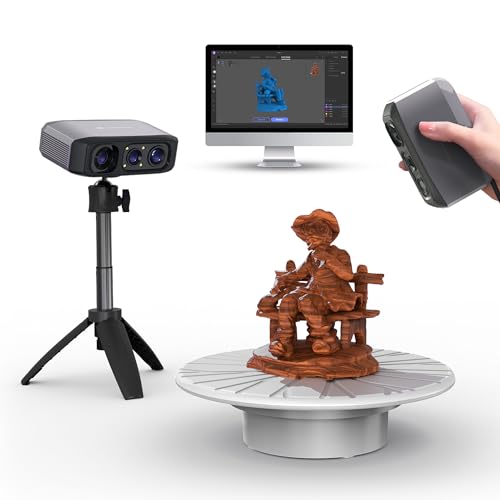
Best Beginner-Friendly 3D Scanner – 3DMakerpro Moose Lite Premium
The 3DMakerpro Moose Lite Premium is designed to make handheld 3d scanners easier to use. AI visual tracking, optical anti-shake hardware, marker-free scanning, and a resume function help reduce the friction of capturing and repairing 3D models.
Best For: Beginners and hobbyists who want guided handheld scanning for 3D printing.
Pros:
- AI visual tracking can detect vulnerabilities and support automated model repair.
- Optical anti-shake modules help compensate for unsteady hands.
- Marker-free technology avoids the need to place reference markers.
- Works with Android, iOS, Windows, and macOS, with lifetime free OTA software upgrades.
Cons:
- The supplied notes list a 10FPS scanning speed, which is lower than several faster options.
- The 3.65-pound package weight is less travel-friendly than pocket-sized scanners.
The Moose Lite Premium stands out for ease-of-use features rather than headline speed. It makes sense for first-time users who value tracking assistance, shake reduction, and software support over a highly specialized industrial workflow.
Best Precision Laser 3D Scanner – Creality CR-Scan Raptor
The Creality CR-Scan Raptor is one of the more precision-focused 3d scanners in this roundup. Its seven blue laser lines reach up to 0.02mm accuracy, while an NIR mode provides marker-free scanning for faces, bodies, and larger artifacts.
Best For: Precision scanning of mechanical parts, artifacts, and objects ranging from miniature components to large subjects.
Pros:
- Up to 0.02mm accuracy with fine blue laser lines.
- Blue-light mode reaches 60FPS, while NIR mode reaches 20FPS.
- Supports both marked blue-laser scanning and marker-free NIR scanning.
- Handles scan volumes from 5×5×5mm to 2000×2000×2000mm.
Cons:
- Requires a high-performance computer with specified Windows or macOS hardware.
- The supplied notes do not indicate mobile operating-system support.
The Raptor is a strong fit when measured detail and scan range take priority. Be prepared to pair it with a capable computer, especially if you plan to use its fastest or most demanding scanning workflows.
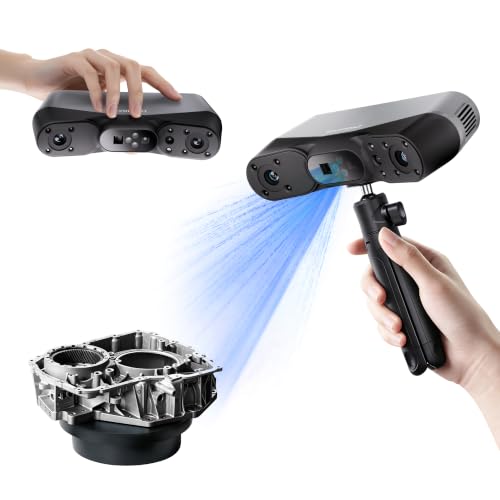
Best All-Weather 3D Scanner – Revopoint POP 4
The Revopoint POP 4 is a feature-rich option among 3d scanners, combining laser and structured-light modes with AI segmentation and photorealistic retopology. Its broad scan range, outdoor lighting support, and wireless battery grip make it suitable for both studio and field work.
Best For: Professional 3D printing, reverse engineering, photorealistic models, and outdoor scanning.
Pros:
- Single-frame accuracy reaches 0.03mm, with multiple modes for different subjects.
- Up to 105FPS in multi-line laser mode and up to 5,000,000 points per second in structured light.
- AI object segmentation filters background noise, while Gaussian Splatting supports realistic textures.
- Supports objects from 10×10×10mm to 2×2×2m and outdoor use up to 100,000 lux in supported modes.
Cons:
- AI object segmentation is limited to Windows.
- Its many scan modes and professional features may be more than casual users need.
- Some advanced performance depends on NVIDIA GPU acceleration.
The POP 4 is the most expansive choice here for users who need one system to cover detailed parts, large objects, dark or reflective surfaces, and field conditions. It is best suited to buyers willing to learn a multi-mode professional workflow.
Best Spray-Free Scanner – Creality Otter Lite Basic
For shoppers comparing 3d scanners, the Creality Otter Lite Basic stands out as a flexible handheld option for both tiny objects and larger projects. Its quad-camera setup, 0.05mm accuracy, 30fps scanning, and direct capture of dark or metallic surfaces make it well suited to detailed scanning without surface spray.
Best For: Reverse engineering, 3D printing, prototyping, inspection, and full-color scanning of objects from coins to large automotive parts.
Pros:
- Offers up to 0.05mm accuracy and scanning speeds of up to 30fps.
- Quad-camera coverage supports objects from 0.8 to 78 inches.
- Can scan dark and metallic surfaces without powder or spray, including outdoors in up to 30,000 lux.
- Captures 24-bit color textures and supports common formats including STL, OBJ, PLY, and 3MF.
Cons:
- The optional Scan Bridge handle is sold separately.
- It requires compatible CrealityScan software and a supported Windows, macOS, iOS, or Android device.
The Otter Lite Basic is a strong all-around choice when ease of use, portability, color capture, and material flexibility matter. Its combination of small-object detail and broad size coverage makes it particularly practical for mixed scanning workloads.
Best All-in-One Scanner – Revopoint MIRACO Plus
Among advanced 3d scanners, the Revopoint MIRACO Plus is designed as a self-contained workflow for capturing, processing, and exporting scans. Its Near and Far modes, integrated hardware, photogrammetric kit, and high-resolution color camera make it especially capable for projects that span small parts to large machinery.
Best For: Portable professional scanning, measurement-focused work, reverse engineering, 3D printing, and large-object capture.
Pros:
- Reaches 0.04mm single-point cloud accuracy, with photogrammetric length accuracy rated at 0.02mm + 0.05mm × L(m).
- Near and Far modes cover tiny components through large machinery.
- Built-in 32GB RAM, 256GB storage, and an 8-core processor support on-device capture and processing.
- Offers up to 2 hours of scanning, 65W fast charging, and Wi-Fi 6 or USB-C transfers.
Cons:
- The Revo Design scan-to-CAD software is sold separately.
- The photogrammetric workflow uses scale bars and coded targets for complex measurements.
- Continuous scanning reaches up to 20fps, which is slower than its single-shot mode for precision capture.
The MIRACO Plus is a compelling pick for users who want fewer dependencies on a separate computer during capture. It combines portability with measurement-oriented features, although buyers should account for the separately sold scan-to-CAD software if CAD conversion is central to their workflow.
Best High-Speed Wireless Scanner – EINSTAR 2 Wireless 3D Scanner
The EINSTAR 2 is one of the more versatile 3d scanners for users who need wireless mobility and multiple capture modes. Its blue-laser system targets fine detail and reflective materials, while VCSEL infrared scanning handles larger objects, black surfaces, and bright outdoor conditions.
Best For: Wireless scanning of small to large objects, reflective or black surfaces, outdoor work, and high-speed capture.
Pros:
- Blue-laser mode reaches up to 90fps and uses 17 parallel lines for detailed capture.
- VCSEL infrared mode supports larger objects and scanning speeds up to 20fps.
- Scans black and reflective objects without spray and works in bright conditions up to 110,000 lux in laser mode.
- Swappable battery supports up to 3 hours of wireless scanning, with cable operation available when needed.
Cons:
- Wireless performance can be affected by Wi-Fi interference, according to the supplied notes.
- The listed package weight is 5.72 pounds, which may be substantial for extended handheld use.
- It relies on EXStar Hub PC software for scanning, processing, and optimization.
The EINSTAR 2 is a practical choice when speed, portability, and challenging surface conditions are priorities. Its two scanning technologies give it broad coverage, while the replaceable battery makes it better suited to work away from a fixed studio setup.
Best Lightweight Outdoor Scanner – INSPIRE 2
The Revopoint INSPIRE 2 is a portable option for shoppers comparing 3d scanners for mobile work, outdoor projects, 3D printing, and detailed modeling. Its 190g design, Wi-Fi 6 connectivity, dual scanning modes, and RGB color capture make it flexible for scanning in varied environments.
Best For: Portable outdoor scanning, 3D printing, digital archiving, and scan-to-CAD workflows.
Pros:
- Supports outdoor scanning in lighting up to 20,000 lux and weighs only 190g.
- Uses infrared structured light and 11-line laser scanning for varied surfaces, including dark or reflective objects without scanning spray.
- Offers accuracy up to 0.05mm and precision up to 0.03mm, plus full-color texture capture.
- Includes a tripod, markers, mini turntable, calibration board, and outdoor filters.
Cons:
- Revo Design is paid separately and supports Windows only.
- Computer users need relatively capable hardware, including 16GB RAM and a suitable dedicated GPU for Windows.
The INSPIRE 2 stands out when portability and outdoor flexibility matter more than a specialized industrial setup. Its included accessories and wireless workflow make it a practical choice for creators and makers, while the software requirements are worth checking before purchase.
Best Versatile High-Speed Scanner – CR-Scan Raptor Pro
The Creality CR-Scan Raptor Pro is aimed at buyers who need 3d scanners for demanding objects and professional workflows. It combines blue lasers with NIR infrared structured light, scans from 5mm to 4m, and captures at speeds up to 660,000 points per second.
Best For: Reverse engineering, automotive and industrial projects, body and face scanning, and large-object capture.
Pros:
- Provides measurement-grade accuracy up to 0.02mm and scanning up to 60fps in laser mode.
- Handles black, metallic, and even 71% transparent glass surfaces without scanning powder, according to the supplied specifications.
- Supports objects from 5mm to 4,000mm and includes body and face scanning capabilities.
- Offers 24-bit RGB color capture, wireless scanning, outdoor operation, and compatibility with software such as Geomagic, Rhino, ZBrush, Maya, and SolidWorks.
Cons:
- Its recommended Windows configuration includes 32GB RAM and an 8GB VRAM GPU.
- At 9.06 pounds in the listed package details, it is less convenient for buyers seeking an especially lightweight setup.
The Raptor Pro is the most broadly adaptable option here, particularly for users moving between small parts, large objects, challenging materials, and professional software. Its demanding system recommendations make it better suited to established workstations than casual scanning.
Best Precision Industrial Scanner – MetroX Pro
The Revopoint MetroX Pro is designed for buyers comparing 3d scanners for precision modeling, inspection, prototyping, and manufacturing. Its blue laser modes deliver single-frame precision up to 0.01mm, while multiple tracking options and a dual-axis turntable support controlled, repeatable scanning.
Best For: Industrial measurement, reverse engineering, quality inspection, precision modeling, and prototyping.
Pros:
- Offers up to 0.01mm single-frame precision, 0.02mm single-frame accuracy, and stated volumetric accuracy of 0.02mm + 0.04mm × L (m).
- Provides cross-line, parallel-line, full-field structured-light, and automated turntable scanning modes.
- Scans shiny or dark surfaces without spray in applicable laser modes.
- Includes feature, marker, and global-marker tracking, plus real-time PC-to-mobile streaming.
Cons:
- Revo Design and Revo Measure are paid separately and support Windows only.
- The listed package weighs 14.82 pounds, making it less suited to highly mobile scanning.
MetroX Pro is the strongest fit when measurement precision and repeatable workflows are the priority. Its specialized modes and automated turntable can streamline inspection and modeling, but buyers should account for the heavier package and separate Windows software costs.
How We Picked the Best 3d Scanners
We compared these 3d Scanners by advertised accuracy, scanning technology, capture speed, supported object sizes, color capability, tracking performance, portability, software compatibility, and intended use. We also considered whether a scanner is suited to small mechanical parts, larger objects, people, outdoor work, or detailed inspection.
Specifications such as accuracy and frame rate are useful starting points, but real-world results also depend on surface texture, lighting, scanning distance, calibration, and post-processing software. A scanner with a lower quoted accuracy may still be the better choice if it is easier to track, more portable, or better matched to your objects.
Quick Comparison
| Best For | What to Prioritize | Most Suitable Scanner Types |
|---|---|---|
| 3D printing and hobby projects | Simple software, reliable tracking, versatile object coverage | Portable structured-light or hybrid scanners |
| Small mechanical parts | Fine detail, high accuracy, blue-laser capture | Advanced laser scanners |
| Large objects and furniture | Long working range, fast capture, stable tracking | Wireless or high-speed scanners |
| People and full-body scans | AI segmentation, body completion, comfortable workflow | Portable scanners with intelligent processing |
| Professional inspection | Repeatability, precision, color data, robust software | Professional blue-laser systems |
Key Buying Factors for 3d Scanners
Accuracy and Resolution
Accuracy describes how closely a scan represents an object’s dimensions, while resolution affects how much fine surface detail can be captured. For functional parts, prioritize dimensional accuracy and repeatability. For artistic models, texture and surface detail may matter more.
Scanning Technology and Tracking
Structured light is often versatile and user-friendly, while blue laser systems can capture precise edges and complex mechanical features. NIR sensors can help with larger objects, darker environments, or human scanning. Good tracking is essential because it reduces alignment errors as you move around the subject.
Object Size, Speed, and Portability
Check the manufacturer’s recommended object range rather than choosing based only on maximum accuracy. Fast frame rates help with moving subjects and large surfaces, while a lightweight or wireless scanner is easier to use outside a studio. Standalone systems can also simplify field work by reducing dependence on a computer.
Software and File Compatibility
Confirm support for your operating system and preferred export formats, such as STL, OBJ, or PLY. Features including automatic alignment, hole filling, mesh editing, color capture, and AI-assisted segmentation can save significant cleanup time.
Who Should Buy Which 3d Scanners?
Choose a compact structured-light scanner if you are new to 3D scanning or mainly want printable models. Buyers working with small parts, prototypes, or inspection should look toward a high-precision blue-laser model. For large objects, vehicles, or outdoor work, prioritize wide coverage, fast tracking, and wireless operation.
If you scan people, select a model with body-completion or segmentation tools and a forgiving workflow. Professionals should favor repeatable accuracy, strong software, multiple scanning modes, and dependable support over the lowest purchase price. Before buying, verify computer requirements, included accessories, calibration needs, and whether the advertised accuracy matches your working distance.