
Choosing among the best astrophotography mounts depends on more than payload ratings. Your camera, lens or telescope, portability needs, tracking goals, and tolerance for manual setup all shape the right choice.
This roundup covers compact star trackers, GoTo equatorial systems, camera mounts, and heavier dual-purpose mounts so you can narrow the field before comparing detailed product specifications.
Best 10 Astrophotography Mounts Picks for 2026
Best Portable GoTo Mount

- Complete tripod and counterweight kit
- Built-in GoTo, Wi-Fi, and polar scope
- Portable design for lightweight setups
Best For: Portable astrophotographers wanting an integrated GoTo package
Best Latitude Adjustment Base
90° Precision Aluminum Equatorial Mount

- 0–90° latitude adjustment range
- 3/8-inch tripod connection
- Compact aluminum-alloy construction
Best For: Tracker and camera setups needing adjustable polar alignment
Best Lightweight Tracker
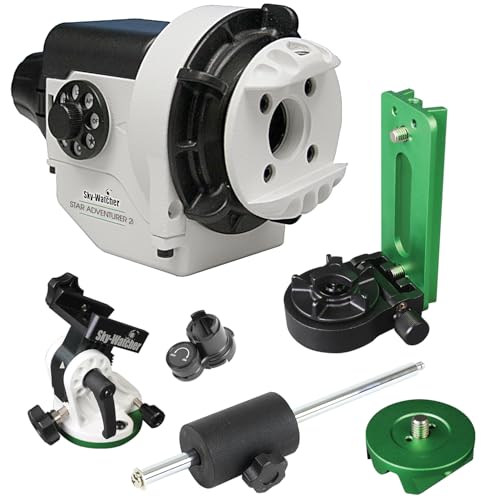
- 7-pound portable tracking platform
- Wi-Fi smartphone control via SAM Console
- Compatible with photographic tripods
Best For: Traveling wide-field astrophotographers and nightscape shooters
Best Connected Equatorial System

- Eight-CPU PMC-Eight control system
- ExploreStars app for multiple tablet platforms
- Dual-axis clutched worm gears and belt drives
Best For: Tablet-controlled GoTo astrophotography setups
Best Portable Tracker

- Compact 2.2-pound all-metal design
- Supports balanced loads up to 11 pounds
- Illuminated polar scope and rechargeable battery
Best For: Portable camera-based astrophotography
Best High-Capacity Mount

- Handles payloads up to 44 pounds
- Offers EQ, Alt-Az, and dual-OTA modes
- Belt drive and dual encoders support smooth operation
Best For: Large telescope and multi-OTA setups
Best Low-Latitude Base
SkyGuider Pro Alignment Platform

- Built for low-latitude polar alignment
- CNC aluminum construction weighs 500 grams
- Designed to reduce wobble and vibration
Best For: SkyGuider Pro users near the equator or in southern regions
Best Portable GoTo Pick
Star Adventurer GTi Mount Head Kit

- Full GoTo functionality in a compact equatorial mount
- Built-in Wi-Fi and illuminated polar scope
- Includes counterweight bar and 5 lb. counterweight
Best For: Portable DSLR or mirrorless-camera astrophotography setups
Best High-Capacity Open-Source Option
TeSeek Equatorial Star Tracker

- Supports stellar, lunar, and custom rotation speeds
- 15 kg stated load capacity with metal latitude base
- Works as an astrophotography tracker or time-lapse gimbal
Best For: Modular setups needing custom tracking and high stated capacity
Best Integrated Gimbal Setup
TeSeek Star Tracker with Ball Head

- Custom rotation speeds and hemisphere switching
- 38 mm quick-release baseplate for compatible clamps
- Compact design with USB Type-C power
Best For: Camera users combining equatorial tracking with gimbal or time-lapse work
Best Portable GoTo Mount – Star Adventurer GTi Mount Kit
The Sky-Watcher Star Adventurer GTi is a complete, portable option for astrophotography mounts buyers who want GoTo tracking without assembling a separate tripod package. It includes the mount head, tripod, pier extension, counterweight system, illuminated polar scope, and built-in Wi-Fi.
Best For: Portable astrophotographers using lightweight camera or telescope setups who want smartphone-friendly GoTo control.
Pros:
- Complete kit with tripod, pier extension, counterweight bar, and 5-pound counterweight.
- Built-in GoTo functionality and Wi-Fi support convenient operation.
- Illuminated polar scope supports alignment in low-light conditions.
- Portable design with a listed item weight of 26 pounds.
Cons:
- Not water resistant.
- The included setup is more substantial than a minimalist tracker-only system.
Choose this model if you want a ready-to-use equatorial tracking package with integrated alignment and control features. Its included accessories make it practical for field use, while its 30-second listed maximum shutter speed indicates a lightweight, portable imaging focus.
Best Latitude Adjustment Base – 90° Precision Aluminum Equatorial Mount
This Zopsc equatorial base is a compact accessory for astrophotography mounts and tracker setups that need adjustable latitude positioning. Its aluminum-alloy construction, graduated 0-to-90-degree scale, micro-adjustment knobs, and standard 3/8-inch tripod thread are designed to support repeatable alignment.
Best For: Users pairing a compatible tracker, camera, or smart telescope with a photography tripod.
Pros:
- Provides latitude adjustment from 0 to 90 degrees.
- Graduated scale and micro-adjustment knobs support controlled alignment.
- Standard 3/8-inch thread connects with many photography tripods.
- Aluminum-alloy construction offers a rigid, relatively lightweight base at 776 grams.
Cons:
- It is an adjustment base rather than a complete tracking mount.
- Compatibility depends on the mounting plate and paired equipment.
- The listed manufacturer warranty is 90 days.
This is best viewed as a precision positioning accessory, not a standalone GoTo or motorized system. It can make polar alignment more manageable when used with compatible Star Field equipment, celestial trackers, cameras, or smart telescopes.
Best Lightweight Tracker – Star Adventurer 2i Pro Pack
The Sky-Watcher Star Adventurer 2i Pro Pack is a lightweight tracking platform for wide-field astrophotography mounts and nightscape work. Its modular design works with existing photographic tripods and supports smartphone control through Wi-Fi and the Sky-Watcher SAM Console app.
Best For: Travelers and wide-field shooters capturing Milky Way scenes, eclipses, time-lapse video, or other astronomical subjects.
Pros:
- Portable 7-pound design for field and travel use.
- Works with existing photographic tripods.
- Built-in Wi-Fi enables smartphone control through the SAM Console app.
- Deluxe equatorial base helps position the tracker for polar alignment.
Cons:
- A photographic tripod is part of the intended modular setup rather than the listed product package.
- It is primarily a portable tracker, so users seeking a complete GoTo mount may need a different system.
For wide-field imaging, the 2i Pro Pack emphasizes portability and flexible tripod integration. Its Wi-Fi control and included equatorial base add convenience without turning the system into a bulky observatory-style mount.
Best Connected Equatorial System – iEXOS-100-2 PMC-Eight
The Explore Scientific iEXOS-100-2 PMC-Eight is an equatorial system for astrophotography mounts buyers who value app-based GoTo control and responsive motor operation. Its PMC-Eight platform uses eight independent CPUs, while Wi-Fi and Bluetooth compatibility support connected control from compatible devices.
Best For: Astrophotographers who want a tripod-and-mount system with app-guided GoTo navigation and precise dual-axis adjustment.
Pros:
- Includes the equatorial mount and tripod system.
- PMC-Eight architecture uses eight independent CPUs for dedicated functions.
- ExploreStars app supports Apple, Android, and Windows tablets.
- Clutched dual-axis worm gears and belt-driven stepper motors support smooth repositioning.
Cons:
- Control is centered on compatible tablets rather than a listed smartphone interface.
- Polar alignment uses an RA-axis sight hole instead of a polar scope.
- The notes do not specify a listed item weight or payload capacity.
This system stands out for connected control and dual-axis handling rather than ultra-light portability. The ExploreStars app, altitude adjustment, and clutched axes make it a practical choice for users who want guided navigation and repeatable balancing.
Best Portable Tracker – SkyGuider Pro Full Package
For photographers building a portable astrophotography mounts setup, the iOptron SkyGuider Pro offers a compact camera-tracking platform with an all-metal body, illuminated polar scope, and support for balanced camera-and-lens combinations up to 11 pounds.
Best For: Portable wide-field astrophotography and photographers who need a lightweight tracker for outdoor sessions.
Pros:
- Compact 2.2-pound design fits easily in a camera bag or backpack.
- Supports up to 11 pounds when properly balanced.
- Illuminated polar scope and adjustable base simplify precise polar alignment.
- Internal rechargeable battery provides up to 20 hours of operation at 20°C.
Cons:
- Maximum capacity depends on careful balancing.
- Not water resistant.
- Designed for camera use rather than the heavier payloads handled by full-size mounts.
The SkyGuider Pro is a practical choice when portability matters most. Its alignment aids, stability-focused construction, and long battery runtime make it well suited to mobile astrophotography, provided your equipment stays within its balanced payload limit.
Best High-Capacity Mount – AZ-EQ6 GoTo Mount
For demanding astrophotography mounts applications, the Sky-Watcher AZ-EQ6 combines German equatorial, Alt-Az, and dual-OTA modes with a 44-pound payload capacity, giving advanced users room for larger optical tube assemblies and accessories.
Best For: Larger telescope setups, dual-OTA configurations, and users who want both equatorial and Alt-Az operating modes.
Pros:
- 44-pound payload capacity accommodates a broad range of OTAs.
- Supports German equatorial, Alt-Az, and dual-OTA configurations.
- Belt drive is designed for smooth, quiet slewing with low backlash.
- Dual encoders with Freedom Find allow manual use without losing alignment.
Cons:
- 44-pound mount weight makes it considerably less portable than a camera tracker.
- Its larger capacity may be excessive for lightweight camera-and-lens setups.
- Not water resistant.
The AZ-EQ6 is the more capable platform for users prioritizing payload capacity and configuration flexibility. Its substantial size and weight favor a permanent or semi-permanent observing setup over grab-and-go astrophotography.
Best Low-Latitude Base – SkyGuider Pro Alignment Platform
The FANAUE SkyGuider Pro base mount is a specialized accessory for astrophotography mounts, providing a rigid CNC-machined aluminum foundation and a low-latitude adjustment range intended to help SkyGuider Pro users achieve accurate polar alignment near the equator or in southern regions.
Best For: SkyGuider Pro owners in low-latitude locations who need a more stable, precisely adjustable alignment base.
Pros:
- Designed specifically for low-latitude polar alignment.
- CNC-machined aluminum construction balances rigidity with a 500-gram weight.
- Precise threading is intended to provide a secure, wobble-free connection.
- Vibration-reduction design supports longer-exposure tracking.
Cons:
- It is a base accessory, not a complete star tracker or telescope mount.
- Its primary compatibility is with iOptron SkyGuider Pro systems.
- Low-latitude specialization may be unnecessary for users at higher latitudes.
For the right SkyGuider Pro user, this base can address alignment and stability challenges that a standard platform may not handle as effectively. Confirm your tracker compatibility and geographic latitude before buying.
Best Portable GoTo Pick – Star Adventurer GTi Mount Head Kit
For photographers seeking versatile astrophotography mounts, the Sky-Watcher Star Adventurer GTi combines GoTo operation, equatorial tracking, and a portable design. It includes a counterweight bar and 5 lb. counterweight, built-in Wi-Fi, and an illuminated polar scope; a camera is not included.
Best For: Portable DSLR or mirrorless-camera astrophotography setups that benefit from full GoTo functionality.
Pros:
- Full GoTo performance in a compact mount head.
- Built-in Wi-Fi supports convenient operation.
- Includes a counterweight bar, 5 lb. counterweight, and illuminated polar scope.
- Compatible with cameras and smartphones through its dovetail mounting system.
Cons:
- Camera and other imaging equipment are not included.
- At 6.9 kg, it is portable but not especially lightweight compared with smaller trackers.
- Battery or external power is required.
The Star Adventurer GTi is a strong all-around choice when you want portable astrophotography mounts with GoTo convenience and included balancing hardware. Its equatorial design and polar scope make it more capable than a basic camera tracker, while the camera-ready dovetail keeps the system adaptable.
Best High-Capacity Open-Source Option – TeSeek Equatorial Star Tracker
Equatorial Mount Star Tracker with Latitude Adjustment Base for Astrophotography
Check Price On AmazonThis TeSeek tracker offers a distinctive option among astrophotography mounts, pairing an open-source design with an EESP32S dual-core controller and a metal latitude adjustment base. It supports stellar, lunar, and custom rotation speeds, and can run from a power bank through USB Type-C.
Best For: Users who want customizable tracking speeds, hemisphere switching, and a tracker that can also serve as a time-lapse gimbal head.
Pros:
- Supports stellar speed, moon speed, and custom rotation speed.
- Switches between northern and southern hemispheres.
- All-metal CNC-machined latitude adjustment base.
- Rated load capacity of 15 kg and usable as a time-lapse gimbal head.
Cons:
- Requires a separate ball head for camera connection.
- A 1/4-to-3/8-inch screw sleeve may be needed for common ball heads.
- It has no built-in battery and requires USB Type-C power.
The TeSeek is appealing for photographers comfortable assembling a modular setup and adjusting accessories around its standard connections. Its high stated load capacity and custom speed controls broaden its uses, but the required ball head and adapter should be included in your planning.
Best Integrated Gimbal Setup – TeSeek Star Tracker with Ball Head
The TeSeek Equatorial Mount Star Tracker is designed for flexible astrophotography mounts and time-lapse work, with customizable rotation speeds, hemisphere switching, and a 38 mm quick-release baseplate. Its included ball-head gimbal configuration is intended to simplify camera and gimbal integration, while USB Type-C provides power from a compatible source.
Best For: Camera users who want an equatorial tracker with gimbal compatibility and adjustable motion control.
Pros:
- Supports stellar, moon, and custom rotation speeds.
- Allows switching between northern and southern hemispheres.
- 38 mm quick-release baseplate works with a standard quick-release clamp.
- Compact PETG and carbon-fiber shell with USB Type-C power.
Cons:
- No built-in battery; an external power source is required.
- Requires a USB-A-to-USB-C cable; USB-C-to-USB-C use is prohibited.
- A 1/4-to-3/8-inch adapter sleeve may be needed for some ball heads.
This model suits photographers who value flexible mounting and straightforward motion options in a compact body. Check your cable, ball-head, and quick-release compatibility before buying, since the power and mounting connections have specific requirements.
How We Picked These Astrophotography Mounts
We selected products across the main categories used for deep-sky and wide-field imaging: lightweight camera trackers, portable equatorial mounts, GoTo systems, and higher-capacity mounts for larger optical tubes. We considered tracking design, stated payload capacity, portability, polar-alignment features, control options, included accessories, and the type of imaging each mount is best suited to support.
Specifications should be interpreted in context. A mount’s advertised payload is not the same as its recommended astrophotography payload, especially when a long telescope, guide scope, camera, and accessories are installed. Stability, balance, tripod quality, and setup accuracy can matter just as much as the headline capacity.
Quick Comparison
- Best for lightweight travel: Star Adventurer 2i, iOptron SkyGuider Pro, and compact ball-head or latitude-base trackers.
- Best for portable GoTo control: Star Adventurer GTi systems and the iEXOS-100-2 PMC-Eight.
- Best for larger telescope setups: Sky-Watcher AZ-EQ6, with substantially greater payload capacity and dual EQ/AZ functionality.
- Best for improved alignment stability: Dedicated precision bases such as the FANAUE low-latitude base or an adjustable equatorial base.
Key Buying Factors for Astrophotography Mounts
Payload and Balance
Choose a mount with comfortable capacity headroom rather than matching the maximum rating exactly. Keep the imaging train balanced around the right ascension axis, and account for the camera, lens or telescope, guide equipment, dovetail hardware, and cables.
Tracking and Control
For wide-field images, a basic motorized tracker may be sufficient. Longer focal lengths and multi-minute exposures benefit from accurate equatorial tracking, GoTo positioning, and—when supported—autoguiding. Wi-Fi, Bluetooth, or a dedicated controller can simplify operation, but confirm compatibility with your preferred imaging software.
Polar Alignment and Setup
A precise polar-alignment scope or a rigid adjustable base can make a noticeable difference. Check the mount’s latitude range if you travel, and consider how quickly you can level the tripod, balance the load, and repeat alignment in the dark.
Portability and Power
Travel-oriented mounts are easier to carry but generally support lighter equipment. Larger mounts provide better stability at the cost of bulk. Also verify battery requirements, connector types, cable management, and whether the package includes the tripod, counterweight, pier extension, or mounting hardware you need.
Who Should Buy Which Astrophotography Mounts?
Beginners using a DSLR or mirrorless camera should start with a simple tracker or a compact package that includes a sturdy base and counterweight. These setups are easier to learn and well suited to wide-field Milky Way and nebula imaging.
Traveling astrophotographers should prioritize low weight, quick setup, and a broad latitude-adjustment range. A compact tracker with a quality tripod and ball head is often more practical than a heavier GoTo mount.
Imagers moving to longer lenses or small telescopes should consider a GoTo equatorial mount with better payload headroom, an optional guide camera, and reliable alignment controls.
Advanced users with larger optical tubes or multiple observing modes should look toward a higher-capacity system such as the AZ-EQ6. It is less portable, but the added stability and EQ/AZ flexibility can support a broader range of observing and imaging tasks.