
Choosing among beginner model rocket sets is easier when you focus on launch readiness, assembly difficulty, included equipment, and the type of flying experience you want.
This roundup compares 10 Estes kits and launch sets for first-time builders, families, classrooms, and groups—so you can find a practical match for your space, skill level, and budget.
Best 10 Beginner Model Rocket Sets Picks for 2026
Best Two-Rocket Launch Set

- Includes two rockets plus launch pad and controller
- Projected altitudes up to 600 and 1,150 feet
- Amazon build takes about an hour
Best For: Families wanting two beginner rocket projects in one set
Best Compact Starter

- Compact 13mm starter format
- Projected maximum altitude of 750 feet
- Uses a streamer recovery system
Best For: Beginners seeking a small STEM-focused rocket starter
Best Ready-to-Fly Option

- Fully assembled with about 15 minutes of preparation
- Projects up to 1,125 feet with a C6-7 engine
- Includes a 12-inch parachute
Best For: Beginners who want to launch without building a rocket
Best Two-Rocket Beginner Kit

- Includes two rockets and a launch system
- Projects up to 1,000 feet per rocket
- Assembly takes about an hour or less
Best For: Families wanting two similar rockets to build and launch
Best for Easy Setup

- Two prebuilt rockets included
- Launch pad and controller included
- Reaches up to 1,100 feet
Best For: Beginners who want to fly without assembling rockets
Best First Build
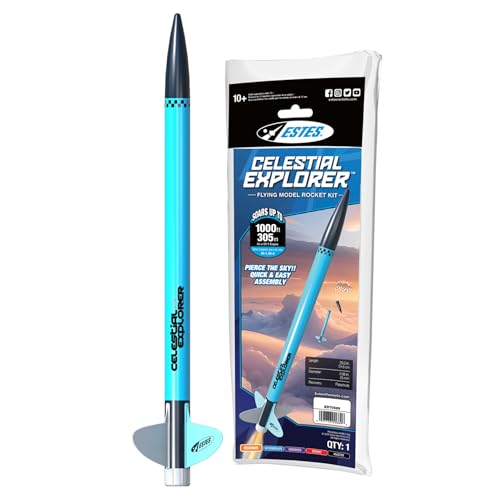
- Assembly takes about an hour
- Includes parachute and instructions
- Reaches up to 1,000 feet
Best For: New builders learning the basics of model rocketry
Best for Groups

- Includes 12 complete rocket kits
- Each build takes about an hour
- Supports several engine options
Best For: Classrooms, clubs, and youth programs
Most Versatile Beginner Set

- Six snap-together build options
- Includes launch pad and controller
- Projects flights up to 600 feet
Best For: Beginners seeking customizable builds and simple assembly
Highest-Flying Beginner Pick

- Projects flights up to 1,150 feet
- Includes parachute recovery
- Launch pad and controller included
Best For: First-time builders who want greater flight altitude
Balanced Beginner Launch Set

- Projects flights up to 1,100 feet
- Includes parachute and launch system
- Assembly takes about one hour
Best For: Beginners wanting a traditional, balanced launch experience
Best Two-Rocket Launch Set – Tandem X
For shoppers comparing beginner model rocket sets, the Estes Tandem X stands out by combining two build-and-launch projects with the essential launch pad and controller. It includes the 30-inch Amazon and 15.6-inch Crossfire ISX rockets, though engines, starters, recovery wadding, and four AA batteries are sold separately.
Best For: Families or beginners who want two different rocket-building experiences and a shared launch system.
Pros:
- Includes two rockets, parachutes, launch pad, and controller.
- Offers projected altitudes of 600 feet and 1,150 feet with specified engines.
- Amazon can be assembled in about an hour and uses precolored parts and self-stick graphics.
- Supports hands-on STEM learning involving construction, physics, and engineering.
Cons:
- Rocket engines, starters, recovery wadding, and batteries are not included.
- The Crossfire ISX uses laser-cut wood fins and may require more building care than the Amazon.
- Requires a suitable launch site and adherence to model-rocket safety procedures.
The Tandem X is a strong choice when variety and included launch equipment matter most. Its two rockets provide a useful progression from a simpler build to a more involved model, but budget for the consumables needed for launch.
Best Compact Starter – Mini Bertha Launch Set
The Estes Rocket Science Starter Mini Bertha is a compact option for shoppers seeking beginner model rocket sets with a straightforward STEM focus. Its listed recovery system uses a streamer, and recommended engines can produce a projected maximum altitude of 750 feet.
Best For: Beginners looking for a smaller STEM-oriented rocket starter with moderate projected altitude.
Pros:
- Designed around a compact 13mm rocket format.
- Lists three compatible recommended engines: 1/2A3-2T, A3-4T, and A10-3T.
- Offers a projected maximum altitude of 750 feet.
- Uses a streamer recovery system.
Cons:
- The supplied notes do not list a launch pad or controller as included.
- The notes do not specify assembly time or a complete list of launch accessories.
- Additional launch supplies may be needed depending on what is included in the package.
Mini Bertha makes the most sense for buyers prioritizing a compact rocket and clear engine guidance. Verify the package contents before purchasing, particularly if you need a complete launch system rather than the rocket starter alone.
Best Ready-to-Fly Option – Athena
Estes 2452 Athena Rocket-Building Kit, Prebuilt Beginner Flying-Rocket Model Kit for Ages 10+, Blue
Check Price On AmazonAmong beginner model rocket sets, the Estes Athena is suited to buyers who want to skip construction and focus on launch preparation. The rocket arrives fully prepared, includes a parachute, and needs about 15 minutes of preparation, while its launch pad, controller, engines, starters, wadding, and batteries are sold separately.
Best For: Kids and beginners who want a ready-to-fly rocket rather than a building project.
Pros:
- Fully assembled and ready to fly after approximately 15 minutes of preparation.
- Includes a 12-inch parachute for recovery.
- Projects up to 1,125 feet with a C6-7 engine.
- Compatible with several Estes engines, including A8-3, B4-4, B6-4, and C6-5.
Cons:
- Launch pad and controller are sold separately.
- Engines, starters, recovery wadding, and four AA batteries are also sold separately.
- Provides less hands-on building than an assemble-yourself kit.
Athena is a practical pick for a first launch because preparation is minimal and the rocket is already assembled. Choose it when ease of entry matters more than learning through construction, and remember to add the required launch equipment and consumables.
Best Two-Rocket Beginner Kit – Pathfinder
The Estes Pathfinder is one of the more complete beginner model rocket sets for shoppers who want two buildable rockets and the core launch hardware together. It includes rocket parts, decals, parachutes, a launch pad, a controller, and instructions; engines, starters, recovery wadding, and four AA batteries are sold separately.
Best For: Beginners or families who want two similar rockets to build, launch, and recover.
Pros:
- Includes two rockets, recovery parachutes, launch pad, controller, and instructions.
- Each rocket can reach a projected altitude of up to 1,000 feet with a C6-5 engine.
- Assembly can be completed in approximately one hour or less.
- Also supports A8-3 and B6-4 engines.
Cons:
- Engines, starters, recovery wadding, and batteries are sold separately.
- Requires a suitable launch site and compliance with model-rocket safety guidance.
- The two included rockets offer less design variety than a mixed-model set.
Pathfinder offers a balanced starting point for a group because two people can work on or fly separate rockets while sharing the launch system. It is especially appealing when buyers want more than one project without purchasing launch equipment separately.
Best for Easy Setup – Rascal and Hijinks Launch Set
For shoppers seeking beginner model rocket sets with minimal setup, the Estes Rascal and Hijinks Launch Set is a convenient ready-to-fly option. It includes two prebuilt rockets, parachutes, a launch pad, and an electronic launch controller, though engines and other launch supplies are sold separately.
Best For: Beginners who want to launch two decorated rockets without building them first.
Pros:
- Includes two fully assembled rockets with no construction required.
- Includes the Porta Pad II Launch Pad and Electron Beam Launch Controller.
- Projected altitude reaches up to 1,100 feet with a compatible C6-7 engine.
Cons:
- Rocket engines, starters, recovery wadding, and four AA batteries are sold separately.
- Requires a suitable launch site and adherence to model-rocket safety practices.
This is the most straightforward choice in the group for getting started quickly. Its two-rocket format also makes it useful for shared family activities, provided you purchase the required consumables separately.
Best First Build – Celestial Explorer Rocket Kit
The Estes Celestial Explorer is a hands-on choice among beginner model rocket sets. It includes the rocket components, fins, decals, parachute recovery system, and instructions, with assembly taking approximately an hour or less. A launch pad, controller, engines, and other launch supplies are sold separately.
Best For: New builders who want a manageable introduction to assembling and flying a model rocket.
Pros:
- Designed for beginners ages 10 and up.
- Assembly can be completed in approximately one hour or less.
- Projected altitude is up to 1,000 feet with a compatible C6-5 engine.
Cons:
- Does not include a launch pad or electronic launch controller.
- Engines, starters, recovery wadding, and batteries are sold separately.
The Celestial Explorer offers a balanced build-and-fly experience without being presented as a complex project. Choose it when the assembly process is part of the appeal and you are prepared to add the necessary launch equipment.
Best for Groups – Alpha III Bulk Pack of 12
For classrooms, science clubs, and youth programs, the Estes Alpha III bulk pack provides 12 beginner model rocket sets in one package. Each kit includes model parts, an engine mount, decals, a parachute, and instructions, while launch pads, engines, starters, recovery wadding, and batteries must be purchased separately.
Best For: Group activities where multiple participants need their own beginner rocket-building kit.
Pros:
- Includes 12 individual Alpha III rocket kits.
- Each kit can be completed in approximately one hour or less.
- Compatible with multiple engine types and reaches up to 1,150 feet with a C6-7 engine.
Cons:
- Launch equipment and flight consumables are not included.
- A 12-kit pack may be more than needed for an individual beginner.
The Alpha III bulk pack is the practical pick when quantity matters. Its one-piece fin unit and range of compatible engines support introductory building and experimentation, while the 12-kit format suits organized group use better than casual solo flying.
Most Versatile Beginner Set – Estes Mini Mod
For shoppers comparing beginner model rocket sets, the Estes Mini Mod stands out for its snap-together design and six possible build configurations. It can be assembled in about an hour and includes the rocket components, decals, recovery streamer, launch pad, controller, and instructions.
Best For: Beginners who want multiple build options and a shorter, approachable assembly project.
Pros:
- Offers six different build options.
- Includes the Porta-Pad II launch pad and Electron Beam Controller.
- Projected altitude reaches up to 600 feet with a compatible Estes engine.
- Designed for ages 10 and up.
Cons:
- Rocket engines, starters, recovery wadding, and four AA batteries are sold separately.
- Uses a recovery streamer rather than a parachute.
The Mini Mod is a flexible choice when variety and simple assembly matter more than maximum altitude. Its included launch system makes it a practical starting point, but remember to purchase the required launch consumables separately.
Highest-Flying Beginner Pick – Estes Alpha III
The Estes Alpha III is a strong option among beginner model rocket sets for first-time builders who want a straightforward kit with impressive altitude potential. Assembly takes about an hour, and the package includes the rocket parts, decals, parachute, launch pad, controller, and instructions.
Best For: New rocketeers who prioritize a higher projected flight while still wanting an easy-to-assemble launch set.
Pros:
- Projected altitude reaches up to 1,150 feet with compatible Estes engines.
- Includes a parachute for recovery.
- Comes with the Porta-Pad II launch pad and Electron Beam Controller.
- Designed for ages 10 and up and suitable for first-time builders.
Cons:
- Engines, starters, recovery wadding, and four AA batteries are not included.
- Higher flights require choosing a compatible engine and an appropriate launch site.
Choose the Alpha III if flight height is a leading consideration. It combines beginner-friendly preparation with the highest stated altitude in this roundup, though the necessary launch supplies must be purchased separately.
Balanced Beginner Launch Set – Estes Journey
The Estes Journey offers a balanced entry point for shoppers looking through beginner model rocket sets. It takes approximately an hour to assemble and includes the rocket, decals, parachute, Porta-Pad II launch pad, Electron Beam Controller, and instructions.
Best For: Beginners who want a classic launch experience with parachute recovery and a projected flight near 1,100 feet.
Pros:
- Projects flights up to 1,100 feet with a compatible C6-7 engine.
- Includes both a parachute and a complete launch system.
- Compatible with several Estes engines, including A8-3, B4-4, B6-4, and C6-5.
- Assembly takes about one hour.
Cons:
- Engines, starters, recovery wadding, and four AA batteries are sold separately.
- Its stated maximum altitude depends on using the compatible C6-7 engine.
The Journey is a practical middle ground: it offers a higher projected altitude than the Mini Mod while remaining beginner-oriented and easy to prepare. Its parachute and included launch hardware make it well suited to a traditional first launch.
How We Picked the Best Beginner Model Rocket Sets
We evaluated these Beginner Model Rocket Sets around the factors that matter most to new flyers: how much assembly is required, whether a launch pad and controller are included, the stated age guidance, and how easily the kit can support repeat launches. We also considered whether each option suits one child, a family, or a larger group.
Prebuilt rockets can shorten the path from opening the box to launch day, while build-it-yourself kits offer a more hands-on introduction to model-rocketry construction. Bulk packs earned consideration for classrooms, camps, clubs, and parties where several participants need their own rocket.
Quick Comparison
- Best for an all-in-one start: Choose a set that includes the rocket, launch pad, and controller.
- Best for hands-on building: Select a traditional rocket-building kit and plan time for careful assembly and finishing.
- Best for younger beginners: Look for a prebuilt or simplified design with clear age guidance.
- Best for groups: A bulk pack can provide better per-person value, but verify how many launch systems and accessories are included.
Key Buying Factors for Beginner Model Rocket Sets
Assembly and Preparation
Check whether the rocket arrives prebuilt, partially assembled, or as a full construction project. Beginners who want immediate action may prefer a prebuilt model; builders who enjoy crafts should allow time for gluing, painting, decals, and drying.
Launch Equipment
A rocket alone is not a complete launch system. Confirm whether the package includes a launch pad, controller, blast deflector, recovery supplies, and any required launch accessories. You may still need compatible engines, igniters, wadding, batteries, or other consumables.
Age, Supervision, and Flying Space
Use the listed age recommendation as a starting point, not a substitute for supervision. Choose a wide, open launch area away from roads, buildings, trees, power lines, and crowds, and follow the manufacturer’s instructions and local regulations.
Rocket Size and Recovery
Consider how much room you have for launches and recovery. A small rocket may be easier to track in a limited field, while a larger or faster model may need more space. Check the recovery method and make sure replacement parts are available.
Who Should Buy Which Beginner Model Rocket Sets?
First-time individual flyer: Pick an all-in-one kit with a straightforward rocket and included launch equipment. It minimizes compatibility questions and keeps the first session focused on learning.
Hands-on young builder: Choose a beginner building kit if the child has an adult available to help with assembly, finishing, safety checks, and launch procedures.
Family looking for repeat activities: Consider a launch set or a kit with widely available replacement engines and recovery supplies. A reusable launch system can make future purchases simpler.
Teacher, club leader, or camp organizer: The 12-kit bulk option is the natural place to start when multiple participants need rockets. Confirm the launch infrastructure and consumables before ordering, since one shared pad and controller may not support a large group efficiently.