
A good monopod gives DSLR photographers extra support without the bulk of a full tripod. The right model can improve sharpness, reduce fatigue, and make it easier to work in crowded or fast-moving locations.
We compared 10 camera monopods for DSLR cameras across height, load capacity, portability, materials, foot design, and added features so you can choose a practical match for your camera kit.
Best 10 Camera Monopods for Dslr Cameras Picks for 2026
Best Budget Pick
Amazon Basics 67-Inch Camera Monopod
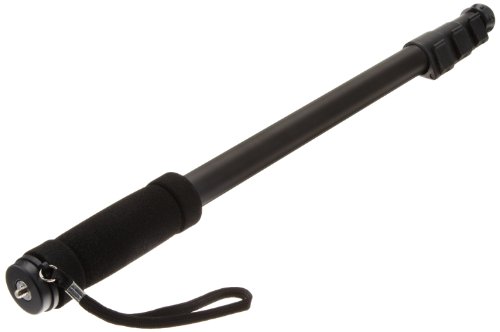
- 67-inch maximum height with four adjustable sections
- Lightweight aluminum body under 1 pound
- Rubber foot, spikes, wrist strap, and carrying bag
Best For: Affordable, lightweight support for smaller camera setups
Most Versatile Setup

- Converts between tripod and monopod configurations
- 77-inch tripod height and 70-inch monopod height
- 360-degree ball head with bubble level and quick-release plate
Best For: Photographers wanting tripod and monopod functionality in one system
Premium Lightweight Pick
Manfrotto 290 Carbon Fiber Monopod

- Carbon-fiber construction at approximately 1.1 pounds
- 22-pound stated payload capacity
- Four sections adjust quickly from about 19 to 59 inches
Best For: Heavier DSLR setups where low monopod weight matters
Best for Travel

- Folds to 16.9 inches and weighs about 0.83 pounds
- Five height positions up to 61 inches
- Also works as a selfie stick or hiking and trekking pole
Best For: Travel, hiking, and wildlife photography with portable DSLR support
Best Lightweight Pick

- Only 0.59 pounds with a 16.75-inch folded size
- Supports DSLR and mirrorless cameras up to 5 pounds
- Includes foam grip, wrist strap, and carry pouch
Best For: Travelers and hikers carrying lighter camera setups
Best Heavy-Duty Travel Pick
Manbily A-555L Compact Monopod

- 15.4-pound load rating with a 28 mm aluminum leg
- Folds to 15.7 inches and weighs 1.1 pounds
- Includes walking-stick handle, phone holder, and carry case
Best For: Sports and wildlife photographers needing extra load capacity
Best Stabilizing Base
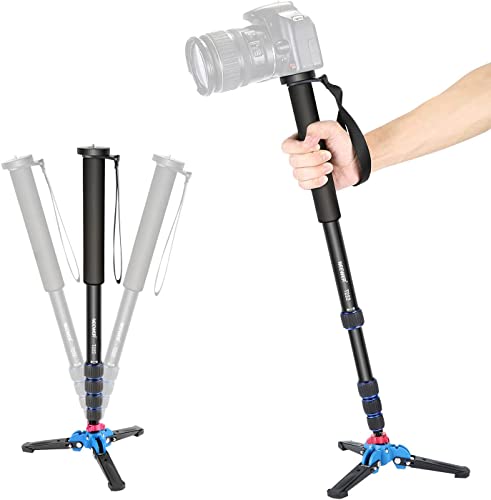
- Includes a detachable three-leg tripod base
- Extends to 66 inches and supports up to 11 pounds
- Provides 15-degree tilt and 360-degree panoramic rotation
Best For: Photographers wanting added base support and flexible positioning
Versatile 2-in-1 Pick

- Converts between tripod and monopod modes
- 33-pound vertical load capacity
- 71-inch height with 360-degree ball head
Best For: DSLR photographers wanting one support system for travel and varied shooting angles
Lightweight Travel Choice

- Weighs about 0.88 pounds
- Supports up to 17.6 pounds
- Rubber and spike feet included
Best For: Traveling DSLR users who prioritize compact carry and versatile outdoor support
Stable Base Option
Manbily A-222 Monopod With Feet

- 67-inch, five-section aluminum monopod
- 15.5-pound maximum load
- Detachable base with rubber and spike feet
Best For: DSLR and video shooters wanting added stability without carrying a full tripod
Best Budget Pick – Amazon Basics 67-Inch Camera Monopod
For shoppers comparing camera monopods for DSLR cameras, this Amazon Basics model offers a lightweight, straightforward support option with useful reach. Its four-section aluminum design extends to 67 inches, while the rubber foot and retractable spikes help it stay planted on different surfaces.
Best For: Budget-conscious photographers who want a lightweight monopod for cameras, scopes, or video equipment up to 6.6 pounds.
Pros:
- Extends from 54.5 to 67 inches for flexible shooting positions.
- Weighs less than 1 pound and includes a cushion grip, wrist strap, and carrying bag.
- Rubber foot and retractable spikes provide adaptable footing.
Cons:
- Its 6.6-pound capacity is lower than the heavier-duty options in this roundup.
- It is not water resistant.
This is a practical entry-level choice when portability and price matter more than advanced features. The modest weight limit makes it best suited to lighter DSLR setups and general-purpose shooting.
Most Versatile Setup – NEEWER TP77 Tripod Monopod
The NEEWER TP77 stands out among camera monopods for DSLR cameras because it combines a full tripod with a detachable monopod. Its adjustable center column, 360-degree ball head, and high stated load capacity make it suitable for photographers who want multiple support configurations.
Best For: DSLR users who want one system that can switch between tripod and monopod shooting.
Pros:
- Converts from a tripod into a monopod with a height range of 35 to 70 inches.
- Tripod height adjusts from 19 to 77 inches and folds to 19 inches.
- 360-degree ball head, bubble level, quick-release plate, and hanging hook add shooting flexibility.
- Supports up to 34 pounds vertically according to the supplied specifications.
Cons:
- At about 3.1 pounds, it is considerably heavier than single-leg monopods.
- The sandbag for the center-column hook is not included.
- It is not water resistant.
Choose this model when versatility is more important than minimum carry weight. It is a particularly capable option for photographers who alternate between stable tripod work and faster monopod shooting.
Premium Lightweight Pick – Manfrotto 290 Carbon Fiber Monopod
For photographers seeking a more premium build among camera monopods for DSLR cameras, the Manfrotto 290 combines a carbon-fiber body with four quick-adjusting sections. Its 22-pound stated capacity and 59-inch maximum height give it a strong balance of portability and support.
Best For: Photographers and videographers who want a lightweight, premium monopod for heavier camera equipment.
Pros:
- Carbon-fiber construction keeps the monopod to about 1.1 pounds.
- Supports up to 22 pounds according to the supplied specifications.
- Four sections allow rapid height adjustments from about 19 to 59 inches.
- Rubber leg warmers and an angled wrist strap improve handling comfort.
Cons:
- Its 59-inch maximum height is shorter than several alternatives here.
- The premium construction may not suit shoppers seeking a basic budget option.
- It is not water resistant.
The Manfrotto 290 is a strong fit when low carry weight and higher equipment capacity are priorities. Its shorter maximum height is the main trade-off for photographers who prefer a taller shooting position.
Best for Travel – ULANZI TB12 61-Inch Monopod
The ULANZI TB12 is a compact choice for shoppers comparing camera monopods for DSLR cameras and travel photography. It weighs about 0.83 pounds, folds to 16.9 inches, and offers five height positions, making it easy to pack while still supporting cameras up to 11.02 pounds.
Best For: Traveling, hiking, and wildlife photographers who value compact packing and multiple carry modes.
Pros:
- Folds to about 16.9 inches and fits into a 20-inch carry-on.
- Five-section design adjusts from 16.9 to 61 inches.
- Supports up to 11.02 pounds while weighing approximately 0.83 pounds.
- Can also function as a selfie stick, walking stick, hiking stick, or trekking pole.
Cons:
- Its 61-inch maximum height is not the tallest in this roundup.
- The compact five-section design provides less height range per section than some larger models.
- It is not water resistant.
This ULANZI is appealing for photographers who carry their gear outdoors and need a monopod that packs small. Its 11-pound capacity accommodates many DSLR combinations, while its extra modes add flexibility away from the camera.
Best Lightweight Pick – Altura Photo 62-Inch Monopod
For photographers seeking lightweight camera monopods for DSLR cameras, the Altura Photo offers a compact aluminum design that is easy to carry and quick to deploy. It extends to 62 inches, supports cameras and accessories up to 5 pounds, and folds to just 16.75 inches.
Best For: Travelers, hikers, and everyday DSLR photographers who prioritize portability.
Pros:
- Weighs only 0.59 pounds and includes a carry pouch.
- Compact 16.75-inch folded size fits easily in a bag.
- Foam grip, wrist strap, rubber foot, and retractable spike support comfortable outdoor use.
- Universal 1/4-inch mount with a 3/8-inch screw adapter supports cameras, ball heads, and scopes.
Cons:
- Its 5-pound weight limit is lower than some competing models.
- The four-section design may require more adjustments than a single-lock system.
The Altura is a strong choice when low carry weight matters most. Its limited load capacity makes it better suited to lighter DSLR setups than heavy professional rigs.
Best Heavy-Duty Travel Pick – Manbily A-555L Compact Monopod
The Manbily A-555L stands out among camera monopods for DSLR cameras when you need higher load capacity without giving up travel convenience. Its aluminum construction supports up to 15.4 pounds, while the six-section design folds to 15.7 inches.
Best For: Sports, wildlife, and travel photographers who need a compact monopod with substantial load support.
Pros:
- Supports up to 15.4 pounds with a 28 mm aluminum leg.
- Folds to 15.7 inches and weighs 1.1 pounds.
- Quarter-turn twist locks extend all sections quickly from 15.7 to 61 inches.
- Includes reversible 1/4-inch and 3/8-inch mounting screws, phone holder, carry case, and walking-stick handle.
Cons:
- It is heavier than the Altura model.
- It is not water resistant according to the supplied specifications.
- The green-and-black finish may not suit every kit.
With its high weight rating and versatile feet, the Manbily is the most capable option here for demanding field use. The added accessories also make it practical for photographers who want one support tool for multiple situations.
Best Stabilizing Base – NEEWER T222 Monopod with Base
The NEEWER T222 adds a detachable three-leg base to the usual monopod design, making it a useful option among camera monopods for DSLR cameras when extra standing support is important. It extends to 66 inches, folds to 20.5 inches, and supports up to 11 pounds.
Best For: DSLR and Sony photographers who want a monopod with a removable stabilizing base for controlled shooting.
Pros:
- Included tripod base helps support the monopod when positioned securely.
- 15-degree base tilt supports 360-degree panoramic rotation.
- Five-section adjustment system reaches 66 inches and folds to 20.5 inches.
- Aluminum alloy construction supports up to 11 pounds and includes a comfortable foam handle.
Cons:
- At 1.3 pounds, it is heavier than the Altura.
- Its 20.5-inch folded length is less compact than the other two models.
- The supplied instructions note that the monopod must still be held when a camera is mounted.
The T222 is a practical middle ground for photographers who value a more stable base and panoramic flexibility. It is less packable than the other options, but its detachable support base adds useful versatility.
Versatile 2-in-1 Pick – SmallRig CT-10 Tripod Monopod
For photographers comparing camera monopods for DSLR cameras, the SmallRig CT-10 stands out as a flexible option that converts from a full tripod into a monopod. Its aluminum construction, 360-degree ball head, and broad height range make it suitable for travel, content creation, and varied shooting angles.
Best For: DSLR users who want one support system for tripod and monopod shooting, including low-angle and macro work.
Pros:
- Converts from a tripod to a monopod for added versatility.
- Supports up to 33 pounds vertically and includes a 360-degree ball head.
- Adjusts from 16 to 71 inches and folds to about 16.9 inches.
- Offers 1/4-inch and 3/8-inch mounting compatibility plus extra threaded holes for accessories.
Cons:
- At about 3.4 pounds, it is heavier than a dedicated travel monopod.
- Telephoto zoom lenses may require an additional tripod or lens mount ring for better balance.
- The stated 33-pound capacity applies to vertical use; tilted support is rated at 11 pounds.
The CT-10 is a strong choice when portability matters but you still want the stability and shooting flexibility of a tripod. It is especially practical for DSLR kits that include multiple accessories.
Lightweight Travel Choice – NEEWER TP41 Camera Monopod
The NEEWER TP41 is a practical choice among camera monopods for DSLR cameras when low weight and easy transport are priorities. It weighs about 0.88 pounds, folds to 17.3 inches, and uses flip locks for quick height adjustments in the field.
Best For: Traveling DSLR photographers, vloggers, and outdoor shooters who need a compact monopod with adaptable feet.
Pros:
- Supports DSLR cameras up to 17.6 pounds while weighing only about 0.88 pounds.
- Extends from 26.6 to 61 inches through four height positions.
- Includes a dual 1/4-inch to 3/8-inch screw adapter for cameras, camcorders, gimbals, and rigs.
- Interchangeable rubber and steel spike feet suit smooth indoor surfaces and softer outdoor ground.
Cons:
- It has a lower maximum height than the SmallRig and Manbily options.
- The product is not water resistant.
- It is a monopod stand rather than a full tripod conversion system.
With its very low carry weight and interchangeable feet, the TP41 is well suited to mobile shooting. Its adapter and accessory compatibility also make it useful beyond standard DSLR photography.
Stable Base Option – Manbily A-222 Monopod With Feet
For shoppers seeking camera monopods for DSLR cameras with extra standing support, the Manbily A-222 combines a five-section aluminum monopod with a detachable three-foot base. It reaches 67 inches, supports up to 15.5 pounds, and includes both rubber and metal spike feet for different surfaces.
Best For: DSLR and video shooters who want a compact monopod with a stability-enhancing base and interchangeable feet.
Pros:
- Supports up to 15.5 pounds and extends from 21 to 67 inches.
- Detachable tripod base provides added stability without being intended as a standalone tripod.
- Includes rubber and metal spike feet for paved surfaces and softer ground.
- Features a rubber grip, wrist strap, and compact 21-inch folded size.
Cons:
- The base is not recommended for use as a tripod and still requires user control.
- It has no ball head, so camera angle adjustment depends on the mounted equipment.
- The manufacturer recommends avoiding the narrowest tube section for better stability.
The A-222 is a useful middle ground for photographers who want more support than a handheld monopod provides without carrying a full tripod. Its base, feet, and wrist strap make it particularly adaptable for travel and location shooting.
How We Picked the Best Camera Monopods for Dslr Cameras
We focused on the features that matter most in real-world DSLR shooting: usable maximum height, folded size, construction, rated capacity, locking design, foot stability, and carrying convenience. We also considered whether each monopod is better suited to travel, sports, wildlife, events, or general everyday photography.
Models with included bags, detachable bases, ball heads, or walking-stick-style handles can offer extra versatility, but those features may add weight or complexity. Capacity ratings should be treated as a starting point: a long, heavy lens creates more leverage than a camera body alone.
Quick Comparison
| Feature | What to look for | Why it matters |
|---|---|---|
| Maximum height | Approximately 60 to 77 inches | Helps you shoot comfortably at eye level and above crowds. |
| Material | Aluminum or carbon fiber | Aluminum is typically more affordable; carbon fiber is lighter and better at damping vibration. |
| Sections | Three to four sections | More sections improve portability but can add setup time and flex. |
| Base design | Rubber foot or detachable stand base | A rubber foot is compact, while a base can provide extra hands-free stability. |
Key Buying Factors for Camera Monopods for Dslr Cameras
Load Capacity and Balance
Choose a monopod rated comfortably above the combined weight of your DSLR, lens, battery grip, and accessories. A sturdy locking system and a rigid upper section are especially important for telephoto lenses.
Height and Folded Portability
Check both maximum and minimum height. A tall monopod is useful for standing work and crowded venues, while a short folded length matters if you travel with a small bag. Four-section designs usually pack more compactly than simpler models.
Foot, Base, and Head Compatibility
A standard rubber foot works well on firm indoor and outdoor surfaces. A detachable tripod-style base can improve stability but is not a substitute for a full tripod in windy conditions or during long exposures. Confirm that the included mount or head supports your camera’s connection and shooting angle.
Weight and Material
Aluminum monopods generally deliver good value and durability. Carbon fiber can reduce carrying weight, which is valuable for hiking, travel, and long event coverage. Compare the weight savings with the price difference and your actual carrying needs.
Who Should Buy Which Camera Monopods for Dslr Cameras?
For budget-conscious photographers: Look for an aluminum model with a reliable rubber foot, carrying bag, and enough capacity for your DSLR and standard zoom.
For travel and hiking: Prioritize low weight, compact folded dimensions, quick locks, and a comfortable grip. Carbon fiber is worth considering if you carry the monopod for hours.
For sports and wildlife: Choose a tall, rigid monopod with generous capacity and smooth height adjustment. A detachable base can help with repositioning, but fast handling should remain the priority.
For events and crowded locations: A lightweight model that reaches eye level quickly is usually more useful than a heavier, highly specialized design. A wrist strap or carrying bag is a practical bonus.
For maximum versatility: Consider a model with a removable stand base or compatible ball head, while remembering that added components increase bulk and may require more setup.