
The best chemistry sets for classrooms make abstract concepts easier to see, measure, and discuss. This roundup covers molecular model kits, graduated containers, test tubes, beakers, and broader labware collections for different teaching needs.
Use the guide below to match your students’ age, lesson plans, storage limits, and safety requirements with a practical classroom setup.
Best 10 Chemistry Sets for Classrooms Picks for 2026
Advanced Molecular Modeling
Swpeet 122-Piece Chemistry Kit

- 122-piece set for organic and inorganic structures
- Color-coded atoms with multiple bond types
- Includes link remover and storage case
Best For: High school and college molecular-modeling lessons
Everyday Lab Measuring
Plastic Beaker and Dropper Set

- Six graduated beakers from 25 ml to 250 ml
- Includes six 3 ml plastic droppers
- Shatter-proof polypropylene construction
Best For: Introductory liquid-measuring classroom activities
Fullerene and 3D Structures

- 444 pieces for basic through advanced chemistry
- Includes ball-and-stick and space-filling models
- Adds 150 components for Carbon-60 Fullerene
Best For: Advanced molecular geometry and stereochemistry instruction
Complete Plastic Measuring Set
Teenitor Cylinders and Beakers

- Five cylinders and five beakers in varied sizes
- Beaker capacity reaches 1,000 ml
- Stable bases and raised, double-sided scales
Best For: Classroom liquid measurement and student lab stations
Molecular Modeling Pick
444-Piece Organic Chemistry Kit

- 444 pieces for building diverse molecular structures
- Supports ball-and-stick and space-filling models
- Portable snap-lock design with included guide
Best For: Organic chemistry and molecular-structure lessons
Classroom Measurement Pick
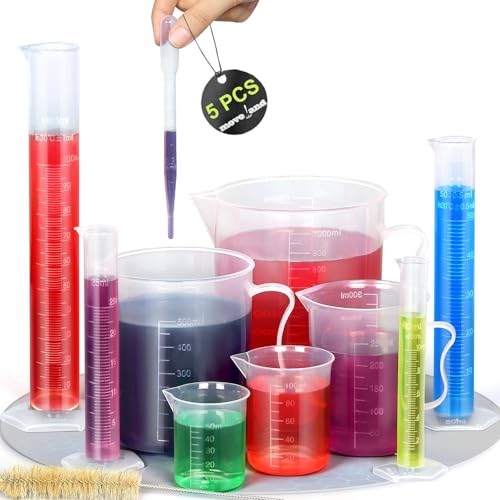
- Four cylinders and five beakers in metric sizes
- Handles and stable bases support easier use
- Includes pipettes and a cleaning brush
Best For: Introductory liquid-measurement activities
Glassware Variety Pick

- 20 pieces for measuring, stirring, and transferring
- Multiple sizes from 10 ml to 1,000 ml
- Borosilicate glass with clear scales
Best For: General classroom and laboratory experiments
Hands-On Starter Kit
33-Piece Plastic Lab Science Set

- Broad mix of beginner lab tools
- Lightweight, easy-clean plastic pieces
- Includes goggles, gloves, and accessories
Best For: Introductory student experiments and classroom science projects
Measurement-Focused Pick
28-Piece Plastic Beaker and Tube Set

- Multiple graduated container sizes
- Includes rack, capped tubes, and pipettes
- Reusable, break-resistant plastic design
Best For: Classroom measurement and liquid-transfer practice
Glassware Classroom Choice
37-Piece Borosilicate Chemistry Kit

- Clear borosilicate glass components
- Wide range of measuring capacities
- Includes rack, flasks, droppers, and rods
Best For: School labs, demonstrations, and science-fair projects
Advanced Molecular Modeling – Swpeet 122-Piece Chemistry Kit
For classrooms needing hands-on chemistry sets for classrooms, the Swpeet kit focuses on building organic and inorganic molecular structures. Its color-coded atoms, multiple bond types, and included storage case make it a practical visual aid for demonstrating molecular composition and bonding.
Best For: High school, college, and advanced classroom lessons involving organic and inorganic molecular models.
Pros:
- Includes 122 pieces with 59 atoms, 62 links, and a link-remover tool.
- Supports models containing carbon, hydrogen, oxygen, nitrogen, and sulfur.
- Color-coded pieces and a storage box help with identification and organization.
- Designed for relatively easy assembly and disassembly.
Cons:
- The manufacturer recommends it for ages 20 and up, so it may not suit younger learners.
- Its selection is more focused on molecular modeling than general laboratory activities.
This is a strong choice when the goal is to make molecular structures tangible during instruction. The included remover and compact case are especially useful for repeated classroom demonstrations and storage.
Everyday Lab Measuring – Plastic Beaker and Dropper Set
This set is a practical option for chemistry sets for classrooms that need multiple measuring vessels for demonstrations and student activities. Six polypropylene beakers provide capacities from 25 ml to 250 ml, while the included droppers support small-volume liquid transfers.
Best For: Classroom liquid-measuring activities, introductory experiments, and general science work where shatter resistance is useful.
Pros:
- Provides six graduated beaker sizes from 25 ml through 250 ml.
- Includes six 3 ml plastic droppers for liquid transfer.
- Polypropylene construction is described as sturdy, durable, and shatter-proof.
- Clear scales support visual measurement.
Cons:
- The largest beaker capacity is 250 ml, limiting larger-volume activities.
- It is a measuring and transfer set rather than a complete chemistry experiment kit.
Choose this set when a classroom needs a basic collection of reusable vessels rather than molecular models or specialized apparatus. Its range of sizes makes it convenient for comparing volumes and practicing careful liquid handling.
Fullerene and 3D Structures – LINKTOR 444-Piece Model Kit
For advanced chemistry sets for classrooms, the LINKTOR kit offers an unusually broad collection of atoms, bonds, and Fullerene components. Its ball-and-stick and space-filling formats can help students examine molecular geometry, bond angles, stereochemistry, and three-dimensional structure.
Best For: Grade 7 through graduate-level instruction covering molecular geometry, stereochemistry, and fullerene structures.
Pros:
- Includes 444 pieces: 136 atoms, 158 bonds, and 150 Fullerene components.
- Supports both ball-and-stick and space-filling molecular models.
- Allows three-dimensional viewing of chemical structures and bond angles.
- Color-standardized atoms and disconnecting tools support learning and reuse.
Cons:
- The large piece count may require careful sorting and storage.
- Its advanced scope may be more than needed for basic introductory lessons.
- The supplied listing information contains inconsistent age details.
This is the most feature-rich modeling option in the group for lessons that benefit from spatial visualization. It is particularly compelling for programs that want to move beyond simple ball-and-stick demonstrations into space-filling and Fullerene models.
Complete Plastic Measuring Set – Teenitor Cylinders and Beakers
The Teenitor set suits chemistry sets for classrooms that need both graduated cylinders and beakers in several sizes. Its reusable plastic construction, raised scales, and hexagonal cylinder bases provide a classroom-friendly alternative to glass for routine liquid-measuring practice.
Best For: Student lab stations, introductory measurement exercises, and classroom activities requiring multiple vessel sizes.
Pros:
- Includes five graduated cylinders from 10 ml to 250 ml and five beakers from 50 ml to 1,000 ml.
- Raised, double-sided scales are designed to remain readable over time.
- Plastic construction is described as acid- and alkali-resistant, reusable, and odorless.
- Hexagonal cylinder bases improve stability during use.
Cons:
- Plastic may not provide the same heat tolerance or laboratory feel as glass.
- The set does not include droppers, molecular models, or other experiment accessories.
For classrooms outfitting several measuring stations, this is a versatile and safety-conscious option with a broad capacity range. The combination of cylinders and beakers makes it more flexible than a single-vessel set for routine demonstrations.
Molecular Modeling Pick – 444-Piece Organic Chemistry Kit
For classrooms seeking chemistry sets for classrooms that make abstract concepts easier to see, this molecular model kit provides hands-on practice with organic structures. Its large assortment of atoms, bonds, and fullerene parts supports model building from basic compounds through more complex structures.
Best For: Grade 7 through graduate-level learners studying organic chemistry, biochemistry, or molecular biology.
Pros:
- Includes 444 pieces: 136 atoms, 158 bonds, and 150 fullerene parts.
- Supports both ball-and-stick and space-filling models.
- Snap-lock design is portable for classroom, home, or lab use.
- Includes a bond remover tool and instructional guide.
Cons:
- Its chemistry focus makes it less suitable for general liquid-measurement activities.
- The extensive piece count may require organized storage between lessons.
This is a strong visual teaching aid when the goal is to build and compare molecular structures rather than conduct liquid experiments. Its broad component selection gives instructors flexibility for demonstrations and student projects.
Classroom Measurement Pick – 15-Piece Plastic Labware Set
When comparing chemistry sets for classrooms, this plastic labware collection is a practical choice for measurement and basic liquid-handling activities. It combines graduated cylinders, beakers, pipettes, and a cleaning brush in one reusable set.
Best For: Home-school and middle-school classrooms that need durable, easy-to-handle measuring equipment.
Pros:
- Includes four graduated cylinders from 10 to 100 ml and five beakers from 50 to 1,000 ml.
- Added handles help improve grip on the plastic beakers.
- Hexagonal cylinder bases provide stability during measurement.
- Includes five 3 ml pipettes and a test tube brush.
Cons:
- Plastic provides a different experience from traditional glass labware.
- The set is designed for measuring and handling liquids, not molecular modeling.
Its clear scales, stable bases, and lightweight construction make this set well suited to introductory classroom activities. The included pipettes and brush add useful functionality without requiring separate purchases for basic liquid work.
Glassware Variety Pick – 20-Piece Borosilicate Lab Set
For chemistry sets for classrooms that need a broad selection of traditional lab tools, this 20-piece borosilicate glass set covers measuring, pouring, stirring, and transferring liquids. Its assortment of sizes can support demonstrations, projects, and general laboratory activities.
Best For: Science classrooms, laboratories, and experimenters who want a varied glassware collection.
Pros:
- Includes five measuring cups, four stirring rods, four graduated cylinders, three droppers, and four beakers.
- Offers multiple capacities, including measuring cups from 50 to 1,000 ml.
- Borosilicate glass is described as acid- and alkali-resistant.
- Clear scales and tapered spouts support reading and pouring.
Cons:
- Glass is heavier than the plastic alternative and requires careful handling.
- The set does not include a cleaning brush.
- It is labware rather than a molecular model or reaction-specific kit.
This set offers the widest range of glass tools among these options, making it useful when students need to practice several basic lab techniques. Choose it when borosilicate glass and varied equipment matter more than lightweight, low-breakage construction.
Hands-On Starter Kit – 33-Piece Plastic Lab Science Set
For classrooms looking for chemistry sets for classrooms that encourage active exploration, this 33-piece plastic kit combines basic lab containers with tools for transferring, observing, and handling materials. Its colorful, easy-to-clean plastic components are suited to introductory science activities.
Best For: Student science projects, junior chemistry activities, and classroom or home experiments.
Pros:
- Includes beakers, test tubes, a rack, droppers, pipettes, a conical flask, goggles, gloves, and other accessories.
- Plastic construction is lightweight and designed for repeated, easy cleanup.
- Colorful pieces can help students observe changes during experiments.
- Supports exploratory learning with a broad range of basic tools.
Cons:
- The components are plastic rather than glass, so this is not a glassware replacement.
- The manufacturer recommends the set for ages 16 and up.
This is a flexible introductory option when a classroom needs many basic pieces in one package. It is especially practical for guided activities where durability and easy cleanup matter more than professional-grade laboratory equipment.
Measurement-Focused Pick – 28-Piece Plastic Beaker and Tube Set
This set stands out among chemistry sets for classrooms when measurement and organized liquid handling are priorities. It combines graduated cylinders, handled beakers, Erlenmeyer flasks, capped test tubes, a rack, and pipettes in several sizes.
Best For: Classroom measurement exercises, repeated demonstrations, and lab-style liquid transfer activities.
Pros:
- Offers multiple graduated cylinder, beaker, and flask sizes for different volume tasks.
- Includes six lidded test tubes, a rack, and ten 3 ml pipettes.
- Thick plastic construction is described as break-resistant and reusable.
- Handles on several beakers can make carrying and pouring more convenient.
Cons:
- Plastic construction may not suit activities requiring glass laboratory ware.
- The listed contents emphasize containers and transfer tools rather than protective equipment.
With capacities ranging from small 10 ml cylinders to a 1000 ml beaker, this is a practical choice for classrooms that need varied measurement equipment. Its reusable plastic format also makes it convenient for routine student practice.
Glassware Classroom Choice – 37-Piece Borosilicate Chemistry Kit
For classrooms seeking chemistry sets for classrooms with traditional labware, this 37-piece collection uses clear borosilicate glass and includes graduated cylinders, beakers, flasks, test tubes, droppers, and stirring rods. The range of capacities supports demonstrations and science-fair projects.
Best For: Middle school through college demonstrations, school labs, home projects, and science fairs.
Pros:
- Includes seven essential tool types for measuring, mixing, transferring, stirring, and holding samples.
- Borosilicate glass provides clear visibility of contents.
- Graduated cylinders range from 10 ml to 100 ml, while beakers span 50 ml to 1000 ml.
- Includes a three-tier test tube rack and two test tube sizes.
Cons:
- Glass components weigh about 5.5 pounds, making the set less lightweight than plastic alternatives.
- Glassware requires more careful handling in student settings.
This kit is a strong fit when visibility, varied capacities, and conventional lab presentation matter. The broad assortment can reduce the need to source individual pieces, though classrooms should plan appropriate handling and supervision.
How We Picked These Chemistry Sets for Classrooms
We focused on classroom usefulness rather than simply counting pieces. The selection includes molecular model kits for teaching structure and bonding, plastic measuring sets for routine demonstrations, and glassware collections for classrooms equipped to manage breakable laboratory tools. We also considered size variety, quantity, material, measurement visibility, storage potential, and whether a kit supports individual or small-group activities.
Because these products serve different purposes, piece count alone is not a reliable measure of value. A smaller, focused kit may work better for a structured lesson, while a larger assortment can support rotating stations or multiple student groups.
Quick Comparison
| Classroom need | Best-suited kit type | What to prioritize |
|---|---|---|
| Teaching molecular structure | Organic and inorganic model kit | Atom variety, bonds, color coding, and enough pieces for groups |
| Measuring liquids | Graduated cylinders and beakers | Readable markings, useful capacities, and stable construction |
| General demonstrations | Plastic labware assortment | Durability, broad size range, and easy cleanup |
| More realistic lab practice | Glassware set | Heat and chemical compatibility, racks, droppers, and supervision |
| Stations or shared activities | Multi-piece classroom set | Duplicate containers, storage, and group coverage |
Key Buying Factors for Chemistry Sets for Classrooms
Match the Kit to the Lesson
Molecular models are most useful for formulas, bonding, isomers, and three-dimensional structure. Beakers and cylinders support volume, solution preparation, density, and observation activities. Test tubes and droppers are useful for small-scale demonstrations. Choose based on the experiments students will actually perform.
Choose Plastic or Glass Deliberately
Plastic is usually the practical choice for younger students, frequent handling, and classrooms where breakage is a concern. Glass can provide a more traditional laboratory experience, but it requires stronger supervision, careful storage, and a clear policy about heat and chemical use. Never assume that a container is suitable for heating or corrosive substances unless the manufacturer specifically states so.
Check Capacities and Readability
Review the included volume sizes before buying. A set with several small containers may be better for elementary demonstrations, while larger beakers and cylinders are more useful for secondary chemistry. Markings should be easy to read, but students should still be taught that many classroom containers provide approximate rather than precision measurements.
Plan for Groups, Cleanup, and Storage
Count student groups, not just students. One kit may be sufficient for teacher demonstrations but inadequate for simultaneous work. Look for racks, stackable pieces, compact storage, and materials that rinse easily. Also confirm whether the listed piece count includes lids, connectors, individual model atoms, or other small components.
Who Should Buy Which Chemistry Sets for Classrooms?
Choose a molecular model kit when your priority is visualizing organic or inorganic structures. Larger 400-plus-piece sets are better for group work or varied assignments, while smaller sets can suit individual practice.
Choose plastic beakers and cylinders for everyday demonstrations, introductory classes, and durable shared equipment. These are generally the easiest options for repeated handling and cleanup.
Choose a broad plastic lab set when you want one purchase to cover beakers, test tubes, cylinders, and basic station activities. Confirm that its capacities fit your curriculum.
Choose glassware for supervised classes that need traditional lab equipment and can provide appropriate storage and handling procedures. For every option, pair the kit with eye protection, age-appropriate instruction, chemical safety rules, and teacher oversight.