
The best chemistry sets for homeschool make abstract concepts easier to understand through safe, hands-on activities. The options below range from guided experiment kits for children to molecular model sets that support lessons in organic and inorganic chemistry.
When choosing, consider the student’s age, the amount of adult supervision required, the included materials, and whether you need experiments, visual modeling, or both.
Best 10 Chemistry Sets for Homeschool Picks for 2026
Best All-Around Lab
National Geographic Amazing Chemistry Set

- 100+ experiment ideas
- Includes beakers, test tubes, and pipettes
- Designed for ages 8 and up
Best For: Homeschool learners seeking variety and extended use
Best for Early Discovery
Learning Resources Beaker Creatures Super Lab
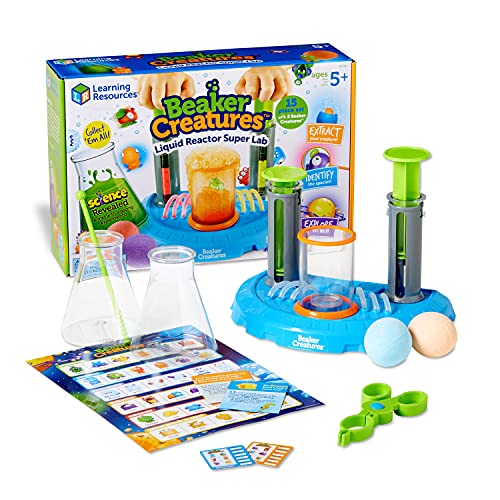
- Recommended for ages 5+
- Features fizzing mystery-creature reactions
- Includes spill-catching overflow tray
Best For: Young learners who enjoy playful, interactive science
Best for Young Beginners
National Geographic Junior Chemistry Set

- Recommended for ages 4 and up
- Includes 50 illustrated experiments
- Comes with 20+ child-friendly lab tools
Best For: Preschool and early-elementary science introductions
Best Complete Lab Station

- 57-piece organized lab setup
- Includes cards and a 16-page manual
- Uses non-hazardous chemicals and no borax
Best For: Families wanting an immersive, repeatable lab experience
Best All-Around Experiment Kit
National Geographic 45-Experiment Chemistry Set

- 45 guided experiments for ages 8 and up
- Includes volcano, geyser, and rocket activities
- Illustrated instructions connect reactions to STEM concepts
Best For: Homeschool learners seeking a varied introductory chemistry kit
Best Molecular Modeling Set
Swpeet 240-Piece Organic Chemistry Model Kit

- 86 atoms and 153 links for building structures
- Supports multiple elements and bond types
- Includes a removal tool and storage box
Best For: Older students studying molecular geometry and organic chemistry
Best for Reluctant Learners
National Geographic Gross Science Chemistry Kit

- Six tactile, gross-themed chemistry experiments
- Bonus guide includes 10 household-item activities
- Explains the science behind slime, goo, and reactions
Best For: Children who respond well to playful, unusual science activities
Advanced Model Building
Swpeet 122-Piece Chemistry Kit

- 122 pieces with atoms, links, and remover tool
- Models organic and inorganic structures
- Includes color-coded parts and storage box
Best For: Hands-on molecular modeling for older homeschool students
Spatial Reasoning Practice
Tiggell 136-Piece Molecular Kit

- 136 pieces with 59 atoms and 76 bonds
- Includes C, H, O, N, P, S, and Cl
- Designed for 3D molecule building and removal
Best For: Ages 14+ studying molecular geometry
Compact Classroom Companion
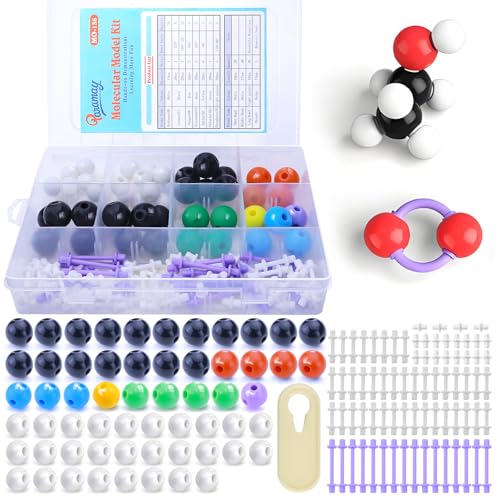
- 136 pieces for organic and inorganic modeling
- Color-coded parts with easy-connect bonds
- Includes remover tool and slim storage case
Best For: Portable homeschool demonstrations and molecular modeling
Best All-Around Lab – National Geographic Amazing Chemistry Set
For families looking for chemistry sets for homeschool, the National Geographic Amazing Chemistry Set offers a broad, hands-on introduction for children ages 8 and up. It includes materials for 15 featured experiments plus a guide with 85 additional activities using common household items.
Best For: Homeschool learners ages 8 and up who want a substantial mix of guided chemistry experiments and follow-up activities.
Pros:
- Includes more than 100 total experiment ideas.
- Provides lab-style tools such as test tubes, beakers, and pipettes.
- Covers engaging activities including crystal growing, color changes, and chemical reactions.
Cons:
- Only 15 featured experiments include the kit’s supplied materials; many bonus activities use household items.
- The recommended age of 8 and up makes it less suitable for preschool learners.
This is a strong choice when variety and continued use matter. Its combination of supplied materials, realistic tools, and bonus experiments gives homeschool families room to build several lessons around one kit.
Best for Early Discovery – Learning Resources Beaker Creatures Super Lab
The Learning Resources Beaker Creatures Liquid Reactor Super Lab brings chemistry concepts to life through fizzing reactions, color mixing, and mystery creature reveals. For families comparing chemistry sets for homeschool, its 15-piece setup offers a playful way to introduce observation and simple reactions to children ages 5 and up.
Best For: Younger homeschool learners who respond well to interactive, themed science activities and collectible discoveries.
Pros:
- Uses reactor pods and fizzing reactions to make observation engaging.
- Includes beakers, tongs, hydroplungers, a stir rod, and classification cards.
- An overflow tray helps contain spills during supervised play.
Cons:
- The set has 15 pieces, so it is more focused than a large experiment collection.
- Its creature-reveal format may provide less traditional chemistry breadth than a general lab kit.
This super lab is best viewed as an introductory, activity-led science tool rather than a comprehensive chemistry curriculum. It can make short homeschool lessons approachable while reinforcing color mixing, reactions, and classification.
Best for Young Beginners – National Geographic Junior Chemistry Set
The National Geographic Junior Chemistry Set is designed for children ages 4 and up, making it a practical starting point for families introducing chemistry sets for homeschool. It combines 50 hands-on experiments with illustrated instructions and more than 20 child-friendly lab tools, while many activities use familiar items such as baking soda and vinegar.
Best For: Preschool and early-elementary homeschool learners who need accessible instructions and introductory experiments.
Pros:
- Offers 50 experiments for repeated hands-on practice.
- Illustrated, step-by-step directions are suited to young learners.
- Includes more than 20 lab tools, including test tubes and goggles.
Cons:
- Many activities rely on common household items, so not every experiment is fully supplied.
- Its early-learning focus may feel basic for older children.
This kit prioritizes accessibility over advanced chemistry. The low age recommendation, visual instructions, and familiar materials make it a sensible first lab for supervised homeschool exploration.
Best Complete Lab Station – Ooze Labs Chemistry Station
The Ooze Labs Chemistry Station gives homeschoolers a dedicated 57-piece workspace for experiments such as glowing slime, fizzing reactions, bubbles, and chromatography. Among chemistry sets for homeschool, it stands out for its large lab-station format, clipped experiment cards, and separate full-color manual for children ages 6 and up.
Best For: Homeschool families wanting a more immersive, organized lab setup for repeated supervised experiments.
Pros:
- Includes 57 pieces, including beakers, flasks, test tubes, pipettes, and other vessels.
- The lab station keeps experiment cards accessible during activities.
- Includes non-hazardous chemicals and does not contain borax.
- Offers both experiment cards and a 16-page illustrated manual.
Cons:
- The larger station requires more storage space than a basic boxed kit.
- It is recommended for ages 6 and up, so it is not intended for very young children.
This is a good fit when presentation and organization are priorities. Its dedicated station can make science time feel more like a real lab, while the included reference materials support guided, repeatable activities.
Best All-Around Experiment Kit – National Geographic 45-Experiment Chemistry Set
For families comparing chemistry sets for homeschool, this National Geographic kit offers a broad, activity-focused introduction for children ages 8 and up. Its 45 experiments include volcanoes, geysers, rockets, and other hands-on reactions, with illustrated instructions designed to make each activity approachable.
Best For: Homeschool learners ages 8 and up who want a varied, guided introduction to chemistry and STEM.
Pros:
- Includes 45 experiments spanning fizzing reactions, volcanoes, geysers, and rockets.
- Kid-friendly, illustrated instructions explain each step and the related chemical reactions.
- Encourages hands-on practice with the scientific process and experiment safety.
Cons:
- The manufacturer lists the kit for ages 8 and up, so it may not suit younger children.
- The activities focus on introductory, entertainment-oriented chemistry rather than advanced coursework.
Its large experiment count makes this a flexible choice for supplementing homeschool science lessons or spreading activities across multiple sessions. Choose it when variety and guided experimentation matter most.
Best Molecular Modeling Set – Swpeet 240-Piece Organic Chemistry Model Kit
For older students, this Swpeet model kit provides a reusable, hands-on way to explore molecular geometry. Rather than focusing on chemical reactions, it lets homeschool learners build organic and inorganic structures from color-coded atom pieces and different types of bonds.
Best For: Teens, advanced homeschool students, teachers, and parents studying molecular structures and bonding.
Pros:
- Includes 86 atom pieces representing 12 elements and 153 links for constructing models.
- Supports single, double, and triple bonds along with flexible and rigid connection options.
- Includes a link-removal tool and a slim storage box for easier reconfiguration and cleanup.
- Listed materials include PP, LDPE, and ABS plastic, with the manufacturer describing the models as non-hazardous.
Cons:
- The manufacturer recommends it for ages 13 and up, limiting its usefulness for younger homeschoolers.
- This is a molecular modeling aid, not a kit for performing wet-lab chemistry experiments.
For chemistry sets for homeschool aimed at conceptual understanding, this is especially useful when students need to visualize atoms, bonds, and three-dimensional structures. It is a strong companion to textbook or classroom-based chemistry study.
Best for Reluctant Learners – National Geographic Gross Science Chemistry Kit
This National Geographic kit uses eye-catching, gross-themed activities to make chemistry more memorable for children ages 8 and up. It includes six experiments involving slime, goo, simulated biological materials, and other unusual results, plus a bonus guide with 10 additional activities using common household items.
Best For: Curious children ages 8 and up who engage more readily with tactile, humorous, and unusual science activities.
Pros:
- Includes six hands-on gross chemistry experiments with memorable visual and tactile results.
- Bonus booklet adds 10 more activities using common household items.
- Experiment explanations connect the activities to real chemistry concepts and gross-science facts.
Cons:
- It offers six kit-based experiments, fewer than the 45 included in the other National Geographic chemistry set.
- The gross theme may not appeal to every child or suit every homeschool setting.
This is a targeted engagement pick rather than a broad chemistry curriculum. Its unusual theme can help spark interest, while the extra household-item activities extend its usefulness beyond the supplied materials.
Advanced Model Building – Swpeet 122-Piece Chemistry Kit
For homeschoolers looking for chemistry sets for homeschool, the Swpeet kit offers a hands-on way to visualize organic and inorganic molecular structures. Its color-coded pieces and included remover tool support lessons ranging from basic compounds to more advanced models.
Best For: High school, college-level, and classroom homeschool chemistry lessons involving molecular structure.
Pros:
- Includes 122 pieces with 59 atoms, 62 links, and a link-remover tool.
- Supports organic and inorganic models using C, H, O, N, and S.
- Color-coded, durable pieces are designed for repeated assembly and storage in the included plastic box.
Cons:
- The set is focused on molecular modeling rather than a broad chemistry experiment curriculum.
- Its advanced structure-building emphasis may be more suitable for older students.
This is a practical choice when your homeschool chemistry work benefits from a reusable 3D modeling aid, especially for studying bonds and complex structures.
Spatial Reasoning Practice – Tiggell 136-Piece Molecular Kit
The Tiggell kit is a focused option among chemistry sets for homeschool, giving students a tactile way to build and take apart 3D molecules. With a broad selection of atoms and bonds, it can make molecular geometry and spatial relationships easier to explore.
Best For: Homeschool students ages 14 and up, teachers, and lessons centered on 3D molecular structure.
Pros:
- Provides 136 pieces, including 59 atoms, 76 bonds, and a remover tool.
- Includes elements such as C, H, O, N, P, S, and Cl, plus single and double bonds.
- Firm connections and the remover tool support repeated construction and disassembly.
Cons:
- The listed manufacturer-recommended age is 14 years and up.
- It is a molecular model set, not a complete experiment-based chemistry kit.
Choose this set if spatial reasoning and molecular geometry are priorities in your homeschool plan and you want more bond pieces for building varied structures.
Compact Classroom Companion – 136-Piece Chemistry Model Kit
For families comparing chemistry sets for homeschool, this 136-piece model kit combines broad structure-building capability with a compact storage case. Its color-coded plastic pieces are intended to help students recognize atoms and assemble organic or inorganic molecules.
Best For: Homeschool chemistry demonstrations and hands-on lessons from introductory through higher-level molecular modeling.
Pros:
- Includes 136 pieces for building organic and inorganic chemical structures.
- Color-coded components and easy-connect bonds support visual, hands-on learning.
- Comes with a short-link remover and slim plastic storage box.
Cons:
- The notes identify C, H, O, N, and S, but do not specify the full range of included atoms.
- The kit emphasizes molecular models rather than hands-on chemical experiments.
Its compact 7.7-by-5.3-by-1.4-inch case makes it convenient for homeschool storage, while the 136-piece count gives learners room to progress beyond simple models.
How We Picked These Chemistry Sets for Homeschool
We selected kits that support practical, home-based science learning across a range of ages and skill levels. The roundup includes experiment-focused sets with guided activities, themed chemistry labs designed to increase engagement, and reusable molecular model kits for studying molecular structure.
We also considered experiment count, stated age range, educational usefulness, setup requirements, and whether the kit can complement a broader homeschool chemistry curriculum. Because included chemicals and components vary, always verify the contents and follow the manufacturer’s safety instructions before beginning an activity.
Quick Comparison
- Best for a broad introduction: National Geographic Amazing Chemistry Set, with more than 100 listed experiments.
- Best for younger learners: National Geographic Junior Chemistry Set, designed around 50 experiments.
- Best for themed engagement: Learning Resources Beaker Creatures and Ooze Labs sets.
- Best for visualizing molecules: Swpeet and tiggell molecular model kits.
- Best for gross-science appeal: National Geographic Gross Science Kit.
Key Buying Factors for Chemistry Sets for Homeschool
Age and Lesson Difficulty
Match the kit to the learner’s developmental level and current coursework. Younger children generally benefit from short, highly guided demonstrations, while older students may get more value from molecular modeling and activities tied to atoms, bonding, formulas, and chemical reactions.
Experiment Materials and Supervision
Check whether a set includes all required ingredients or only the equipment and instructions. Some activities may require household supplies, protective eyewear, ventilation, or close adult supervision. Treat every kit as an educational tool rather than a substitute for standard laboratory safety practices.
Experiment Kits Versus Model Kits
Experiment sets provide visible reactions and can make science feel immediately engaging. Molecular models are quieter and more reusable, helping students build compounds, compare structures, and understand three-dimensional relationships. For a complete homeschool program, combining both formats can be more useful than choosing either one alone.
Organization and Reusability
Look for clearly labeled parts, sturdy tools, and instructions that are easy to follow. Model kits typically offer long-term reuse, whereas experiment kits may have consumable materials that limit the number of activities after the first few projects.
Who Should Buy Which Chemistry Sets for Homeschool?
Choose a guided National Geographic experiment set if you want an accessible starting point with multiple activities. The Junior Chemistry Set is a sensible direction for younger children, while the larger Amazing Chemistry Set may suit families seeking more variety for ages 8 to 12.
Pick Beaker Creatures or Ooze Labs when motivation and playful presentation are priorities. Choose a Swpeet, tiggell, or comparable molecular model kit for students who need help visualizing bonding and molecular structure, especially alongside textbook or online lessons. If your homeschool routine includes several age groups, an experiment kit for demonstrations plus a reusable model set for older learners can provide the most flexible combination.