
Computerized telescopes make it easier to find celestial objects, follow them across the sky, and spend more time observing instead of adjusting the mount.
This roundup includes traditional GoTo models for visual astronomy alongside compact smart telescopes designed for app-controlled imaging. The right choice depends on your observing goals, portability needs, setup preferences, and budget.
Best 10 Computerized Telescopes Picks for 2026
Advanced GoTo Choice

- 5-inch Schmidt-Cassegrain optics
- 40,000+ object GoTo database
- Built-in wedge for entry-level imaging
Best For: Visual observers who want room to grow into astrophotography
Travel Imaging Pick
DWARFLAB Dwarf 3 Smart Telescope

- Backpack-friendly 3-pound design
- 4K auto-tracking for sky and wildlife
- App-based cloud image processing
Best For: Portable, beginner-friendly astronomy and nature imaging
Family-Friendly Reflector

- 130mm Newtonian reflector optics
- 4,000+ object computerized database
- Portable design with two eyepieces
Best For: Families seeking automated visual astronomy on a budget-friendly setup
Urban Smart Imaging Pick
- Automatic GoTo and object tracking
- Built-in light-pollution filtering
- One-tap 4K deep-sky imaging
Best For: App-based astrophotography from urban skies and travel locations
Advanced Choice

- 6-inch Schmidt-Cassegrain optics
- 40,000-plus-object computerized GoTo system
- SkyAlign setup and object tracking
Best For: Observers ready for brighter lunar, planetary, and deep-sky views
Beginner-Friendly Pick

- 4,000-object computerized GoTo mount
- Sky Tour suggests targets to observe
- Includes two eyepieces and Starry Night software
Best For: Families and beginners starting with guided stargazing
Compact Planetary Pick

- 4-inch Maksutov-Cassegrain optics
- Automated GoTo with 40,000-plus objects
- Built-in wedge for entry-level imaging
Best For: Portable Moon and planet viewing with imaging flexibility
Best Portable Pick

- Compact 102mm refractor
- SkyAlign and 40,000-plus-object database
- Includes two eyepieces and Starry Night software
Best For: Beginners, families, and portable observing
Best Heavy-Duty Pick

- 8-inch Schmidt-Cassegrain optics
- Automated GoTo with 40,000-plus objects
- Suitable for visual observing and astroimaging
Best For: Experienced observers and deep-sky viewing
Best Planetary Views

- 127mm Maksutov-Cassegrain optics
- Sharp, high-contrast lunar and planetary views
- GoTo database with more than 40,000 objects
Best For: Moon and planet viewing with portable computerized control
Advanced GoTo Choice – Celestron NexStar 5SE
The Celestron NexStar 5SE is a strong choice among computerized telescopes for users who want traditional viewing through a 5-inch Schmidt-Cassegrain optical tube with automated locating and tracking. Its SkyAlign system, 40,000-plus-object database, and built-in wedge make it especially versatile for visual astronomy and introductory astrophotography.
Best For: Beginners and intermediate observers who want a compact computerized telescope with substantial aperture and an upgrade path.
Pros:
- 5-inch Schmidt-Cassegrain optics can show lunar detail, Jupiter’s cloud bands, galaxies, and globular clusters.
- Fully automated GoTo mount locates and tracks targets from a database of more than 40,000 objects.
- SkyAlign simplifies setup by using any three bright stars or planets.
- Built-in wedge supports entry-level long-exposure astrophotography.
Cons:
- Power options such as AA batteries or an AC adapter are not included.
- At 17.6 pounds, it is less lightweight than compact smart telescope cameras.
- Astrophotography requires additional setup and polar alignment.
The NexStar 5SE balances capable optics, automated operation, and portability. It is a particularly good fit if you want hands-on eyepiece observing now and the option to explore basic imaging later.
Travel Imaging Pick – DWARFLAB Dwarf 3 Smart Telescope
The DWARFLAB Dwarf 3 is a highly portable alternative in the computerized telescopes category, built around app-controlled imaging rather than conventional eyepiece viewing. Its dual-lens design handles astronomy, landscapes, wildlife, and panoramas, while automated tracking and cloud processing simplify image capture.
Best For: Travelers, beginners, and casual astrophotographers who prioritize portability and automated image creation.
Pros:
- Lightweight 3-pound design fits easily in a standard backpack.
- Dual imaging system supports telephoto subjects and wide-angle night scenes.
- 4K auto-tracking follows celestial objects and moving daytime subjects.
- Dedicated app provides one-touch cloud-powered image processing without a PC.
Cons:
- Its 35mm objective lens is geared more toward imaging convenience than traditional large-aperture observing.
- Operation depends on the dedicated app and compatible smart devices.
- Altazimuth operation may be less suited to advanced long-exposure workflows than a dedicated equatorial setup.
The Dwarf 3 stands out for grab-and-go imaging. Choose it when quick, shareable photos and all-day versatility matter more than a conventional telescope-and-eyepiece experience.
Family-Friendly Reflector – Celestron NexStar 130SLT
The Celestron NexStar 130SLT is one of the more traditional computerized telescopes in this roundup, pairing a 130mm Newtonian reflector with an automated altazimuth mount. It offers a sizable aperture for lunar, planetary, and deep-sky viewing while remaining compact enough for camping trips and dark-sky outings.
Best For: Families and beginners who want automated target locating with a conventional reflector telescope.
Pros:
- 130mm aperture and parabolic primary mirror support views of planets, nebulae, galaxies, and star clusters.
- Computerized GoTo system locates and tracks objects from a database of more than 4,000 targets.
- Compact design is convenient for weekend trips and dark-sky sites.
- Includes 20mm and 9mm eyepieces plus Starry Night software.
Cons:
- AA batteries are not included, so an appropriate power source is needed.
- Newtonian reflectors can require more setup and handling than sealed smart telescope cameras.
- The supplied computerized database is smaller than the NexStar 5SE’s database.
The 130SLT is a sensible entry point for shared family observing. Its reflector design delivers useful aperture, while GoTo automation reduces the challenge of finding targets manually.
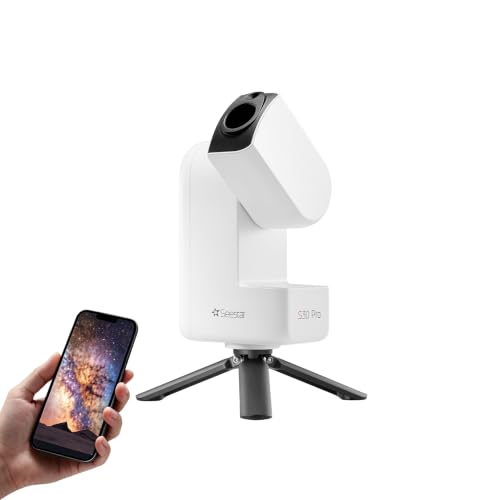
Urban Smart Imaging Pick – ZWO Seestar S30 Pro
The ZWO Seestar S30 Pro is an app-controlled option among computerized telescopes, designed for simple one-tap astrophotography rather than conventional eyepiece observation. Its automatic GoTo, tracking, apochromatic optics, built-in light-pollution filters, and AI processing are well suited to convenient imaging from urban or travel locations.
Best For: Beginners and mobile astrophotographers who want automated deep-sky and wide-field imaging with minimal setup.
Pros:
- Automatic GoTo and tracking make it easy to locate and follow celestial objects.
- Apochromatic optics and built-in filters are designed to improve clarity in bright urban skies.
- Dual-camera 4K imaging supports deep-sky subjects and wide night landscapes.
- One-tap capture, mosaic stitching, and AI processing simplify image creation.
Cons:
- It is designed for deep-sky and wide-field imaging, not planetary observation.
- Deep-sky imaging requires the device to remain stationary for stable tracking.
- Its smartphone- and tablet-based workflow may not suit users seeking traditional eyepiece viewing.
The S30 Pro is a compelling low-friction imaging tool for city observers and travelers. It favors automated results and app convenience over the tactile experience and planetary capability of a conventional telescope.
Advanced Choice – Celestron NexStar 6SE
The Celestron NexStar 6SE is one of the more capable computerized telescopes for observers ready to move beyond a manual scope. Its 6-inch Schmidt-Cassegrain optics, 40,000-plus-object GoTo database, and SkyAlign technology make it easier to locate and track everything from lunar details and planets to selected deep-sky targets.
Best For: Experienced beginners and intermediate observers who want strong all-around viewing in a relatively compact setup.
Pros:
- 6-inch aperture provides bright views of the Moon, Jupiter, galaxies, and globular clusters.
- Fully computerized mount automatically locates and tracks objects.
- SkyAlign can align the telescope using any three bright stars or planets.
- Includes a 25mm eyepiece, tripod, red-dot finderscope, and NexStar+ hand control.
Cons:
- Power adapter, batteries, and external PowerTank options are not included.
- At 21 pounds, it is less portable than smaller computerized models.
- Manual focusing may feel less convenient for users seeking fully automated operation.
The 6SE is a strong upgrade pick when aperture and deep-sky capability matter more than minimum size. Its automated alignment and tracking simplify observing, while the accessory compatibility leaves room to expand the system over time.
Beginner-Friendly Pick – Celestron 114LCM
The Celestron 114LCM is a practical entry point for shoppers comparing computerized telescopes for family or beginner use. Its motorized GoTo mount can locate 4,000 celestial objects, while the Sky Tour feature suggests targets when you are unsure what to observe.
Best For: Beginners, families, and kids who want an accessible computerized telescope with useful starter accessories.
Pros:
- Computerized mount automatically finds thousands of celestial objects.
- Sky Tour recommends visible objects for the current observing session.
- Includes 25mm and 9mm eyepieces, a full-height tripod, and a red-dot finderscope.
- Free Starry Night software can simulate the sky and help plan observations.
Cons:
- Its 4,000-object database is smaller than the databases in the NexStar SE models.
- Battery-powered operation may require attention to power during longer sessions.
- Fully coated optics and a smaller aperture are geared more toward beginner viewing than advanced observing.
The 114LCM emphasizes ease of use and guided exploration rather than maximum optical reach. It is a sensible choice for first-time observers who want automation, included eyepieces, and software support without stepping into a more advanced telescope.
Compact Planetary Pick – Celestron NexStar 4SE
The Celestron NexStar 4SE is a compact option among computerized telescopes, combining 4-inch Maksutov-Cassegrain optics with automated GoTo control. Its long focal length and high-contrast design are suited to sharp Moon and planet views, while SkyAlign simplifies setup.
Best For: Portable observers focused on lunar and planetary viewing who also want entry-level astrophotography potential.
Pros:
- Compact Maksutov-Cassegrain design delivers sharp, high-contrast lunar and planetary views.
- 40,000-plus-object GoTo database automatically locates and tracks targets.
- SkyAlign helps complete alignment by centering three bright stars or planets.
- Built-in wedge supports polar alignment for entry-level long-exposure imaging.
Cons:
- Its 4-inch aperture is less suited to faint deep-sky viewing than the 6SE’s larger aperture.
- Power accessories are not included.
- The narrow stated field of view is better suited to focused targets than broad sky views.
The 4SE makes sense when portability and planetary performance are priorities. Its built-in wedge adds useful imaging flexibility, but the smaller aperture means buyers seeking stronger deep-sky performance may prefer the NexStar 6SE.
Best Portable Pick – Celestron NexStar 102SLT
For shoppers comparing computerized telescopes, the Celestron NexStar 102SLT is a compact refractor designed for straightforward setup and transport. Its 102mm aperture, SkyAlign technology, and 40,000-plus-object database make it a practical choice for backyard observing, camping trips, and family stargazing.
Best For: Beginners, families, and observers who prioritize portability and quick alignment.
Pros:
- SkyAlign helps align the telescope by centering three bright objects.
- 40,000-plus-object database automatically locates and tracks targets.
- Compact refractor design includes 20mm and 9mm eyepieces.
- Includes Starry Night software, a two-year warranty, and technical support.
Cons:
- Power options require eight AA batteries or a 12 VDC source; batteries are not included.
- The 102mm aperture is smaller than those of the other telescopes in this roundup.
- Manual focusing may require hands-on adjustment.
The 102SLT emphasizes convenience and portability rather than maximum light-gathering ability. It is a sensible entry point for users who want computerized locating without carrying a larger optical tube.
Best Heavy-Duty Pick – Celestron NexStar 8SE
The Celestron NexStar 8SE is one of the more capable computerized telescopes for observers who want stronger deep-sky performance in a portable package. Its 8-inch Schmidt-Cassegrain optics collect substantially more light, while the automated GoTo mount and SkyAlign system simplify target selection and tracking.
Best For: Experienced observers seeking detailed planetary views, deep-sky targets, and a setup that can support visual observing or astroimaging.
Pros:
- Large 8-inch aperture is suited to lunar, planetary, and deep-sky observation.
- GoTo mount provides access to a database of more than 40,000 objects.
- SkyAlign can complete alignment by centering three bright stars or planets.
- Compatible with Celestron accessories for future upgrades.
Cons:
- Power sources, including AA batteries and a 12 V AC adapter, are not included.
- Its larger optical system and mount are less convenient to transport than the 102SLT.
- Only one 25mm eyepiece is listed as included.
The 8SE is the strongest option here for gathering light and exploring fainter objects, but its greater capability comes with a larger, heavier setup and more attention to power planning.
Best Planetary Views – Celestron NexStar 127SLT
The Celestron NexStar 127SLT combines computerized convenience with a 127mm Maksutov-Cassegrain optical design. Among computerized telescopes, it stands out as a balanced option for sharp, high-contrast views of the Moon and planets while remaining compact enough for backyard use, camping, or dark-sky trips.
Best For: Beginners and intermediate observers focused on the Moon, planets, and compact portability.
Pros:
- 127mm Maksutov-Cassegrain optics are designed for high-contrast, high-resolution views.
- Computerized hand control offers a database of more than 40,000 objects.
- SkyAlign simplifies setup by using three bright objects.
- Includes 20mm and 9mm eyepieces, StarPointer finderscope, and Starry Night software.
Cons:
- Battery-powered operation may require keeping spare batteries available.
- Its 27-inch optical tube is less compact than the 102SLT’s tube.
- It is heavier than the 102SLT at approximately 18.1 pounds.
The 127SLT offers a useful middle ground: more aperture and planetary-focused optical performance than the compact 102SLT, without the larger footprint of the 8SE.
How We Picked the Best Computerized Telescopes
We selected these models to cover the main ways people use Computerized Telescopes: visual observing, beginner-friendly learning, portable backyard astronomy, and automated astrophotography. We considered optical design, aperture, computerized alignment and tracking, portability, app functionality, power requirements, and the type of experience each telescope provides.
Traditional GoTo telescopes generally offer a more hands-on astronomy experience and can work well with eyepieces for observing the Moon, planets, star clusters, and brighter deep-sky objects. Smart telescopes simplify imaging by combining a camera, computerized mount, and mobile app in one system.
Quick Comparison
| Best For | Look For | Models in This Roundup |
|---|---|---|
| Beginner visual observing | Simple alignment, stable mount, manageable setup | Celestron 114LCM, NexStar 4SE, NexStar 102SLT |
| More detailed visual views | Larger aperture and accurate tracking | NexStar 5SE, NexStar 6SE, NexStar 8SE |
| Portable smart imaging | App control, automated capture, compact design | DWARFLAB Dwarf 3, ZWO Seestar S30 Pro |
| Compact planetary observing | Long focal length and sharp optical design | NexStar 127SLT |
Key Buying Factors for Computerized Telescopes
Aperture and Optical Design
Aperture determines how much light a telescope gathers and strongly affects detail and performance on dimmer targets. Larger Schmidt-Cassegrain and reflector models can reveal more, but they are usually heavier and may require more careful setup. Refractors are often straightforward and low-maintenance, while Maksutov-Cassegrain telescopes are compact and well suited to the Moon and planets.
GoTo Operation Versus Smart Imaging
GoTo systems use a computerized mount to locate and track selected objects, but you typically align the telescope and observe through an eyepiece. Smart telescopes use an app and built-in camera to automate much of the process and create digital images. Choose GoTo if you want a traditional observing workflow; choose a smart telescope if capturing and sharing images is the priority.
Portability, Power, and Setup
Check the assembled weight, tripod size, battery requirements, and whether the telescope can be carried in one trip. A telescope that is quick to deploy is more likely to be used regularly. Also confirm that your observing location has a clear view of enough sky for alignment and tracking.
Accessories and Upgrade Path
Budget for useful extras such as additional eyepieces, a red flashlight, a power supply, a carrying case, or a dew shield. If you may pursue astrophotography later, verify the mount’s tracking capabilities and compatibility with the accessories or camera system you expect to use.
Who Should Buy Which Computerized Telescopes?
Beginners who want an approachable visual telescope should focus on the simpler 114LCM, 102SLT, or 4SE options. Observers seeking brighter, more detailed views and room to grow should consider the 5SE, 6SE, or 8SE, provided they are comfortable with added size and setup.
For compact planetary viewing, the 127SLT is a practical direction. Buyers who mainly want effortless, app-based astrophotography should compare the DWARFLAB Dwarf 3 and ZWO Seestar S30 Pro. Whichever model you choose, prioritize the telescope you can set up consistently—regular use matters more than specifications alone.