
Whether you are troubleshooting loud equipment, checking workplace noise, tuning an audio setup, or monitoring a home environment, the right digital sound level meter makes measurements easier to repeat and compare.
These 10 options cover portable SPL testers, large-display meters, rechargeable data loggers, and models with A/C weighting, memory, alarms, and USB export.
Best 10 Digital Sound Level Meters Picks for 2026
Best All-Around Value
RISEPRO HT-80A Digital Sound Level Meter

- 30–130 dB range with ±1.5 dB accuracy
- Backlight, data hold, and MAX/MIN readings
- Includes carrying pouch and gift box
Best For: General home, workplace, and industrial noise checks
Best Established Brand
Extech 407730 Sound Level Meter

- 40–130 dB measurement range
- 0.1 dB resolution and analog bar graph
- Includes batteries, windscreen, and one-year warranty
Best For: Straightforward monitoring with visual level tracking
Best for Loudness Testing
Goldeep SL750A Sound Level Meter

- dB and SONE units for intensity and loudness
- A/C weighting plus fast/slow response
- 30–130 dB range with MAX/MIN tracking
Best For: Environmental, workplace, classroom, and music testing
Best Feature Set
Protmex PT6708 Sound Level Meter

- 30–130 dB range with 0.1 dB resolution
- A/C weighting and fast/slow response modes
- Backlight, data hold, MAX, and dB/SONE selection
Best For: Flexible environmental, machinery, audio, and nighttime testing
Best Portable Pick
TopTes TS-501B Sound Level Meter

- Backlit 2.25-inch LCD
- 30–130 dB A/C weighting
- MAX/MIN, hold, case, and batteries
Best For: Portable household and workplace noise checks
Best Budget Monitor
VLIKE VL6708 Digital Decibel Meter
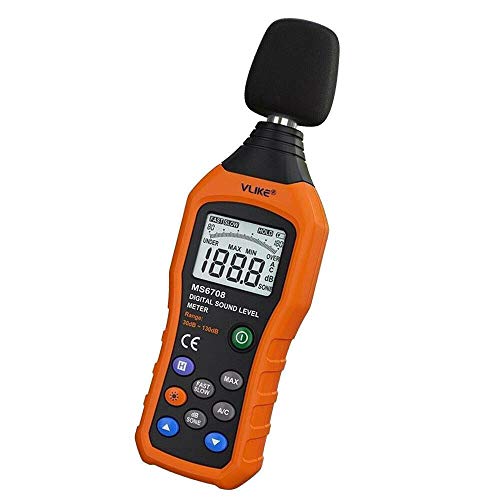
- 30–130 dB measurement range
- A/C modes and max locking
- Backlit, portable, and power-saving design
Best For: Basic real-time sound monitoring
Best for Data Logging

- Stores up to 3,100 records
- USB rechargeable with PC export
- Graphical display and three-color alarms
Best For: Documented, repeated noise monitoring
Best Wall-Mount Display

- Large red LCD display
- Wall-hanging design
- 30–130 dB measurement range
Best For: Stationary noise monitoring with easy-to-see readings
Best Heavy-Duty Pick

- Stores up to 43,000 readings
- Exports data to Excel via PC
- A/C weighting with fast/slow response
Best For: Long-term monitoring and computer-based analysis
Best Simple Pick
Tadeto SL720 Digital Sound Level Meter
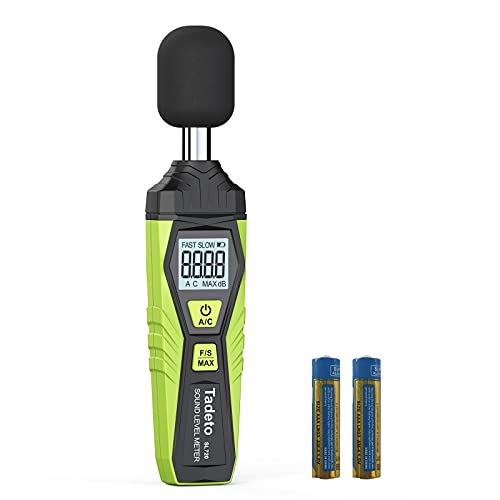
- Lightweight portable design
- A/C weighting and fast/slow response
- Backlit 4-digit LCD
Best For: Routine handheld noise checks in varied locations
Best All-Around Value – RISEPRO HT-80A Digital Sound Level Meter
The RISEPRO HT-80A is a practical choice among digital sound level meters for checking noise at home, work, or in industrial settings. Its 30–130 dB range, ±1.5 dB accuracy, backlight, and MAX/MIN tracking cover everyday monitoring needs.
Best For: General home, workplace, study, and industrial noise checks.
Pros:
- Broad 30–130 dB measurement range with ±1.5 dB accuracy.
- Includes data hold, MAX/MIN readings, backlight, and auto power-off.
- Comes with a carrying pouch and gift box; IPX5-rated construction is listed.
Cons:
- Frequency response is listed as 31.5 Hz–4 kHz, narrower than some alternatives.
- Uses only fast time weighting rather than selectable fast and slow modes.
Choose this meter if you want a straightforward, portable noise tester with useful display and recording features at a general-purpose price point.
Best Established Brand – Extech 407730 Sound Level Meter
The Extech 407730 is a compact option for shoppers comparing digital sound level meters from an established test-equipment brand. It measures 40–130 dB, offers 0.1 dB resolution, and combines a digital display with a fast-responding analog bar graph.
Best For: Users who want a simple Extech meter with visual level tracking.
Pros:
- Provides 0.1 dB resolution across a 40–130 dB range.
- Records maximum and minimum values and includes Max Hold.
- Includes a microphone windscreen, four AAA batteries, and a one-year parts-and-labor warranty.
Cons:
- Its stated accuracy is 2 dB, less precise than several competing models here.
- Does not list a backlight or selectable fast/slow response in the supplied specifications.
The Extech is a sensible pick when brand familiarity, a bar-graph display, and basic maximum/minimum functions matter more than the widest range or tightest accuracy rating.
Best for Loudness Testing – Goldeep SL750A Sound Level Meter
The Goldeep SL750A stands out among digital sound level meters by offering both dB and SONE units. Along with a 30–130 dB range and ±1.5 dB accuracy, it provides A/C weighting and fast/slow response settings for environmental, workplace, and perceived-loudness checks.
Best For: Home, classroom, workplace, construction, and music-related sound testing.
Pros:
- Measures 30–130 dB with ±1.5 dB accuracy and a 31.5 Hz–8 kHz response.
- Offers A/C weighting, fast/slow response, and MAX/MIN tracking.
- Displays both dB and SONE units and includes a windbreak ball and two AAA batteries.
Cons:
- The supplied notes do not mention auto power-off or a backlight.
- Its bright orange finish may not suit users seeking a more understated instrument.
This is a versatile choice for buyers who want more than basic decibel readings, particularly the ability to view perceived loudness in SONE units.
Best Feature Set – Protmex PT6708 Sound Level Meter
The Protmex PT6708 is one of the more feature-rich digital sound level meters in this lineup. It combines 30–130 dB measurement, ±1.5 dB accuracy, 0.1 dB resolution, selectable weighting and response modes, and a backlit display for flexible field use.
Best For: Environmental, workplace, machinery, audio, and nighttime noise measurements.
Pros:
- Uses 0.1 dB resolution with a stated ±1.5 dB accuracy.
- Supports A/C weighting, fast/slow response, MAX, data hold, and dB/SONE selection.
- Has an anti-slip design, backlight, and backlight auto-off for power savings.
Cons:
- The device cannot keep or generate a report directly.
- At 190 g, it is heavier than the listed RISEPRO and Goldeep meters.
The PT6708 is a strong fit when measurement controls and usability features are priorities, especially for users switching between environmental noise, machinery, and audio applications.
Best Portable Pick – TopTes TS-501B Sound Level Meter
For everyday checks, the TopTes TS-501B is one of the more convenient digital sound level meters to consider. It combines a large backlit display with A/C weighting, a 30–130 dB range, and simple MAX/MIN and data-hold functions for checking noise around the home, office, workshop, or factory.
Best For: Portable household, workplace, and workshop noise checks.
Pros:
- 2.25-inch backlit LCD is easy to read, including in dim conditions.
- A/C weighting measures levels from 30–130 dB with stated ±1.5 dB accuracy.
- Includes three AAA batteries, a carry case, and automatic power-off.
Cons:
- Does not offer the data-recording and PC-export features of a logger.
- Requires AAA batteries rather than USB recharging.
The TS-501B is a practical choice when you want a straightforward handheld meter with a readable screen and useful peak-reading controls. Its included batteries and case also make it ready for portable use.
Best Budget Monitor – VLIKE VL6708 Digital Decibel Meter
The VLIKE VL6708 is a compact option among digital sound level meters for real-time monitoring. Its 30–130 dB range, A/C modes, backlight, auto-ranging, and max-locking function suit quick checks in homes, schools, offices, workshops, roads, and other environments.
Best For: Basic real-time sound monitoring on a budget.
Pros:
- Measures from 30–130 dB with selectable A/C modes.
- Backlight supports viewing sound data at night and powers off automatically.
- Portable casing includes an anti-drop structure and power-saving circuit design.
Cons:
- Batteries are not included.
- Cannot store or generate a report directly from the device.
- Its feature set is geared toward monitoring rather than data logging.
Choose the VLIKE when you need an uncomplicated meter for spot checks rather than documented measurement projects. The backlight, max lock, and portable design add useful convenience for routine monitoring.
Best for Data Logging – GAIN EXPRESS SLM-442 Meter
The GAIN EXPRESS SLM-442 stands out among digital sound level meters for recording and reviewing measurements. It combines a 30–130 dB range with graphical readings, three-color alarm indicators, USB connectivity, and storage for up to 3,100 records, making it better suited to repeated monitoring than a basic spot-check meter.
Best For: Documented noise monitoring in classrooms, offices, homes, and industrial settings.
Pros:
- Stores up to 3,100 data records and supports PC data export on Windows 7, 10, and 11.
- USB rechargeable design runs for up to eight hours per charge.
- Offers graphical readings, three-color alarm lights, and a stated ±1.5 dB accuracy.
Cons:
- Its recording and computer-connection features may be unnecessary for occasional checks.
- Battery runtime is limited to about eight hours per charge.
- PC compatibility is specified for Windows systems.
If you need to capture a series of readings instead of viewing one measurement at a time, the SLM-442 is the strongest fit of these options. Its logging, alarms, rechargeable battery, and adjustable auto-shutoff make it useful for ongoing inspections.
Best Wall-Mount Display – SW-525A Sound Level Meter
The SW-525A is a straightforward option for buyers who want digital sound level meters with a large, easy-to-read red LCD display. Its automatic operation and wall-hanging design suit fixed monitoring locations where visibility matters.
Best For: Wall-mounted noise monitoring in homes, offices, workshops, or other spaces where a prominent display is useful.
Pros:
- Large screen LCD display for quick readings.
- Wall-hanging design works well for stationary use.
- Measures sound from 30 to 130 dB.
- Automatic operation keeps the design simple to use.
Cons:
- Its plastic acrylic construction may feel less rugged than heavier-duty alternatives.
- The supplied notes do not mention data logging, PC export, or A/C weighting.
Choose this model if clear at-a-glance readings and a fixed installation matter more than advanced analysis or portability.
Best Heavy-Duty Pick – DANOPLUS DP-441 Decibel Meter
The DANOPLUS DP-441 stands out among digital sound level meters for recording and exporting measurements. It stores up to 43,000 data points, connects to Windows PCs, and combines visual alarms with adjustable measurement settings.
Best For: Users who need extended noise monitoring, PC-based review, Excel export, or printable measurement records.
Pros:
- Records up to 43,000 data points and supports PC viewing and Excel export.
- 30–130 dB range with stated ±1.5 dB accuracy.
- Supports A/C frequency weighting and fast/slow response modes.
- Three-color alarm indicators provide low, medium, and high noise alerts.
Cons:
- PC connectivity and data-analysis features may be more than casual users need.
- Charging takes about 1.5 hours, according to the supplied notes.
This is the strongest fit of the three for documented measurements and trend analysis, especially when exporting readings to a Windows computer is important.
Best Simple Pick – Tadeto SL720 Digital Sound Level Meter
The Tadeto SL720 is a practical portable choice among digital sound level meters, with a 30–130 dB range, a backlit LCD, and selectable A/C weighting. Its lightweight design makes it suitable for checking noise levels in several everyday and work environments.
Best For: Portable spot checks around homes, offices, factories, vehicles, construction sites, and audio systems.
Pros:
- Lightweight design is convenient to carry.
- Measures 30–130 dB with stated ±2.0 dB accuracy.
- A/C weighting supports ambient-noise and higher-intensity sound checks.
- Backlit four-digit LCD improves readability in darker locations.
Cons:
- Its stated accuracy is lower than the DANOPLUS DP-441’s ±1.5 dB specification.
- The supplied notes do not mention data logging or PC export.
- Manual operation may require more user input than an automatic meter.
For buyers who want a compact meter for routine checks rather than stored reporting, the SL720 offers useful weighting and response controls in a portable format.
How We Picked These Digital Sound Level Meters
We compared the selected meters by measurement range, weighting options, display readability, portability, controls, power source, and recording features. Most cover approximately 30 to 130 dB, making them suitable for everyday noise checks from quiet rooms to loud machinery. We also considered whether a meter supports MAX/MIN readings, data hold, backlighting, alarms, or stored measurements.
Feature depth matters, but so does ease of use. A simple handheld tester can be the better choice for occasional checks, while a data logger is more useful when readings must be reviewed later or shared as evidence.
Quick Comparison
- Best for basic portable checks: Look for a compact meter with a clear LCD, backlight, data hold, and MAX/MIN functions.
- Best for audio and technical work: Choose a model with both A and C weighting and a stated accuracy specification.
- Best for monitoring over time: Select a rechargeable data logger with internal memory and USB export.
- Best for visibility: A large or brightly backlit display is easier to read across a room or in dim spaces.
- Best for fixed locations: Wall-hanging designs with alarm indicators can suit workshops, classrooms, and production areas.
Key Buying Factors for Digital Sound Level Meters
Measurement Range and Accuracy
A 30–130 dB range handles common household, office, traffic, and equipment measurements. Check the manufacturer’s accuracy rating when results may influence compliance, workplace decisions, or technical adjustments. These consumer and general-purpose meters should not automatically be treated as certified instruments for legal testing.
Frequency Weighting
A-weighting approximates human hearing and is widely used for general environmental and workplace noise. C-weighting captures low-frequency sound more fully and can be useful around speakers, engines, and bass-heavy equipment. If you expect varied applications, choose a meter offering both.
Memory and Data Logging
MAX/MIN and data-hold functions are enough for quick spot checks. For recurring monitoring, look for substantial memory, timestamps where available, rechargeable power, and USB export. A visual three-color alarm or threshold indicator can also make changing noise levels easier to interpret.
Display and Operation
Backlighting, large digits, accessible buttons, and automatic power-off improve everyday usability. Consider whether you will read the meter up close, at arm’s length, or from across a room.
Who Should Buy Which Digital Sound Level Meters?
Homeowners and DIY users should prioritize an affordable handheld meter with a backlit display, data hold, and MAX/MIN readings. Audio hobbyists should favor A/C weighting and a broad range. Workshop and workplace users may benefit from a visible alarm, wall-mounting, or continuous monitoring features. Researchers, inspectors, and technicians should choose the strongest logging and export capabilities available, then verify whether a professionally calibrated sound meter is required for their application.