
Educational programmable humanoid robots can turn coding, AI, and robotics concepts into something students can see, control, and improve in real time.
Whether you want a beginner-friendly classroom kit or a more advanced build for Python, Scratch, or ROS, the right robot depends on age, skill level, and learning goals.
Best 10 Educational Programmable Humanoid Robots Picks for 2026
AI Vision & Voice Builder

- 17DOF humanoid with ESP32 control
- Arduino, Python, and Scratch support
- AI vision, voice, and sensor expansion
Best For: Coding-focused STEM learners who want AI-style interaction
Kid-Friendly AI Lab

- Builds a six-legged AI learning robot
- App-based gesture and sound training
- Includes a 64-page illustrated manual
Best For: Kids learning AI basics through guided building and play
Micro:bit STEM Performer

- Walks, dances, sings, and self-balances
- Block, JavaScript, and Python support
- 30+ free online STEM classes
Best For: Playful learners who want a compact, expandable coding robot
ROS Vision Platform

- ROS robot with Raspberry Pi 5
- 24 servos, camera, and mechanical hands
- Inverse kinematics and OpenCV tracking
Best For: Advanced robotics study with ROS, vision, and motion control
Kid-Friendly Starter Robot
Contixo R1 Interactive Learning Robot

- Voice and touch control
- Sings, dances, and walks
- Compact for ages 3+
Best For: Young children who want a simple interactive robot toy
ROS-Based AI Learning Platform
HIWONDER AiNex Raspberry Pi 5 Kit
- ROS robot with Raspberry Pi 5
- 24 servos plus HD camera
- Tutorials in English and Chinese
Best For: Hands-on AI and robotics learners needing a technical humanoid kit
Advanced AI Humanoid Platform
HIWONDER TonyPi Pro Raspberry Pi 5

- ChatGPT-style multimodal interaction
- 20 servos with vision tracking
- Open-source learning resources included
Best For: Advanced AI robotics study and programming projects
AI Vision Starter Pick

- Raspberry Pi 5 4GB with open-source access
- AI vision features include tracking, line following, and motion control
- ChatGPT voice and scene understanding for interactive learning
Best For: Learners starting hands-on AI humanoid robotics with Python
Power User Robotics Kit
- Raspberry Pi 5 16GB for more advanced projects
- Open-source AI robotics platform for experimentation
- ChatGPT, vision, and voice recognition in one kit
Best For: Advanced users building more demanding AI robotics projects
Compact Learning Build
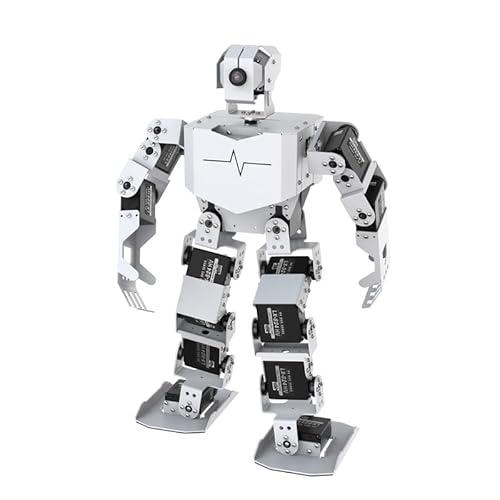
- Most accessible Raspberry Pi 5 configuration in the lineup
- AI vision, voice, and ChatGPT interaction are included
- Learning resources cover Python, OpenCV, and sensors
Best For: Budget-minded beginners focused on core robotics and coding skills
AI Vision & Voice Builder – Tonybot Standard Kit
Tonybot is a strong fit for buyers looking for educational programmable humanoid robots that go beyond basic motion demos. Built on ESP32 with 17 intelligent servos, it supports Arduino, Python, and Scratch, while adding AI vision, voice interaction, and expandable sensor options for hands-on STEM learning.
Best For: Learners who want a programmable humanoid with AI vision, voice control, and multi-language coding support.
Pros:
- 17DOF humanoid design with smooth walking, dancing, kicking, and self-stand-up actions
- Supports Arduino, Python, and Scratch with open-source low-level code and step-by-step tutorials
- Includes ESP32-S3 vision and voice modules for face recognition, tracking, line following, and voice control
- Expandable with sensors like ultrasonic, IMU, buzzer, and optional display or environmental modules
Cons:
- AI model module features are listed for the Ultimate Kit only
- More advanced than a simple starter robot, so it may take time to learn
Tonybot stands out for builders who want a real robotics project with room to grow into AI development, not just preprogrammed play. Its blend of movement, sensing, and coding support makes it a versatile education robot.
Kid-Friendly AI Lab – Thames & Kosmos Kai Robot
Kai is a practical pick for educational programmable humanoid robots if your goal is to introduce kids to AI concepts through building and experimentation. The robot reacts to gestures and sounds, and the companion app lets users assign movements so they can see a simple version of machine learning in action.
Best For: Kids and families wanting a hands-on introduction to AI and robotics with guided assembly.
Pros:
- Build-your-own six-legged robot with AI-inspired behavior
- App lets users assign motions to gestures and sounds for interactive learning
- 64-page full-color manual explains mechanics and AI history/future
- Designed as a hands-on and digital learning experience for ages 10+
Cons:
- Not a humanoid robot in the traditional biped form
- Requires adult help for younger builders
- Runs on AAA batteries, which adds ongoing upkeep
Kai is less about advanced humanoid motion and more about making AI ideas understandable and engaging. It works well for learners who benefit from structured guidance and an approachable robotics build.
Micro:bit STEM Performer – Robot PU Humanoid
Robot PU is a lively option among educational programmable humanoid robots, especially if you want a compact platform with lots of personality. It combines walking, dancing, talking, singing, and self-balancing with Micro:bit-based programming and a large set of free online learning projects.
Best For: Younger STEM learners who want a playful, expandable robot with Micro:bit coding resources.
Pros:
- Performs moonwalks, spins, splits, dancing, walking, and self-balancing
- Supports Block, JavaScript, and Python programming with open-source resources
- Includes 30+ free online classes covering programming, 3D design, printing, AI, and coding
- Expandable with accessories like construction kits, AI cameras, and green energy solutions
Cons:
- Much smaller than many humanoid robots at 6.3 inches tall
- Battery-powered with AAA cells, so runtime depends on replacements
Robot PU is a strong match for hands-on learners who like a robot with entertainment value as well as coding depth. Its community support and class library make it especially useful for ongoing STEM exploration.
ROS Vision Platform – HIWONDER AiNex Pi 5 Kit
AiNex is aimed at buyers who want a serious educational programmable humanoid robot built around Raspberry Pi 5 and ROS. With 24 intelligent servos, an HD camera, mechanical hands, and inverse kinematics gait planning, it is set up for more advanced AI, vision, and robotics study.
Best For: Advanced students, classrooms, and hobbyists working on ROS, vision, and humanoid motion control.
Pros:
- Built on ROS with Raspberry Pi 5 and 24 intelligent serial bus servos
- Supports inverse kinematics and omnidirectional gait planning for flexible movement
- Includes HD camera and OpenCV-based object recognition and tracking
- Offers app, wireless handle, and PC software control options with extensive tutorials
Cons:
- More complex than beginner kits and better suited to experienced users
- Large, high-end build is likely overkill for casual play
AiNex is the most technical option in this roundup, especially for users who want to study robotics platforms rather than just assemble a toy. Its hardware depth and tutorial support make it a strong education kit for serious experimentation.
Kid-Friendly Starter Robot – Contixo R1 Interactive Learning Robot
If you want an entry-level option in educational programmable humanoid robots, the Contixo R1 is a simple, kid-friendly choice focused on interaction rather than coding. It talks, dances, walks, and responds to voice and touch commands, making it a playful way to introduce young children to robotics concepts.
Best For: Toddlers and young kids ages 3+ who want a compact, easy-to-use robot toy for interactive play.
Pros:
- Voice control and touch induction make it easy for kids to operate
- Can sing, dance, repeat, and walk in multiple directions
- Voice recording feature adds a fun personal touch
- Compact size makes it easy to store and carry
Cons:
- Runs on 3 AAA batteries, which are not included
- More of a learning toy than a true programmable robotics kit
- Best suited to younger children, not advanced students
The R1 is a good pick if your priority is an affordable, portable robot that keeps younger kids engaged. It is less technical than the bigger humanoid kits, but it still offers a practical first step into interactive robotics.
ROS-Based AI Learning Platform – HIWONDER AiNex Raspberry Pi 5 Kit
For buyers comparing educational programmable humanoid robots, the HIWONDER AiNex stands out as a serious learning platform built around ROS and Raspberry Pi 5. It combines 24 servos, an HD camera, inverse kinematics, and cross-platform control tools, so it is aimed at hands-on robotics study rather than casual play.
Best For: Students, educators, and hobbyists who want a ROS-based humanoid robot for AI, vision, and programming practice.
Pros:
- Built on ROS with Raspberry Pi 5 for advanced learning
- Includes 24 intelligent serial bus servos and an HD camera
- Supports inverse kinematics and omnidirectional gait planning
- Multiple control options via app, wireless handle, and PC software
Cons:
- Designed for educational use, so setup is more involved than a toy
- Best suited to users comfortable with technical learning
- Adult-oriented age range limits it as a family play robot
AiNex is a strong fit if you want a humanoid robot that teaches real robotics workflows, not just basic movement. Its tutorials and multi-platform controls make it especially useful for structured learning environments.
Advanced AI Humanoid Platform – HIWONDER TonyPi Pro Raspberry Pi 5
The HIWONDER TonyPi Pro is one of the most advanced educational programmable humanoid robots here, combining ChatGPT-based interaction with vision, voice understanding, and Raspberry Pi 5 power. It is built for learners who want to explore embodied AI, OpenCV, motion control, and humanoid behavior in a single platform.
Best For: Advanced learners, makers, and robotics enthusiasts who want an AI-powered humanoid robot with rich programming resources.
Pros:
- Integrates ChatGPT, AI vision, and voice command recognition
- Powered by Raspberry Pi 5 with open-source development support
- Includes 20 intelligent bus servos for precise movement
- Comes with extensive tutorials covering AI and robotics topics
Cons:
- Clearly aimed at advanced educational use, not beginners
- Complex feature set may require significant setup and study
- Large humanoid format is less portable than smaller robots
TonyPi Pro is best viewed as a deep-learning robotics platform rather than a simple classroom toy. If you want a feature-rich humanoid robot for experimenting with AI models and robot programming, it offers a lot of capability in one kit.
AI Vision Starter Pick – TonyPi Advanced RPi5 4GB
For buyers comparing educational programmable humanoid robots, TonyPi Advanced is a strong pick if you want a hands-on platform centered on AI vision, voice interaction, and Python programming. It pairs Raspberry Pi 5 power with open-source access, OpenCV, inverse kinematics, and guided learning materials, making it suited to practical experimentation rather than passive play.
Best For: Learners who want an approachable AI humanoid robot for Python, vision, and voice-based projects.
Pros:
- Raspberry Pi 5 4GB platform with open-source development access
- Supports AI vision features like color recognition, tracking, line following, and MediaPipe motion control
- ChatGPT-based multimodal interaction adds voice and scene understanding
- Includes broad learning resources for motion control, OpenCV, deep learning, and sensors
Cons:
- 4GB configuration may be less headroom than higher-memory versions for heavier experimentation
- Focused on education and development, so it is not a simple ready-to-run toy
- Best value depends on whether you need advanced AI projects versus basic coding practice
Overall, TonyPi Advanced is best viewed as an educational build-and-code robot for users who want a structured path into embodied AI. Its mix of camera-based perception, voice control, and tutorials makes it especially useful for learning by doing.
Power User Robotics Kit – TonyPi Pro RPi5 16GB
If you want educational programmable humanoid robots with more room for advanced development, TonyPi Pro stands out with its Raspberry Pi 5 16GB configuration and open-source AI robotics platform. It is built around multimodal ChatGPT integration, AI vision, voice recognition, and a learning-focused design aimed at experimentation, innovation, and more demanding projects.
Best For: Advanced learners and makers who want a higher-memory robot kit for AI robotics development.
Pros:
- Raspberry Pi 5 16GB offers the most headroom in this lineup
- Open-source environment supports advanced AI robotics development
- AI vision, voice recognition, and ChatGPT-based interaction are built in
- Includes learning resources for OpenCV, deep learning, MediaPipe, and sensors
Cons:
- More advanced configuration may be more than beginners need
- Uses external power supply, so it is less self-contained than battery-powered setups
- Designed for AI education and development, not casual tabletop use
In practice, TonyPi Pro is the strongest option here for users who want to push beyond introductory projects. The extra memory and educational software support make it a better fit for heavier AI experimentation and robotics work.
Compact Learning Build – TonyPi Advanced RPi5 2GB
For shoppers looking at educational programmable humanoid robots with a lower-cost entry point, TonyPi Advanced in the Raspberry Pi 5 2GB version keeps the same AI vision and ChatGPT-based learning focus in a leaner setup. It still includes OpenCV, inverse kinematics, voice understanding, and guided educational content, making it useful for coding and robotics practice.
Best For: Budget-conscious learners who want a compact AI humanoid robot for programming and vision basics.
Pros:
- Raspberry Pi 5 2GB version keeps the platform accessible
- Supports AI vision recognition, target tracking, ball kicking, and line following
- ChatGPT multimodal integration enables voice and scene interaction
- Educational materials cover motion control, deep learning, MediaPipe, and sensors
Cons:
- 2GB memory is the most limited configuration in the group
- Best suited to learning and experimentation rather than heavy development
- Some buyers may prefer the higher-memory variants for more advanced AI work
This version makes sense if you want the TonyPi educational experience but do not need the extra memory of the Pro model. It still delivers the core vision, voice, and Python learning tools that define the platform.
How We Picked the Best Educational Programmable Humanoid Robots
We focused on Educational Programmable Humanoid Robots that balance learning value, software flexibility, and clear upgrade potential. Priority went to models that support common coding paths such as Scratch, Python, micro:bit, Arduino, or ROS, since those platforms make it easier to move from beginner lessons to more advanced projects.
We also looked at interaction features, build quality, documentation, and whether a robot is better suited to a classroom, home lab, or supervised maker environment.
Quick Comparison
For younger learners, compact voice- and motion-based robots are usually the easiest starting point. For middle-school and high-school STEM work, kits with programmable behaviors, sensors, and modular hardware offer more long-term value. Advanced buyers should look at AI-enabled humanoid platforms with vision, multimodal interaction, or ROS support for deeper robotics experiments.
Key Buying Factors for Educational Programmable Humanoid Robots
Coding Platform Support
Choose a robot that matches the learner’s current level. Scratch and block coding are best for beginners, while Python, Arduino, and ROS are stronger choices for students ready to handle text-based programming and robotics concepts.
Hardware Complexity
Some Educational Programmable Humanoid Robots arrive nearly ready to use, while others require assembly, calibration, or ongoing tuning. More complex kits usually teach more, but they also demand more time, patience, and technical confidence.
Movement, Sensors, and AI Features
Look for servos, self-balancing behavior, vision, voice interaction, and touch or motion sensing if you want more than simple scripted actions. These features help learners explore feedback loops, autonomy, and human-robot interaction.
Curriculum Fit
If the robot is for a classroom or club, check whether it supports lesson-friendly learning outcomes such as coding logic, machine learning basics, or engineering design. A strong guidebook or project path can matter as much as the hardware itself.
Who Should Buy Which Educational Programmable Humanoid Robots?
Beginners and younger students should prioritize approachable robots with simple programming and playful interaction. Families and casual STEM learners may prefer compact models that are easy to operate and maintain. For serious robotics students, choose a platform with expansion options, stronger coding depth, and sensor-rich features. Advanced hobbyists, educators, and university-level users will get the most from AI-focused humanoid kits that support research-style experimentation and open-ended development.
In short, the best Educational Programmable Humanoid Robots are the ones that match the user’s skill level today while leaving room to grow tomorrow.