
The best electronics breadboard kits for hobbyists make it easier to turn circuit ideas into working projects without buying every resistor, jumper, or LED separately. This roundup compares beginner-friendly Arduino bundles, component assortments, and breadboard-focused sets for learning and experimentation.
Whether you are building your first LED circuit or expanding an existing electronics bench, look for a kit with dependable essentials, a useful tutorial, and enough variety to support projects beyond the first few experiments.
Best 10 Electronics Breadboard Kits for Hobbyists Picks for 2026
Best Guided UNO Kit
ELEGOO UNO R3 Super Starter Kit

- 22+ guided Arduino projects
- Sensors, motors, LCD, and input modules included
- Solderless setup with pre-soldered LCD header
Best For: Beginners and classroom-style STEM learning
Best Component Assortment
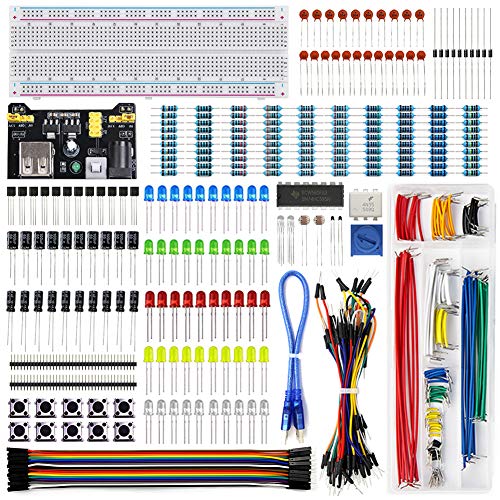
- More than 400 components and sensors
- 830 tie-point breadboard and power module
- Labeled parts in a sturdy storage box
Best For: Hobbyists who already own a controller board
Best for Advanced Arduino Projects

- 35+ guided electronics projects
- 200+ components with RFID, RTC, and motion sensors
- 54 digital I/O pins and 256 KB flash
Best For: Growing makers and multi-component projects
Best Organized Value Kit
BOJACK 480-Piece Component Kit
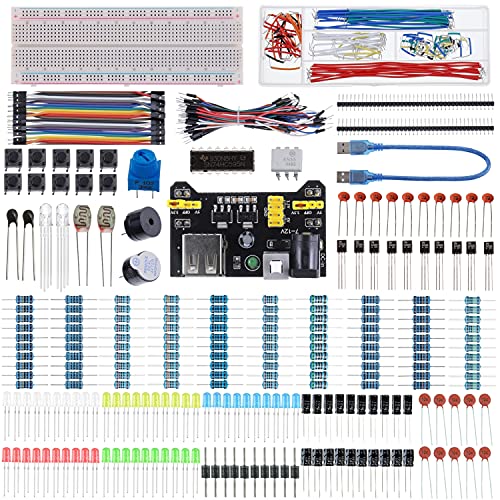
- 480-piece, 37-value component assortment
- 830 tie-point breadboard and power module
- Labeled transparent storage box
Best For: Existing Arduino, Raspberry Pi, and STM32 owners
Best Compact Arduino Starter

- 235 parts for LED, button, buzzer, and sensor experiments
- Selectable 3.3V or 5V breadboard power module
- Compact 400-tie-point setup for beginners
Best For: Small Arduino-compatible learning projects and classroom demonstrations
Best for Component Variety
1530-Piece Electronics Lab Starter Set

- Broad assortment of resistors, capacitors, LEDs, diodes, and transistors
- 830-tie-point breadboard with Dupont leads and jumpers
- Organized storage case for classroom or bench use
Best For: Hobbyists who want a large, varied inventory for repeated prototyping
Best for Larger Circuits
Upgraded 830-Point Electronics Fun Kit

- 830-point breadboard for ICs and multi-stage circuits
- More than 300 parts with multiple wiring options
- Selectable 3.3V or 5V power module included
Best For: Arduino-compatible projects that need extra breadboard workspace
Versatile Starter Kit
Miuzei 400+ Component Breadboard Kit

- More than 400 labeled components
- USB cable and power module included
- Controller board not included
Best For: Beginners and hobbyists exploring Raspberry Pi or STM32 projects
Organized Value Pick
REXQualis 300+ Component Basic Kit

- More than 300 components included
- Labeled storage box for parts
- USB power cable and supply module included
Best For: Beginners making Arduino or Raspberry Pi experiments
Expanded Power Kit
Minidodoca Upgraded Electronics Fun Kit

- 830-point breadboard and 9V adapter
- Includes displays, ICs, and sensors
- 3.3V and 5V power outputs
Best For: Hobbyists building varied Raspberry Pi or STM32 circuits
Best Guided UNO Kit – ELEGOO UNO R3 Super Starter Kit
For shoppers comparing electronics breadboard kits for hobbyists, this ELEGOO UNO R3 set is a practical beginner option built around 22+ guided projects. It combines a controller, solderless breadboard, sensors, motors, displays, and example code so new builders can focus on wiring and programming without soldering.
Best For: Beginners, family weekend builds, homeschool lessons, coding clubs, and introductory STEM projects.
Pros:
- Includes 22+ guided lessons covering LEDs, sensors, motors, displays, and input devices.
- Provides a broad mix of components, including an LCD1602, ultrasonic sensor, DHT11, servo, stepper motor, relay, and joystick.
- Pre-soldered LCD header and plug-in components simplify initial setup.
- Includes a breadboard power module, storage-friendly component list, USB cable, and remote.
Cons:
- The UNO R3 has 2 KB of RAM and a 16 MHz processor, limiting larger projects.
- The power module should not be used with input above 9V.
- First-time builders may need adult guidance when checking polarity, wiring, and power.
This is a well-rounded path into Arduino-style electronics, especially when structured lessons matter more than maximum processing capacity. Its component variety also leaves room to adapt the examples into alarms, monitors, and interactive projects.
Best Component Assortment – REXQualis 400+ Piece Fun Kit
This REXQualis set is a component-focused choice for electronics breadboard kits for hobbyists who already have, or plan to add, a controller board. It supplies more than 400 sensors and components, an 830 tie-point breadboard, a power module, and labeled storage for repeatable prototyping.
Best For: Hobbyists who want a broad parts assortment for Arduino, Raspberry Pi, or STM32 experiments.
Pros:
- Includes more than 400 components and sensors for simple electronics projects.
- Parts are individually packaged, labeled, and stored in a sturdy box.
- Includes an 830 tie-point breadboard, breadboard power supply, USB power cable, jumper wire, and precision potentiometer.
- Datasheets and tutorials are available for download or through customer service.
Cons:
- Does not include a controller board.
- The extensive assortment may require separate project planning and reference materials.
Choose this kit when component quantity and organization are more important than an all-in-one lesson plan. You will need a compatible controller separately, but the labeled parts and power module make it a useful expansion kit.
Best for Advanced Arduino Projects – ELEGOO Mega 2560 Starter Kit
For hobbyists who want room to grow, the ELEGOO Mega 2560 kit is one of the more capable electronics breadboard kits for hobbyists in this group. Its MEGA 2560 board offers 54 digital I/O pins, 15 PWM outputs, 16 analog inputs, four hardware serial ports, and 256 KB of flash for larger multi-component builds.
Best For: Teens, coding clubs, makers, and learners ready for multi-sensor, RFID, display, and motor projects.
Pros:
- Includes 35+ guided projects with examples involving RFID, clocks, motion sensing, environmental monitoring, and motor control.
- Provides more than 200 components, including RC522 RFID, RTC, PIR, ultrasonic, water-level, and motion sensors.
- The MEGA board offers substantially more I/O and memory than a basic UNO-style controller.
- Pre-soldered modules, a solderless breadboard, storage case, and small-parts box support repeatable learning.
Cons:
- The larger feature set may be more than a first-time learner needs.
- Its 2.2-pound, 13.7-by-8.4-inch package is less compact than simpler starter kits.
- Manufacturer-recommended age is 13 years and up.
This kit makes the most sense when you expect projects to outgrow a basic controller. The extensive guided curriculum and larger board provide a strong bridge from introductory wiring to more involved automation and robotics builds.
Best Organized Value Kit – BOJACK 480-Piece Component Kit
This BOJACK set is a practical pick among electronics breadboard kits for hobbyists who need a large, organized supply of plug-in parts. It includes more than 400 components, a power module, USB data cable, jumper wires, precision potentiometer, and an 830 tie-point breadboard, but not a dedicated controller board.
Best For: Arduino, Raspberry Pi, and STM32 users building simple breadboard experiments from an existing controller.
Pros:
- Includes 37 component values and 480 pieces according to the product title.
- Parts are classified, labeled, and stored in a transparent box for easier access.
- Includes a breadboard power module and USB cable for convenient prototyping.
- Components plug directly into the breadboard without soldering and are compatible with STM32, Raspberry Pi, and Arduino setups.
Cons:
- A controller board is not listed as included.
- The supplied product information does not provide a complete inventory of the remaining components.
BOJACK is best viewed as an organized component and prototyping bundle rather than a guided starter course. It is a sensible add-on for makers who already own compatible hardware and want commonly used parts close at hand.
Best Compact Arduino Starter – 235-Piece Breadboard Fun Kit
For hobbyists comparing electronics breadboard kits for hobbyists, this ELEGOO bundle offers a compact selection for learning fundamental circuits and building small Arduino-compatible projects. Its 400-tie-point breadboard, power module, and included components support hands-on experiments without soldering.
Best For: Beginners, classroom demonstrations, and makers building LED, button, buzzer, light-sensitive, and RGB circuits with a compatible microcontroller.
Pros:
- Includes 235 components for repeatable circuit experiments.
- Features a selectable 3.3V or 5V breadboard power module.
- Includes parts such as a 74HC595, 4N35 optocoupler, PN2222 transistors, and 1N4007 diodes for expanded learning.
Cons:
- The breadboard is smaller than the 830-point models in this roundup.
- A controller board, programming cable, and wall adapter are not included.
- The power module requires a suitable 6.5–9V DC input and must not exceed 9V.
This is a practical, space-saving choice when you want core components and guided circuit possibilities rather than a large inventory. Plan on supplying your own compatible controller and power source for coded projects.
Best for Component Variety – 1530-Piece Electronics Lab Starter Set
This 1530-piece set stands out among electronics breadboard kits for hobbyists who want a broad supply of commonly used components. It combines an 830-tie-point breadboard with resistors, capacitors, LEDs, diodes, transistors, and wiring for solder-free prototyping.
Best For: Makers, STEM classrooms, and hobbyists who need a varied component inventory for Arduino, Raspberry Pi, ESP32, and general electronics labs.
Pros:
- Provides 600 resistors, 300 ceramic capacitors, 120 electrolytic capacitors, and other parts across many values and types.
- Includes an 830-tie-point breadboard, 60 Dupont leads, and 65 pre-formed jumpers.
- Organizes parts by type and resistor value in a sturdy storage case.
- Supports beginner projects such as LED circuits, RC delays, and transistor switches.
Cons:
- The large assortment may be more than beginners need for simple projects.
- Users must observe polarity with electrolytic capacitors and diodes.
- Static-sensitive components require appropriate handling.
The main advantage is breadth: this kit is suited to repeated experiments where having multiple values and replacement parts matters. Its full-size breadboard and extensive assortment also leave room to progress from basic circuits to more involved microcontroller labs.
Best for Larger Circuits – Upgraded 830-Point Electronics Fun Kit
For hobbyists seeking electronics breadboard kits for hobbyists with more workspace, this upgraded ELEGOO kit uses an 830-point solderless breadboard and includes more than 300 parts. The larger board is useful for arranging ICs, multi-stage circuits, and experiments with a compatible Arduino-style controller.
Best For: Learners and makers building larger LED, traffic-light, RGB, buzzer, button, and light-activated circuits.
Pros:
- Offers an 830-point breadboard for larger or multi-stage circuit layouts.
- Includes more than 300 components plus rigid, solderless, and Dupont wiring.
- Provides selectable 3.3V or 5V rails through the included breadboard power module.
- Includes parts for exploring shift-register output expansion, optocoupler isolation, transistor switching, and diode protection.
Cons:
- A controller board, programming cable, and wall adapter are not included.
- The power module needs a suitable 6.5–9V DC input and must not exceed 9V.
- Its larger footprint may be less convenient for very small workspaces.
This kit is a strong middle ground for users who have outgrown a compact breadboard but do not necessarily need the 1530-piece inventory of a full lab set. Its larger board and component selection make rewiring more manageable as projects become more complex.
Versatile Starter Kit – Miuzei 400+ Component Breadboard Kit
For hobbyists comparing electronics breadboard kits for hobbyists, the Miuzei Electronics Component Kit offers more than 400 labeled components for simple experiments and DIY projects. It includes a breadboard power setup with a USB power cable, but the controller board is not included.
Best For: Beginners and hobbyists building projects with Raspberry Pi, STM32, or other compatible single-board computers.
Pros:
- Includes more than 400 LEDs, resistors, buttons, capacitors, transistors, diodes, and integrated circuits.
- Components are individually packaged, labeled, and stored in a sturdy box.
- Includes a USB power cable, jumper wires, potentiometer, and power supply module.
- Datasheets and tutorials are available for download.
Cons:
- The controller board is not included.
- The broad assortment may require beginners to consult the available documentation.
This is a practical choice when you want a large, organized component selection and USB-powered breadboard experimentation in one beginner-friendly package.
Organized Value Pick – REXQualis 300+ Component Basic Kit
The REXQualis Basic Kit is a straightforward option among electronics breadboard kits for hobbyists, combining more than 300 components with a breadboard, jumper wires, and a power supply module. Its labeled storage and downloadable datasheet make it easier to start simple electronics projects, though the controller board must be supplied separately.
Best For: Beginners who need a compact assortment for Arduino or Raspberry Pi experiments.
Pros:
- Includes more than 300 sensors and electronic components.
- Resistors, LEDs, transistors, and integrated circuits are individually packaged and labeled.
- Includes a breadboard power supply and USB power cable.
- Datasheet support is available online or through customer service.
Cons:
- The controller board is not included.
- The notes do not specify the exact quantity of every component type.
Choose this kit if organized storage and a basic power setup matter more than having the largest possible component assortment.
Expanded Power Kit – Minidodoca Upgraded Electronics Fun Kit
For hobbyists seeking electronics breadboard kits for hobbyists with a wider project range, the Minidodoca upgraded kit combines an 830-point breadboard, power modules, a 9V adapter, and a broad selection of components. It supports Raspberry Pi and STM32 projects and includes displays, ICs, sensors, and assorted passive parts.
Best For: Hobbyists who want a more extensive kit for breadboard circuits involving displays, sensors, LEDs, and common integrated circuits.
Pros:
- Includes an 830-point breadboard, 9V 1A adapter, battery clip, DuPont wires, and power supply modules.
- Offers multiple ICs, including 4N35, 74HC595, and 74HC138.
- Includes a four-digit display, RGB LED, buzzer, thermistor, photoresistor, buttons, and precision potentiometer.
- Power module provides 3.3V and 5V outputs and can use an adapter or battery input.
Cons:
- A battery is not included.
- The kit requires careful wiring, including series resistance for LEDs.
- The four-digit display is common-anode, so wiring rules must be followed.
With its larger breadboard and varied components, this kit is suited to learners ready to move beyond basic LED and resistor exercises into more involved circuit builds.
How We Picked These Electronics Breadboard Kits for Hobbyists
We compared the 10 selected kits by looking at the usefulness of their included components, breadboard and jumper-wire coverage, power options, Arduino compatibility, documentation, and overall suitability for hands-on learning. Kits range from focused component packs to larger starter bundles with a compatible development board and project guidance.
Because package contents can vary by seller or revision, confirm the current listing before buying, especially for board inclusion, sensor counts, power-supply compatibility, and tutorial access.
Quick Comparison
| Kit type | Best suited for | What to prioritize |
|---|---|---|
| Arduino starter bundle | Beginners building guided projects | Development board, clear tutorials, USB and power accessories |
| Component fun kit | Experimenting with basic circuits | Resistor values, LEDs, capacitors, transistors, diodes, and jumpers |
| Large electronics assortment | Growing hobby benches | Component variety, labeled storage, and a full-size breadboard |
| Power-supply-focused kit | Standalone breadboard work | Stable 5V/3.3V output, adjustable voltage support, and safe connections |
Key Buying Factors for Electronics Breadboard Kits for Hobbyists
Board and Connection Quality
A standard 830-tie-point breadboard provides room for typical beginner circuits, while smaller boards are easier to carry but limit expansion. Check that the kit includes adequate jumper wires and that the power rails match your intended setup.
Component Range and Labeling
Useful kits should include multiple resistor values, LEDs, capacitors, diodes, transistors, potentiometers, and basic sensors. Clearly labeled bags or organizers save time and reduce wiring mistakes. A high piece count is less important than a practical mix of commonly used parts.
Arduino Compatibility and Documentation
If you want programmable projects, choose a bundle with a compatible Arduino-style board, USB cable, and current tutorials. A component-only kit may be better if you already own a controller or want to focus on analog circuits.
Power and Project Scope
A breadboard power-supply module is convenient for independent circuit experiments, but verify its input requirements and voltage outputs. For microcontroller projects, also consider whether the kit includes a suitable USB connection and reliable power accessories.
Who Should Buy Which Electronics Breadboard Kits for Hobbyists?
- First-time learners: Choose an Arduino starter kit with a tutorial, board, breadboard, and broad selection of beginner components.
- Arduino owners: A component fun kit can add LEDs, resistors, capacitors, sensors, and jumpers without paying for another controller.
- Experimenters: Look for a larger assortment with several component values and a power-supply module.
- Growing hobbyists: Prioritize the most comprehensive kit, labeled parts, and compatibility with your existing boards and power system.
Before ordering, compare the included parts against your next two or three projects. The best value is the kit that supplies the components you will actually use while leaving room to learn new circuit techniques.