
The best electronics breadboard kits under $300 make it easier to move from circuit theory to working prototypes. This roundup compares beginner-friendly component sets, Arduino-compatible kits, and larger assortments with breadboards, power modules, jumper wires, LEDs, resistors, capacitors, and transistors.
Whether you are building a first electronics project or expanding an existing bench, focus on component variety, included power options, documentation, and compatibility with the boards you already use.
Best 10 Electronics Breadboard Kits Under 300 Picks for 2026
Best All-in-One Assortment
1530-Piece Electronics Component Kit

- 1,530 components across common circuit categories
- 830-tie breadboard with leads and jumpers
- Organized storage for Arduino, Raspberry Pi, and ESP32 projects
Best For: Makers and classrooms needing a broad component supply
Best Guided Learning Option

- 830-point breadboard and 300-plus project parts
- Selectable 3.3V or 5V power module
- Supports Arduino-compatible learning experiments
Best For: Students and beginners following structured circuit projects
Best Multi-Board Value
1628-Piece DIY Electronics Kit

- Large supply of LEDs, resistors, capacitors, and transistors
- Includes four breadboards and four PCB boards
- Useful for prototyping and repeated learning projects
Best For: Shared workspaces and users needing multiple build surfaces
Best Compact Starter Set
Smraza 298-Piece Electronics Kit

- Breadboard, power module, wires, and common components
- Includes an 18-project PDF tutorial
- Compact storage box for beginner setups
Best For: First-time Arduino and Raspberry Pi experimenters
Most Complete Component Selection

- 326-item assortment with sensors and ICs
- 830-point breadboard and power modules included
- Compatible with Raspberry Pi and STM32
Best For: Makers seeking broad component variety
Beginner-Friendly No-Solder Pick
WWZMDiB 438-Piece Breadboard Kit

- 438 common electronic components
- No soldering required for breadboard use
- Compatible with Arduino, STM32, and Raspberry Pi
Best For: Beginners learning breadboard basics
Best Organized Value
REXQualis Basic Electronics Kit

- More than 300 sensors and components
- Labeled, individually packaged parts
- USB cable and breadboard power supply included
Best For: Organized basic electronics projects
Best All-in-One Starter Kit
380-Piece Electronics Starter Kit

- 830-point solderless breadboard with 65 jumper wires
- Selectable 3.3V/5V USB power module
- Compatible with Arduino, ESP32, Raspberry Pi, and STM32
Best For: Beginners and general-purpose prototyping
Best Learning-Focused Kit
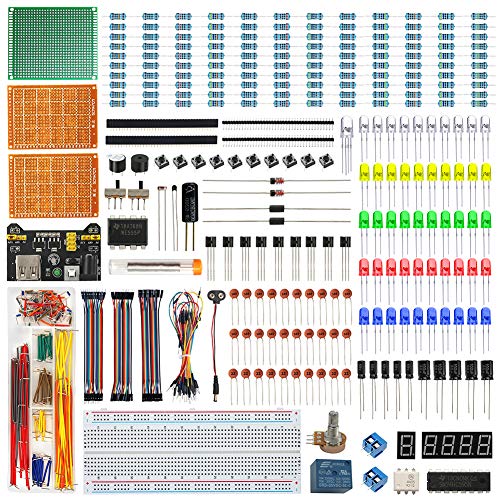
- Combines breadboard parts with a PCB soldering kit
- Includes an e-book and varied common components
- Supports Arduino, Raspberry Pi, ESP32, and ESP8266
Best For: Learners practicing breadboarding and soldering
Best Component Variety
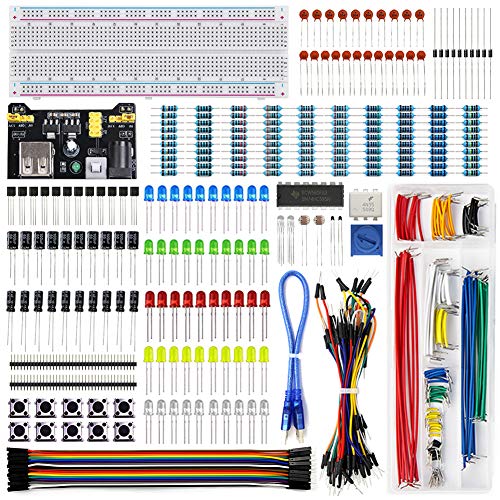
- More than 400 sensors and components
- 830 tie-point breadboard with USB power cable
- Individually labeled parts plus downloadable tutorials
Best For: Experimenters who want a broad, organized component assortment
Best All-in-One Assortment – 1530-Piece Electronics Component Kit
For shoppers comparing electronics breadboard kits under 300, this 1,530-piece set emphasizes component variety and organized storage. It combines an 830-tie solderless breadboard with resistors, capacitors, LEDs, diodes, transistors, Dupont leads, and pre-formed jumpers for hands-on circuit building without soldering.
Best For: Beginners, STEM classrooms, makers, and microcontroller projects using Arduino, Raspberry Pi, or ESP32.
Pros:
- Broad assortment with 600 resistors, 300 ceramic capacitors, 120 electrolytics, and 180 transistors.
- Includes an 830-tie breadboard, 60 Dupont leads, and 65 pre-formed jumpers.
- Parts are organized by type, with resistors taped by value, in a portable storage case.
Cons:
- The large assortment may be more than needed for simple starter projects.
- Electrolytic capacitors and diodes require careful polarity handling.
This is a strong choice when quantity and breadth matter more than a guided curriculum. Its component mix supports projects ranging from LED experiments and RC timing circuits to transistor switching and basic 3.3V or 5V labs.
Best Guided Learning Option – ELEGOO Electronics Fun Kit
Among electronics breadboard kits under 300, the ELEGOO Fun Kit stands out for experiment-focused learning. Its 830-point breadboard, power module, wiring, and 300-plus parts support repeatable projects such as LED indicators, traffic lights, button inputs, RGB effects, and buzzer alarms.
Best For: Learners who want to study core components and build Arduino-compatible experiments.
Pros:
- Includes a selectable 3.3V or 5V breadboard power module.
- Offers components for exploring output expansion, optocouplers, transistor switching, and diode protection.
- Provides ample breadboard space for ICs and multi-stage circuits.
Cons:
- A controller board, programming cable, and wall adapter are not included.
- The power module requires a suitable 6.5–9V DC input and should not exceed 9V.
This kit is a practical match for users who prefer structured experimentation over simply collecting parts. Plan to supply a compatible controller and power adapter separately for coded projects and follow the included digital guidance.
Best Multi-Board Value – 1628-Piece DIY Electronics Kit
For anyone comparing electronics breadboard kits under 300, this 1,628-piece set offers unusually high component quantities along with four breadboards and four PCB boards. It is designed for solderless prototyping, compact circuit integration, and repeated practice across beginner to advanced projects.
Best For: Students, hobbyists, and project teams that want multiple boards and substantial replacement parts.
Pros:
- Includes 600 resistors, 300 ceramic capacitors, 200 LEDs, 180 transistors, and 100 diodes.
- Provides four breadboards and four PCB boards for separate experiments or users.
- Includes 120 Dupont wires and categorized, labeled component packaging.
Cons:
- The supplied notes do not specify the individual breadboard sizes or detailed component values.
- The broad assortment may require sorting before a project begins.
This kit makes sense when shared use, backups, or multiple simultaneous builds are priorities. The combination of breadboards and PCBs gives you flexibility to prototype first and consolidate selected circuits later.
Best Compact Starter Set – Smraza 298-Piece Electronics Kit
For shoppers seeking electronics breadboard kits under 300 without a large parts inventory, the Smraza starter kit keeps the essentials together. It includes a breadboard, power supply module, common LEDs, resistors, buttons, capacitors, transistors, diodes, jumper wire, and male-female Dupont wires.
Best For: New Arduino or Raspberry Pi users who want a compact kit with beginner projects and storage.
Pros:
- Includes a breadboard and power supply module for quick solderless builds.
- Supports Arduino and Raspberry Pi projects, with components commonly used in beginner circuits.
- Comes with a sturdy storage box, datasheet, tutorial, and an 18-project PDF guide.
Cons:
- A controller board is not included.
- Its 298-piece assortment is smaller than the larger component kits in this roundup.
The Smraza is a sensible entry point for learners who value a manageable selection and clear starting guidance. It is less suited to extensive component experimentation, but its compact format and project materials can help beginners get building quickly.
Most Complete Component Selection – Upgraded Electronics Fun Kit
For shoppers comparing electronics breadboard kits under 300, this upgraded fun kit stands out for its broad selection of components and included power options. It combines an 830-point breadboard, power supply modules, jumper wires, ICs, displays, sensors, and discrete components for a wide range of Raspberry Pi and STM32 experiments.
Best For: Makers who want a large, varied component collection for experimenting with Raspberry Pi, STM32, and basic electronics circuits.
Pros:
- Includes 326 items, including sensors, ICs, LEDs, capacitors, resistors, transistors, and diodes.
- Offers both a 9V adapter and battery-clip input options for the power module; the battery is sold separately.
- Includes an 830-point breadboard, DuPont wires, a four-digit display, buzzer, buttons, and other commonly used parts.
- Components are tested and sorted before packaging, according to the supplied product information.
Cons:
- The kit does not include the 9V battery.
- LEDs require suitable series resistors, and the four-digit display has specific wiring requirements.
- The wide assortment may feel more complex for absolute beginners.
Its extensive parts list makes this a strong choice when variety matters more than a tightly focused project kit. Pay attention to the power and LED guidance when building circuits.
Beginner-Friendly No-Solder Pick – WWZMDiB 438-Piece Breadboard Kit
Among electronics breadboard kits under 300, the WWZMDiB starter kit focuses on accessible circuit building. Its 438-piece assortment is designed for inserting components into a breadboard without soldering, while compatibility with Arduino, STM32, and Raspberry Pi supports common learning platforms.
Best For: Beginners who want a no-solder introduction to electronic components and breadboard-based projects.
Pros:
- Includes 438 pieces of common electronic components.
- Components are inserted into the breadboard, so soldering is not required.
- Listed as compatible with Arduino, STM32, and Raspberry Pi.
Cons:
- The supplied notes do not provide a detailed component-by-component inventory.
- The notes do not specify whether a controller board or power supply is included.
- Detailed product information is directed to the product images.
This kit is a straightforward option for learners who prioritize a broad parts count and solder-free experimentation. Review the included-part images before buying if you need specific components.
Best Organized Value – REXQualis Basic Electronics Kit
For buyers evaluating electronics breadboard kits under 300, the REXQualis Basic Kit offers more than 300 sensors and components in an organized package. It includes a breadboard power supply, USB power cable, jumper wires, LEDs, resistors, and other parts for simple electronic projects, but it does not include a controller board.
Best For: Learners and hobbyists who value labeled component storage and a USB-powered breadboard supply for basic projects.
Pros:
- Includes more than 300 sensors and components for simple electronics projects.
- Resistors, LEDs, transistors, and integrated circuits are individually packaged and labeled.
- Includes a breadboard power supply and USB power cable.
- Datasheet support is available through the manufacturer’s website or customer service.
Cons:
- The controller board is not included.
- The supplied notes do not identify the exact component count for every part category.
- A separate controller may be needed for projects built around Arduino or Raspberry Pi.
REXQualis is a practical pick when organization and a USB power connection are priorities. Account for the missing controller board when planning a complete project setup.
Best All-in-One Starter Kit – 380-Piece Electronics Starter Kit
If you want electronics breadboard kits under 300 with a strong mix of parts and beginner-friendly power options, this Aurevita kit is a practical choice. It combines an 830-point solderless breadboard, 65 jumper wires, more than 200 electronic components, and a USB power supply module in one package.
Best For: Beginners, students, educators, and hobbyists building Arduino, ESP32, Raspberry Pi, or STM32 prototypes.
Pros:
- Includes an 830-point reusable solderless breadboard and 320+ listed pieces.
- USB power module offers selectable 3.3V or 5V output.
- Works with popular Arduino, ESP32, Raspberry Pi, and STM32 projects.
- Can be powered from a laptop, USB charger, or power bank.
Cons:
- The controller board is not listed as included.
- The broad component selection may require sorting before use.
Its combination of a large breadboard, USB-powered 3.3V/5V supply, and wide board compatibility makes this a flexible starting point for learning and repeat prototyping.
Best Learning-Focused Kit – Electronics Component Fun Kit
Among electronics breadboard kits under 300, this WayinTop set stands out for combining core breadboarding parts with a PCB soldering kit and an e-book. Its component mix covers common experiment parts such as LEDs, resistors, capacitors, diodes, buttons, buzzers, and potentiometers.
Best For: Learners who want to explore both solderless breadboard circuits and basic PCB soldering with Arduino, Raspberry Pi, ESP32, or ESP8266 platforms.
Pros:
- Includes a breadboard, jumper wires, and PCB soldering kit.
- Offers a varied selection of LEDs, resistors, capacitors, diodes, and control components.
- Includes an e-book to support project learning.
- Designed for compatibility with Arduino, Raspberry Pi, ESP32, and ESP8266 devices.
Cons:
- The supplied details do not specify the total component count or breadboard size.
- A compatible controller board is not identified as included.
This is a good fit when learning resources and soldering practice matter as much as basic breadboard experimentation, though shoppers wanting a clearly specified large breadboard may prefer a more detailed kit.
Best Component Variety – REXQualis 400-Piece Fun Kit
For shoppers comparing electronics breadboard kits under 300, the REXQualis kit emphasizes component variety and organized storage. It includes more than 400 sensors and components, an 830 tie-point breadboard, jumper wire, a power supply module, and individually labeled parts.
Best For: Hobbyists and learners who want a large assortment of labeled components for simple electronics projects without purchasing a controller board.
Pros:
- Includes more than 400 sensors and electronic components.
- Features an 830 tie-point breadboard and breadboard power supply module.
- Parts such as resistors, LEDs, transistors, and integrated circuits are individually packaged and labeled.
- USB power cable, datasheets, and tutorials are available.
Cons:
- The controller board is explicitly not included.
- The large component assortment may be more than needed for very simple projects.
- Some learning materials require downloading or contacting customer service.
Its labeled organization and unusually broad component selection make it appealing for experimentation, while the missing controller board means you should budget for one if your projects require Arduino or another development platform.
How We Picked the Best Electronics Breadboard Kits Under 300
We focused on kits that provide a practical starting point for breadboard prototyping rather than collections of disconnected parts. The selection includes options with 830-point breadboards, USB or plug-in power modules, jumper wires, LEDs, resistors, capacitors, diodes, transistors, potentiometers, and other commonly used components.
We also considered component count, Arduino and single-board-computer compatibility, beginner accessibility, included learning materials, and how useful each kit may remain as projects become more advanced. Product descriptions and included accessories can vary by seller, so verify the current contents before ordering.
Quick Comparison
| Kit type | Best for | What to prioritize |
|---|---|---|
| Large component assortment | Experimenters and classrooms | Part variety, labeled storage, and reliable counts |
| Arduino-compatible starter kit | Beginners and coding projects | Board compatibility, power supply, and project guidance |
| Breadboard and power-module kit | Fast circuit prototyping | 830-point breadboard, jumper wires, and stable voltage options |
| Kit with sensors or extras | Interactive projects | Sensor selection, documentation, and expansion potential |
Key Buying Factors for Electronics Breadboard Kits Under 300
Component Selection
A high piece count is not automatically better. Look for useful ranges of resistor and capacitor values, several LED colors, diodes, transistors, potentiometers, and jumper wires. A balanced assortment is more valuable than numerous duplicates.
Breadboard and Power
An 830-point solderless breadboard gives room for many beginner circuits, while a USB power module can simplify projects using a computer or power bank. Check whether the kit includes selectable 3.3V and 5V outputs, a USB cable, or a separate adapter.
Compatibility and Documentation
Arduino, ESP32, STM32, and Raspberry Pi compatibility can make a kit more versatile, but compatibility usually refers to the components rather than a development board being included. An e-book, circuit diagrams, or project examples can significantly shorten the learning curve.
Organization and Quality
Storage cases, labeled bags, and clearly identified values reduce setup time and help prevent mistakes. Also check reviews for reports of missing parts, loose breadboard contacts, unclear labeling, or inconsistent component values.
Who Should Buy Which Electronics Breadboard Kits Under 300?
Choose a broad component kit if you want maximum variety for experimenting, teaching, or maintaining a small electronics bench. An Arduino-focused kit is usually the better fit for beginners who want guided coding and hardware projects. If you already own a microcontroller, prioritize a kit with a dependable breadboard, power module, jumper wires, and complementary components rather than paying for another board.
For classrooms or shared workspaces, favor higher counts, organized storage, and repeatable component assortments. For occasional hobby use, a smaller, well-documented kit may be easier to manage and still cover the fundamentals. Across these Electronics Breadboard Kits Under 300, the best choice is the one whose power system, component mix, and documentation match the projects you plan to build first.