
The right electronics breadboard kit makes it easier to move from theory to working circuits. These kits combine solderless breadboards with jumper wires, power modules, LEDs, resistors, capacitors, and other parts for hands-on experimentation.
Our selection covers compact starter sets, larger component assortments, and Arduino-friendly bundles, so beginners and hobbyists can choose based on project scope, included tools, and organization.
Best 10 Electronics Breadboard Kits Picks for 2026
Most Versatile Basic Kit
300+ Piece Electronics Starter Set

- More than 300 sensors and components
- USB breadboard power supply included
- Labeled parts in a sturdy storage box
Best For: Beginners building simple Arduino- or Raspberry Pi-compatible circuits
Largest Assortment
1530-Piece Electronics Lab Kit

- 1530 resistors, capacitors, LEDs, and semiconductors
- 830-tie solderless breadboard included
- Storage case and multiple jumper-wire options
Best For: Classrooms, makers, and repeated 3.3V or 5V prototyping
Best for Guided Experiments

- 400-tie-point breadboard with 235 parts
- Selectable 3.3V and 5V power rails
- Includes parts for LEDs, sensors, and switching
Best For: Arduino learners and classroom circuit demonstrations
Best Multi-Board Value
1628-Piece DIY Electronics Kit

- 1628 components across major part categories
- Four breadboards and four PCB boards
- Includes 120 Dupont wires and labeled parts
Best For: Students and hobbyists running multiple electronics prototypes
Best for Larger Circuits
ELEGOO Upgraded Electronics Fun Kit

- 830-point breadboard for multi-stage builds
- Selectable 3.3 V and 5 V power rails
- 300+ parts for repeatable experiments
Best For: Arduino-compatible circuit learning and larger breadboard projects
Best All-in-One Learning Set
WayinTop Electronics Component Fun Kit
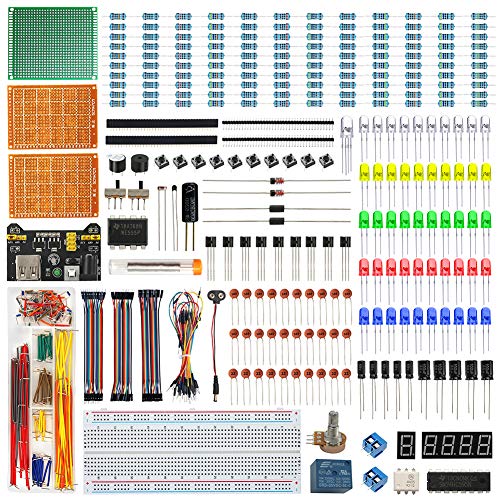
- Includes breadboard and jumper wire supplies
- Adds a PCB soldering kit and e-book
- Works with Arduino, Raspberry Pi, ESP32, and ESP8266
Best For: Beginners learning breadboarding and basic soldering
Best USB-Powered Starter Kit
Aurevita 380 PCS Electronics Starter Kit

- 830-point solderless breadboard
- USB module with selectable 3.3 V/5 V output
- Compatible with Arduino, ESP32, Raspberry Pi, and STM32
Best For: Convenient STEM learning and general-purpose prototyping
Most Versatile Kit
Upgraded 326-Piece Electronics Fun Kit

- 326 components with sensors, ICs, and displays
- Includes 830-point breadboard and power options
- Compatible with Raspberry Pi and STM32
Best For: Experimenters seeking broad component variety
Best Organized Set
BOJACK 480-Piece Component Kit
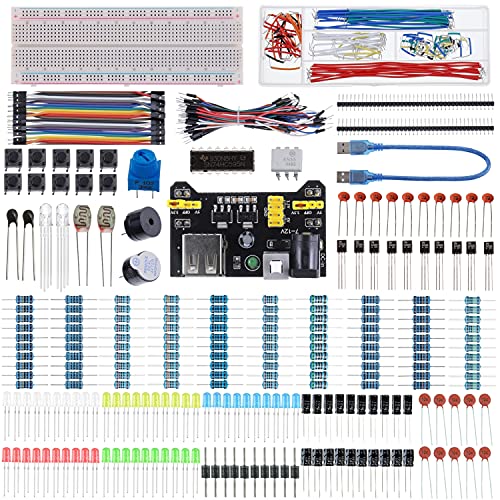
- More than 400 components for experiments
- Labeled parts in a transparent storage box
- Includes breadboard, power module, and USB cable
Best For: Beginners who want organized, solder-free prototyping
Best for Guided Projects
REXQualis 400-Piece Component Kit
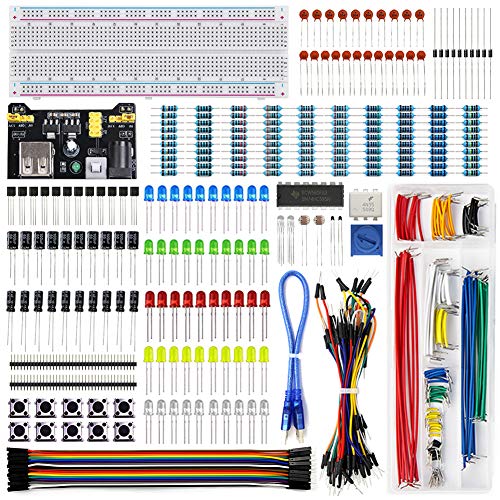
- More than 400 sensors and components
- Labeled storage with USB power cable
- Datasheets and tutorials available
Best For: Learners with their own controller board
Most Versatile Basic Kit – 300+ Piece Electronics Starter Set
This REXQualis set is a practical choice among electronics breadboard kits for beginners who want a broad selection of parts for simple experiments. It includes more than 300 sensors and components, along with a breadboard power supply and USB cable, but does not include a controller board.
Best For: Beginners and hobbyists building simple Arduino- or Raspberry Pi-compatible projects.
Pros:
- Includes more than 300 sensors and electronic components.
- Components are individually packaged, labeled, and stored in a sturdy box.
- Power supply module includes a USB power cable.
Cons:
- A controller board is not included.
- The broad assortment may require consulting the downloadable datasheet.
Its organized packaging and unusually useful USB-powered supply make this a convenient starting point for hands-on circuit practice, provided you already have—or plan to buy—a compatible controller.
Largest Assortment – 1530-Piece Electronics Lab Kit
This 1530-piece option is one of the more comprehensive electronics breadboard kits for learners, makers, and classroom labs. It combines a full-size 830-tie solderless breadboard with substantial quantities of resistors, capacitors, LEDs, diodes, transistors, and hookup wires.
Best For: STEM classrooms, makers, and hobbyists who want extensive component variety for repeated 3.3V or 5V experiments.
Pros:
- Includes 1530 components across several common part categories.
- 830-tie breadboard has bridged power rails for solderless prototyping.
- Provides Dupont leads and pre-formed jumpers for quick connections.
- Parts are organized by type and packed in a portable storage case.
Cons:
- Users must observe polarity with electrolytic capacitors and diodes.
- Static-sensitive parts require appropriate handling.
With its unusually large assortment and clear organization, this kit is suited to repeated experimentation rather than just a few introductory builds. Its compatibility with Arduino, Raspberry Pi, and ESP32 platforms adds flexibility.
Best for Guided Experiments – ELEGOO 235-Piece Arduino Kit
The ELEGOO Electronic Fun Kit is a focused choice among electronics breadboard kits for learning core circuit concepts and building small Arduino projects. Its 235 parts cover common inputs, outputs, switching components, and a 400-tie-point breadboard, while the power module offers selectable 3.3V or 5V rails.
Best For: Arduino learners, classroom demonstrations, and makers practicing LED, button, buzzer, sensor, and transistor circuits.
Pros:
- Includes a 400-tie-point solderless breadboard and 235 total items.
- Supports projects involving LEDs, buttons, buzzers, RGB effects, and light-sensitive components.
- Includes learning-oriented parts such as a 74HC595, 4N35 optocoupler, PN2222 transistors, and 1N4007 diodes.
- Power module provides selectable 3.3V or 5V rails.
Cons:
- Controller board, programming cable, and wall adapter are not included.
- The power module requires a suitable 6.5–9V DC input and must not exceed 9V.
This is a more structured, project-oriented kit than a large general-purpose parts assortment. It makes sense for learners who want to explore specific circuit functions, as long as they supply compatible Arduino hardware and power.
Best Multi-Board Value – 1628-Piece DIY Electronics Kit
This 1628-piece set stands out among electronics breadboard kits by combining a large component assortment with four breadboards and four PCB boards. It offers resistors, capacitors, LEDs, diodes, transistors, and Dupont wires for both solderless prototyping and more compact circuit layouts.
Best For: Students, electronics enthusiasts, and advanced hobbyists who need many parts and multiple boards for varied projects.
Pros:
- Includes 1628 pieces, including 600 resistors, 300 ceramic capacitors, and 180 transistors.
- Provides four breadboards and four PCB boards for different build styles.
- Includes 120 Dupont wires for connecting components and boards.
- Parts are categorized and clearly marked for easier selection.
Cons:
- The large assortment may be more than beginners need for basic projects.
- Detailed specifications for individual components should be checked in the product images or labeling.
The combination of multiple breadboards, PCBs, and high component counts gives this kit strong flexibility for ongoing experimentation. It is particularly appealing when you want to keep several prototypes or learning exercises available at once.
Best for Larger Circuits – ELEGOO Upgraded Electronics Fun Kit
The ELEGOO Upgraded Electronics Fun Kit is a strong choice among electronics breadboard kits when you want room for multi-stage experiments. Its 830-point breadboard, selectable power rails, and broad component selection support projects ranging from LED and button circuits to transistor, optocoupler, and 74HC595 experiments.
Best For: Learners and hobbyists building larger Arduino-compatible breadboard circuits and exploring core electronic components.
Pros:
- Includes an 830-point solderless breadboard with ample space for larger circuits.
- Offers selectable 3.3 V or 5 V rails through the included power module.
- Includes 300+ parts, including LEDs, switches, capacitors, transistors, diodes, and buzzers.
- Supports experiments with output expansion, signal isolation, switching, and rectification.
Cons:
- A controller board, programming cable, and wall adapter are not included.
- The power module requires a suitable 6.5–9 V DC input and must not exceed 9 V.
This kit stands out for circuit capacity and component variety, but buyers should budget for a compatible controller and power source if they plan to build coded projects.
Best All-in-One Learning Set – WayinTop Electronics Component Fun Kit
The WayinTop Electronics Component Fun Kit combines breadboard prototyping with a PCB soldering kit and an e-book. For shoppers comparing electronics breadboard kits, it offers a varied component assortment for use with Arduino, Raspberry Pi, ESP32, and ESP8266 projects.
Best For: Beginners who want breadboard parts, soldering supplies, and reference material in one starter package.
Pros:
- Combines a breadboard jumper wire kit with a PCB soldering kit.
- Includes LEDs, resistors, capacitors, diodes, a photocoupler, buttons, a buzzer, and a potentiometer.
- Designed for compatibility with Arduino, Raspberry Pi, ESP32, and ESP8266 devices.
- Includes an e-book for added learning support.
Cons:
- The supplied notes do not specify the breadboard point count or exact component quantities.
- Its listed compatibility assumes you already have a suitable controller or single-board computer.
Choose this set if you value both solderless experimentation and soldering practice. Its broader learning format may be more useful than a component-only kit for getting started across several platforms.
Best USB-Powered Starter Kit – Aurevita 380 PCS Electronics Starter Kit
The Aurevita 380 PCS Electronics Starter Kit is a convenient option among electronics breadboard kits, pairing an 830-point solderless breadboard with USB power and more than 200 electronic components. Its selectable 3.3 V/5 V output suits common Arduino, ESP32, Raspberry Pi, and STM32 prototyping setups.
Best For: Students, educators, and hobbyists who want a reusable breadboard kit powered from a laptop, USB charger, or power bank.
Pros:
- Includes an 830-point breadboard, 65 jumper wires, a USB power module, and 200+ components.
- Provides selectable 3.3 V and 5 V output for circuit testing.
- Compatible with Arduino, ESP32, Raspberry Pi, STM32, and other 3.3 V/5 V boards.
- USB power works with a laptop, charger, or power bank.
Cons:
- A compatible controller board is not listed as included.
- The supplied notes do not identify the individual component types in detail.
This is a practical starter choice when USB convenience matters. The large reusable breadboard and dual-voltage module make it suitable for classroom work, home prototyping, and beginner embedded-system projects.
Most Versatile Kit – Upgraded 326-Piece Electronics Fun Kit
For shoppers comparing electronics breadboard kits, this upgraded set stands out for its broad mix of components, sensors, and ICs. It includes an 830-point breadboard, power options, jumper wires, displays, and commonly used parts for Raspberry Pi and STM32 projects.
Best For: Experimenters who want a wide variety of components for hands-on electronics projects.
Pros:
- Includes 326 items, including sensors, ICs, LEDs, capacitors, resistors, transistors, and diodes.
- Offers both a breadboard power module and a 9V adapter, with battery-clip support.
- Includes a 4-digit display, RGB LED, buzzer, buttons, thermistor, photoresistor, and potentiometer.
- Components are tested and divided before packaging, according to the product information.
Cons:
- The 9V battery is not included.
- LEDs require appropriate series resistors to help prevent damage.
- The 4-digit display is common anode, so wiring rules require attention.
This is a strong choice when variety matters most, but beginners should review the included wiring guidance and power requirements before starting experiments.
Best Organized Set – BOJACK 480-Piece Component Kit
This BOJACK set is a practical option among electronics breadboard kits for simple experiments and prototyping. Its more-than-400-component assortment includes an 830-point breadboard, power module, USB cable, jumper wire, and precision potentiometer.
Best For: Beginners and hobbyists who value labeled storage and solder-free setup.
Pros:
- Includes more than 400 components for simple electrical experiments.
- Parts are classified, labeled, and stored in a transparent box for easier access.
- Components plug directly into the breadboard without soldering.
- Compatible with STM32, Raspberry Pi, and Arduino projects.
Cons:
- The supplied product information does not specify the complete component list.
- The kit includes a USB data cable, but the notes do not detail the power module’s full specifications.
Choose this kit if organized storage and convenient breadboard experimentation are higher priorities than having a fully itemized parts list.
Best for Guided Projects – REXQualis 400-Piece Component Kit
For electronics breadboard kits that emphasize organization and learning support, this REXQualis package includes more than 400 sensors and components. It pairs an 830-point breadboard and USB-powered supply module with labeled storage and downloadable datasheets and tutorials.
Best For: Arduino, Raspberry Pi, and STM32 hobbyists who want reference materials alongside core components.
Pros:
- Includes more than 400 components for fun and simple electronic projects.
- Resistors, LEDs, transistors, and integrated circuits are individually packaged and labeled.
- Includes an 830-point breadboard, jumper wire, precision potentiometer, and USB power cable.
- Datasheets and tutorials are available to download from the manufacturer.
Cons:
- The controller board is not included.
- The product information does not provide a complete itemized component list.
This set is appealing for learners who appreciate labeled parts and downloadable guidance, provided they already have—or plan to add—their own controller board.
How We Picked These Electronics Breadboard Kits
We focused on the features that matter most when building and testing circuits without soldering. Each kit was assessed for breadboard size, component variety, power options, jumper-wire coverage, Arduino or microcontroller compatibility, and usefulness for beginners. We also considered whether the assortment supports more than simple LED experiments, including sensor projects, timing circuits, transistor tests, and basic prototyping.
Because product contents can vary by seller or listing revision, check the current parts list before ordering. A high piece count is useful only when the kit includes practical component values and a clear way to identify and store them.
Quick Comparison
| Best For | Look For | Typical Kit Strength |
|---|---|---|
| First-time learners | 830-point breadboard, power module, LEDs, resistors | Simple setup for foundational circuits |
| Arduino and ESP32 projects | Compatible jumper wires, sensors, and stable power options | Fast microcontroller prototyping |
| Broad experimentation | Large resistor and capacitor assortments, transistors, diodes | More circuit possibilities |
| Organized workbenches | Component cases, labeled values, and included documentation | Less setup and easier replacement |
Key Buying Factors for Electronics Breadboard Kits
Breadboard Size and Quality
An 830-tie-point board is a versatile choice for multi-component circuits, while smaller boards are easier to carry and adequate for basic lessons. Look for firm spring contacts and adhesive backing if you plan to mount the board in a project enclosure.
Power and Wiring
A USB power module or breadboard power supply can provide convenient 5V or 3.3V connections, but verify voltage settings before connecting sensitive components. A useful kit should include multiple jumper-wire types and enough wire to avoid cramped layouts.
Component Range
Prioritize practical resistor values, LEDs, diodes, capacitors, transistors, potentiometers, and integrated-circuit support over an inflated total piece count. Metal-film resistors and clearly labeled storage can make troubleshooting and repeat projects easier.
Documentation and Compatibility
Beginners benefit from an e-book, circuit diagrams, or project instructions. For Arduino, ESP32, and similar boards, confirm that the kit provides compatible connection options; the breadboard parts themselves generally work across platforms, but power and pin layouts still require care.
Who Should Buy Which Electronics Breadboard Kits?
Choose a basic kit if you are learning voltage, resistance, LEDs, switches, and series or parallel circuits. Select a larger component set if you want to explore analog circuits, timing, transistor switching, or several projects without repeatedly buying replacement parts. Arduino users should favor kits with reliable power modules, generous jumper-wire supplies, and components suited to sensors and microcontroller connections. If storage and repeatability matter most, choose a set with labeled compartments and a documented inventory.
Before buying, compare the included quantities, power-module settings, board dimensions, and current listing photos. A well-organized kit with the right component values is usually more useful than the biggest advertised piece count.