
Whether you are learning circuit design, building Arduino projects, or restocking a workbench, an electronics component kit can provide the parts needed to experiment without buying every resistor, LED, or capacitor separately.
We selected 10 electronics component kits under $100 with different strengths, from beginner-focused bundles with breadboards and power modules to large assortments designed for longer-term prototyping.
Best 10 Electronics Component Kits Under 100 Picks for 2026
Best Complete Starter Set
1530-Piece Electronics Lab Kit

- 1,530 components across common circuit categories
- 830-tie breadboard with wires and jumpers
- Organized case for learning and prototyping
Best For: Beginners, classrooms, and microcontroller labs
Best Guided Arduino Practice Kit

- 400-point breadboard and selectable 3.3V/5V power
- Project parts for LEDs, buttons, buzzers, and sensors
- Includes 74HC595 and 4N35 learning components
Best For: Arduino practice and classroom demonstrations
Best Large Component Assortment

- 2,200 parts spanning many component categories
- Includes ICs, crystals, PCBs, LDRs, and controls
- Packed in a recyclable storage box
Best For: Experienced hobbyists and varied prototyping benches
Best USB-Powered Basics Kit

- More than 300 sensors and components
- Breadboard power supply with USB cable
- Labeled parts in a sturdy storage box
Best For: Beginners doing simple Arduino or Raspberry Pi experiments
Most Complete Assortment
2038-Piece Electronic Component Kit

- 16 component categories
- 2,038 total pieces
- Sorted storage container
Best For: Large Arduino, Raspberry Pi, PLC, and general electronics projects
Best Breadboard Starter
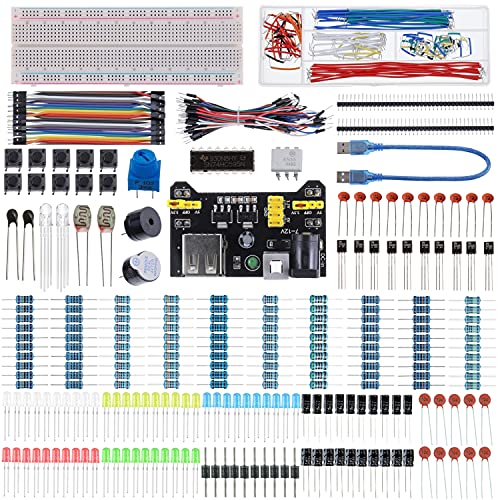
- Includes 830-point breadboard
- Power module and USB cable included
- No-solder breadboard setup
Best For: Beginner experiments with Arduino, Raspberry Pi, or STM32
Best Compact Basics

- Six core component categories
- Stamped resistor values
- Compact storage box
Best For: Routine hobby projects, repairs, and replenishing common parts
Versatile Starter Pick

- Includes breadboard, power module, jumper wires, and 9V adapter
- Covers LEDs, ICs, sensors, displays, and passive components
- Compatible with Raspberry Pi and STM32 projects
Best For: Beginners building powered breadboard projects
Largest Assortment
1780-Piece DIY Electronics Kit

- Provides high quantities of resistors, capacitors, transistors, and LEDs
- Includes breadboards, PCBs, wires, headers, and active components
- Categorized packaging supports easier storage and retrieval
Best For: Frequent prototyping and classroom or lab use
Focused Essentials
1400-Piece Basic Component Kit

- Covers six core categories for basic electronic projects
- Includes 1400 LEDs, resistors, capacitors, diodes, and transistors
- Labeled bags help with sorting and storage
Best For: Learning fundamentals and replenishing through-hole components
Best Complete Starter Set – 1530-Piece Electronics Lab Kit
For shoppers comparing electronics component kits under 100, this 1,530-piece set is a well-rounded option for building circuits without soldering. It combines a full-size breadboard, common through-hole components, and connection wires in an organized case.
Best For: Beginners, STEM classrooms, makers, and Arduino, Raspberry Pi, or ESP32 prototyping.
Pros:
- Broad assortment of resistors, capacitors, LEDs, diodes, and transistors.
- Includes an 830-tie breadboard, Dupont leads, and pre-formed jumpers.
- Organized packaging and storage case support quick component selection.
- Suitable for 3.3V and 5V learning projects.
Cons:
- No controller board is listed among the included components.
- Electrolytic capacitors and diodes require correct polarity.
Its combination of quantity, breadboard space, and beginner-friendly organization makes it a particularly versatile choice for hands-on circuit practice and repeated prototyping.
Best Guided Arduino Practice Kit – ELEGOO 235-Piece Fun Kit
Among electronics component kits under 100, the ELEGOO bundle stands out for project-focused experimentation. Its 235 parts include a breadboard power module and components suited to LED, button, buzzer, light-sensing, and output-expansion exercises.
Best For: Arduino learners, classroom demonstrations, and makers practicing fundamental breadboard circuits.
Pros:
- Includes a 400-tie-point solderless breadboard and selectable 3.3V/5V power module.
- Supports projects involving LEDs, buttons, RGB effects, buzzers, and light-sensitive parts.
- Includes educational components such as a 74HC595, 4N35 optocoupler, PN2222, and 1N4007.
- Rigid jumpers and Dupont wires simplify circuit rewiring.
Cons:
- Controller board, programming cable, and wall adapter are not included.
- The power module requires a suitable 6.5–9V DC input and must not exceed 9V.
This is a focused learning bundle rather than a large parts warehouse, making it attractive when repeatable guided projects matter more than maximum component count.
Best Large Component Assortment – 2200-Piece Electronics Kit
For buyers seeking electronics component kits under 100 with breadth across many part categories, this 2,200-piece assortment offers a substantial inventory. The recyclable box contains components ranging from resistors and capacitors to inductors, ICs, crystals, switches, and PCBs.
Best For: Experienced hobbyists and repair or prototyping benches that need varied through-hole parts.
Pros:
- Large 2,200-piece assortment covers many common electronic component types.
- Includes ICs, crystal oscillators, PCBs, potentiometers, trim pots, and LDRs.
- Also provides connectors, headers, terminals, switches, LEDs, and diodes.
- Comes in a sizable recyclable storage box.
Cons:
- The supplied notes do not specify exact quantities for each component type.
- It is presented as an assortment rather than a clearly project-guided starter kit.
- Specific electrical ratings may vary across the included parts.
This kit favors variety and bench coverage over a narrowly curated curriculum, so it is best suited to users who already know which component categories their projects require.
Best USB-Powered Basics Kit – REXQualis 300+ Piece Set
This REXQualis set is a practical contender among electronics component kits under 100 for simple breadboard projects. It combines more than 300 sensors and components with a breadboard power supply, USB cable, jumper wire, LEDs, resistors, transistors, and integrated circuits.
Best For: Beginners building simple Arduino or Raspberry Pi-compatible experiments who want USB power included.
Pros:
- Includes more than 300 sensors and electronic components.
- Provides a breadboard power supply with a USB power cable.
- Components are individually packaged, labeled, and stored in a sturdy box.
- Datasheet support is available through the manufacturer.
Cons:
- The controller board is not included.
- The supplied notes do not provide a detailed breakdown of component quantities or ratings.
Its included USB power cable and labeled storage make this a convenient entry point for straightforward experiments, provided you already have a compatible controller board when needed.
Most Complete Assortment – 2038-Piece Electronic Component Kit
If you want broad coverage from electronics component kits under 100, this 2,038-piece assortment is built around commonly used through-hole parts. It includes resistors, capacitors, diodes, transistors, ICs, digital tubes, switches, headers, PCBs, and more, with components separated into bags and a plastic container for easier storage.
Best For: Electronics enthusiasts and professionals who want a large general-purpose parts assortment for Arduino UNO, MEGA, Raspberry Pi, or PLC projects.
Pros:
- Includes 16 component categories and 2,038 total pieces.
- Provides broad variety, including 820 metal-film resistors, 300 ceramic capacitors, 205 LEDs, and 190 transistors.
- Components are sorted for easier storage and retrieval.
- Listed as compatible with Arduino, Raspberry Pi, and PLC projects.
Cons:
- The large assortment may be more than beginners need for a small project.
- The components use through-hole mounting, which may not suit surface-mount designs.
This is the strongest choice when quantity and category breadth matter most. Its extensive selection makes it useful as a workshop starter supply or replenishment box, though you should confirm the included values meet your specific circuit requirements.
Best Breadboard Starter – 480-Piece Electronics Fun Kit
Among electronics component kits under 100, this BOJACK set stands out for combining basic parts with a ready-to-use breadboard setup. The package includes more than 400 components, a power supply module, USB cable, jumper wire, precision potentiometer, and an 830 tie-point breadboard, so many experiments can be assembled without soldering.
Best For: Beginners, students, and makers building simple breadboard experiments with Arduino, Raspberry Pi, or STM32 boards.
Pros:
- Includes a breadboard, power module, USB data cable, jumper wire, and potentiometer.
- Components can be plugged directly into the breadboard without soldering.
- Parts are classified in a transparent box with clear labels.
- Listed as compatible with STM32, Raspberry Pi, and Arduino.
Cons:
- The supplied information does not specify the values of all remaining components.
- With 480 pieces, it offers less overall quantity than the larger assortment kits.
This kit is a practical option if your priority is getting from unboxing to hands-on experimentation quickly. The included breadboard and power accessories add convenience, while the clearly organized box should make component selection easier during learning projects.
Best Compact Basics – 1390-Piece Component Kit
This 1,390-piece set is a straightforward choice among electronics component kits under 100 for stocking up on everyday through-hole parts. It focuses on six core categories—diodes, resistors, transistors, LEDs, electrolytic capacitors, and ceramic capacitors—with resistor values stamped for easier identification.
Best For: Hobbyists and electronics professionals who need a compact supply of common components for routine projects and repairs.
Pros:
- Provides 1,390 pieces across six practical component categories.
- Includes metal-film resistors, common diodes, transistors, LEDs, and two capacitor types.
- Resistor values are stamped to help identify parts quickly.
- Individual components are bagged and supplied in a storage box.
Cons:
- It does not include the broader selection of ICs, switches, headers, or PCBs found in larger kits.
- The supplied notes do not specify the full range of resistor and capacitor values.
This kit keeps the assortment focused on frequently used basics, making it easier to manage than a much larger collection. Choose it when common discrete components matter more than specialty parts or breadboard accessories.
Versatile Starter Pick – 326-Piece Electronics Fun Kit
For shoppers comparing electronics component kits under 100, this 326-piece set offers a practical mix of breadboarding essentials, power accessories, ICs, displays, and commonly used components. It is designed for projects involving Raspberry Pi, STM32, and similar platforms.
Best For: Beginners and hobbyists who want a powered breadboard kit with a broad selection of components.
Pros:
- Includes an 830-point breadboard, jumper wires, power modules, and a 9V adapter.
- Provides varied parts such as LEDs, capacitors, resistors, transistors, diodes, sensors, buttons, and buzzers.
- Adds 4-digit display tubes and ICs including 4N35, 74HC595, and 74HC138.
- Components are tested before being sorted, according to the supplied listing.
Cons:
- The 9V battery is not included.
- LEDs require suitable series resistance, and the display has common-anode wiring requirements.
- The included power module uses a 5.5mm × 2.5mm input interface.
This is a well-rounded choice when you want to start experimenting immediately rather than assemble a parts collection one category at a time. Pay close attention to the power and wiring notes when building circuits.
Largest Assortment – 1780-Piece DIY Electronics Kit
Among electronics component kits under 100, this 1780-piece assortment stands out for its extensive quantities and wider project coverage. It combines resistors, capacitors, semiconductors, connection parts, breadboards, PCBs, and several active components.
Best For: Students, makers, and experienced hobbyists who need many replacement parts for repeated experiments.
Pros:
- Includes 600 resistors, 120 electrolytic capacitors, 300 ceramic capacitors, 180 transistors, and 104 LED diodes.
- Supplies two breadboards, four PCB boards, jumper wires, Dupont wires, headers, and power jacks.
- Adds ICs, crystal oscillators, potentiometers, photoresistors, buzzers, a motor, speakers, and switches.
- Components are packaged by category and labeled for easier storage and selection.
Cons:
- The listing emphasizes component variety and quantity rather than a dedicated power adapter.
- The large assortment may require more storage and organization than a smaller starter set.
- It includes both through-hole and surface-mount items, so some parts may suit more advanced work.
Choose this kit if quantity matters most. Its mix of consumable parts and build hardware makes it useful for classrooms, labs, and ongoing prototyping where a few components are unlikely to be enough.
Focused Essentials – 1400-Piece Basic Component Kit
This 1400-piece set is a straightforward option for shoppers seeking electronics component kits under 100 focused on core through-hole parts. It concentrates on six foundational categories used in Arduino projects and general electronic DIY work.
Best For: Learners and hobbyists who need a basic reserve of passive components, LEDs, diodes, and transistors.
Pros:
- Includes LED diodes, metal-film resistors, electrolytic capacitors, common diodes, ceramic capacitors, and transistors.
- Offers 1400 total components for repeated practice and replacement needs.
- Parts are organized in labeled bags to simplify sorting and identification.
- The set is specified for through-hole mounting and includes a stated 50-volt operating voltage.
Cons:
- It does not list a breadboard, jumper wires, power supply, ICs, sensors, or motors.
- The assortment covers six component types, so it is less varied than broader project kits.
- Users should verify component ratings for each circuit; the listing also states a 4.2-volt maximum voltage detail.
This kit makes sense as a compact component replenishment set or as a foundation for learning basic circuit behavior. If you need a complete build platform, pair it with a breadboard and connecting accessories.
How We Picked the Best Electronics Component Kits Under 100
We focused on the parts that make a kit useful immediately: a practical component range, clear organization, breadboard compatibility, jumper wires, and accessories that support hands-on projects. We also considered whether each assortment suits beginners, Arduino users, classroom activities, or experienced hobbyists who need replacement parts.
Quantity matters, but it is not the only measure of value. A smaller kit with a power supply module and well-chosen components may be more useful than a larger assortment filled with parts you are unlikely to use. Product descriptions and included-item lists should be checked carefully because counts, component values, and accessories can vary.
Quick Comparison
| Best For | Look For | Why It Matters |
|---|---|---|
| First electronics kit | Breadboard, LEDs, resistors, capacitors, and jumper wires | Provides the essentials for simple circuits |
| Arduino projects | Arduino-compatible components and sensors | Makes it easier to follow beginner tutorials |
| Broad parts coverage | Multiple resistor and capacitor values, diodes, transistors, and ICs | Supports more circuit experiments |
| Workbench restocking | Large, organized assortments | Reduces the need for frequent individual purchases |
Key Buying Factors
Component Variety and Values
Check the range of resistor values, capacitor types, diode categories, LEDs, transistors, potentiometers, and integrated circuits. Metal-film resistors and a mix of ceramic and electrolytic capacitors are particularly useful for general prototyping.
Breadboard and Power Support
A full-size 830-tie-point breadboard is convenient for larger beginner circuits. A compatible power supply module can also simplify projects by providing regulated rails from a common DC adapter, though you should verify the required adapter and voltage limits before use.
Organization and Documentation
Cases, labeled bags, and clearly identified values save time and reduce wiring mistakes. Beginners should favor kits with readable labels or guides, while experienced users may prioritize component breadth and quantity.
Compatibility and Safety
Confirm that the included jumper wires, headers, and accessories fit standard breadboards and your development boards. Use current-limiting resistors with LEDs, observe capacitor polarity, and verify ratings before connecting power.
Who Should Buy Which Electronics Component Kits Under 100?
Beginners should choose a balanced kit containing a breadboard, jumper wires, power module, LEDs, resistors, and capacitors. These essentials support basic series, parallel, timing, and sensor circuits.
Arduino learners will benefit from a bundle that explicitly supports Arduino projects and includes beginner-friendly components or sensors. This can make guided tutorials easier to follow.
Experimenters and students should look for the broadest useful selection of values, including transistors, diodes, potentiometers, ICs, and inductors. A larger assortment is worthwhile when it is organized and clearly documented.
Experienced hobbyists may prefer a high-count replacement assortment. Prioritize missing values and component categories over headline piece counts, and consider buying a specialized kit only when it fills a gap in your existing inventory.