
The right component kit can make electronics projects faster, more affordable, and less frustrating. These kits combine common parts such as resistors, capacitors, LEDs, diodes, transistors, breadboards, jumper wires, and power modules in convenient assortments.
We selected 10 options for different experience levels and project types, from compact Arduino-friendly bundles to larger assortments designed for expanding a home lab. Use the guide below to compare contents, organization, compatibility, and overall value before buying.
Best 10 Electronics Component Kits Under 300 Picks for 2026
Complete Breadboard Starter
BOJACK 480-Piece Component Kit
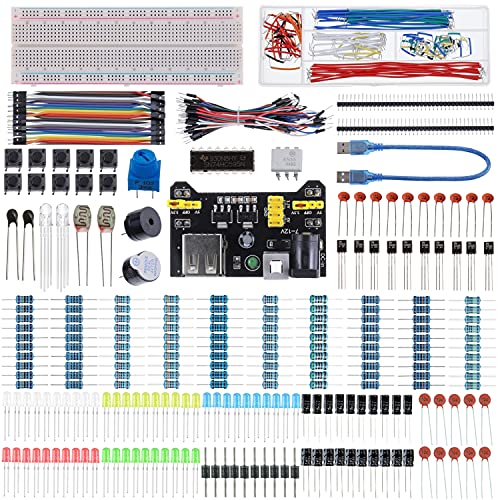
- Includes breadboard, power module, USB cable, and jumpers
- More than 400 parts in a labeled transparent case
- Works with Arduino, Raspberry Pi, and STM32
Best For: No-solder beginner experiments and breadboard projects
Largest Parts Assortment
2830-Piece DIY Electronics Kit
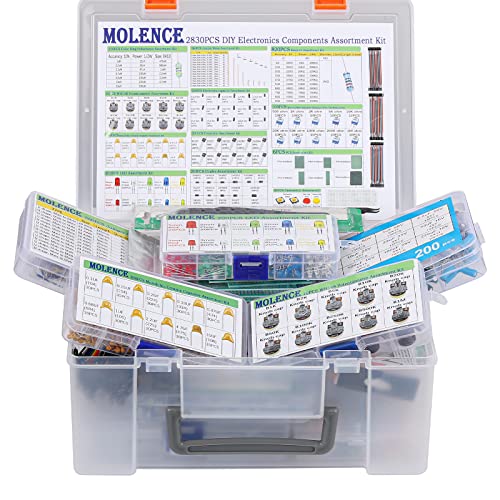
- Contains 2830 resistors, capacitors, semiconductors, and accessories
- Includes breadboard, PCBs, jumper wires, and Dupont leads
- Stored in a reusable case for transport and organization
Best For: Large-scale hobby benches and repeated microcontroller projects
Guided Arduino Practice

- Supports LEDs, buttons, buzzers, sensors, and logic experiments
- Includes 400-point breadboard and selectable 3.3V/5V power module
- Controller board and power adapter are not included
Best For: Arduino learners and classroom breadboard demonstrations
Organized Lab Essentials
1530-Piece Electronics Component Kit

- Includes 600 resistors, 300 ceramic capacitors, and 180 transistors
- Pairs an 830-point breadboard with Dupont leads and jumpers
- Organized storage supports Arduino, Raspberry Pi, and ESP32 work
Best For: Structured STEM labs and repeatable breadboard prototyping
Best Value Starter Kit
300+ Piece Electronics Basics Kit

- More than 300 components and sensors
- Labeled parts in a sturdy box
- USB-powered breadboard supply included
Best For: Beginners starting Arduino or Raspberry Pi projects
Best Assortment
2200-Piece Electronic Components Kit

- Includes 2200 assorted components
- Broad mix of passive and active parts
- Organized recyclable storage box
Best For: Makers needing a wide component inventory
Best for Breadboard Projects
400+ Piece Electronics Fun Kit
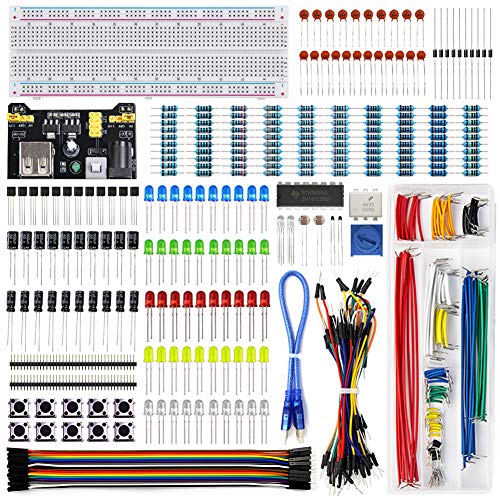
- More than 400 components and sensors
- 830 tie-point breadboard included
- Tutorials and USB power supply included
Best For: Breadboard learners using Arduino, Raspberry Pi, or STM32
Most Complete Assortment

- 1,628 pieces across major component types
- Includes breadboards, PCBs, and DuPont wires
- Clearly categorized for storage and access
Best For: Broad DIY projects, learning, and prototyping
Best for Powered Projects

- Includes power adapter and breadboard module
- Adds sensors, display, ICs, and active parts
- Compatible with Raspberry Pi and STM32
Best For: Powered, interactive breadboard experiments
Best Basic Value
1400-Piece Component Assortment

- Covers six foundational component categories
- Labeled bags support quick sorting and storage
- Designed for Arduino and DIY electronics projects
Best For: Basic component replenishment and DIY circuits
Complete Breadboard Starter – BOJACK 480-Piece Component Kit
For shoppers comparing electronics component kits under 300, the BOJACK 37-value set is a practical breadboard-focused option. It includes more than 400 components, an 830-tie-point breadboard, jumper wires, a power module, USB cable, and a precision potentiometer, with parts sorted in a labeled transparent case.
Best For: Beginners and makers building no-solder experiments with Arduino, Raspberry Pi, or STM32 boards.
Pros:
- Includes an 830-tie-point breadboard and power module for quick setup.
- More than 400 components are organized in a labeled storage box.
- Components plug into the breadboard without soldering.
- Compatible with Arduino, Raspberry Pi, and STM32 platforms.
Cons:
- The supplied information does not list every included component.
- A controller board is not identified as included.
This kit emphasizes convenience and organization rather than a highly detailed parts inventory. It is a sensible choice when you want a ready-to-use breadboard setup for introductory experiments.
Largest Parts Assortment – 2830-Piece DIY Electronics Kit
Among electronics component kits under 300, this 2830-piece assortment stands out for its broad selection and large quantities. It combines resistors, capacitors, transistors, inductors, LEDs, diodes, potentiometers, switches, PCBs, jumper wires, Dupont leads, and a breadboard in a reusable storage case.
Best For: Hobbyists, students, and makers who want a wide parts inventory for repeated Arduino, Raspberry Pi, PLC, or microcontroller projects.
Pros:
- Provides 2830 total components across many common categories.
- Includes 820 metal-film resistors, 200 transistors, 200 diodes, and 200 LEDs.
- Comes with a breadboard, six PCBs, jumper wire, and Dupont lines.
- Parts are assorted in a reusable, portable storage case.
Cons:
- The large assortment may be more than beginners need for a few simple projects.
- The supplied notes do not specify the full value range for every component category.
This is the strongest pick for quantity and variety in the group. Choose it when having replacement parts and multiple component types on hand matters more than a compact starter selection.
Guided Arduino Practice – ELEGOO 235-Item Fun Kit
For electronics component kits under 300, the ELEGOO bundle offers a focused selection for breadboard learning and mini projects. Its 235 parts support LED indicators, button inputs, traffic-light sequences, RGB effects, light-sensitive circuits, and buzzer experiments.
Best For: Arduino learners, classroom demonstrations, and makers practicing core circuit concepts with a compact kit.
Pros:
- Includes a 400-tie-point solderless breadboard and power module.
- Covers LEDs, buttons, resistors, capacitors, diodes, transistors, buzzers, and light-sensitive parts.
- Includes a 74HC595, 4N35 optocoupler, PN2222 transistors, and 1N4007 diodes for varied experiments.
- Power module supports selectable 3.3 V or 5 V rails.
Cons:
- A controller board, programming cable, and wall adapter are not included.
- The power module requires a suitable 6.5–9 V DC input and must not exceed 9 V.
This kit is less about maximum component count and more about approachable project practice. It makes sense if you already have a compatible microcontroller and want a neatly scoped set for learning and prototyping.
Organized Lab Essentials – 1530-Piece Electronics Component Kit
This 1530-piece set is a balanced choice among electronics component kits under 300, pairing a detailed assortment with a full-size 830-tie-point breadboard. It includes metal-film resistors, ceramic and electrolytic capacitors, LEDs, diodes, transistors, Dupont leads, and pre-formed jumpers for no-solder prototyping.
Best For: STEM classrooms, makers, and hobbyists building 3.3 V or 5 V circuits with Arduino, Raspberry Pi, or ESP32 boards.
Pros:
- Includes 1530 parts with clearly specified resistor, capacitor, LED, diode, and transistor quantities.
- Full-size 830-tie-point breadboard has bridged power rails.
- Provides 60 Dupont leads and 65 pre-formed jumpers for quick connections.
- Parts are grouped by type and packed in a sturdy, portable case.
Cons:
- The kit does not list a power module or microcontroller board.
- Users must observe polarity with electrolytic capacitors and diodes and handle static-sensitive parts carefully.
This set offers a useful middle ground between a compact learning kit and a very large assortment. Its specified values and organized packaging make it particularly suitable for structured lab work and repeatable prototyping.
Best Value Starter Kit – 300+ Piece Electronics Basics Kit
For shoppers comparing electronics component kits under 300, this REXQualis set offers a practical mix of more than 300 sensors and components for simple projects. It includes a breadboard power supply with a USB cable, while the controller board must be purchased separately.
Best For: Beginners building basic Arduino or Raspberry Pi projects who want labeled parts and a breadboard power supply.
Pros:
- Includes more than 300 sensors and components.
- Resistors, LEDs, transistors, and ICs are individually packaged and labeled.
- Includes a breadboard power supply and USB power cable.
Cons:
- Controller board is not included.
- Datasheet access requires downloading it or contacting customer service.
This is a well-organized entry point for straightforward electronics experimentation, particularly if you already own a compatible controller board.
Best Assortment – 2200-Piece Electronic Components Kit
Among electronics component kits under 300, this 2200-piece assortment stands out for breadth. The organized box covers common through-hole parts such as resistors, capacitors, transistors, diodes, inductors, ICs, LEDs, switches, potentiometers, and more.
Best For: Makers and experienced hobbyists who want a broad stock of individual components for repeated circuit-building work.
Pros:
- Contains 2200 electronic components.
- Includes resistors, capacitors, transistors, diodes, ICs, LEDs, PCBs, and other parts.
- Comes in a recyclable 11 x 7 x 2.5-inch organized box.
Cons:
- The assortment focuses on components rather than a stated breadboard or power supply.
- The broad inventory may be more than beginners need for a single project.
Choose this kit when component variety matters more than bundled project accessories or step-by-step support.
Best for Breadboard Projects – 400+ Piece Electronics Fun Kit
For electronics component kits under 300 aimed at hands-on learning, this REXQualis Fun Kit combines more than 400 components with an 830 tie-point breadboard, jumper wires, a precision potentiometer, and a breadboard power supply. It is compatible with Arduino, Raspberry Pi, and STM32 boards, though no controller board is included.
Best For: Students and hobbyists who want a ready assortment for breadboard experiments with compatible controller boards.
Pros:
- Includes more than 400 sensors and components.
- Provides an 830 tie-point breadboard and USB power cable.
- Includes tutorials and datasheets available through the official website or customer service.
- Compatible with Arduino, Raspberry Pi, and STM32.
Cons:
- Controller board is not included.
- Its project-oriented selection may offer less overall component variety than a larger assortment kit.
This kit is a strong fit for practical breadboard work when you want accessories and learning resources bundled with the components.
Most Complete Assortment – 1628-Piece Electronics Kit
For shoppers comparing electronics component kits under 300, this 1,628-piece assortment emphasizes quantity and variety. It combines LEDs, diodes, resistors, capacitors, transistors, DuPont wires, PCB boards, and breadboards for learning, prototyping, and larger DIY projects.
Best For: Beginners, students, electronics enthusiasts, and users who want a broad through-hole component supply.
Pros:
- Includes 1,628 components across several common categories.
- Supplies four breadboards, four PCB boards, and 120 DuPont wires for circuit building.
- Components are packaged by category and clearly marked for easier storage and selection.
- Breadboards support solderless testing, while PCB boards suit more compact circuits.
Cons:
- The large assortment may be more than needed for simple projects.
- The notes do not provide detailed values for every included component.
This is a strong all-purpose choice when variety and quantity matter most. Its combination of breadboards, PCBs, and connection wires makes it more immediately project-ready than a component-only assortment.
Best for Powered Projects – Upgraded Electronics Fun Kit
Among electronics component kits under 300, this upgraded fun kit stands out by adding power hardware, displays, sensors, and connection accessories to its core components. It is designed for hands-on work with platforms such as Raspberry Pi and STM32.
Best For: Makers building powered breadboard projects, experimenting with displays and sensors, and working with Raspberry Pi or STM32.
Pros:
- Includes a 9V 1A adapter, breadboard power module, battery clip, and 830-point breadboard.
- Offers varied parts such as LEDs, capacitors, resistors, transistors, buttons, buzzers, and thermistors.
- Adds a four-digit display, RGB LED, photoresistor, potentiometer, and integrated circuits.
- Components are tested and the kit includes a 12-month warranty description.
Cons:
- A 9V battery is not included and must be purchased separately.
- LEDs require suitable series resistance, and the four-digit display has specific wiring rules.
- The broad selection may require more setup knowledge than a basic assortment.
This kit is a practical pick when a project needs more than passive components. Its included power options and assortment of sensors, display parts, and ICs provide a useful starting point for interactive experiments.
Best Basic Value – 1400-Piece Component Assortment
For buyers seeking electronics component kits under 300 with a straightforward parts assortment, this 1,400-piece set focuses on six foundational categories. It is a practical option for Arduino-related work, electronic DIY projects, and maintaining a supply of common through-hole components.
Best For: Electronics enthusiasts and DIY users who need a categorized stock of basic resistors, capacitors, diodes, LEDs, and transistors.
Pros:
- Provides 1,400 pieces across six common component types.
- Includes metal film resistors, electrolytic and ceramic capacitors, LEDs, diodes, and transistors.
- Parts are organized in labeled bags to simplify identification and storage.
- Components are tested for stability, consistency, and reliability according to the supplied notes.
Cons:
- Does not list a breadboard, wires, power supply, or PCB boards among the included components.
- The assortment is focused on basics rather than sensors, displays, or integrated circuits.
- Exact quantities by component type are not specified in the notes.
This set makes sense for buyers who already have their own breadboard and wiring tools. Its clearly labeled basic parts keep the kit focused and useful for routine Arduino and DIY circuit work.
How We Picked the Best Electronics Component Kits Under 300
We compared these kits by looking at component variety, stated piece count, usefulness for breadboard prototyping, included accessories, and suitability for beginners or more experienced makers. We also considered whether a kit includes practical essentials such as an 830-point breadboard, jumper wires, a 5V power-supply module, potentiometers, LEDs, and a mix of passive and active components.
Piece count is only one part of the evaluation. A kit with thousands of items may contain many duplicates, while a smaller bundle can be more useful if its selection is better balanced and clearly labeled.
Quick Comparison
| Kit type | Best for | What to prioritize |
|---|---|---|
| Starter kit | Beginners and students | Breadboard, jumper wires, LEDs, resistors, and instructions |
| Arduino-oriented bundle | Microcontroller projects | Compatible breadboard parts, sensors, and easy-to-use wiring |
| Large assortment | Growing workbenches | Broad component range, duplicates, and storage organization |
| Power-module kit | Standalone breadboard work | Reliable regulated output and suitable input options |
Key Buying Factors for Electronics Component Kits Under 300
Component Range and Quantities
Look for a useful balance of resistor values, ceramic and electrolytic capacitors, common diodes, LEDs, transistors, potentiometers, and inductors. Extra duplicates are valuable for classroom work or projects that require repeated builds.
Compatibility and Voltage Needs
Confirm that the breadboard, jumper wires, power module, and included components suit your boards and circuits. Arduino projects often benefit from kits with sensors or clearly identified low-voltage parts, while basic circuit practice may need only passive components and LEDs.
Organization and Labeling
Storage cases, labeled bags, color coding, and printed value charts save time and reduce wiring mistakes. A well-organized 1,400-piece kit can be more practical than a larger assortment that is difficult to identify.
Build Quality and Safety
Check that the breadboard has secure contacts, jumper wires fit firmly, and component leads are clean and undamaged. Always verify polarity, voltage ratings, resistor values, and capacitor specifications before powering a circuit.
Who Should Buy Which Electronics Component Kits Under 300?
Choose a smaller starter bundle if you are learning Ohm’s law, LED circuits, breadboarding, or basic transistor experiments. Arduino users should favor a bundle that emphasizes breadboard accessories and compatible sensors rather than raw component quantity. Pick a larger assortment if you already own a power supply and want more values, duplicates, and replacement parts for ongoing projects.
For classrooms, makerspaces, and shared benches, prioritize broad assortments with labeled storage and plenty of duplicate components. If you mainly build occasional prototypes, a focused kit with a breadboard, jumper wires, power module, and common values offers better day-to-day convenience than the highest advertised piece count.