
An enclosed 3D printer can make printing cleaner, quieter, and more consistent while helping protect prints from drafts, dust, and accidental contact. The right model depends on whether you prioritize speed, multicolor production, engineering materials, or simple automation.
We compared ten current options across core hardware, calibration features, enclosure design, software, and expansion potential to help you choose a printer that fits your workspace and printing goals.
Best 10 Enclosed 3d Printers Picks for 2026
Best High-Speed Enclosed 3D Printer

- 500mm/s maximum print speed
- Enclosed design with automatic bed leveling
- Optional AMS supports up to 16 colors
Best For: Fast, easy FDM printing with upgradeable multi-color capability
Best Filtered Enclosed 3D Printer
FLASHFORGE Adventurer 5M Pro Bundle

- HEPA13 and activated-carbon filtration
- 280°C direct-drive extruder
- Automatic leveling and multiple nozzle sizes
Best For: Home, classroom, or workshop printing with quieter operation
Best Enclosed 3D Printer for Multi-Color Printing
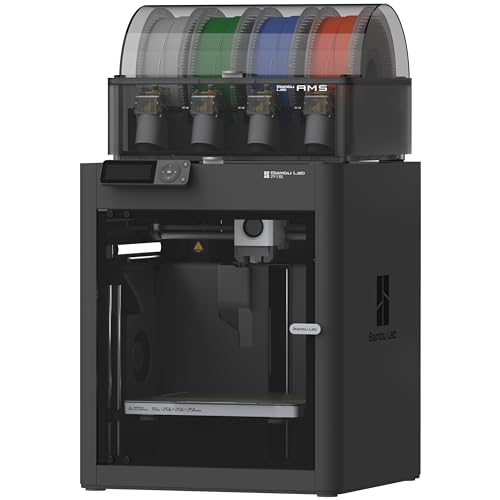
- AMS included for up to 16 colors
- 500mm/s maximum print speed
- Automatic leveling and enclosed chamber
Best For: Fast multi-color and multi-material projects
Best Quiet Enclosed 3D Printer

- 600mm/s CoreXY performance
- HEPA13 and carbon dual filtration
- Quiet printing under 50dB
Best For: Fast, monitored printing in home, office, or classroom spaces
Multicolor Powerhouse
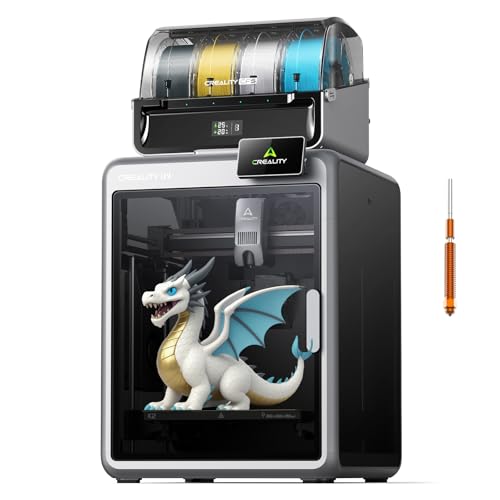
- Up to 16 colors with expandable CFS
- 600 mm/s printing and 300 °C nozzle
- Camera monitoring and air filtration
Best For: Multicolor projects and advanced materials
Fast Carbon-Fiber Specialist
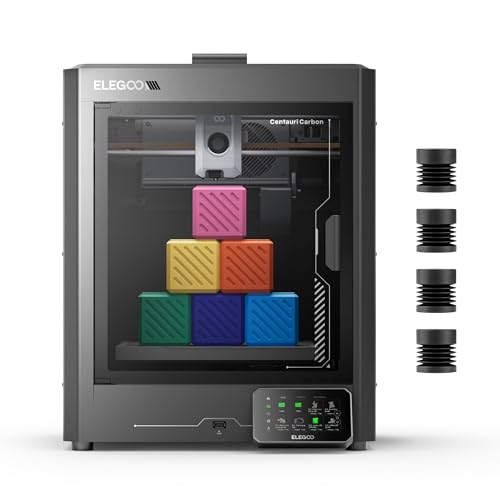
- 500 mm/s CoreXY printing
- 320 °C hardened steel nozzle
- Enclosed chamber for advanced filaments
Best For: Functional parts and carbon-fiber materials
Streamlined Multicolor Workflow

- 600 mm/s printing with flow compensation
- AMS 2 Pro adds multicolor and drying
- AI detection and automatic calibration
Best For: Easy multicolor printing and connected workflows
Best Multicolor Option
ELEGOO Centauri Carbon 2 Combo
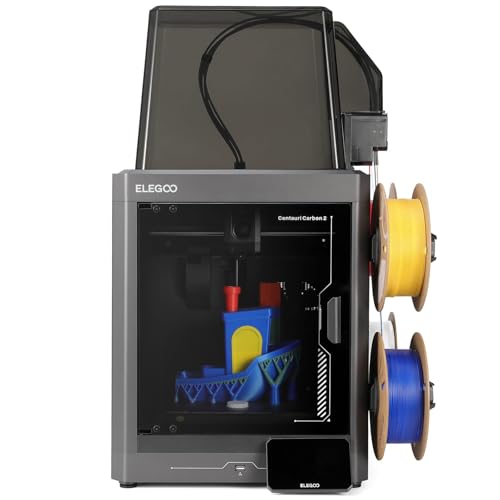
- Four-color CANVAS printing
- Auto refill and tangle detection
- Up to 500 mm/s CoreXY speed
Best For: Automated multicolor printing
Best Beginner-Friendly Choice

- One-click automatic calibration
- Up to 600 mm/s CoreXY printing
- Tool-free nozzle swaps in about 3 seconds
Best For: Easy setup and everyday home printing
Best High-Speed Enclosed 3D Printer – Bambu Lab P1S
The Bambu Lab P1S is a practical choice among enclosed 3D printers when you want fast, largely automatic FDM printing in a ready-to-use package. Its enclosed body supports a broad range of everyday and advanced filaments, while automatic bed leveling helps simplify setup and first-layer consistency.
Best For: Makers who prioritize speed, easy setup, and enclosed printing for PLA, PETG, TPU, ASA, and similar materials.
Pros:
- Prints at up to 500mm/s with 20,000 mm/s² acceleration.
- Fully enclosed design improves performance with advanced filaments.
- Automatic bed leveling and a claimed 15-minute setup reduce hands-on preparation.
- Supports optional Bambu Lab AMS multi-material printing of up to 16 colors.
Cons:
- AMS is required for the advertised multi-color and multi-material capability.
- Carbon- and glass-fiber-reinforced polymers are not recommended.
- At 38.9 pounds, it is not especially portable.
The P1S balances speed, convenience, and enclosure benefits well. Choose it if you want a streamlined single-material printer now, with the option to add AMS later for more colorful projects.
Best Filtered Enclosed 3D Printer – FLASHFORGE Adventurer 5M Pro Bundle
This FLASHFORGE Adventurer 5M Pro is one of the more versatile enclosed 3D printers for home, classroom, or workshop use. It combines automatic leveling, a high-temperature direct-drive extruder, multiple nozzle options, quiet operation, and dual filtration for a feature-rich setup.
Best For: Users who want quiet, enclosed printing, filtration, flexible material support, and remote monitoring.
Pros:
- Fully enclosed body with HEPA13 and activated-carbon filtration.
- Automatic leveling calculates offsets without manual Z-axis calibration.
- 280°C direct-drive extruder supports TPU, ASA, PLA, ABS, PETG, and composite options.
- Supports interchangeable 0.25, 0.4, 0.6, and 0.8mm nozzles and printing as quiet as 50dB in standard mode.
Cons:
- The supplied listing does not state a maximum print speed despite emphasizing high-speed performance.
- Its 33-pound weight may make moving it inconvenient.
- Advanced remote and multi-printer controls may be more than casual users need.
With filtration, quiet modes, material flexibility, and network-oriented controls, this model is well suited to shared spaces. It is a strong option when enclosure and air-quality features matter as much as print versatility.
Best Enclosed 3D Printer for Multi-Color Printing – Bambu Lab P1S Combo
The Bambu Lab P1S Combo is a convenient pick among enclosed 3D printers if multi-color or multi-material work is a priority. It combines the enclosed P1S platform with an included AMS, while automatic bed leveling and a short setup process keep the workflow approachable.
Best For: Creators who want fast enclosed printing with multi-color capability included rather than added later.
Pros:
- Includes AMS for multi-color and multi-material printing of up to 16 colors.
- Offers up to 500mm/s speed and 20,000 mm/s² acceleration.
- Enclosed body is suited to PLA, PETG, TPU, PVA, PET ABS, ASA, PA, and PC use within the stated limitations.
- Automatic bed leveling and a claimed 15-minute setup simplify operation.
Cons:
- Carbon- and glass-fiber-reinforced polymers are not recommended.
- The included AMS makes the package heavier at 40.8 pounds.
- Multi-color printing can add workflow complexity compared with single-material printing.
The Combo makes the most sense for buyers already interested in color changes or multi-material projects. Its included AMS avoids the need to purchase that upgrade separately while retaining the P1S’s speed and enclosure.
Best Quiet Enclosed 3D Printer – FLASHFORGE Adventurer 5M Pro
The FLASHFORGE Adventurer 5M Pro is a strong enclosed 3D printer choice for users who need speed without an open-frame design. Its CoreXY structure, filtration, automatic leveling, quick-swap nozzles, camera, and remote controls create a practical package for home, office, classroom, and workshop printing.
Best For: Users seeking fast, quiet, enclosed printing with broad filament compatibility and convenient monitoring features.
Pros:
- Reaches 600mm/s with 20,000 mm/s² acceleration and vibration compensation.
- Enclosure and HEPA13 plus activated-carbon filtration are designed for ABS, ASA, PC, and other supported materials.
- 280°C direct-drive extruder and tool-free quick-swap nozzles support varied project requirements.
- Automatic leveling, filament detection, camera monitoring, and power-off resume improve convenience.
Cons:
- The enclosed design and filtration add size compared with an open-frame printer.
- Its extensive controls and material options may be unnecessary for very basic PLA printing.
- The listing does not specify the camera resolution or storage details.
This model is particularly appealing when low noise and enclosed operation are important. Its 10-minute ready-to-print claim, broad material support, and included monitoring features make it a capable all-around option.
Multicolor Powerhouse – Creality K2 Combo
The Creality K2 Combo is a strong choice among enclosed 3d printers for makers who want fast, multicolor output and broad material support. Its included CFS system, automatic leveling, camera monitoring, and pre-assembled design make it practical for both beginners and experienced users.
Best For: Multicolor projects, prototypes, and users who want high-speed printing with automated filament handling.
Pros:
- Included CFS supports up to 16 colors when expanded and provides RFID filament identification.
- Prints at up to 600 mm/s with a rigid aluminum frame, steel X-axis rail, and dual Z-axis.
- Supports materials including PLA, ABS, PETG, and engineering-grade filaments with a 300 °C hardened steel nozzle.
- Includes AI chamber camera monitoring, air filtration, Wi-Fi, and automatic leveling.
Cons:
- Its 55-pound weight and 21 x 25 x 20-inch dimensions require substantial workspace.
- Advanced multicolor capabilities may be more than needed for simple single-color prints.
Choose the K2 Combo if color flexibility, material range, and automation are priorities. Its enclosed design and smart filament system add convenience, while the larger footprint is the main practical trade-off.
Fast Carbon-Fiber Specialist – ELEGOO Centauri Carbon
The ELEGOO Centauri Carbon stands out among enclosed 3d printers for high-speed production and advanced filament use. It arrives assembled and pre-calibrated, pairing a CoreXY motion system with a rigid die-cast frame, auto calibration, and a 320 °C hardened steel nozzle.
Best For: Makers producing strong, lightweight parts for drones, automotive projects, athletic applications, and other demanding uses.
Pros:
- CoreXY mechanics deliver speeds up to 500 mm/s with 20,000 mm/s² acceleration.
- Enclosed chamber and 320 °C hardened steel nozzle support carbon-fiber-reinforced filament.
- Die-cast aluminum frame, vibration compensation, and pressure advance promote consistent results.
- Built-in camera, dual LED lighting, auto bed leveling, and a 256 mm cubed build volume improve usability.
Cons:
- The brass-hardened steel nozzle may be less suitable for users seeking a non-wear nozzle option.
- Its 38.5-pound weight still calls for a stable, dedicated surface.
The Centauri Carbon is a focused pick for speed and reinforced materials rather than multicolor printing. Its ready-to-use setup and enclosed, stable construction make it especially appealing for functional-part workflows.
Streamlined Multicolor Workflow – Bambu Lab P2S Combo
The Bambu Lab P2S Combo is one of the more workflow-focused enclosed 3d printers, combining fast printing with the AMS 2 Pro multicolor and filament-drying system. Automatic calibration, AI failure detection, adaptive airflow, and quick-swap nozzles help reduce setup and monitoring demands.
Best For: Beginners and experienced makers who want rapid setup, multicolor printing, and a connected design-to-print workflow.
Pros:
- Prints at up to 600 mm/s with active flowrate compensation for smooth, accurate layers.
- AMS 2 Pro enables multicolor and multimaterial printing while drying filament up to 65 °C.
- Automatic calibration, AI failure detection, and quick-swap nozzles simplify operation.
- Adaptive airflow can cool overhangs or maintain a 50 °C chamber for engineering-grade materials.
Cons:
- The base P2S does not support multicolor printing; that capability requires this Combo configuration.
- The 18 x 22 x 18-inch footprint and 47.5-pound weight require dedicated space.
The P2S Combo is a practical fit for users who value convenience and a unified software ecosystem as much as print speed. Its AMS 2 Pro adds meaningful multicolor and filament-drying functionality, while the Combo configuration is essential for those features.
Best Carbon-Fiber Pick – Creality K1C
For shoppers comparing enclosed 3d printers, the Creality K1C stands out for fast CoreXY printing, automatic calibration, and support for demanding carbon-fiber-reinforced filaments. Its enclosed chamber, 300°C hotend, hardened nozzle tip, and AI camera make it a versatile option for advanced materials and monitored printing.
Best For: Makers who want high-speed enclosed printing with carbon-fiber filament support and remote monitoring.
Pros:
- CoreXY motion system reaches speeds up to 600 mm/s with 20,000 mm/s² acceleration.
- Clog-resistant direct extruder and tri-metal nozzle support wear-resistant materials.
- Automatic calibration, AI monitoring, activated-carbon purification, and a silent mode rated at 45 dB or less.
Cons:
- Its advanced material support may be more than beginners need.
- At 27.3 pounds, it is not especially lightweight for frequent relocation.
The K1C is a strong enclosed 3d printer choice when speed, tougher filament compatibility, and built-in monitoring matter more than a basic entry-level setup.
Best Multicolor Option – ELEGOO Centauri Carbon 2 Combo
The ELEGOO Centauri Carbon 2 Combo is one of the more feature-rich enclosed 3d printers for users who want multicolor output without a complicated workflow. Its CANVAS system supports four-color printing, while automated calibration, filament detection, and CoreXY motion aim to keep the process smooth.
Best For: Creators who prioritize convenient four-color printing and automated operation.
Pros:
- CANVAS system enables four-color printing with instant color switching.
- Smart filament detection, auto refill, and tangle detection help maintain continuous prints.
- Fully automated calibration and monitoring simplify setup and operation.
- CoreXY construction supports speeds up to 500 mm/s and 20,000 mm/s² acceleration.
Cons:
- The combo’s 42.6-pound weight may make it difficult to move.
- The multicolor system adds equipment and workflow complexity compared with a single-filament printer.
Choose the Centauri Carbon 2 Combo if multicolor capability is central to your projects and you want automation to reduce hands-on management.
Best Beginner-Friendly Choice – FLASHFORGE AD5M
The FLASHFORGE AD5M is a practical contender among enclosed 3d printers for beginners and experienced users alike. One-click automatic calibration, a stable all-metal CoreXY structure, and a tool-free quick-swap nozzle make it easier to start printing and handle routine maintenance.
Best For: Beginners and home makers who want fast setup, simple maintenance, and reliable remote control features.
Pros:
- Fully automatic one-click leveling helps establish an accurate first layer.
- CoreXY motion reaches up to 600 mm/s while maintaining a low-noise operation design.
- Quick-release nozzles can be changed without tools in as little as three seconds.
- Power-loss recovery, a flexible double-sided PEI plate, and remote monitoring add convenience.
Cons:
- Its 220 × 220 × 220 mm print volume is more limited than larger-format machines.
- The supplied notes do not list a heated enclosed chamber or high-temperature hotend specifications.
The AD5M makes a sensible choice for straightforward everyday printing, particularly if easy calibration and quick nozzle maintenance are higher priorities than advanced-material specifications.
How We Picked the Best Enclosed 3d Printers
We focused on practical features that affect everyday printing rather than headline specifications alone. Our comparison considers build volume, motion system, maximum print speed, automatic calibration, nozzle temperature, filament compatibility, chamber design, cameras, filtration, multicolor options, and overall ease of use.
We also separated genuinely useful capabilities from features that may require additional accessories, proprietary materials, or more maintenance. A fast printer is only valuable if it can maintain reliable first layers, consistent extrusion, and manageable noise during regular use.
Quick Comparison
| Priority | Look For | Best Fit |
|---|---|---|
| Fast general-purpose printing | CoreXY motion, automatic calibration, high-flow hot end | Users making functional parts and prototypes |
| Multicolor models | Included or compatible multicolor material system | Hobbyists, educators, and display-model makers |
| Beginner-friendly operation | Ready-to-use setup, guided software, camera monitoring | First-time and family users |
| Engineering materials | Higher nozzle temperature and controlled enclosure | Advanced makers and technical users |
Key Buying Factors for Enclosed 3d Printers
Enclosure and Temperature Control
A fully enclosed design helps reduce drafts and can improve dimensional consistency, especially with materials prone to warping. Check whether the enclosure is actively heated or simply covered; these are not equivalent. Also consider ventilation, filtration, and the amount of clearance needed around the printer.
Speed Versus Print Quality
Published speed figures usually represent ideal conditions. Real-world results depend on acceleration, layer height, filament, model geometry, and cooling. Automatic input shaping, pressure advance, and a rigid frame often matter more than the maximum number on the specification sheet.
Materials and Hot-End Capability
PLA and PETG work on many machines, while ABS, ASA, nylon, and composite filaments may require a hotter nozzle, stronger heat management, and abrasion-resistant components. Confirm the nozzle temperature, build-plate temperature, extruder design, and manufacturer-supported materials before buying.
Automation and Maintenance
Automatic bed leveling, first-layer checks, filament runout detection, clog detection, and a built-in camera can reduce supervision. However, every printer still needs periodic nozzle, belt, build-surface, and filament-path maintenance. Accessible components and readily available replacement parts are valuable for long-term ownership.
Who Should Buy Which Enclosed 3d Printers?
Choose a compact, ready-to-use enclosed model if you want dependable everyday printing with minimal setup. A printer bundled with a multicolor material system makes more sense for decorative models, signs, toys, and educational projects. Users printing functional parts should prioritize a rigid CoreXY platform, reliable calibration, and broad filament support over color-changing convenience.
For demanding materials, select the model with the strongest thermal specifications and the most effective enclosure management, then verify the manufacturer’s material recommendations. If remote monitoring matters, prioritize a built-in camera and mature software ecosystem. Finally, compare total ownership cost—including multicolor accessories, nozzles, build plates, and filament—rather than judging the printer by its base price alone.