
The best engineering building sets for classrooms turn abstract STEM concepts into hands-on challenges students can see, test, and improve. The options in this roundup range from bridge and playground design kits to gears, engines, interlocking discs, straws, and broad construction sets.
Use the guide below to compare classroom fit, project flexibility, durability, age range, and the kind of engineering thinking each set encourages before choosing supplies for your students.
Best 10 Engineering Building Sets for Classrooms Picks for 2026
Best Classroom Bridge-Building Set

- 305-piece bridge and tower construction set
- Supports testing, problem-solving, and collaboration
- Designed for children ages 5 and up
Best For: Small-group structural engineering challenges
Best Working Engine Model
National Geographic 4-Cylinder Engine Kit
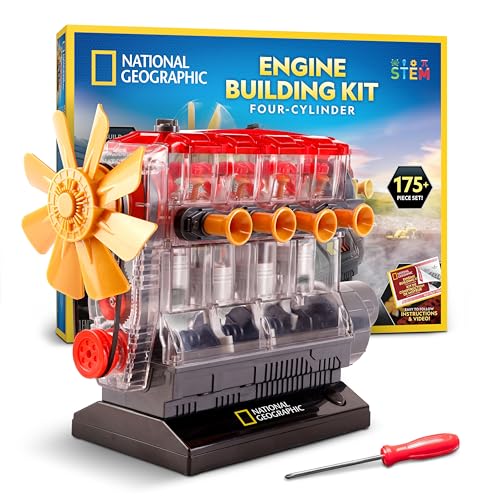
- 175+ pieces create a working engine model
- Moving pistons, valves, and gears are visible
- Recommended for ages 10 and up
Best For: Mechanics-focused STEM stations and projects
Best Geometry Manipulative Set

- 58 pieces for building 2D and 3D shapes
- Includes an activity guide and shape challenges
- Recommended for ages 5 to 10
Best For: Hands-on geometry centers and early STEM learning
Best Large Group Construction Set

- 1,200 pieces for shared group construction
- Supports open-ended models and teamwork
- Recommended for children ages 3 and up
Best For: Preschool and early-elementary cooperative building
Best Gear-Based STEM Set

- 100 pieces for moving mechanical builds
- Explores motion and cause and effect
- Useful for classroom centers and STEM challenges
Best For: Early STEM lessons focused on simple mechanics
Best Large-Group Construction Set

- 600 pieces for larger shared builds
- Encourages logic and spatial reasoning
- Designed for individual or group STEM projects
Best For: Collaborative classroom construction challenges
Best Guided Engineering Set
Playground Engineering & Design
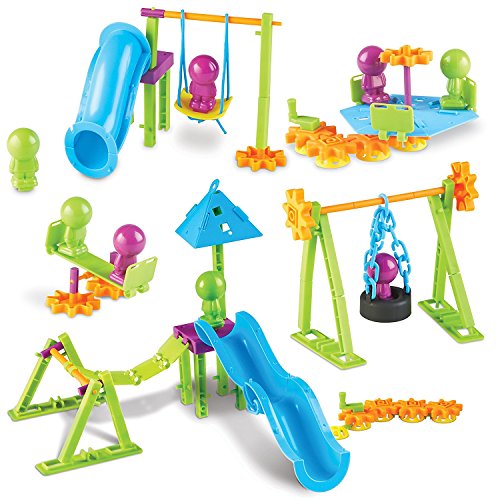
- 104 pieces for playground-style builds
- Includes challenge cards and worksheets
- Supports guided or open-ended STEM activities
Best For: Teacher-led engineering lessons for ages 5–12
Colorful Classroom Creators

- 170 colorful pieces with 20 wheels
- Ideas for 18+ creative models
- Storage box and washable parts
Best For: Early elementary building stations and open-ended vehicle projects
Collaborative Design Station

- 500+ discs in 12 colors
- Easy connections for solo or group building
- Jar storage plus idea booklet
Best For: Classroom makerspaces and collaborative, open-ended design
Moving Machines Workshop

- Builds 10 engineering vehicles and machines
- Includes assembly instructions
- Storage box with 112 listed pieces
Best For: Guided STEM centers focused on construction vehicles and problem solving
Best Classroom Bridge-Building Set – Bridge Builders Classroom Set
For classrooms seeking engineering building sets for classrooms, the Learning Resources STEM Explorers Bridge Builders Classroom Set focuses on designing, constructing, testing, and refining bridges and towers. Its 305 interlocking plastic pieces and challenges support small-group STEM activities for children ages 5 and up.
Best For: Small-group classroom engineering challenges focused on structures, testing, and collaboration.
Pros:
- Introduces suspension bridges, beam bridges, and other real-world structures.
- Encourages students to test and adjust their designs.
- Classroom-oriented set supports collaboration and up to 10 players.
- Includes 305 pieces and requires no batteries.
Cons:
- The recommended age begins at 5 years, so it may be too advanced for younger preschoolers.
- The set centers mainly on bridges and towers rather than broad construction themes.
This is a strong classroom choice when the goal is hands-on structural engineering with teamwork and iterative problem-solving.
Best Working Engine Model – National Geographic 4-Cylinder Engine Kit
The National Geographic 4-Cylinder Engine Building Kit gives older students a more mechanical option among engineering building sets for classrooms. With more than 175 pieces, included tools, and a clear working model, it demonstrates how pistons, valves, and gears move after assembly.
Best For: Engineering lessons and independent projects for students ages 10 and up who are interested in mechanics.
Pros:
- Builds a visible four-cylinder engine model with moving components.
- Includes tools, illustrated instructions, and a Learning Guide.
- Connects hands-on construction with mechanics and engineering concepts.
- Clear housing lets students observe pistons, valves, and gears in motion.
Cons:
- Recommended for ages 10 and up, limiting use with younger classes.
- Requires three AA batteries, which are not included.
- Its single-engine format is less suited to simultaneous group building.
This kit is best used as an advanced STEM station, demonstration model, or focused mechanics project rather than a large collaborative set.
Best Geometry Manipulative Set – STEM Explorers Geomakers
Learning Resources STEM Explorers Geomakers is a compact choice for early geometry lessons within engineering building sets for classrooms. The 58-piece set and activity guide let children ages 5 to 10 build both two-dimensional and three-dimensional shapes while practicing fine-motor and reasoning skills.
Best For: Preschool, kindergarten, and elementary geometry centers using hands-on shape construction.
Pros:
- Supports construction of both 2D and 3D shapes.
- Includes an activity guide with shape-building challenges.
- STEM.org certified as an educational product.
- Requires no batteries and works well for indoor classroom use.
Cons:
- With 58 pieces and one listed player, it is better suited to individual or small-center work than large groups.
- Its geometry focus may not meet the needs of students seeking complex mechanical engineering projects.
Geomakers offers a straightforward way to turn geometry concepts into tactile building activities, especially in early-learning classrooms and homeschool settings.
Best Large Group Construction Set – Ggiibro Straw Constructor Kit
For teachers who need a high-piece-count option among engineering building sets for classrooms, the Ggiibro Straw Constructor Kit includes 1,200 interlocking plastic pieces. Designed for children ages 3 and up, it supports open-ended models, cooperative play, and early lessons in structure, reasoning, math, and imagination.
Best For: Preschool and early-elementary group building, free-form design, and teamwork activities.
Pros:
- 1,200 pieces provide enough materials for three to five children to share.
- Supports open-ended construction of vehicles, castles, animals, robots, and other forms.
- Encourages teamwork, social interaction, and early engineering skills.
- Includes a storage box and uses non-toxic plastic materials.
Cons:
- Open-ended play may require teacher-created challenges for structured instruction.
- The recommended age range is broad, so younger children may need guidance with designs.
- The set does not include powered or moving mechanical components.
This is a practical pick when quantity and cooperative building matter most, particularly for classrooms, kindergartens, and children’s centers.
Best Gear-Based STEM Set – Gears Deluxe Building Set
For classrooms seeking engineering building sets for classrooms that demonstrate motion, this 100-piece gears set offers a hands-on way to explore cause and effect. Students can assemble colorful gears, axles, pillars, bases, and a crank to create moving designs.
Best For: Early elementary STEM centers, fine-motor practice, and guided lessons on simple mechanics.
Pros:
- Includes 100 pieces for building gears, towers, rows, pyramids, and other moving structures.
- Supports exploration of motion, spatial reasoning, problem-solving, and cause and effect.
- Works for classroom centers, group challenges, homeschool activities, or independent play.
- Requires no batteries and includes an activity guide.
Cons:
- The recommended age range begins at 36 months, so it may be less suitable for older students seeking advanced engineering challenges.
- Plastic pieces and small connectors require organized classroom storage and supervision with younger children.
This is a strong choice when the goal is to make basic mechanical concepts visible and interactive. Its crank-operated builds provide immediate feedback as students experiment with gear arrangements.
Best Large-Group Construction Set – 600-Piece Straw Constructor
This 600-piece straw construction kit is one of the more flexible engineering building sets for classrooms, especially when students need enough materials for larger or collaborative structures. The long and short straws connect with included pieces for open-ended designing and rebuilding.
Best For: Group STEM projects, classroom construction challenges, and activities that develop planning and spatial reasoning.
Pros:
- Provides 600 pieces: 80 long straws, 220 short straws, and 300 connectors.
- Supports creative thinking, logical thinking, motor skills, and problem-solving through hands-on construction.
- Suitable for individual play or group activities and allows students to build larger creations.
- Notes indicate laboratory testing for CPSC regulations and necessary safety standards.
Cons:
- The many loose pieces may require bins or labeled storage in a classroom.
- The set is open-ended, so teachers may need to provide their own project instructions or design prompts.
- The recommended age range starts at 36 months, which may limit its challenge level for advanced students.
Choose this kit when quantity and collaboration matter most. Its high piece count makes it practical for shared building sessions, while the simple connector system leaves room for teacher-created engineering challenges.
Best Guided Engineering Set – Playground Engineering & Design
For teachers who want engineering building sets for classrooms with more structure, this 104-piece playground-themed kit combines hands-on construction with challenge cards, an activity guide, and reproducible worksheets. Students can follow designs or invent playground-style builds of their own.
Best For: Ages 5–12, guided STEM lessons, partner work, and classroom activities connecting design with problem-solving.
Pros:
- Includes 104 pieces for building playground-inspired structures.
- Challenge cards, an activity guide, and reproducible worksheets support teacher-led lessons.
- Encourages students to build, take apart, revise, and collaborate without screens.
- Supports problem-solving, coordination, logic, and fine-motor development.
Cons:
- The playground theme may be less versatile than a completely open-ended construction system.
- With 104 pieces, it offers fewer components than the 600-piece straw set for large-group builds.
- The set is designed for two players, which may require multiple kits for a larger class.
This is a practical pick for classrooms that value ready-to-use engineering prompts. The guided materials can help teachers introduce design challenges while still leaving room for creative revisions and independent ideas.
Colorful Classroom Creators – 170-Piece STEM Building Kit
For classrooms seeking engineering building sets for classrooms that encourage open-ended construction, this 170-piece kit combines colorful interlocking parts with removable wheels. Its mix of guided model ideas and free building can support creative play, color learning, and hands-on motor-skill practice.
Best For: Early elementary classrooms, small-group building stations, and children ages 3 and up who enjoy vehicles, robots, and other moving creations.
Pros:
- Includes 170 pieces in six colors, including 20 removable wheels.
- Offers ideas for more than 18 models, such as dinosaurs, robots, cars, and helicopters.
- Comes in a sturdy storage box and can be rinsed clean.
- Uses ABS plastic described as free of BPA, lead, cadmium, phthalates, and sharp edges.
Cons:
- The many small pieces may require classroom sorting and supervision.
- The supplied details do not specify how many children can build at once.
This is a flexible choice when a teacher wants bright, approachable construction materials with enough parts for varied designs. The storage case is especially useful for keeping a classroom building center organized.
Collaborative Design Station – Brain Flakes 500-Piece Set
Brain Flakes is a strong option for engineering building sets for classrooms where students need a quiet, collaborative activity with a large shared piece count. The flexible discs connect easily and support both guided examples and independent design challenges.
Best For: Classrooms, makerspaces, libraries, Montessori settings, and mixed-age groups working on spatial thinking, color recognition, dexterity, and teamwork.
Pros:
- Includes 500-plus interlocking discs in 12 colors.
- Supports open-ended building while also providing an idea booklet and online resources.
- Discs connect easily and can be used for solo or group activities.
- Includes a durable storage jar for cleanup and organization.
Cons:
- The discs are a single building format, so they may offer less vehicle-focused construction than kits with wheels.
- A 500-piece set may still need additional sets for larger simultaneous groups.
With its high piece count and simple connection method, this set is well suited to a classroom construction shelf. It can accommodate a broad age range and makes it easy to shift between teacher prompts and student-led creations.
Moving Machines Workshop – 10-in-1 STEM Construction Kit
This 10-in-1 kit suits engineering building sets for classrooms that emphasize step-by-step assembly and functional models. Students can follow the included instructions to build different engineering vehicles and machines while practicing hands-on problem solving.
Best For: Kindergarten and early elementary project centers, guided STEM activities, and children ages 4 to 8 who enjoy construction vehicles and moving builds.
Pros:
- Provides plans for 10 models, including cranes, a bulldozer, forklift, windmill, and carrier vehicle.
- Includes detailed assembly instructions with corresponding parts and steps.
- Offers 112 construction pieces and models that are described as moving.
- Comes with a sturdy storage box and is described as non-toxic.
Cons:
- The guided designs may provide less open-ended building than a loose-part construction set.
- The supplied specifications vary between 112 pieces and a 100-piece listing.
- The kit is presented as a one-player activity, so group use may require turn-taking.
This set is a practical pick for teachers who want clearly structured engineering projects rather than only free-form building. Its range of machine designs gives students repeatable challenges while keeping the activity focused on assembly and problem solving.
How We Picked These Engineering Building Sets for Classrooms
We focused on sets that support active building, testing, and redesign rather than one-time assembly. The selection includes structured kits for teaching specific concepts—such as bridges, gears, playground design, and mechanical motion—alongside open-ended construction systems that work well for exploration and student-led projects.
We also considered stated age ranges, piece variety, likely group-work potential, and how easily teachers can connect each set to lessons in forces, structures, mechanisms, spatial reasoning, and problem-solving. Because classroom needs vary, the roundup includes both focused learning resources and larger general-purpose building collections.
Quick Comparison
| Set type | Best classroom use | What to look for |
|---|---|---|
| Bridge and playground kits | Guided design challenges | Clear activity prompts and structural concepts |
| Gears and engine models | Mechanisms and motion | Moving parts, sequencing, and demonstration value |
| Straw and connector sets | Large-group construction | High piece counts and repeatable connections |
| Discs and general building blocks | Open-ended STEM centers | Creative flexibility and easy sorting |
| Multi-project STEM kits | Mixed-age activities | Project variety and adaptable instructions |
Key Buying Factors for Engineering Building Sets for Classrooms
Age and Skill Alignment
Choose a set that matches students’ dexterity, reading ability, and attention span. Younger learners often benefit from large, easy-to-connect pieces and simple build prompts, while older students may get more value from mechanisms, constraints, and multistep challenges.
Open-Ended Versus Guided Learning
Guided kits can make lesson planning easier and help introduce a specific concept. Open-ended sets are better for design cycles, collaborative construction, and stations where students can create multiple solutions. A balanced classroom collection may include both.
Piece Count, Storage, and Group Size
A high piece count is useful for teams, but only if the pieces are easy to sort and replace. Check whether the set includes a storage solution or can be organized in labeled classroom bins. For larger groups, prioritize systems that allow several students to build simultaneously.
Durability and Classroom Management
Look for sturdy connectors and pieces that tolerate repeated handling. Sets with limited connector types are often faster to distribute and clean up, while specialized parts can add valuable learning opportunities but require more careful inventory control.
Curriculum Connections
Consider how the kit supports your goals: structures and stability, simple machines, rotational motion, geometry, force and load, prototyping, or communication. The strongest choice is one that can be reused across several lessons instead of serving a single activity.
Who Should Buy Which Engineering Building Sets for Classrooms?
Teachers introducing structural engineering should consider bridge or playground-focused sets with clear challenges. For lessons about motion and mechanisms, a gears set or working engine model can provide a useful visual demonstration. Makerspaces and STEM centers serving several groups may prefer large straw-construction collections or versatile interlocking building pieces.
For younger classrooms, choose larger, simpler components that support free building and fine-motor practice. Mixed-age programs will benefit from multi-project kits that can be simplified for beginners and extended with design constraints for advanced students. If collaboration is the priority, select a high-count set with enough parts for teams to prototype, compare results, and revise their designs.