
The best engineering building sets for elementary students turn STEM concepts into something children can build, test, revise, and explain. The options in this roundup range from guided bridge and skyscraper projects to flexible straw, block, and construction systems.
We compared project structure, age fit, piece count, material variety, and the kinds of engineering challenges each set supports. Use the guide below to narrow the choices by learning goals, workspace, supervision needs, and budget.
Best 10 Engineering Building Sets for Elementary Students Picks for 2026
Best Creative City Builder
City Engineering & Design Building Set
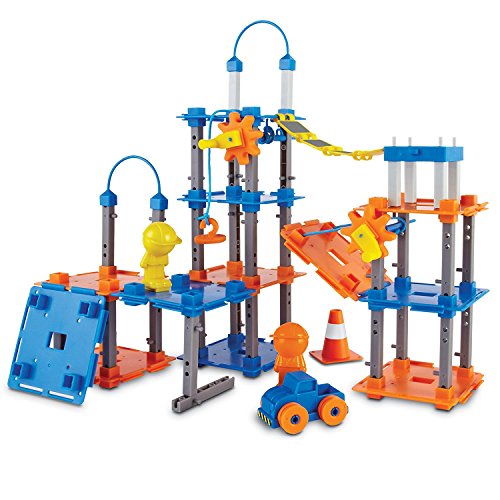
- 89-piece kit for towers, bridges, and city structures
- Activity cards follow the engineering design process
- Designed for ages 5–8; no batteries required
Best For: Young learners who like guided city-themed STEM building
Best Real-World Bridge Study
Intro to Structures: Bridges Set

- 207 pieces for 13 functioning bridge replicas
- Covers truss, arch, suspension, and other bridge types
- Includes teacher guide and portable storage tray
Best For: Grades 3–5 classroom bridge and structures lessons
Best Geometry Starter Set

- 58 pieces for building 2D and 3D shapes
- Activity guide adds guided geometry challenges
- Recommended for ages 5–10 and classroom use
Best For: Early geometry, spatial reasoning, and shape-building practice
Best Advanced Structural Engineering Set
Bridges & Skyscrapers Engineering Set

- Build 20 models exploring structural forces
- Includes over 285 interchangeable pieces
- Recommended for ages 8–14; intermediate level
Best For: Older elementary students ready for structural physics
Creative Starter
600-Piece Interlocking Building Blocks

- 600 colorful pieces support open-ended construction
- Encourages spatial reasoning and coordination
- Designed for ages 3 and up
Best For: Young builders and introductory STEM play
Guided Engineering Lab
Structures, Buildings & Bridges
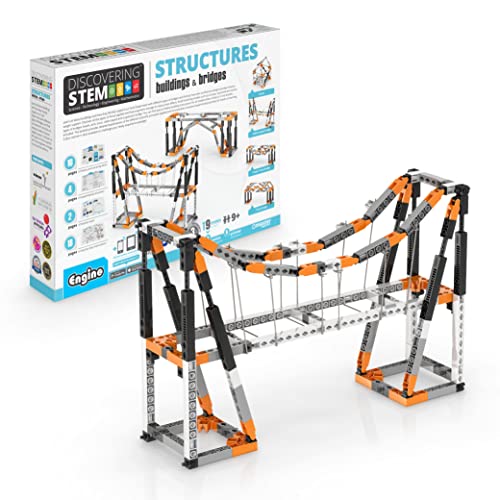
- Constructs nine real-world building and bridge models
- Includes theory, experiments, quizzes, and instructions
- Recommended for ages 9 and up
Best For: Older elementary students exploring structural engineering
Hands-On Design Builder

- Combines 300 connectors with 300 straws
- Supports logic, motor skills, and spatial reasoning
- Suitable for individual or group STEM projects
Best For: Collaborative, open-ended structure building
Best Metal Pick

- 236-piece metal construction set
- Step-by-step model instructions
- Supports STEM and fine-motor skills
Best For: Older elementary students who enjoy mechanical building
Best for Group Play
1200-Piece Straw Constructor Set

- 1,200 pieces for shared building
- Open-ended STEM design play
- Includes storage box
Best For: Classrooms and multi-child collaborative projects
Best Compact Classroom Set

- 600 colorful building pieces
- Includes wheels and extra connectors
- Storage box for organized play
Best For: Younger learners and small-group STEM activities
Best Creative City Builder – City Engineering & Design Building Set
For younger children comparing engineering building sets for elementary students, this 89-piece city-themed kit offers a gentle introduction to designing towers, bridges, and other structures. Activity cards organize play around asking, imagining, planning, creating, and improving, while stickers and open-ended pieces leave room for independent builds.
Best For: Preschool and early elementary learners ages 5–8 who enjoy guided STEM challenges and imaginative city building.
Pros:
- Introduces basic engineering and problem-solving concepts through hands-on construction.
- Includes activity cards that model the engineering design process.
- Supports both guided projects and open-ended city creations.
- Requires no batteries and works well at home, in classrooms, or homeschool spaces.
Cons:
- Its recommended age range may make it less suitable for older elementary students seeking advanced structures.
- Plastic pieces may offer less structural complexity than larger, more specialized engineering sets.
This is a practical starting point for young builders who need clear prompts without losing creative freedom. Choose it for approachable, city-themed STEM play rather than advanced structural engineering.
Best Real-World Bridge Study – Intro to Structures: Bridges Set
Among engineering building sets for elementary students, this K’NEX Education set stands out for its focused exploration of real bridge design. The 207 rods, stems, and connectors can be assembled into 13 functioning bridge replicas, with educational materials covering structural types and related design concepts.
Best For: Grades 3–5 learners, small groups of two or three, and classrooms studying bridges through hands-on construction.
Pros:
- Builds 13 bridge types, including truss, arch, suspension, beam, and cable-stayed designs.
- Snap-fit pieces connect securely and can be reassembled into new models.
- Includes building instructions, a teacher’s guide, and lesson or experiment support.
- Portable storage tray with a snap-on lid helps organize the parts.
Cons:
- The bridge-focused models may feel less open-ended than general construction kits.
- With 207 pieces and small connectors, sorting and cleanup may require supervision.
- Educational materials may be more useful with classroom or adult guidance.
This is a strong choice when the goal is concrete, real-world learning rather than free-form building alone. Its bridge variety and classroom-oriented resources make it especially suitable for structured STEM lessons.
Best Geometry Starter Set – STEM Explorers Geomakers
For families and teachers seeking engineering building sets for elementary students with a geometry emphasis, Geomakers uses 58 linking pieces to turn shape concepts into hands-on activities. The included guide challenges children to construct both 2D and 3D forms while practicing fine motor skills and critical thinking.
Best For: Children ages 5–10 in preschool, kindergarten, elementary, classroom, homeschool, or at-home math settings.
Pros:
- Supports hands-on learning of 2D and 3D shapes.
- Includes an activity guide with shape-building challenges.
- STEM.org certified as an educational product.
- Compact, manual play format suits classroom or homeschool use.
Cons:
- Its geometry focus may not provide the bridge, tower, or mechanical challenges found in broader engineering kits.
- The 58-piece set is designed for one player, so group construction may be limited.
- Children seeking highly complex builds may outgrow it sooner.
Geomakers is best viewed as a shape-building and spatial-reasoning tool rather than a full structural engineering curriculum. It offers an accessible way to add construction and geometry practice to early elementary learning.
Best Advanced Structural Engineering Set – Bridges & Skyscrapers Engineering Set
Older elementary students comparing engineering building sets for elementary students may appreciate this intermediate Thames & Kosmos kit. It includes more than 285 interchangeable pieces and instructions for 20 models, using bridges and skyscrapers to explore force, load, compression, tension, and related structural ideas.
Best For: Builders ages 8–14 who are ready for guided structural models and introductory mechanical physics.
Pros:
- Offers 20 different structural models to build and compare.
- Explores force, load, compression, tension, and building materials.
- Includes over 285 interchangeable plastic pieces.
- 36-page illustrated experiment manual and assembly guide support independent learning.
Cons:
- Intermediate skill level may be challenging for younger or first-time builders.
- The structural-physics focus may be less appealing to children seeking character or vehicle builds.
- Its 8–14 recommendation places it above the starting level of many early elementary students.
This kit is a better match for older elementary learners who want to understand why structures stand, bend, or carry loads. The model variety and experiment manual provide more depth than a basic construction set, but expect a steeper learning curve.
Creative Starter – 600-Piece Interlocking Building Blocks
For families seeking engineering building sets for elementary students, this 600-piece interlocking block kit offers an accessible way to practice spatial reasoning, coordination, and creative construction. The colorful pieces attach with minimal pressure and are designed for children ages 3 and up.
Best For: Young builders, open-ended family play, and introductory STEM construction activities.
Pros:
- Includes 600 colorful pieces for varied 3D creations.
- Supports spatial reasoning, problem-solving, fine motor skills, and hand-eye coordination.
- Pieces are easy for little fingers to handle and lock firmly together.
- Suitable for solo or group play with 1–4 players.
Cons:
- Offers open-ended building rather than specific engineering model instructions.
- Small pieces require age-appropriate supervision.
This is a flexible choice when you want a high-piece-count construction set that emphasizes imagination and foundational building skills over guided projects.
Guided Engineering Lab – Structures, Buildings & Bridges
Among engineering building sets for elementary students, this Engino kit is geared toward older children who are ready to explore how structures work. It includes instructions and learning materials for building nine models, including houses, bridges, and a pyramid.
Best For: Children ages 9 and up who prefer guided engineering projects, structural concepts, and science-fair-style activities.
Pros:
- Builds nine engineering models, including beam, arch, truss, cable-stayed, and suspension bridges.
- Includes theory, facts, experiments, a quiz book, instruction manual, and a free app.
- Snap-fit components connect in multiple directions for complex 3D models.
- Made from ABS plastic and backed by a two-year limited warranty.
Cons:
- Recommended for ages 9 and up, so it may be too advanced for younger elementary students.
- The guided model focus provides less open-ended play than a basic block set.
This is the strongest fit for learners who want construction to lead into formal engineering ideas, with enough supporting content for classroom, home, or STEM-program use.
Hands-On Design Builder – 600-Piece Straw Constructor
This straw-based option brings a different approach to engineering building sets for elementary students: children plan, connect, and experiment with lightweight straws and connectors. The 600-piece assortment supports individual projects or collaborative construction for ages 3 to 12.
Best For: Group STEM activities, larger free-form structures, and practicing planning, logic, spatial reasoning, and motor skills.
Pros:
- Includes 80 long straws, 220 short straws, and 300 connectors.
- Encourages design thinking, problem-solving, spatial reasoning, and hand-eye coordination.
- Works well for individual play or group projects.
- Lab tested to meet CPSC regulations and necessary safety standards, according to the supplied details.
Cons:
- Does not include specific model-based engineering instructions in the supplied details.
- Straw construction may be less suitable for children seeking rigid, permanent builds.
Choose this set when the goal is experimentation and collaboration rather than following fixed plans. Its mix of long and short straws gives children room to test different designs and scales.
Best Metal Pick – 236-Piece Erector STEM Kit
For families seeking engineering building sets for elementary students ages 8 and up, this 236-piece metal Erector kit offers a more hands-on construction experience. Children can follow the step-by-step guide to build models or experiment with their own designs while practicing coordination, dexterity, logic, and problem-solving.
Best For: Older elementary students, beginning builders, and children who enjoy mechanical projects with metal components.
Pros:
- 236 durable metal pieces support detailed model building.
- Includes updated, step-by-step assembly instructions.
- Encourages STEM learning, creativity, teamwork, and fine-motor development.
- Requires no batteries and uses washable, child-friendly materials.
Cons:
- The manufacturer recommends it for ages 8 and up, so it may be too advanced for younger elementary students.
- With 236 pieces and mechanical assembly, builds may require patience and adult guidance for some children.
This is a strong choice when you want a traditional erector set that emphasizes mechanical construction rather than simple stacking. Its metal parts and guided projects make it particularly suitable for older children developing sustained building and problem-solving skills.
Best for Group Play – 1200-Piece Straw Constructor Set
This 1,200-piece straw construction set is a flexible option for classrooms, siblings, or playgroups searching for engineering building sets for elementary students ages 3 and up. The interlocking tubes and connectors can be assembled into planes, vehicles, castles, robots, animals, and other imaginative designs.
Best For: Preschool and early elementary classrooms, cooperative projects, and households with several children who want to build together.
Pros:
- Large 1,200-piece supply can support three to five children sharing the set.
- Open-ended parts encourage imagination, structural reasoning, math, and engineering practice.
- Suitable for indoor or outdoor multiplayer activities.
- Includes a storage box and is described as non-toxic, with CPSIA and ASTM certification.
Cons:
- The set uses plastic components rather than metal or more specialized mechanical parts.
- The very large piece count may require consistent cleanup and storage after group play.
Choose this set when collaboration and open-ended design matter more than following fixed models. Its generous quantity makes it especially practical for shared building sessions, while the lightweight straw-and-connector format remains approachable for younger children.
Best Compact Classroom Set – 600-Piece Straw Constructor
For younger children who need accessible engineering building sets for elementary students, this 600-piece straw constructor combines open-ended building with manageable classroom storage. The colorful tubes, connectors, wheels, and multi-directional connectors can form vehicles, animals, castles, robots, and other imaginative structures.
Best For: Preschool and early elementary learners, small-group activities, and families wanting a versatile set with a storage box.
Pros:
- 600 pieces provide substantial variety without the quantity of the larger version.
- Wheels and multi-directional connectors expand the possible vehicle and structure designs.
- Supports engineering, construction, imagination, teamwork, and hand-eye coordination.
- Includes easy storage and is described as non-toxic, with CPSIA and ASTM certification.
Cons:
- It may offer less sharing capacity than a 1,200-piece classroom set.
- The PVC straw-and-connector design is better suited to open-ended models than detailed mechanical builds.
This set strikes a practical balance between variety and storage needs. It works well for children who benefit from tactile, imaginative construction and for adults who want a reusable STEM activity for small groups without managing an exceptionally large parts collection.
How We Picked These Engineering Building Sets for Elementary Students
We focused on sets that make engineering active rather than purely instructional. Strong options encourage children to plan a structure, assemble components, test stability or function, and make improvements. We also considered age recommendations, project clarity, reusability, piece variety, storage demands, and whether the set works well for independent play, classroom activities, or parent-guided projects.
The roundup includes both structured educational kits and open-ended construction systems. That mix matters because some children learn best from step-by-step challenges, while others benefit from experimenting without a fixed final design.
Quick Comparison
| Best For | Look For | Typical Strength |
|---|---|---|
| Guided STEM lessons | Project cards and clear instructions | Easy-to-follow engineering challenges |
| Bridge and tower building | Structural components and testing ideas | Learning about balance, load, and support |
| Open-ended creativity | Many connectors, rods, blocks, or straws | Flexible designs and repeat play |
| Older elementary students | More complex assemblies and mechanisms | Longer, deeper building projects |
Key Buying Factors
Age and Challenge Level
Check the recommended age and grade range rather than choosing solely by piece count. Younger elementary learners often need larger parts, simple connectors, and visible results. Older students may prefer smaller components, metal construction pieces, or projects involving load-bearing structures and multiple steps.
Guided Versus Open-Ended Play
Instruction-led kits are useful for classrooms, homeschooling, and children who want a clear starting point. Open-ended sets are better for imaginative building and repeated experimentation, but they may require an adult to introduce challenges such as building the tallest stable tower or strongest bridge.
Materials, Durability, and Storage
Plastic straws and interlocking blocks are usually lightweight and easy to handle, while metal sets can provide a more traditional construction experience but may need closer supervision. Large piece counts can add value, provided the set includes a practical storage solution and parts are easy to sort.
Learning Goals
For early STEM exposure, prioritize sets that develop spatial reasoning, fine-motor control, sequencing, and problem-solving. For a more focused engineering lesson, choose a kit that introduces structural ideas such as compression, tension, balance, load, and reinforcement.
Who Should Buy Which Engineering Building Sets for Elementary Students?
Choose a guided bridge or structures kit for a child who enjoys challenges with a defined objective or for an adult planning lessons. Pick a flexible block, straw, or connector set for siblings, creative builders, and children who like inventing their own designs. A larger set can suit classrooms and group activities, while a smaller, more focused kit may be easier to manage at home.
For younger elementary students, prioritize safe, easy-to-connect pieces and straightforward projects. For older students, consider kits with more detailed instructions, stronger structural demands, or metal and specialized components. The best Engineering Building Sets for Elementary Students match the child’s patience, dexterity, and interests—not simply the highest piece count.