
The best engineering building sets for high school students turn complex ideas into projects they can build, test, troubleshoot, and improve. This roundup covers structural engineering, physics, electronics, mechanics, hydraulics, and robotics kits for different ages, skill levels, and budgets.
Use the comparison and buying advice below to match a kit with the learner’s interests, available workspace, desired challenge, and need for guided experiments or open-ended construction.
Best 10 Engineering Building Sets for High School Students Picks for 2026
Structural Model Builder

- Builds 20 structural models
- Explores compression, tension, and load
- Includes 285+ interchangeable pieces
Best For: Hands-on learners interested in structural engineering
Physics Lab Explorer
Electricity & Magnetism Experiments
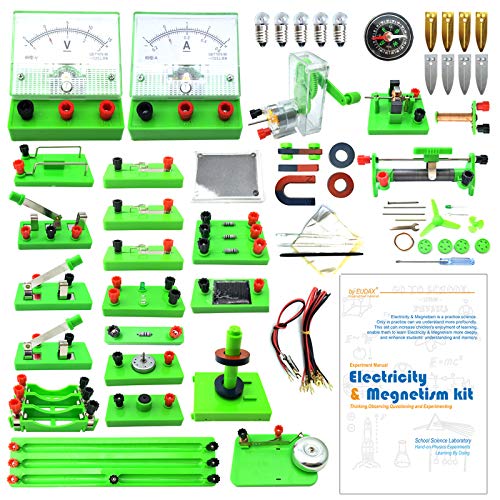
- Includes 79 listed items
- Builds circuits, electromagnets, and a generator
- Color manual guides hands-on experiments
Best For: Grades 9–11 exploring electricity and magnetism
Hydraulic Robotics Project

- Builds a functional hydraulic arm
- Requires no batteries
- Offers six axes and a movable gripper
Best For: Teens seeking an in-depth mechanical robotics build
Mechanical Systems Builder

- Includes 20 builds and 22 experiments
- Covers gears, forces, gravity, and energy
- 80-page manual guides varied projects
Best For: Beginners exploring mechanical engineering concepts
Advanced Circuit Exploration

- More than 750 electronic projects
- Includes guided student training materials
- Features advanced components and computer interface
Best For: Beginning electronics learners seeking structured, hands-on circuit practice
Structural Design Fundamentals
Thames & Kosmos Architectural Engineering

- Build more than 20 structural models
- Explores trusses, arches, domes, and buildings
- Includes a 44-page illustrated manual
Best For: Architecture and structural-design learners who prefer guided model building
Hands-On Mechanical Building

- Includes 194 precision-finished metal pieces
- Builds two mechanical designs one at a time
- Includes illustrated instructions and hand tools
Best For: Learners who enjoy manual assembly and mechanical vehicle-style models
Hands-On RC Construction
5-in-1 STEM Robot Excavator Kit

- 430 pieces with five construction-themed models
- Remote and app control with programming features
- Supports creative thinking and problem-solving
Best For: Beginners who enjoy RC vehicles and construction engineering
Physics in Motion
Engino Inertia, Friction & Circular Motion Kit

- Build six working physics models
- Includes theory, experiments, and quizzes
- Adds an interactive 3D building app
Best For: Structured physics learning through guided projects
Mechanical Design Challenge

- Combines motors, circuits, and mechanical movement
- Wooden build develops patience and problem-solving
- No soldering required; six AA batteries are needed
Best For: Teens and classrooms exploring introductory robotics
Structural Model Builder – Bridges & Skyscrapers
For shoppers comparing engineering building sets for high school students, this Thames & Kosmos kit offers a practical introduction to structural engineering through 20 models. Builders explore force, load, compression, tension, and building materials with reusable components and an illustrated manual.
Best For: Students who enjoy construction-focused projects and want to connect hands-on models with basic mechanical physics.
Pros:
- Supports 20 different structural models.
- Explores force, load, compression, and tension.
- Includes more than 285 interchangeable plastic pieces.
- Comes with a 36-page manual and assembly guide.
Cons:
- The manufacturer recommends it for ages 8–14, so older high school students may find it introductory.
- It focuses on structural models rather than electronics or powered mechanisms.
This is a solid choice for learners interested in bridges, skyscrapers, and the physics of structures. Its intermediate skill level and guided experiments make it more educational than a basic construction toy, though advanced students may want a more specialized challenge.
Physics Lab Explorer – Electricity & Magnetism Experiments
Among engineering building sets for high school students, this EUDAX kit stands out for its broad set of electricity and magnetism experiments. It provides components and a color manual for building circuits, investigating electromagnetism, and exploring concepts such as Ohm’s law.
Best For: Students in grades 9–11 who want a guided, experiment-based introduction to basic electricity and magnetism.
Pros:
- Includes 56 electricity items and 21 magnetism items.
- Supports series circuits, parallel circuits, fruit batteries, electromagnets, and more.
- Offers hands-on investigations of Ohm’s law and magnetic effects.
- Includes a color-page manual, repair tools, and a storage bag.
Cons:
- Three AA batteries are required but not included.
- The kit is focused on basic experiments rather than advanced electronics.
With 79 listed items and several project options, this is a versatile lab-style kit for students who learn best by testing circuits and building simple models. Buyers should plan to supply the required batteries before beginning.
Hydraulic Robotics Project – Working Hydraulic Robot Arm
This Teach Tech Hydrobot is a project-oriented option among engineering building sets for high school students. Instead of using batteries, builders assemble a working hydraulic arm and use water-powered controls to investigate mechanics, fluid power, and robotic movement.
Best For: Students ages 12 and up who want a multi-hour mechanical engineering build with a functional result.
Pros:
- Builds a working hydraulic robotic arm.
- Uses water power, so no batteries are required.
- Provides six axes of movement and rotation up to 270 degrees.
- The gripper can be replaced with suction components for picking up objects.
Cons:
- Assembly requires careful following of detailed instructions and can take multiple hours.
- It is a single focused project rather than a collection of separate builds.
- The supplied instructions are in English.
This kit is a strong match for teens who prefer building a functioning mechanism over completing many small experiments. Its hydraulic controls and movable gripper offer a clear demonstration of fluid power, although the build demands patience and attention to assembly.
Mechanical Systems Builder – Machines & Vehicles
For families seeking engineering building sets for high school students, this Thames & Kosmos set combines 20 mechanical building projects with 22 supplemental experiments. The reusable system covers machines, vehicles, forces, gears, gravity, momentum, and energy through models such as cranes, windmills, and an all-wheel-drive ATV.
Best For: Students who want broad exposure to mechanical engineering and real-world machine applications.
Pros:
- Includes 20 hands-on building projects and 22 experiments.
- Builds models including a tightrope walker, elevator, crane, windmill, and ATV.
- Explains forces, simple machines, gears, momentum, and energy conversion.
- Provides an 80-page, full-color manual with illustrated instructions.
Cons:
- The manufacturer recommends it for ages 8 and up, so advanced high school students may find some material introductory.
- It focuses on mechanical systems and does not provide electronics projects.
This is one of the more comprehensive options here for exploring mechanical engineering concepts through varied builds. The combination of models, experiments, and real-world examples makes it a useful starting point for curious beginners who want more than a single construction project.
Advanced Circuit Exploration – Snap Circuits Extreme SC-750R
For shoppers comparing engineering building sets for high school students, the SNAP CIRCUITS Extreme SC-750R is an electronics-focused option built around hands-on circuit experimentation. Its 80-plus pieces, guided study materials, and more than 750 project combinations provide a broad introduction to electrical engineering concepts.
Best For: Older children and beginning electronics learners who want structured projects involving radios, switches, sound, light, and other circuits.
Pros:
- Supports more than 750 electronic project combinations.
- Includes a student training program and study guide for more structured learning.
- Adds advanced components such as an electromagnet, solar cell, analog meter, and computer interface.
- Projects include an AM radio, lie detector, sound-activated switch, and adjustable light controller.
Cons:
- The large number of projects may feel overwhelming without guided use.
- Its focus is electrical engineering rather than architectural or mechanical construction.
- The recommended age range is 8–15, so older high school students may find the material introductory.
The SC-750R stands out when circuit building and curriculum-style exploration matter most. The included interface and training materials give it more depth than a basic snap-together electronics kit.
Structural Design Fundamentals – Thames & Kosmos Architectural Engineering
Among engineering building sets for high school students, the Thames & Kosmos Architectural Engineering kit emphasizes how structures work. Builders progress from trusses, arches, and domes to scaled-down versions of real-world buildings while using flexible pieces that mimic steel frames.
Best For: Students interested in architecture, structural elements, building materials, and guided model construction.
Pros:
- Builds more than 20 models, including structural elements and real-world buildings.
- Covers trusses, arches, domes, modern materials, and architectural design.
- Includes a 44-page full-color manual with guided exercises.
- Plastic parts are compatible with other Thames & Kosmos engineering and physics kits.
Cons:
- It is primarily a structural and architectural kit, not an electronics or mechanical set.
- The recommended age range is 8–14, which may make it less challenging for advanced high school students.
- Only plastic building parts and the manual are included, with no batteries or powered elements.
This kit is a practical choice for exploring structural engineering through progressively more complex models. Its manual helps keep projects focused while leaving room for original designs.
Hands-On Mechanical Building – 3D Metal Engineering Kit
For buyers seeking engineering building sets for high school students with a tangible mechanical focus, this 194-piece metal kit offers a hands-on assembly challenge. The set uses precision-finished metal components to create two mechanical designs, with illustrated instructions plus a screwdriver and wrench included.
Best For: Builders ages 8 and up who want to practice assembly, spatial reasoning, concentration, and creative mechanical design.
Pros:
- Includes 194 metal components for detailed construction.
- Develops logical thinking, spatial imagination, concentration, and hands-on ability.
- Provides step-by-step illustrated instructions and the basic tools needed for assembly.
- Allows two unique mechanical designs, including an off-road vehicle-style model.
Cons:
- Only one model can be built at a time.
- The kit focuses on manual assembly rather than powered or electronic engineering.
- Small metal parts and tools may require supervision for younger builders.
This set is best suited to learners who enjoy fastening parts together and seeing a mechanical form take shape. Its metal construction and included tools make the activity feel closer to a small-scale assembly project than a conventional plastic building set.
Hands-On RC Construction – 5-in-1 STEM Robot Excavator Kit
For shoppers comparing engineering building sets for high school students, this 430-piece kit offers a construction-focused introduction to robotics and mechanical design. Builders can create five model styles, including an RC excavator, robot, and loader, then control the finished model with a remote or mobile app.
Best For: Younger learners and beginners who enjoy construction vehicles, app-controlled play, and guided STEM building projects.
Pros:
- Includes 430 parts and five model options for repeated building.
- Offers remote-control and app-control operation, including programming and navigation features.
- Connects assembly with logical thinking, troubleshooting, and basic engineering concepts.
- Uses non-toxic ABS plastic and is described as ASTM- and CPSIA-certified.
Cons:
- The listed age guidance varies, with manufacturer information indicating ages 6–10 while the description also mentions older children.
- Requires a battery for operation, and the set is designed for one player.
This is a lively entry-level option rather than an advanced high-school engineering project. Its strongest appeal is the combination of construction-themed models, hands-on assembly, and programmable app play.
Physics in Motion – Engino Inertia, Friction & Circular Motion Kit
This Engino set is a strong choice for engineering building sets for high school students who want the science behind a working model. It explores inertia, friction, and circular motion through six buildable projects, supported by theory, experiments, quizzes, and an interactive 3D app.
Best For: Students who prefer structured physics exploration, explanatory reading, experiments, and multiple mechanical models.
Pros:
- Builds six working models, including a rocket launcher, crash test rig, and sharpening wheel.
- Includes 12 pages of theory, experiments, a quiz section, and an instruction manual.
- The free interactive 3D app adds a virtual building experience.
- Targets concentration, critical thinking, construction skills, and logical thinking.
Cons:
- The recommended age is 9 and up, so advanced students may find the projects introductory.
- The set uses plastic components and contains one primary building kit rather than a large multi-project parts collection.
Among these options, this is the clearest fit for learners who want engineering concepts explained alongside construction. Its educational materials make it especially useful for independent study or a guided STEM activity.
Mechanical Design Challenge – DIY Robot Arm Engineering Kit
For hands-on engineering building sets for high school students, this wooden robot arm kit combines mechanical assembly with introductory circuits. Builders work with motors, a PCB microcontroller board, wires, and wooden components to create and operate a mechanical hand without soldering.
Best For: Teens, older children, adults, and classroom or family projects focused on robotics, circuits, and patient step-by-step construction.
Pros:
- Introduces circuits, motors, mechanical movement, and basic robotics in one project.
- Provides a challenging wooden build that supports patience and problem-solving.
- No soldering is required, and the kit includes the listed assembly accessories.
- Can suit personal projects, school science classes, camps, or family STEM activities.
Cons:
- Requires six AA batteries, which are not included.
- The build is a single robot-arm project rather than a collection of alternate models.
- Wooden precision parts and electronic connections may require more patience than a basic block set.
This is the most mechanically focused choice in the group. It offers a more substantial project for learners ready to move beyond simple blocks and explore how electrical controls produce physical movement.
How We Picked These Engineering Building Sets for High School Students
We focused on kits that offer meaningful hands-on engineering practice rather than simple assembly alone. The selection includes projects involving structures, forces, motion, circuits, magnetism, hydraulics, mechanical systems, programming-adjacent robotics, and model design. We also considered project variety, reusable components, age guidance, learning value, and how well each set can support independent or family-assisted work.
Because “high school student” can describe a wide range of experience, the list includes approachable introductory kits as well as more involved construction and experiment sets. Check each product’s stated age range and contents before buying, particularly when selecting a kit for an older beginner or an advanced student.
Quick Comparison
| Best For | Look For |
|---|---|
| Structures and architecture | Bridge, skyscraper, and structural-element modeling |
| Physics experimentation | Guided labs covering electricity, magnetism, motion, or friction |
| Mechanical engineering | Gears, machines, vehicles, linkages, and moving mechanisms |
| Electronics | Clearly labeled components, many circuits, and reusable modules |
| Robotics and building | Motors, remote control, articulated arms, or multiple build options |
| Open-ended STEM projects | Versatile parts, strong instructions, and room for experimentation |
Key Buying Factors
Match the Subject to the Student’s Interests
A student fascinated by buildings may get more from a structural or architectural engineering set, while someone interested in coding, machines, or automation may prefer a robot arm or motorized construction kit. Electronics and physics lab sets are better choices for learners who enjoy measuring results and following experiments.
Check the Challenge Level and Age Range
Age labels are useful starting points, but they do not measure prior experience precisely. Look at whether the kit requires careful small-part assembly, reading diagrams, using batteries, or troubleshooting circuits. A guided set can build confidence; a modular set with many possible models may suit a student who wants more independence.
Consider Project Variety and Replay Value
Multiple models, experiments, or mechanisms generally provide better long-term value than a kit with one finished object. Favor sets that allow parts to be rebuilt, compared, and modified. Reusable components also make it easier to create original designs after the instructions are complete.
Review What Is Included
Confirm whether batteries, tools, motors, controllers, wires, or specialized accessories are included. Also consider workspace and storage: larger structural models and robotics projects need more room than compact circuit kits. For younger users, supervise small parts, batteries, tools, and any project involving moving components.
Who Should Buy Which Engineering Building Sets for High School Students?
Choose a structural or architectural kit for students drawn to bridges, towers, load distribution, and design. Pick a mechanical engineering set for learners who enjoy gears, vehicles, machines, and cause-and-effect motion. Physics and electricity kits are strongest for students who want classroom-style experiments and measurable results.
Electronics training kits suit beginners who want many circuit-building opportunities, while hydraulic and robot-arm sets offer an engaging introduction to mechanisms and control. A multi-build robotics or construction kit is the better choice for a student who values variety, imaginative projects, and physical problem-solving. When in doubt, prioritize the student’s interests and the level of guidance they are likely to use consistently.