
Engineering building sets can turn homeschool STEM lessons into practical design challenges. Students explore structures, machines, bridges, and city planning while practicing measurement, problem-solving, and persistence.
We selected 10 sets with different project styles, skill levels, and construction systems so you can match a kit to your child’s age, curriculum goals, and available learning space.
Best 10 Engineering Building Sets for Homeschool Picks for 2026
Best Overall for Architectural Exploration

- Builds 26 architectural and structural models
- Includes a 44-page illustrated manual
- Designed for ages 8–14
Best For: Architecture-focused homeschool STEM learning
Best for Younger Builders

- Includes nine STEM building challenges
- Uses gears, pulleys, belts, and connectors
- Designed for ages 5–8
Best For: Early elementary engineering practice
Best for Structural Engineering Lessons

- Builds 20 structural models
- Explores force, load, compression, and tension
- Includes 287 plastic pieces and a 36-page manual
Best For: Intermediate bridge and skyscraper studies
Best for Collaborative Bridge Building

- Includes 207 K’NEX pieces
- Builds 13 real-world bridge types
- Supports grades 3–5 and small-group work
Best For: Hands-on bridge and infrastructure lessons
Hands-On Physics Pick

- Build 26 models with gears and six classic simple machines.
- Use the included spring scale to measure forces.
- Includes a 32-page illustrated instruction and science manual.
Best For: Homeschool physics lessons for ages 8 and up
Structural Engineering Choice
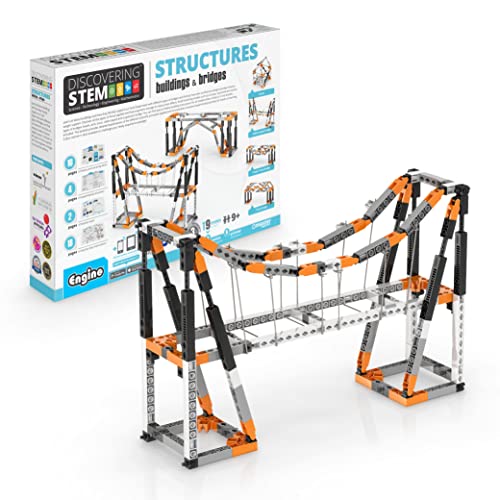
- Construct nine building and bridge models.
- Explores real structural engineering principles.
- Includes theory, experiments, quizzes, instructions, and an app.
Best For: Guided STEM and architecture projects for ages 9 and up
Early Engineering Starter
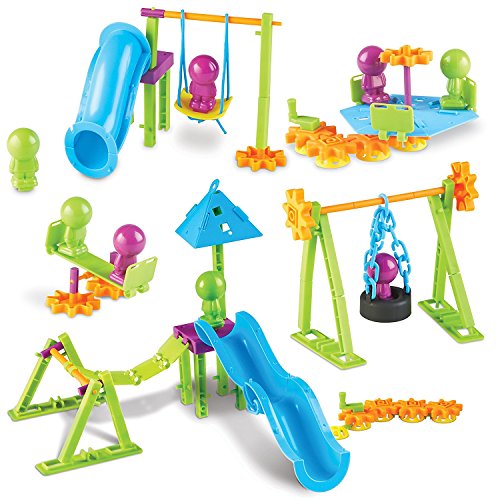
- Build playground-style structures with 104 pieces.
- Includes challenge cards, worksheets, and an activity guide.
- Supports screen-free STEM play for ages 5 to 12.
Best For: Elementary homeschool design and building activities
Best Metal Engineering Set

- 236 metal pieces for construction projects
- Includes updated step-by-step instructions
- Supports problem-solving and fine-motor skills
Best For: Older children, teens, and guided homeschool engineering activities
Best Guided Preschool Set
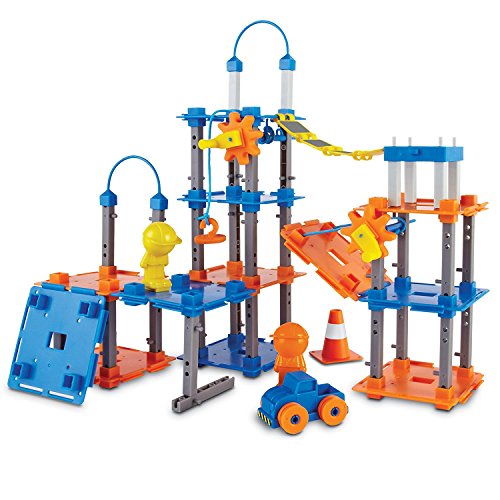
- 89 pieces for towers, bridges, and cities
- Activity cards guide design challenges
- Designed for ages 5 to 8
Best For: Preschool and early elementary homeschool STEM lessons
Best for Group Building

- 600 pieces support shared building projects
- Includes wheels and multidirectional connectors
- Comes with a storage box
Best For: Collaborative preschool and early elementary building activities
Best Overall for Architectural Exploration – Architectural Engineering
For families comparing engineering building sets for homeschool, this Thames & Kosmos kit offers a structured introduction to architectural design. Children ages 8 and up build more than 20 models, progressing from trusses, arches, and domes to scaled-down real-world buildings.
Best For: Homeschool learners interested in architecture, structural elements, and guided STEM building activities.
Pros:
- Builds 26 models covering basic structures and real-world buildings.
- Flexible pieces mimic steel frames and the plastic parts work with other Thames & Kosmos engineering and physics kits.
- Includes a 44-page, full-color manual with guided exercises and design prompts.
Cons:
- Recommended for ages 8–14, so it may be too advanced for younger children.
- Its architectural focus may be narrower than a general construction set.
Choose this set when you want a guided, architecture-centered homeschool activity that combines model building with planning and structural exploration.
Best for Younger Builders – Machine Makers
Among engineering building sets for homeschool, Learning Resources STEM Explorers Machine Makers is designed for younger children ages 5–8. Its 50 pieces support nine challenges involving gears, pulleys, belt drives, and connectors.
Best For: Early elementary homeschoolers developing basic engineering, physics, critical-thinking, and problem-solving skills.
Pros:
- Includes nine hands-on STEM challenges.
- Children can build machines such as a satellite dish, crane, and space rover.
- Compatible with Gears! Gears! Gears! sets for expanded building options.
- No batteries are required.
Cons:
- The set is intended for ages 5–8 and may not challenge older learners.
- Its 50-piece design offers less component variety than larger engineering sets.
This is a practical entry point for homeschool lessons that emphasize experimentation and iteration without requiring batteries or complex equipment.
Best for Structural Engineering Lessons – Bridges & Skyscrapers
For homeschool students ready to study how structures handle forces, this Thames & Kosmos engineering set provides an intermediate building experience. The models introduce load, compression, tension, and related mechanical-physics concepts through 20 structures.
Best For: Ages 8–14 studying bridges, skyscrapers, structural forces, and building materials in a focused science lesson.
Pros:
- Builds 20 different structural models.
- Includes more than 285 interchangeable building pieces.
- Comes with a 36-page illustrated experiment manual and assembly guide.
Cons:
- Its intermediate skill level may require adult guidance for some learners.
- The primary focus is structural engineering rather than broad, open-ended construction.
Consider this kit when your homeschool curriculum calls for concrete demonstrations of tension, compression, force, and load through repeatable model-building exercises.
Best for Collaborative Bridge Building – Intro to Structures: Bridges
K’NEX Education’s Intro to Structures: Bridges is a strong option for homeschool families seeking engineering building sets for homeschool with a real-world infrastructure focus. Its 207 rods, stems, and connectors let learners construct 13 functioning bridge replicas and explore several bridge designs.
Best For: Grades 3–5 learners working independently or in small groups on bridge types, construction, and STEAM concepts.
Pros:
- Builds 13 bridge models, including truss, arch, suspension, cantilever, and cable-stayed types.
- Snap-fit pieces can be reassembled into new creations, including buildings, houses, and towers.
- Includes a portable storage tray with a snap-on lid.
- Teacher materials and lesson plans support hands-on, standards-aligned learning.
Cons:
- The set is specifically centered on bridges and structures.
- Its intended grade range may not suit preschoolers or advanced older students.
This set fits a classroom-style homeschool routine especially well, offering collaborative construction, organized storage, and guided lessons connected to real-world bridge infrastructure.
Hands-On Physics Pick – Simple Machines
For families comparing engineering building sets for homeschool, the T&K Simple Machines kit offers a focused way to explore how everyday mechanisms work. Learners build 26 models involving gears and all six classic simple machines, then use the included spring scale to measure changes in force.
Best For: Homeschool students ages 8 and up who want structured, hands-on physics and engineering activities.
Pros:
- Covers levers, pulleys, wheels and axles, inclined planes, screws, and wedges.
- Includes a spring scale for practical force measurement.
- Provides a 32-page illustrated manual with step-by-step instructions and science explanations.
- Modular pieces are compatible with other Thames & Kosmos construction, physics, and engineering kits.
Cons:
- The curriculum is centered specifically on simple machines rather than broad construction projects.
- Plastic components may be less suitable for children below the recommended age of 8.
This is a strong choice when your homeschool plan calls for concrete demonstrations of force, motion, and mechanical advantage. The included measuring tool adds an experiment component beyond basic model building.
Structural Engineering Choice – Buildings & Bridges
The Engino Structures, Buildings & Bridges set is a practical option for families seeking engineering building sets for homeschool with a structural-design focus. Children can construct nine models, including houses, pyramids, and several bridge types, while learning the principles behind each design.
Best For: Learners ages 9 and up who are ready for guided construction, structural engineering concepts, and STEM projects.
Pros:
- Offers nine real engineering models, including beam, arch, truss, cable-stayed, and suspension bridges.
- Includes instructions, theory and facts, experiments, a quiz book, and a free app.
- Snap-fit components connect in multiple directions for more complex three-dimensional builds.
- Supports construction skills, creative thinking, and engineering skills.
Cons:
- Its recommended starting age of 9 may be too advanced for younger homeschool students.
- The set emphasizes structured models, so it may offer less open-ended play than a general building kit.
Choose this set when you want building projects tied directly to architecture and bridge design. Its theory content, experiments, and quiz provide useful support for a more formal homeschool STEM unit.
Early Engineering Starter – Playground Design
For younger learners, the Learning Resources Playground Engineering & Design Building Set brings engineering building sets for homeschool into an approachable, screen-free format. Children can follow challenge cards and blueprints or invent their own playground-style structures using 104 pieces.
Best For: Homeschool children ages 5 to 12 developing early engineering, problem-solving, coordination, and fine motor skills.
Pros:
- Designed for hands-on, open-ended playground construction and repeatable rebuilding.
- Includes challenge cards, an activity guide, reproducible worksheets, and an art component supporting STEAM lessons.
- Works for independent or group activities at home or in a classroom.
- Requires no batteries and supports screen-free play.
Cons:
- The playground theme is narrower than a general-purpose construction set.
- It may provide less advanced engineering theory for older students.
- No manufacturer warranty is listed.
This set fits best at the elementary level, especially when you want flexible activities that combine building with worksheets and design challenges. It is a sensible starting point before moving to more technical bridge or simple-machine kits.
Best Metal Engineering Set – 236-Piece Erector Kit
For families comparing engineering building sets for homeschool, this 236-piece metal Erector kit offers a hands-on way to explore construction, mechanics, and problem-solving. Children ages 8 and up can follow the updated step-by-step guide or experiment with their own designs, without batteries or screens.
Best For: Older children, teens, and families seeking a durable metal set for guided builds, tinkering, and introductory engineering activities.
Pros:
- 236 metal pieces support construction and model-building projects.
- Step-by-step instructions help learners connect pieces and complete models.
- Encourages fine-motor skills, logical thinking, creativity, and problem-solving.
- Manual, battery-free play can support individual or collaborative projects.
Cons:
- The recommended age of 8 and up may make it too advanced for preschool learners.
- Metal construction pieces may require more patience and dexterity than simple plastic blocks.
This is a strong choice when your homeschool plans include more advanced, hands-on building. Its metal components and guided instructions provide structure, while open-ended tinkering leaves room for creative engineering challenges.
Best Guided Preschool Set – City Engineering & Design Kit
For younger learners using engineering building sets for homeschool, the City Engineering & Design Building Set introduces basic design concepts through towers, bridges, and city structures. Its activity cards organize projects around asking, imagining, planning, creating, and improving.
Best For: Preschool and early elementary learners ages 5 to 8 who benefit from short, guided engineering challenges and open-ended city building.
Pros:
- 89-piece set provides materials for towers, bridges, and city structures.
- Activity cards make the engineering design process easier to introduce.
- Children can follow challenges or create their own designs.
- Suitable for tables at home, in classrooms, or in homeschool spaces.
Cons:
- The set is aimed at younger learners and may feel limited for older children.
- It focuses on basic engineering concepts rather than advanced mechanical construction.
This kit works well as a structured introduction to engineering thinking. The city theme can make abstract design steps more approachable, while the open-ended format gives children room to extend activities beyond the included cards.
Best for Group Building – 600-Piece Straw Constructor
Families looking for flexible engineering building sets for homeschool can use this 600-piece straw constructor for freeform structures, models, and collaborative challenges. Colorful straws, connectors, wheels, and multidirectional pieces allow children ages 3 and up to build shapes such as vehicles, castles, robots, and animals.
Best For: Preschool and early elementary groups that need a high-piece-count set for imaginative, cooperative building indoors or outdoors.
Pros:
- 600 pieces provide enough materials for multiple children to build together.
- Connectors, wheels, and multidirectional parts support varied shapes and models.
- Encourages engineering skills, spatial reasoning, imagination, and teamwork.
- Includes a storage box and is designed for battery-free play.
Cons:
- The open-ended format may require an adult to provide project ideas or structure.
- The recommended age range begins at 3, so very young children may need supervision with the pieces.
This set is particularly useful for shared homeschool activities because its large quantity supports cooperative projects. It is less curriculum-directed than an activity-card kit, but its flexibility makes it easy to adapt for building prompts, design challenges, and imaginative play.
How We Picked the Best Engineering Building Sets for Homeschool
We focused on kits that support hands-on engineering concepts rather than open-ended construction alone. The selection includes structure and bridge sets, simple-machine activities, architectural models, city and playground design, reusable building systems, and classroom-oriented STEM kits.
We also considered project variety, age suitability, the usefulness of included components, and whether a set can support guided lessons or independent exploration. Product descriptions and recommended ages should still be checked carefully, since piece size, tools, and project complexity vary.
Quick Comparison
| Best For | Look For |
|---|---|
| Structures and architecture | Model plans, structural elements, bridges, and skyscrapers |
| Physics lessons | Levers, pulleys, gears, wheels, and other simple machines |
| Younger learners | Large, easy-to-connect parts and short guided projects |
| Older elementary students | More detailed builds, engineering challenges, and testing |
| Group learning | Large piece counts, multiple project options, and collaborative activities |
Key Buying Factors for Engineering Building Sets for Homeschool
Age, Skill Level, and Supervision
Choose a kit that is challenging without requiring constant adult correction. Younger children generally benefit from larger connectors, visual instructions, and quick successes. Older students can handle smaller components, more complex plans, and projects that require redesigning a failed model.
Curriculum Fit
Match the set to the lesson you want to teach. Bridge and skyscraper kits are useful for forces, balance, compression, and tension. Simple-machine sets support introductory physics. City, playground, and architectural kits can connect engineering with planning, geometry, accessibility, and real-world design.
Project Variety and Reusability
A kit with multiple build plans is more useful for a full homeschool term than one that produces only a single model. Check whether parts can be rebuilt into original designs and whether instructions encourage testing, recording results, and improving the structure.
Parts, Storage, and Durability
Count the pieces and consider how they will be organized between lessons. Interlocking plastic parts are often easy to rebuild, while metal construction sets may offer a different tactile experience but can require tools and closer supervision. A storage container or labeled compartments can prevent lost connectors from limiting future projects.
Who Should Buy Which Engineering Building Sets for Homeschool?
Choose an architectural or structures-focused set for students interested in buildings, bridges, and visual design. A simple-machines kit is a strong choice for introducing motion and mechanical advantage. For collaborative lessons, prioritize larger sets with plenty of pieces and several simultaneous project options.
Families teaching younger children should favor straightforward connectors and guided activities, while older elementary learners may get more value from detailed construction systems and open-ended engineering challenges. If you want the most flexible long-term option, select a durable kit that combines instructions with enough parts for experimentation and redesign.