
The best engineering building sets for science fairs turn abstract STEM concepts into working models students can build, test, measure, and improve. This roundup covers structures, machines, circuits, hydraulics, solar power, and engine mechanics for a range of ages and project goals.
Use the guide below to match a kit with your student’s experience level, available preparation time, and the kind of experiment or demonstration they want to present.
Best 10 Engineering Building Sets for Science Fairs Picks for 2026
Architectural Design Lab

- Build 26 models of structures and buildings
- Explores trusses, arches, domes, and steel-frame concepts
- Includes a 44-page full-color manual
Best For: Young builders interested in architecture and structural design
Hydraulic Robotics Workshop
Hydrobot Hydraulic Arm STEM Kit

- Builds a working water-powered robotic arm
- Six axes with up to 270-degree rotation
- Includes a controllable gripper and suction components
Best For: Ages 12+ exploring hydraulics and mechanical engineering
Structural Forces Studio
Bridges & Skyscrapers Engineering Set

- Build 20 bridge and skyscraper models
- Explores force, load, compression, and tension
- Includes over 285 interchangeable pieces
Best For: Intermediate structural-engineering projects for ages 8–14
Da Vinci Mechanics Workshop
Da Vinci Catapult Wood STEM Kit

- Build a ballista, bombard, and catapult
- Includes laser-cut wood, rubber bands, and sandpaper
- No special tools or batteries required
Best For: Ages 12+ exploring historical machines and mechanical construction
Best Circuit Experiment Kit

- Eight guided electricity experiments
- Includes a circuit learning book
- Covers series, parallel, fruit, and saltwater power
Best For: Ages 8–12 exploring introductory electrical engineering
Best Working Engine Model
National Geographic 4-Cylinder Engine Kit
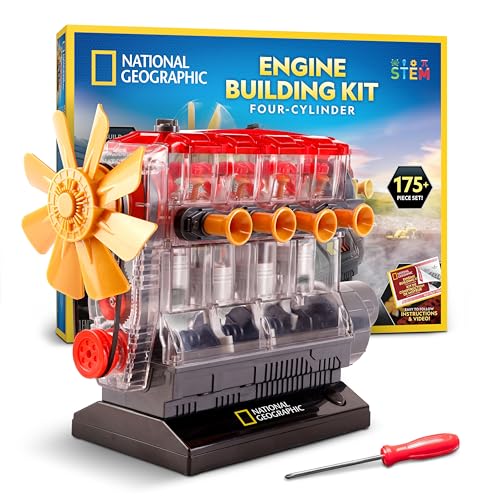
- Builds a clear four-cylinder engine
- Features moving pistons, valves, and gears
- Includes 175-plus pieces, tools, and guides
Best For: Ages 10+ presenting a mechanical engineering demonstration
Best Rebuildable Maker Set
PATHFINDERS Engineering Maker Set

- Builds hydraulic and mechanical machines
- Includes 10 challenges and 15 challenge cards
- Uses 156 reusable wood-based pieces
Best For: Ages 8+ conducting open-ended mechanical engineering projects
Solar-Powered Classroom Pick

- Six kits support group activities
- Explores solar power and circuits
- No soldering or special tools
Best For: Elementary classroom groups and solar-energy science fair projects
Structural Engineering Choice
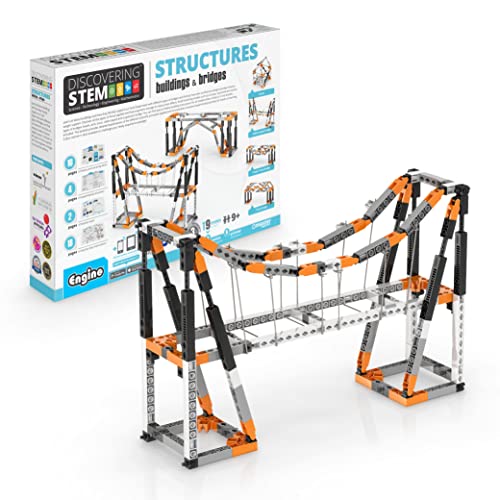
- Offers nine structural models
- Covers multiple bridge designs
- Includes theory, experiments, and a quiz
Best For: Ages 9+ building structure-focused science fair displays
Advanced Mechanics Project

- 703-piece mechanical building project
- Visible moving pistons and engine parts
- USB-powered motor requires no batteries
Best For: Teens and adults presenting automotive engineering projects
Architectural Design Lab – Architectural Engineering Kit
For families seeking engineering building sets for science fairs, this architectural kit offers a broad introduction to structural design. Children ages 8 and up can build 26 models, beginning with trusses, arches, and domes before progressing to scaled-down real-world buildings.
Best For: Young builders exploring architecture, structural elements, and independent STEM design projects.
Pros:
- Includes more than 20 structural and building models.
- Flexible pieces mimic steel frames and are compatible with other Thames & Kosmos engineering and physics kits.
- The 44-page, full-color manual supports guided exercises and original designs.
Cons:
- Recommended for ages 8–14, so it may not suit younger children.
- The kit focuses on plastic construction rather than working powered mechanisms.
This is a versatile choice when a science-fair project benefits from comparing different building forms and materials. Its guided progression also leaves room for creative model development.
Hydraulic Robotics Workshop – Hydrobot Hydraulic Arm STEM Kit
This hydraulic robot arm is a hands-on option among engineering building sets for science fairs, especially for students interested in fluid power and mechanical control. Designed for ages 12 and up, it requires assembly and uses water rather than batteries to operate six axes.
Best For: Older students who want a working engineering demonstration involving hydraulics, motion, and a controllable gripper.
Pros:
- Builds a functioning hydraulic arm with six axes and up to 270-degree rotation.
- Water-powered design requires no batteries.
- Levers control a gripper that can open, close, or be replaced with suction components.
- Detailed instructions support a multi-hour assembly project.
Cons:
- Recommended for ages 12 and up.
- Assembly requires patience and careful adherence to the instructions.
Compared with static building sets, the Hydrobot gives a science-fair display a visible mechanical outcome. It is best suited to students prepared for an in-depth build rather than a quick construction activity.
Structural Forces Studio – Bridges & Skyscrapers Engineering Set
For science-fair learners comparing how structures handle forces, this intermediate set provides 20 bridge and skyscraper models to build. Its interchangeable components and illustrated manual introduce concepts including load, force, compression, and tension.
Best For: Ages 8–14 investigating structural engineering and mechanical physics through multiple model configurations.
Pros:
- Offers 20 different models focused on bridges and skyscrapers.
- Includes more than 285 interchangeable building pieces.
- The 36-page manual combines assembly guidance with illustrated experiments.
Cons:
- Listed as an intermediate-level set.
- Its recommended age range may limit use for younger students.
This set is a strong fit when a project needs repeated structural comparisons rather than one finished model. The variety of builds can help students organize observations about tension, compression, and load.
Da Vinci Mechanics Workshop – Da Vinci Catapult Wood STEM Kit
This wood-based kit gives older students a compact, manual engineering project for science-fair demonstrations. Rather than focusing on modern structures, it recreates three Leonardo da Vinci-inspired machines—a ballista, bombard, and catapult—with laser-cut components and rubber bands.
Best For: Students ages 12 and up who want to demonstrate construction skills, mechanical motion, and historical engineering.
Pros:
- Builds three distinct working-style machines: a ballista, bombard, and catapult.
- Includes laser-cut wooden parts, rubber bands, sandpaper, and instructions.
- Each model is designed for assembly in approximately one to three hours.
- No special tools or batteries are required.
Cons:
- Recommended for ages 12 and up.
- The project centers on three historical machines rather than a broad range of structures.
This is a practical choice for a science-fair display that benefits from a clear historical connection and manually operated mechanisms. Its three separate builds can also support comparisons between different launching designs.
Best Circuit Experiment Kit – Electric Circuit Science Kit
For engineering building sets for science fairs, this circuit kit offers a focused way to demonstrate electricity and conductivity. It includes eight guided experiments, including series and parallel circuits, saltwater power generation, and fruit batteries. Note that AA batteries are required but not included.
Best For: Kids ages 8–12 working on introductory electricity projects at home or in the classroom.
Pros:
- Includes eight experiments across seven packs.
- Guided circuit book supports step-by-step learning.
- Introduces series circuits, parallel circuits, conductivity, and energy.
Cons:
- AA batteries are required and must be purchased separately.
- Its focus is electrical experimentation rather than mechanical construction.
This is a practical choice when a science-fair project needs a clear electricity theme and repeatable demonstrations. The guided format can help younger learners organize their work and explain the underlying concepts.
Best Working Engine Model – National Geographic 4-Cylinder Engine Kit
Among engineering building sets for science fairs, this National Geographic kit stands out as a visual mechanical demonstration. Builders assemble a clear four-cylinder engine with more than 175 pieces, then use three AA batteries to operate the moving pistons, valves, and gears. Batteries are not included.
Best For: Builders ages 10 and up who want a hands-on project demonstrating engine mechanics and motion.
Pros:
- Clear working model makes the pistons, valves, and gears visible.
- Includes more than 175 parts, tools, instructions, and a learning guide.
- Provides a substantial construction-focused STEM activity.
Cons:
- Requires three AA batteries, which are not included.
- The 175-plus-piece assembly may need more time and patience than a simple experiment.
This kit is well suited to a presentation where demonstrating moving parts matters. Its transparent design lets students show how several engine components work together, while the assembly process adds construction and problem-solving practice.
Best Rebuildable Maker Set – PATHFINDERS Engineering Maker Set
For engineering building sets for science fairs that encourage repeated testing, the PATHFINDERS Engineering Maker Set combines wood construction with hydraulics, gears, levers, and pulleys. Its manual provides 10 guided challenges, while 15 challenge cards invite students to develop their own solutions.
Best For: Kids ages 8 and up, maker spaces, and classroom projects focused on mechanical advantage and iterative design.
Pros:
- Includes 156 wood-based pieces designed for repeated builds.
- Demonstrates working water-powered hydraulics and mechanical systems.
- Offers both step-by-step challenges and open-ended invention cards.
- Explores levers, gear ratios, hydraulic pressure, and the engineering design process.
Cons:
- Manual operation and water-based hydraulics may require hands-on troubleshooting.
- Its open-ended challenges may require more planning than a single guided model.
This is the strongest option for a science-fair project built around experimentation rather than one finished model. Students can compare designs, troubleshoot hydraulic systems, and explain how changes affect lifting, launching, or movement.
Solar-Powered Classroom Pick – Solar Car Circuit Kits
For group-focused engineering building sets for science fairs, this six-pack solar car kit gives students a practical way to explore circuits, solar energy, and gear transmission. The plug-in design and illustrated instructions make it suitable for classroom, homeschool, or camp activities.
Best For: Elementary-age classroom groups, science fairs, and hands-on solar energy projects.
Pros:
- Includes six individual kits for group building.
- Introduces solar panels, basic circuits, and gear transmission.
- No soldering or special tools are required.
- Uses non-toxic plywood with smooth surfaces and rounded corners.
Cons:
- Recommended for ages 8 and up, so it may be too advanced for younger children.
- Solar operation depends on available sunlight.
This is a practical choice when a science fair or classroom needs multiple accessible projects rather than one complex display. Its main strength is combining simple construction with visible solar-powered movement.
Structural Engineering Choice – Buildings & Bridges Set
This Engino set is one of the more directly relevant engineering building sets for science fairs, with nine model options covering houses, pyramids, and several bridge designs. Its theory pages, experiments, and quiz help connect the building process to structural engineering principles.
Best For: Students ages 9 and up who want to demonstrate bridges, buildings, and real-world structures.
Pros:
- Builds nine engineering models, including truss, arch, suspension, and cable-stayed bridges.
- Includes theory, facts, experiments, and a quiz for deeper learning.
- Snap-fit parts support complex three-dimensional models.
- Designed for use by schools and STEM programs.
Cons:
- It is a single set, not a bulk classroom pack.
- Recommended for ages 9 and up.
Choose this kit when the science fair project needs a strong connection between a physical model and engineering concepts. The range of bridge designs also gives students flexibility in selecting a presentation topic.
Advanced Mechanics Project – Running V8 Engine Model
For older students or adults seeking engineering building sets for science fairs, this 703-piece V8 engine model provides a detailed mechanical project. Its transparent cylinder heads and motorized piston movement make the engine’s internal action visible after assembly.
Best For: Teens 14 and up, adult builders, and mechanics-focused science fair demonstrations.
Pros:
- Includes realistic features such as simulated pistons, a turbocharger, and transparent cylinder heads.
- USB-powered motor lets viewers observe the moving internal parts.
- Offers a substantial 703-piece construction project.
- Supports creativity, logical thinking, and problem-solving through mechanical assembly.
Cons:
- The recommended age is 14 and up, limiting use with younger students.
- Its automotive focus may be less suitable for projects about structures or general physics.
- The set includes an instruction manual but no stated multi-project model options.
This is best treated as an advanced demonstration model rather than a quick classroom activity. The moving engine components can create an engaging science fair display for students interested in mechanics and automotive engineering.
How We Picked These Engineering Building Sets for Science Fairs
We selected kits that support hands-on investigation rather than simple assembly. Each option offers a practical way to explore concepts such as structural strength, motion, energy transfer, mechanical advantage, electricity, hydraulics, or renewable power. We also considered project flexibility, the clarity of the build experience, age suitability, and whether students can change a design and compare results.
For a strong science-fair project, the best kit is not necessarily the most complex. It should provide a repeatable experiment, measurable variables, and enough room for students to explain what changed and why.
Quick Comparison
| Project focus | Good fit | What students can investigate |
|---|---|---|
| Structures | Architectural Engineering; Structures, Buildings & Bridges | Load capacity, stability, shapes, and material efficiency |
| Hydraulics and mechanisms | Hydrobot Arm; PATHFINDERS Engineering Maker Set | Pressure, levers, gears, pulleys, and mechanical advantage |
| Circuits and solar power | Electric Circuit Kit; Solar Car Circuit Kits | Conductivity, circuit design, light output, and solar performance |
| Engines and motion | 4-Cylinder Engine Kit; V8 Engine Model Kit | Crankshafts, pistons, timing, rotational motion, and energy conversion |
| Historical machines | Da Vinci Catapult Kit | Projectile motion, stored energy, and launcher design |
Key Buying Factors for Engineering Building Sets for Science Fairs
Age, Supervision, and Build Complexity
Check the recommended age, small-part warnings, and expected assembly time. Younger students may benefit from guided circuit or solar projects, while older students may be ready for multi-stage structures, hydraulic systems, or visible engine mechanisms. Allow time for troubleshooting and rebuilding.
Experiment Potential
Look for adjustable designs and components that can be tested repeatedly. Useful variables include bridge span, load weight, gear ratio, hydraulic force, panel angle, number of circuit components, or launcher tension. A kit becomes more valuable when students can collect data instead of displaying only a finished model.
Materials and Working Conditions
Confirm whether batteries, glue, tools, measuring equipment, or extra building materials are included. Also consider the presentation space: moving engines, solar cars, and catapults need more room than a static structural model, while electrical projects may require careful wire organization.
Presentation Value
Choose a model that makes the underlying principle easy to demonstrate. Visible moving parts, clear before-and-after comparisons, and a simple test procedure can help students communicate their findings to judges and visitors.
Who Should Buy Which Engineering Building Sets for Science Fairs?
Choose an architectural or bridge-focused kit for students interested in buildings, load testing, and structural design. Pick a hydraulic arm or maker set for hands-on mechanical systems and multiple challenge types. Circuit and solar kits suit students who want straightforward experiments involving electricity, light, or renewable energy.
Engine model kits are best for older students who enjoy detailed mechanical assembly and want to explain how motion transfers through pistons, crankshafts, and rotating components. The catapult kit is a good choice for a focused physics project involving distance, angle, and stored energy. Before buying, match the kit’s complexity to the student’s skills and leave enough time to test several versions before the fair.