
A hard drive enclosure with cooling fan can turn an unused SATA drive into dependable external storage while helping manage heat during long transfers, backups, and media workloads.
Our 2026 roundup covers compact single-drive enclosures, tool-free multi-bay systems, high-speed USB-C models, and RAID-capable options for home, office, and professional use.
Best 10 Hard Drive Enclosure with Cooling Fan Picks for 2026
Best Value
FIDECO Single-Bay Enclosure with Cooling Fan

- Supports 2.5-inch and 3.5-inch SATA drives
- USB 3.0 with UASP and up to 5Gbps transfers
- Tool-free, plug-and-play design with 12V adapter
Best For: Single-drive SATA storage on Windows, Mac, or Linux
Best for Large-Capacity Drives
SABRENT USB 3.0 Dock with Cooling Fan
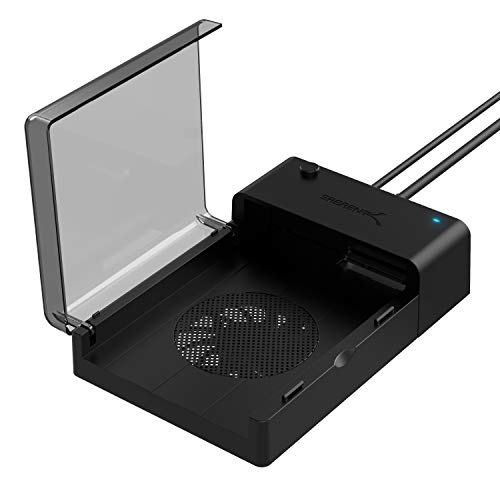
- Supports 2.5-inch and 3.5-inch SATA drives
- Handles hard drives up to 22TB
- Hot-swappable design with free cloning software
Best For: Large-drive backups, cloning, and frequent drive changes
Best Fan Control
Vantec NexStar HX 3.5-Inch Enclosure

- 60mm fan includes on/off and variable-speed control
- Aluminum enclosure with vents for airflow
- Hot-swappable USB 3.0 design for 3.5-inch SATA drives
Best For: Desktop users wanting adjustable cooling for a 3.5-inch drive
Best Multi-Drive Option
CENMATE Aluminum 2-Bay Enclosure

- Holds two 2.5-inch or 3.5-inch SATA drives
- Supports hot swapping and tool-free installation
- USB A/C 3.0 with daisy-chain expansion
Best For: Expanding desktop storage across two drives without RAID or NAS
Best for Maximum Capacity
Yottamaster 5-Bay USB-C Enclosure

- Five SATA bays support up to 110TB total
- 80mm fan and aluminum shell aid cooling
- Non-RAID design with 5Gbps USB-C
Best For: Large independent-drive storage setups
Best for Fast Dual-Bay Expansion
CENMATE 2-Bay 10Gbps Enclosure

- 10Gbps USB 3.2 Gen 2 interface
- Hot-swappable, tool-free dual bays
- Cooling fan and USB-A/USB-C support
Best For: Fast two-drive desktop expansion
Best for Built-In RAID Flexibility

- Supports RAID 0, RAID 1, JBOD, and independent mode
- 10Gbps USB-C with UASP support
- Two-speed fan and aluminum cooling design
Best For: Flexible two-drive RAID storage
Best Overall Capacity

- Four SATA drive bays with up to 80TB capacity
- Cooling fan and aluminum-alloy construction
- USB 3.0 with USB-A/C connectivity
Best For: Flexible external storage without RAID or NAS
Best Flexible RAID Setup

- Four RAID and drive-organization modes
- Four SATA bays with up to 80TB capacity
- Two cooling fans in an aluminum chassis
Best For: Users needing configurable RAID in a four-drive enclosure
Best for Large Arrays

- Ten bays and up to 200TB listed capacity
- Eight RAID and storage modes
- USB 3.0 plus eSATA connectivity
Best For: Advanced multi-drive DAS storage and RAID setups
Best Value – FIDECO Single-Bay Enclosure with Cooling Fan
For a straightforward hard drive enclosure with cooling fan, the FIDECO supports both 2.5-inch and 3.5-inch SATA HDDs and SSDs. Its USB 3.0 connection, UASP support, included 12V power adapter, and tool-free design make it practical for everyday external storage.
Best For: Users who want an affordable, plug-and-play enclosure for one SATA drive.
Pros:
- Supports both 2.5-inch and 3.5-inch SATA drives
- Built-in cooling fan and included 12V power adapter
- USB 3.0 supports transfer speeds up to 5Gbps with UASP
- Works with Windows, Mac, and Linux without drivers
Cons:
- Does not support IDE hard drives
- Holds only one drive
The FIDECO is a sensible choice when you need simple access to a single SATA drive and want active cooling without a more elaborate docking setup. New drives may need to be initialized before the computer recognizes them.
Best for Large-Capacity Drives – SABRENT USB 3.0 Dock with Cooling Fan
The SABRENT is a versatile hard drive enclosure with cooling fan for standard 2.5-inch and 3.5-inch SATA HDDs and SSDs. It combines hot-swappable, tool-free operation with USB 3.0 connectivity and support for drives up to 22TB.
Best For: Users handling large-capacity drives, backups, or frequent drive swaps.
Pros:
- Supports standard 2.5-inch and 3.5-inch SATA drives
- Built-in fan helps keep drives cool
- Hot-swappable, plug-and-play operation without drivers
- Supports capacities up to 22TB and includes free Acronis cloning software
Cons:
- Designed for one drive at a time
- USB 3.0 limits the external connection to up to 5Gbps
With its broad capacity support and easy drive replacement, the EC-DFFN is well suited to backup workflows and storage migration. Its SATA bus supports up to 6Gbps, while the USB connection remains backward compatible with USB 2.0 and USB 1.1.
Best Fan Control – Vantec NexStar HX 3.5-Inch Enclosure
Vantec NexStar HX, 3.5" SATA III Hard Drive Enclosure USB 3.0 With Fan (NST-387S3-BK)
Check Price On AmazonThe Vantec NexStar HX is a substantial hard drive enclosure with cooling fan built specifically for 3.5-inch SATA drives. It pairs an aluminum enclosure with vents and a 60mm fan that includes on/off and variable-speed control.
Best For: 3.5-inch drive owners who want adjustable fan operation and a durable aluminum enclosure.
Pros:
- Large 60mm fan offers on/off and variable-speed control
- Aluminum enclosure and ventilation help manage heat
- Supports SATA III drives with up to 5Gbps USB 3.0 transfers
- Hot-swappable and compatible with Windows, Mac, and Linux systems
Cons:
- Supports 3.5-inch drives only
- Not compatible with phones
- Power-saving mode requires connection to a working computer system
The NexStar HX stands out for users who want more control over active cooling than a fixed-speed fan provides. Its included stand, AC adapter, screw set, and USB cable make it a complete desktop-oriented enclosure package.
Best Multi-Drive Option – CENMATE Aluminum 2-Bay Enclosure
For expanding external storage, the CENMATE is a two-bay hard drive enclosure with cooling fan that accepts 2.5-inch and 3.5-inch SATA HDDs and SSDs. It provides USB A and USB C 3.0 connectivity, tool-free installation, hot swapping, and support for up to 20TB per drive.
Best For: Users who need two-drive external storage and expansion without RAID or NAS functionality.
Pros:
- Two bays support 2.5-inch and 3.5-inch SATA HDDs and SSDs
- Aluminum-alloy body and built-in 2-inch fan aid cooling
- Tool-free, hot-swappable drive installation
- USB A/C 3.0 connectivity and daisy-chain expansion support
Cons:
- Does not provide RAID or NAS functionality
- Fan noise is rated around 40–50 decibels
- USB 3.0 transfers are rated up to 5Gbps
The CENMATE is the most flexible option here for users managing multiple drives or planning a larger storage setup. Its expansion features are useful, but buyers should account for the stated fan noise and the lack of RAID or NAS features.
Best for Maximum Capacity – Yottamaster 5-Bay USB-C Enclosure
If you need a hard drive enclosure with cooling fan for a large multi-drive setup, the Yottamaster PS500C3 offers five SATA bays, USB-C connectivity, and up to 110TB of stated total capacity. Its aluminum shell, removable trays, and 80mm fan make it practical for expanding desktop storage, backups, and media workflows.
Best For: Users who need five independent SATA drives and high-capacity external storage without hardware RAID.
Pros:
- Supports up to five 2.5-inch or 3.5-inch SATA HDDs or SSDs, with up to 22TB per drive.
- Provides a 5Gbps USB 3.1 Gen 1 Type-C connection and stated SSD read/write speeds up to 260MB/s.
- Aluminum construction and a low-noise 80mm fan help with heat dissipation and airflow.
- Removable trays and a push-latch front door simplify drive installation and replacement.
Cons:
- This is a non-RAID enclosure; RAID must be configured through operating-system software.
- Total drive power consumption must remain within the included 78W power adapter’s limit.
- New drives may need to be formatted and partitioned before use.
The PS500C3 is a strong fit when bay count and capacity matter more than built-in RAID. Confirm your drives’ combined power needs and plan to use software RAID if required.
Best for Fast Dual-Bay Expansion – CENMATE 2-Bay 10Gbps Enclosure
The CENMATE 802TC is a hard drive enclosure with cooling fan designed for two 2.5-inch or 3.5-inch SATA drives. It combines USB 3.2 Gen 2 connectivity, tool-free hot swapping, and both USB-A and USB-C cable support for a flexible desktop storage setup.
Best For: Users who want fast two-drive expansion with hot-swappable bays and broad computer compatibility.
Pros:
- USB 3.2 Gen 2 provides up to 10Gbps interface speed, with stated two-drive read/write speeds of 500MB/s.
- Supports two SATA HDDs or SSDs, with up to 20TB per drive.
- Hot swapping allows drives to be replaced without powering off the enclosure.
- Includes USB-A and USB-C connectivity and can daisy-chain with additional enclosures.
Cons:
- The built-in fan is rated around 40–50 decibels, which may be noticeable in quiet spaces.
- This is a DAS enclosure and does not provide RAID or NAS functionality.
- Actual speeds depend on the drives and the connected computer’s interface.
Choose the CENMATE when quick transfers and convenient drive swaps are priorities. Its fan improves airflow, but noise-sensitive buyers should account for the stated 40–50 dB operating level.
Best for Built-In RAID Flexibility – MAIWO Dual-Bay RAID Enclosure
For buyers seeking a hard drive enclosure with cooling fan and selectable storage modes, the MAIWO dual-bay enclosure supports RAID 0, RAID 1, JBOD, and independent-disk operation. Its 10Gbps USB-C interface, aluminum body, and two-speed fan suit users who want flexible external storage for desktops or laptops.
Best For: Users who want hardware RAID choices for speed, mirroring, combined capacity, or independent disks.
Pros:
- Offers RAID 0, RAID 1, LARGE/JBOD, and NORMAL/PM modes.
- USB 3.1 Gen 2 Type-C provides a 10Gbps interface with UASP support.
- Two drive bays support 3.5-inch SATA drives up to 24TB each, for 48TB total.
- Full aluminum construction, ventilation holes, and a two-speed rear fan support heat management.
Cons:
- Using 2.5-inch drives requires an additional 2.5-to-3.5-inch mounting bracket.
- Changing RAID modes requires backing up data and initializing or formatting the drives.
- The drives themselves may limit real-world speeds below the enclosure’s 10Gbps interface rating.
The MAIWO is the most versatile option here for users who specifically need enclosure-level RAID modes. Treat RAID configuration changes as a data-management task and back up important files first.
Best Overall Capacity – 4-Bay USB 3.0 Enclosure
This four-bay hard drive enclosure with cooling fan is a practical choice for expanding desktop or laptop storage without setting up a NAS. It accepts 2.5-inch and 3.5-inch SATA HDDs or SSDs, supports up to 80TB total, and connects through USB 3.0 with USB-A/C cable support.
Best For: Individuals and small businesses needing flexible, high-capacity external storage with tool-free drive installation.
Pros:
- Supports four 2.5-inch or 3.5-inch SATA drives, up to 80TB total
- Aluminum construction and a 2-inch cooling fan help manage heat
- USB 3.0 offers up to 5Gbps transfer speeds with UASP
- Plug-and-play compatibility with Windows, Mac, and Linux
Cons:
- Fan noise is rated around 40–50 decibels
- Provides DAS storage only, with no RAID or NAS functionality
- Requires the included 12V power adapter
This is the most straightforward option in the group for users who want four independently accessible drives and broad operating-system compatibility. Its cooling fan is useful for sustained storage activity, but noise-sensitive buyers should take the stated fan level into account.
Best Flexible RAID Setup – 2×2-Bay RAID Enclosure
This hard drive enclosure with cooling fan combines two two-bay RAID units in one aluminum chassis. It supports four 2.5-inch or 3.5-inch SATA HDDs or SSDs, up to 80TB total, and offers RAID 0, RAID 1, Normal, and JBOD modes through USB 3.0.
Best For: Users who want multiple RAID and drive-organization options in a compact four-drive external enclosure.
Pros:
- Supports RAID 0, RAID 1, Normal, and JBOD modes
- Holds up to four 2.5-inch or 3.5-inch SATA drives
- Aluminum construction and two 2-inch fans aid cooling
- USB 3.0 supports up to 5Gbps under UASP
Cons:
- Changing or configuring RAID can result in data loss
- Mac OS does not include RAID software support according to the notes
- Fan noise is rated around 40–50 decibels
The defining advantage here is flexibility: buyers can choose between performance-focused RAID 0, redundancy-oriented RAID 1, JBOD, or Normal mode. Because RAID setup may format or otherwise affect data, back up drives before changing the array.
Best for Large Arrays – 10-Bay RAID Enclosure
For very large external storage setups, this ten-bay hard drive enclosure with cooling fan supports 2.5-inch and 3.5-inch SATA HDDs or SSDs, with capacity listed up to 200TB. It includes USB 3.0 and eSATA connectivity, plus eight RAID modes for more advanced DAS configurations.
Best For: Experienced users and businesses managing many drives who need high capacity, RAID flexibility, and external USB or eSATA access.
Pros:
- Ten bays support up to 200TB with compatible drives
- Offers eight modes, including RAID 0, RAID 5, RAID 50, RAID 00, Clone, and Normal
- Includes USB 3.0 and eSATA connectivity
- Two 2.7-inch fans and an aluminum-alloy enclosure support cooling
Cons:
- At least two drives are required, with one in each five-drive group
- RAID changes require a specific power-off, switch, and reset procedure and may cause data loss
- Not compatible with WD 20TB hard drives; Seagate 20TB drives are supported
This enclosure offers the greatest capacity and RAID breadth of the three, but it also demands the most careful setup. Follow the manufacturer’s drive-loading and RAID instructions, and maintain a separate backup before configuring or switching modes.
How We Picked the Best Hard Drive Enclosure with Cooling Fan
We evaluated these enclosures by looking at the features that most affect everyday storage use: drive compatibility, bay count, interface speed, cooling design, installation convenience, power requirements, and expansion potential. The selection includes models for both 2.5-inch and 3.5-inch SATA HDDs and SSDs, along with single-drive docks and larger direct-attached storage systems.
We also considered practical differences between USB 3.0, USB 3.1, USB 3.2 Gen 2, USB-C, and eSATA connections. Advertised interface speeds are theoretical maximums, so actual performance depends on the installed drive, computer port, cable, and file workload.
Quick Comparison
- Single-drive use: FIDECO, SABRENT, and Vantec are suited to backups, drive access, and simple external storage.
- Two drives: CENMATE and MAIWO dual-bay models add capacity, convenient swapping, and in some cases RAID functionality.
- Four or five drives: CENMATE 4-bay and Yottamaster 5-bay enclosures fit users building larger direct-attached storage setups.
- Highest expansion: The CENMATE 10-bay model is designed for substantial multi-drive collections and desktop storage arrays.
- Faster connectivity: Choose a 10Gbps USB-C or USB 3.2 Gen 2 model when your computer and drives support the standard.
Key Buying Factors for a Hard Drive Enclosure with Cooling Fan
Drive Size and Compatibility
Confirm whether the enclosure accepts 2.5-inch drives, 3.5-inch drives, or both. Most 3.5-inch hard drives require dedicated external power, while 2.5-inch SATA SSDs and laptop drives may use less power. Also verify SATA compatibility and the maximum supported capacity before buying.
Cooling and Noise
A built-in fan is especially useful for multi-drive enclosures, sustained transfers, surveillance storage, and RAID workloads. Look for ventilation around the drives and consider fan noise if the enclosure will sit near your desk or entertainment system. A fan helps manage temperature, but it does not replace good airflow around the enclosure.
Connection Speed and Ports
USB 3.0 is adequate for many hard drives, while 10Gbps USB-C or USB 3.2 Gen 2 can better accommodate fast SATA SSDs. Check whether the package includes the cable you need and whether your computer has a matching port. An adapter may preserve compatibility but can limit speed.
RAID, Hot Swapping, and Installation
RAID support can provide mirroring or other storage configurations, but RAID is not a substitute for an independent backup. Hot-swappable and tool-free designs make it easier to replace or rotate drives. For a permanent setup, prioritize stable power, accessible drive bays, and clear status indicators.
Who Should Buy Which Hard Drive Enclosure with Cooling Fan?
Choose a compact single-drive enclosure if you need occasional drive recovery, a backup destination, or a simple way to reuse one SATA drive. A dual-bay model is a better fit for users who want two drives, easier swapping, or RAID options without the footprint of a large storage tower.
Move to a four- or five-bay enclosure for photographers, video editors, home-server users, and anyone managing several drives. The 10-bay option makes the most sense for extensive media libraries, work archives, and expandable desktop storage. Before purchasing, match the enclosure’s power supply, interface, drive capacity, and operating-system support to your intended setup.