
Illuminated solar system models make astronomy easier to explore by combining moving planets, glowing lights, and hands-on construction. The right model can turn a science lesson into an engaging activity while still looking good on a desk, shelf, or ceiling.
This roundup includes build-it-yourself kits, orbital demonstrations, interactive learning models, glow-in-the-dark sets, and decorative LED displays. Use the guide below to match features, complexity, and age suitability to your needs.
Best 10 Illuminated Solar System Models Picks for 2026
Hands-On Builder
Smartivity DIY Solar System Kit

- Gear-driven rotating model
- Build-focused STEM activity
- Designed for ages 8–14
Best For: Kids who enjoy assembling science projects
Orbital Demonstrator
Eisco Illuminated Sun-Earth-Moon Model
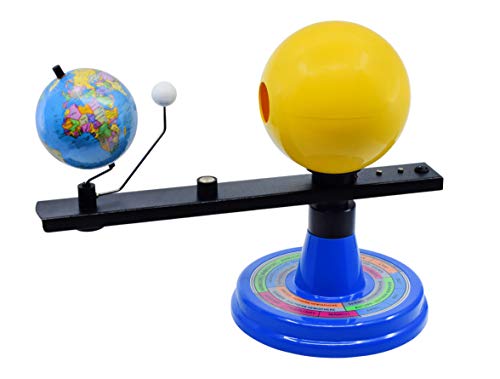
- 12V illuminated Sun
- Gear-driven orbital motion
- Includes three activities
Best For: Adult learners and classroom demonstrations
Glow-In-The-Dark Decor
Great Explorations 3D Glow Solar System

- Nine glowing planets
- Over 200 adhesive stars
- No batteries required
Best For: Battery-free space-themed bedroom décor
Interactive Projector
Science Can Talking Solar System Model
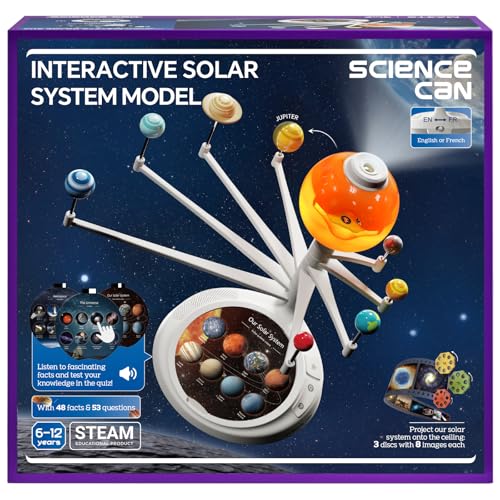
- 48 facts and 53 quiz questions
- Projects 24 color space images
- Light-up Sun with bilingual support
Best For: Interactive STEM learning and space-themed play
Best Interactive Build

- 556-piece STEM construction kit
- Rotating planets with gear movement
- Light-up sun and rocket design
Best For: Hands-on builders and space-themed displays
Best Orbital Demonstration

- Demonstrates rotation and revolution
- Covers seasons, phases, and eclipses
- Push-button illuminated sun
Best For: Introductory astronomy lessons
Best Glow-in-the-Dark Kit
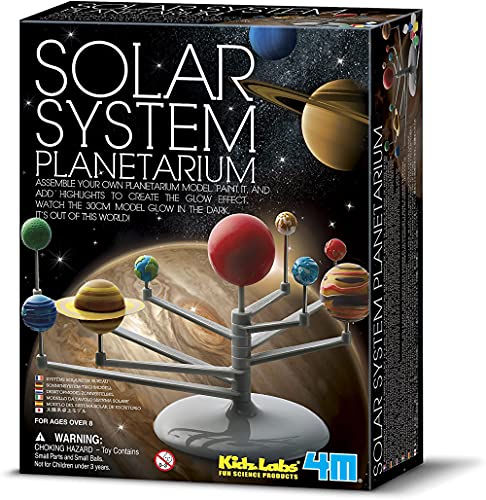
- Assemble-and-paint astronomy project
- Includes glow paint and educational chart
- Battery-free design for ages 8+
Best For: Creative science activities and room displays
Best Mechanical Pick
Orbiting Solar System STEM Kit

- Windup-powered planetary motion
- Explores gear ratios and planetary gears
- Compact option for science fair projects
Best For: Hands-on STEM learning and mechanical model building
Best Decorative Light

- Touch-activated LED illumination
- Six color-changing light options
- 3D laser-engraved K9 crystal
Best For: Space-themed décor and compact gifts
Best Large Building Set
Dual-Mode Spinning Solar System Kit
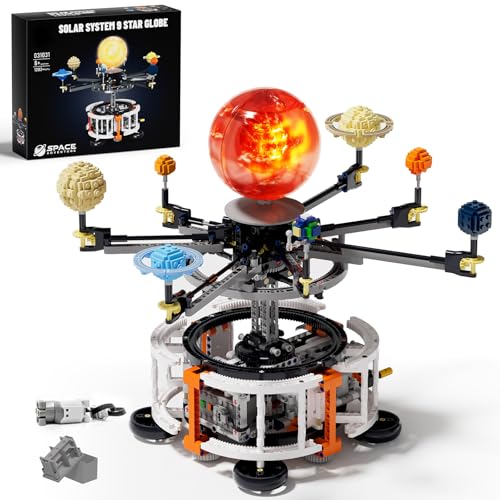
- 1,282-piece construction project
- Hand-crank and automatic rotation modes
- Light-up sun and eight-planet display
Best For: Interactive STEM building and larger space displays
Hands-On Builder – Smartivity DIY Solar System Kit
For shoppers seeking illuminated solar system models with a strong construction component, the Smartivity DIY Solar System Kit offers a hands-on way for children ages 8–14 to assemble and rotate a planetary model. It focuses on basic astronomy, STEM learning, and creative building rather than electronic lighting.
Best For: Children ages 8–14 who enjoy building projects and introductory space science.
Pros:
- Gear-driven, rotating design encourages active exploration of planets and orbits.
- Combines construction, creativity, and basic astronomy concepts.
- Uses MDF and is described as made with eco-friendly, child-safe materials.
Cons:
- Does not include an illuminated or light-up feature.
- Requires assembly, so it is less suitable for children wanting an immediately playable model.
This is a practical choice when the learning value comes from making and operating the model. If illumination is essential, consider a different option in this roundup; if building and STEM exploration matter more, this kit offers a focused experience.
Orbital Demonstrator – Eisco Illuminated Sun-Earth-Moon Model
Among illuminated solar system models, the Eisco Sun, Earth, and Moon Orbital Model is the most demonstration-oriented option. Its gear-driven motion, 12V illuminated Sun, month-labeled base, and included activities support detailed exploration of eclipses, moon phases, and orbital relationships.
Best For: Adult learners, educators, and science demonstrations focused on the Sun-Earth-Moon system.
Pros:
- Illuminated Sun helps demonstrate the interaction of light with Earth and the Moon.
- Gear-driven mechanism shows orbital motion and eclipse alignment.
- Month-labeled base and three included activities add structured learning.
- Metal construction provides a more study-oriented presentation.
Cons:
- Recommended for adults ages 18 and up.
- Its 14-inch-tall format requires more display space than compact models.
- Focuses on the Sun, Earth, and Moon rather than a full set of planets.
This model is a strong fit when realistic motion and illumination are more important than covering every planet. Its adult recommendation and larger footprint make it better suited to a classroom, study area, or serious demonstration setting than casual children’s play.
Glow-In-The-Dark Decor – Great Explorations 3D Glow Solar System
For families comparing illuminated solar system models as room décor, the Great Explorations 3D Glow Solar System Ceiling Kit uses glow-in-the-dark planets and more than 200 adhesive stars. It provides a battery-free way to turn a child’s ceiling into a space-themed display while introducing planetary facts.
Best For: Children ages 5 and up who want a space-themed ceiling display or gentle night-light effect.
Pros:
- Includes nine glow-in-the-dark planets and over 200 adhesive stars.
- Requires no batteries and can function as a night-light.
- Stars are designed to be removable without damaging walls.
- Includes a solar system guide with planetary facts.
Cons:
- Glow-based illumination is different from an electrically lit display.
- It is a ceiling kit rather than a freestanding, moving solar system model.
- The supplied details describe it as compact, so it may not create a large-scale room installation.
This kit works best for decorative learning and bedtime atmosphere rather than demonstrating planetary motion. Choose it when easy, battery-free glow and removable ceiling décor are priorities.
Interactive Projector – Science Can Talking Solar System Model
For shoppers wanting illuminated solar system models with added digital-style interaction, the Science Can Talking Solar System Model combines a light-up Sun with bilingual knowledge cards, quiz mode, and a projector. It is designed to make astronomy more engaging for children ages 6–12 without requiring assembly.
Best For: Children who learn well through quizzes, spoken facts, projected images, and interactive play.
Pros:
- Provides 48 facts through three knowledge cards and includes 53 quiz questions.
- Offers English and French options for broader accessibility.
- Projects 24 full-color space images from three included disks.
- Light-up Sun and hands-on design support learning about planetary positions and sunlight.
Cons:
- Requires three AA batteries, which are not included.
- Made from plastic and may be less display-focused than a traditional model.
- Its educational functions may be more appealing to interactive learners than children seeking a simple static model.
This is the most feature-rich choice for children who enjoy audio-style facts, quizzes, and projection. It offers more ways to explore space than a basic illuminated display, while its no-assembly design makes it easy to start using.
Best Interactive Build – Solar System Building Set
For shoppers seeking illuminated solar system models with an active building experience, this 556-piece set combines a light-up sun, rotating planets, rocket elements, and a detailed space theme. Its gear-driven movement makes the finished display more engaging than a static model.
Best For: Kids ages 8 and up, teens, adults, and space enthusiasts who enjoy STEM construction projects and display models.
Pros:
- 556-piece construction set supports hands-on STEM learning.
- Gear mechanism lets multiple planets rotate together.
- Light-up sun creates an attractive illuminated display.
- Includes rocket elements and a futuristic space design.
Cons:
- Assembly is likely more involved than a simple ready-made model.
- The supplied details do not specify the power source for the light-up sun.
This is a strong choice when you want illuminated solar system models that function as both a building challenge and a decorative display. The rotating mechanism and light-up centerpiece add visual interest after assembly.
Best Orbital Demonstration – Sun Earth Moon Orbital Model
This illuminated solar system model focuses on the relationship between the sun, Earth, and moon. Its moving orbital design can help demonstrate Earth’s rotation, its revolution around the sun, moon orbits, seasons, moon phases, and eclipses.
Best For: Students and families looking for a focused astronomy teaching aid rather than a full multi-planet display.
Pros:
- Illustrates Earth’s rotation and revolution around the sun.
- Helps explain moon orbits, seasons, phases, and eclipses.
- Sun lights when the raised button is pressed.
- Instructions are provided in English.
Cons:
- It covers the sun, Earth, and moon rather than the complete solar system.
- The notes caution that it is not intended for rigorous scientific research.
- The recommended age information is oriented toward older children and teens.
Choose this model if orbital concepts are more important than decorative detail. The lighted sun and moving relationships make it useful for introductory astronomy lessons and demonstrations.
Best Glow-in-the-Dark Kit – 4M Solar System Planetarium
Among illuminated solar system models, this 4M planetarium stands out as a creative assemble-and-paint project. The kit includes planets, stencils, rods, string, glow paint, a fact-filled wall chart, and quiz questions for an activity that combines crafts with astronomy learning.
Best For: Children ages 8 and up who enjoy painting, DIY science kits, and glow-in-the-dark room decorations.
Pros:
- Includes planets, stencils, rods, string, and a glow paint pen.
- Combines assembly, painting, and astronomy education.
- Fact-filled wall chart and 10 sets of quiz questions add learning value.
- Requires no batteries.
Cons:
- Pluto is not included.
- Glow effects come from paint rather than an electric light.
- Children must assemble and paint the planets before display.
This is a practical pick for families who prefer a low-tech, creative project over a motorized or electrically lit model. The glow paint and included educational materials extend the activity beyond simple decoration.
Best Mechanical Pick – Orbiting Solar System STEM Kit
This compact model is a practical choice if you want illuminated solar system models alternatives focused on hands-on mechanics rather than lights. Its windup motor rotates the planets without batteries while introducing gear ratios and planetary gears.
Best For: Children ages 6–14, science fair projects, and learners interested in mechanical STEM concepts.
Pros:
- Windup motor requires no batteries.
- Demonstrates rotating planetary orbits and gear mechanics.
- Includes a slot for a possible Planet Nine addition.
Cons:
- It is a small model measuring 10 x 2.5 x 11 inches.
- It does not provide illuminated planets or a light-up sun.
This kit is best when the educational value of building and motion matters more than display lighting. Its intermediate design may also make it a stronger project choice than a purely decorative model.
Best Decorative Light – 3D Solar System Crystal Ball
For shoppers seeking illuminated solar system models primarily for display, this tabletop crystal ball combines a laser-engraved 3D solar system design with a touch-activated, six-color LED base. Its compact size suits desks, shelves, and bedside tables.
Best For: Space-themed décor, gifts, and users who want a small color-changing night light.
Pros:
- Features 3D laser engraving inside K9 crystal.
- Offers six lighting color changes.
- Includes a colored base and gift box.
- Touch activation makes operation straightforward.
Cons:
- At 2.36 inches, it is a small decorative model.
- It is not designed as a rotating or buildable educational kit.
This is the most décor-focused option in the group. Choose it for visual appeal and ambient lighting rather than for demonstrating planetary scale, orbit, or construction techniques.
Best Large Building Set – Dual-Mode Spinning Solar System Kit
This 1,282-piece kit is a strong choice for families comparing illuminated solar system models with more interactive building features. It includes rotating planets, a motorized auto mode, a hand-crank mode, and manually activated lights that simulate the sun’s rays.
Best For: Children ages 6 and up who enjoy larger construction projects, moving models, and introductory astronomy activities.
Pros:
- Includes 1,282 pieces for an extended building activity.
- Offers both hand-crank and automatic rotation modes.
- Light-up sun effects add visual interest.
- Models the sun and eight planets with detailed colors and features.
Cons:
- Its 16 x 16 x 14-inch footprint requires substantial display space.
- Assembly may be more involved than with smaller models.
- It uses a lithium battery system for motorized operation.
This set offers the broadest combination of construction, motion, and lighting among these products. It is a better fit for children who want an active building project rather than a simple tabletop ornament.
How We Picked These Illuminated Solar System Models
We focused on models that make the solar system easier to understand through light, motion, construction, sound, or visual display. The selection spans beginner-friendly kits for young children, more detailed STEM projects for older kids, and polished orbital or LED models for classrooms, offices, and home décor.
We also considered the type of learning each model supports: assembling gears, observing planetary movement, identifying celestial bodies, learning through audio prompts, or using glow and illumination to create a memorable display. Because these products vary considerably, age range, assembly requirements, power source, and intended use are important when comparing them.
Quick Comparison
| Best For | Look For |
|---|---|
| Young learners | Large parts, simple assembly, clear labels, and supervised activities |
| STEM projects | Gears, rotating planets, building steps, and explanations of orbital motion |
| Classrooms | Durable construction, visible lighting, and demonstrations students can follow |
| Older students and adults | More realistic orbital arrangements, detailed construction, and display quality |
| Room décor | LED illumination, touch controls, compact size, and a stable base or mounting system |
Key Buying Factors for Illuminated Solar System Models
Age and Assembly Difficulty
Check the recommended age before buying. Younger children generally need larger components and straightforward instructions, while older kids may prefer gear systems, multi-step construction, and independent experimentation. Small parts can require adult supervision.
Type of Illumination
Lighting can serve different purposes. Glow-in-the-dark pieces are useful for ceiling or bedroom displays, while LEDs provide brighter presentation lighting. Confirm whether batteries, USB power, or another power source is required, and check whether the lighting is continuous, touch-activated, or decorative rather than instructional.
Motion and Educational Value
A rotating model can demonstrate relationships between the Sun, Earth, and Moon, but not every product represents scale or real orbital mechanics accurately. Gear-driven and windup designs are especially useful for hands-on STEM activities; talking or interactive versions may suit children who learn best through prompts and repetition.
Size, Durability, and Display Needs
Measure the available desk, shelf, or ceiling space before ordering. Consider the base stability, assembly quality, replacement parts, and whether the finished model is intended for frequent handling or occasional display. A compact crystal-ball-style model may be better for décor, while a larger orbital model may be easier to demonstrate to a group.
Who Should Buy Which Illuminated Solar System Models?
Choose a simple glow or construction kit for a first astronomy project or a younger child. Families seeking a hands-on STEM challenge should prioritize gear-driven or rotating models that explain movement through building and demonstration. For classrooms, select a bright, durable model with easily visible planets and controls students can understand.
Older students, hobbyists, and adults may prefer a more detailed Sun-Earth-Moon or orrery-style design. If the main goal is decoration, choose an illuminated model with a stable base, attractive finish, and convenient controls rather than paying extra for complex educational features you will not use.
Before purchasing, verify the included components, dimensions, power requirements, assembly time, and current age guidance. Those details will help you choose among these Illuminated Solar System Models with greater confidence.