
Industrial robotics training kits are a smart way to build real automation skills without needing a full factory setup. The best kits let you practice control, programming, vision, teleoperation, and motion planning in a hands-on environment.
Whether you are training students, upskilling engineers, or building a lab, the right kit should match your goals, software stack, and budget. This guide focuses on practical options that can support modern robotics workflows in 2026.
Best 10 Industrial Robotics Training Kits Picks for 2026
PLC Trainer
WiFi 485 Starter Kit for Arduino

- Arduino IDE compatibility
- WiFi, 485, and Ethernet training
- Compact PLC trainer for IoT labs
Best For: Arduino users and PLC training labs
Teleop Arm
ROS Wireless Teaching Arm for AI Data Collection

- Aloha and LeRobot compatible
- ROS1/ROS2 wireless teleoperation
- 0.8ms response and open-source support
Best For: Robotics researchers and advanced teleoperation users
Collaborative Arm
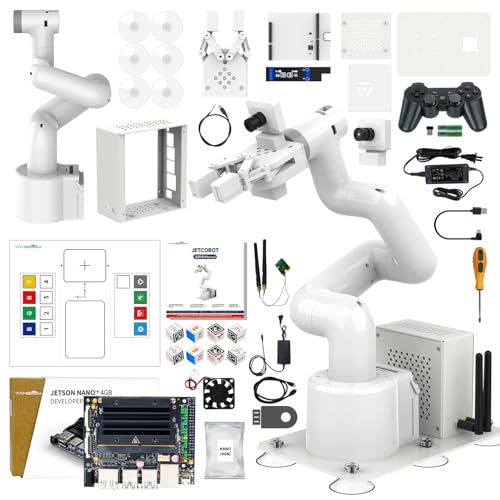
- Jetson Nano and Orin ecosystem support
- ROS and Python development tools
- AI vision tasks for recognition and grasping
Best For: Developers learning ROS and vision-based robot control
Desktop Robot Arm
6DoF Mini Industrial Kit with Bluetooth Control

- 6DoF desktop robotic arm
- Bluetooth, app, and software control
- Expansion interfaces for secondary development
Best For: Students and instructors needing a compact training arm
AI Learning Arm

- LeRobot and Hugging Face compatible
- Real-time leader-follower training
- Jetson-ready open-source kit
Best For: AI robotics developers and Jetson-based training projects
Embodied Intelligence Arm
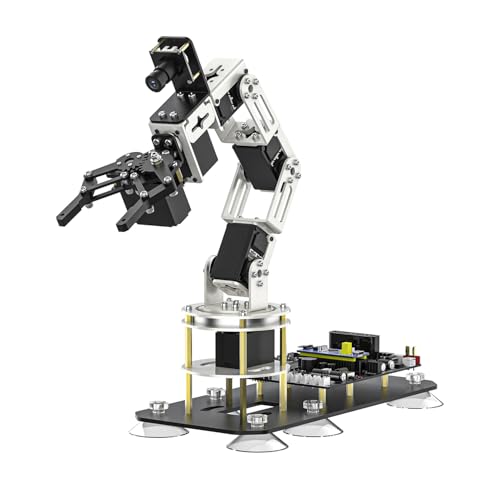
- ROS2 desktop arm with VM control
- Supports vision, voice, and AI tasks
- Multiple control methods included
Best For: ROS2 learners and AI robotics projects with voice/vision interaction
Autonomous Mobility Kit

- ROS2 platform with 5DOF vision arm
- Depth camera and lidar for SLAM
- Supports autonomous driving and tracking
Best For: Engineering students building mobile AI and ROS2 projects
Advanced ROS2 AI Arm

- ROS2 and Raspberry Pi compatible
- 3D depth vision and voice interaction
- Six 25KG servos for precise control
Best For: Adult learners building advanced AI and ROS robotics projects
Open-Source Arduino Arm

- ESP32 and Arduino compatible
- Supports vision, voice, and sensor expansion
- Includes 200+ tutorials and open-source code
Best For: Makers and students who want a customizable coding-focused robot arm
Bundled ROS2 Learning Kit
ArmPi Ultra with Raspberry Pi 5
- Includes Raspberry Pi 5 8GB
- ROS2, vision, and voice ready
- Covers advanced AI and robotics topics
Best For: Learners who want a bundled ArmPi Ultra setup with compute included
PLC Trainer – WiFi 485 Starter Kit for Arduino
If you want industrial robotics training kits that lean more toward industrial IoT and PLC fundamentals than arm motion, this PLC Cables Inc starter kit is a practical place to begin. It is built around Arduino IDE compatibility, WiFi and 485 connectivity, and an Ethernet-ready training setup for hands-on learning.
Best For: Arduino users, PLC learners, and training labs focused on industrial IoT connectivity.
Pros:
- Works with Arduino IDE and is made for Arduino-based training.
- Includes WiFi, 485, and Ethernet-oriented industrial IoT features.
- Compact trainer form factor at 12 x 9 x 7 inches and 3 pounds.
- Useful for PLC and networking practice in a lab setting.
Cons:
- Not a robotic arm, so it is less suited to motion-control demos.
- Information provided is focused on connectivity rather than curriculum extras.
This is a solid pick when your training goal is PLC communication and industrial IoT integration rather than mechanical manipulation. It fits best as a control-and-networking trainer inside a broader robotics curriculum.
Teleop Arm – ROS Wireless Teaching Arm for AI Data Collection
Among industrial robotics training kits, this teaching arm stands out for teleoperation, imitation learning, and robotics research workflows. It is designed for precise wireless control with ROS1/ROS2 support, Aloha and LeRobot compatibility, and a focus on AI data collection rather than classroom-only exercises.
Best For: Robotics researchers and advanced users building teleoperation or imitation learning setups.
Pros:
- Supports Aloha and LeRobot frameworks for teleoperation research.
- Offers 0.8ms response time and 5-8mm control precision.
- Compatible with ROS1/ROS2 and MoveIt for integration work.
- Includes open-source control code and documentation for setup.
Cons:
- Geared toward researchers and engineers, not casual beginners.
- Requires setup and familiarity with drivers, ROS, and programming tools.
If your priority is collecting high-quality robot control data or experimenting with teleoperation, this is a strong specialist option. Its open-source support and wireless control make it especially useful in advanced development environments.
Collaborative Arm – Jetson Nano ROS Vision Robot
For industrial robotics training kits centered on AI, ROS, and vision-based manipulation, this Yahboom collaborative arm is built for serious desktop development. It integrates with Jetson Nano and Orin Nano/Orin NX ecosystems, supports ROS and programming workflows, and adds AI vision tasks like recognition, tracking, and grasping.
Best For: Developers and mechanical engineers exploring ROS, AI vision, and collaborative robot programming.
Pros:
- Works with Jetson Nano, Orin Nano Super, and Orin NX Super ecosystems.
- Supports ROS development, Python driver libraries, and multiple programming options.
- Includes AI vision tasks such as recognition, tracking, and grasping.
- Comes with remote-control options including an Android app and USB game controller.
Cons:
- Recommended for users with basic programming knowledge, not complete beginners.
- Power adapters must be used correctly to avoid damage.
This is a capable choice when your training plan involves both robotics software and vision-driven interaction. It is especially appealing if you want a collaborative arm that fits into a modern Jetson-based development stack.
Desktop Robot Arm – 6DoF Mini Industrial Kit with Bluetooth Control
This Mirobot kit is a strong fit if you want industrial robotics training kits with a real desktop arm, multiple control options, and secondary-development potential. It combines a 6DoF metal-and-plastic arm with software control, mobile app support, virtual control, and expansion interfaces for training and experimentation.
Best For: Students, teachers, and engineers who want a compact desktop robotic arm for training and coding.
Pros:
- Includes the Professional Kit extras, including a wireless Bluetooth controller.
- Supports computer software, mobile app, and virtual control methods.
- Offers multiple training uses such as writing, drawing, engraving, and palletizing.
- Reserved expansion interfaces support secondary development and added accessories.
Cons:
- Assembly is required.
- At 12.4 pounds, it is less portable than smaller desktop kits.
For a hands-on industrial arm with broad teaching and experimentation options, this kit delivers a lot of flexibility in a compact footprint. It works well for structured training programs that want both hardware control and software-based learning.
AI Learning Arm – Open-Source 6-DOF AI Arm Kit
If you’re comparing industrial robotics training kits for hands-on AI development, the SO-ARM101 Pro is built for imitation learning, reinforcement learning, and open-source experimentation. It’s a low-cost 6-DOF robotic arm kit designed for LeRobot and Hugging Face workflows, with improved wiring and smoother leader-arm behavior versus the earlier SO-ARM100.
Best For: AI robotics enthusiasts, developers, and Jetson users who want an open-source training arm for real-world learning workflows.
Pros:
- Compatible with LeRobot and Hugging Face frameworks for training and deployment.
- Real-time leader-follower tracking supports human intervention during RL training.
- Improved wiring helps prevent disconnection at joint 3.
- Works with Nvidia Jetson edge devices, including reComputer Mini J4012 Orin NX 16 GB.
Cons:
- 3D-printed parts are not included.
- Assembly and calibration require DIY effort.
- Focused on robotics development rather than plug-and-play use.
Overall, this is a strong choice if your priority is an open-source training platform rather than a finished desktop robot. It leans heavily toward experimentation, learning, and model-driven robotics work.
Embodied Intelligence Arm – ROS2 Desktop Robot Arm Kit
For buyers focused on industrial robotics training kits with AI vision and ROS2 learning, the Yahboom DOFBOT-SE offers a desktop arm with embodied intelligence features. It uses a virtual machine as the main controller, supports custom model training and recognition tasks, and combines 3D vision with multimodal AI for interactive robotics projects.
Best For: Adults and students who want a ROS2 learning platform with voice, vision, and embodied intelligence features.
Pros:
- ROS2-based desktop arm with a virtual-machine control workflow.
- Supports custom model training, garbage classification, and gesture recognition.
- 6 bus servos provide position/status readback and are built for precise movement.
- Includes multiple control methods: wireless handle, mobile app, and computer mouse.
Cons:
- VM software is not supported on Mac.
- Kit is sold as a standard package, so it’s less turnkey than a fully assembled industrial platform.
- Advanced AI features may be more than casual hobby users need.
This kit stands out if you want a training-oriented robotic arm that goes beyond basic pick-and-place. It combines software learning, AI interaction, and motion control in a compact desktop format.
Autonomous Mobility Kit – ROS2 AI Robot Car and Arm
If you want industrial robotics training kits that combine navigation, mapping, and manipulation, the JetAuto Pro Ultimate Kit is built for that kind of workflow. It pairs ROS2 development with a 5DOF vision robot arm, depth camera, lidar, SLAM tools, and AI vision features, making it a broad platform for autonomous driving and object handling.
Best For: Engineering students and adult learners who want a mobile ROS2 platform for navigation and AI vision experiments.
Pros:
- Includes a 5DOF vision robot arm with 35KG torque servos and a 500g payload.
- Supports SLAM methods like gmapping, hector, karto, and cartographer.
- Combines depth camera and lidar for 3D mapping and obstacle avoidance.
- Offers multiple control options, including ROS, keyboard, wireless handle, and the WonderAi app.
Cons:
- Kit is designed for learning and development, so it may be more complex than a beginner robot.
- WonderAi navigation app is Android-only.
- Mobile robot plus arm setup is more involved than a simple desktop training kit.
As a robotics learning platform, this kit is especially appealing if you want one system that covers mobility, perception, and manipulation. It’s a versatile choice for building practical ROS2 and AI projects.
Advanced ROS2 AI Arm – ArmPi Ultra ROS2 AI Arm
If you want industrial robotics training kits that go beyond basic motion demos, ArmPi Ultra is built for advanced AI and ROS education. This 6DOF robotic arm combines 3D depth vision, voice interaction, and ROS2 compatibility, making it a strong fit for learners working on perception, planning, and real-world manipulation workflows.
Best For: Adult learners, robotics students, and developers exploring ROS2, AI vision, and embodied intelligence.
Pros:
- ROS2-compatible and powered by Raspberry Pi for Python-based development.
- Includes a 3D depth camera and WonderEcho AI voice box for vision and interaction projects.
- Uses six 25KG intelligent serial bus servos for high torque and precise control.
- Comes with tutorials covering ROS, OpenCV, YOLOv8, MediaPipe, MoveIt, Gazebo, and more.
Cons:
- Advanced feature set may be more than a first-time robotics beginner needs.
- Raspberry Pi is not included with this advanced kit.
Overall, ArmPi Ultra is best viewed as a serious learning platform for robotics and AI experimentation rather than a simple classroom toy. Its mix of vision, voice, and ROS2 tools makes it especially relevant for hands-on industrial robotics training kits focused on modern automation skills.
Open-Source Arduino Arm – LeArmAI Arduino AI Arm
For buyers comparing industrial robotics training kits with a more open-ended programming path, LeArmAI stands out as an Arduino-compatible 6DOF arm with AI vision and voice interaction support. It is designed for STEM projects, coding practice, and secondary development, making it a flexible option for learners who want to experiment with sensors and custom control methods.
Best For: Makers, students, and hobbyists who want an open-source robot arm for Arduino-based learning and experimentation.
Pros:
- ESP32-powered and fully compatible with Arduino programming.
- Supports AI vision, voice, ultrasonic, and acceleration sensor expansion.
- Six smart bus servos and inverse kinematics support smooth motion planning.
- Includes 200+ tutorials, sample experiments, open-source code, and schematics.
Cons:
- Feature-rich setup may take time to explore fully.
- Best suited to users comfortable with coding or learning by doing.
LeArmAI is a practical pick if you want a robot arm that encourages customization and hands-on programming. Its open-source materials and broad sensor support make it a strong training platform for foundational robotics skills and creative automation projects.
Bundled ROS2 Learning Kit – ArmPi Ultra with Raspberry Pi 5
If you are shopping industrial robotics training kits and want a bundled setup, this ArmPi Ultra version pairs the advanced ROS2 robotic arm with a Raspberry Pi 5 8GB. It is aimed at AI and robotics education, with 3D vision, voice interaction, and a learning path that covers modern tools used in advanced robotics development.
Best For: Learners who want the ArmPi Ultra platform with a Raspberry Pi 5 included for faster setup.
Pros:
- Includes Raspberry Pi 5 8GB along with the ArmPi Ultra advanced kit.
- ROS2-compatible and built for Python and deep learning workflows.
- Features a 3D depth camera and WonderEcho AI voice box for interaction tasks.
- Training resources cover ROS, OpenCV, YOLOv8, MediaPipe, MoveIt, Gazebo, and more.
Cons:
- Still positioned as an advanced kit rather than an entry-level starter.
- Focus is on education and development, not turnkey industrial deployment.
This bundle is the most convenient route for learners who want the ArmPi Ultra ecosystem with core compute hardware included. For robotics training, it offers a well-rounded setup for AI vision, manipulation, and ROS2 practice in one package.
How We Picked the Best Industrial Robotics Training Kits
For this roundup, we focused on Industrial Robotics Training Kits that offer meaningful skill development rather than novelty. Priority went to systems with strong programming support, open ecosystems, realistic arm or mobile manipulation features, and clear educational value for robotics, automation, or mechatronics training.
We also considered setup complexity, compatibility with common tools like ROS/ROS2, Python, Arduino, vision stacks, and AI features, plus how useful each kit is for different learning levels.
Quick Comparison
In simple terms, some kits are better for PLC and industrial I/O practice, while others are stronger for ROS2, computer vision, teleoperation, or AI-assisted manipulation. Desktop robotic arms tend to suit classrooms and labs, while larger 6DOF or 7DOF systems are better for advanced robotics training and research workflows.
Key Buying Factors for Industrial Robotics Training Kits
Software and Control Stack
Check whether the kit supports the tools your program actually teaches. ROS2, Python, Arduino, PLC logic, OpenCV, SLAM, and teleoperation features all serve different learning goals. If you want to future-proof training, look for open-source support and active software documentation.
Degrees of Freedom and Motion Quality
More joints do not automatically mean better training, but they do expand what students can learn. A 6DOF arm is a strong baseline for pick-and-place, path planning, and kinematics. 7DOF systems add flexibility for advanced manipulation and redundancy exercises.
AI, Vision, and Connectivity
Many modern Industrial Robotics Training Kits now include cameras, voice modules, wireless control, or embodied AI features. These are useful if your curriculum includes machine vision, perception, autonomous behavior, or human-robot interaction. For basic automation courses, they may be optional rather than essential.
Mechanical Build and Classroom Fit
Desktop-size kits are usually easier to deploy, store, and maintain. If you need durability for repeated student use, pay attention to servo type, gripper design, payload expectations, and availability of replacement parts.
Who Should Buy Which Industrial Robotics Training Kits?
Choose PLC-focused kits if your goal is industrial automation, communications, and I/O fundamentals. Choose ROS2 and AI-enabled arms if you want modern robotics programming, vision, and teleoperation practice. Choose compact desktop arms for K12, labs, and introductory courses. Choose more advanced collaborative or embodied-intelligence kits for university programs, engineering teams, and research environments where software depth matters more than simplicity.
For most buyers, the best choice is the kit that aligns with your teaching outcomes, not the one with the longest spec sheet. In Industrial Robotics Training Kits, software compatibility and curriculum fit matter more than raw hardware size.