
The best large electronics breadboard kits make it easier to learn circuit design, test Arduino and ESP32 projects, and keep essential components close at hand. The kits in this roundup range from practical starter bundles to extensive assortments with hundreds or thousands of parts.
We compared breadboard size, component variety, power solutions, jumper-wire selection, organization, and overall usefulness so you can choose a kit that matches your experience level and project goals.
Best 10 Large Electronics Breadboard Kits Picks for 2026
Best All-in-One Assortment
1530-Piece Electronics Starter Kit

- 1,530 components across common circuit types
- 830-tie breadboard with extensive jumper wiring
- Organized for beginner and microcontroller projects
Best For: STEM learning, makers, and broad component experimentation
Best Guided Learning Kit
ELEGOO Fun Kit with Power Supply

- 830-point breadboard and selectable 3.3V/5V power module
- 300+ parts for repeatable circuit experiments
- Controller and wall adapter are not included
Best For: Beginners learning Arduino-compatible electronics
Best Large Breadboard Setup

- 1,660 total test points for larger layouts
- 415 jumper wires in multiple formats
- Binding posts and color-coded coordinates
Best For: Arduino shield prototyping and circuit testing
Best Multi-Board Value
1628-Piece DIY Electronics Kit

- Four breadboards and four PCB boards included
- Large quantities of core components
- Categorized packaging supports easier sorting
Best For: Shared labs, students, and multiple simultaneous prototypes
Best Guided Project Kit
ELEGOO 235-Piece Arduino Breadboard Bundle

- 235 parts for repeatable electronics experiments
- Selectable 3.3 V or 5 V breadboard power
- Includes components for LEDs, logic, switching, and sensors
Best For: Beginners, classrooms, and guided maker projects
Best Large Component Assortment
2300-Piece Electronics DIY Kit

- Broad assortment of parts for DIY circuit work
- Includes breadboards, PCBs, ICs, motors, and speakers
- Compartmented box and 30X magnifying glass included
Best For: Broad electronics learning, sorting, and prototyping
Best Large Breadboard Platform
380-Piece 830-Point Starter Kit

- 830-point solderless breadboard for larger circuits
- USB power module with selectable 3.3 V or 5 V output
- Works with Arduino, ESP32, Raspberry Pi, and STM32
Best For: Larger microcontroller, STEM, and embedded prototypes
Most Comprehensive Kit
Upgraded Electronics Component Fun Kit

- 326 listed items with an 830-point breadboard
- Includes adapter, power modules, jumper wires, ICs, and displays
- Broad mix of LEDs, sensors, passives, and discrete components
Best For: Beginners and experimenters seeking maximum component variety
Best Organized Kit
BOJACK 37-Value Component Fun Kit
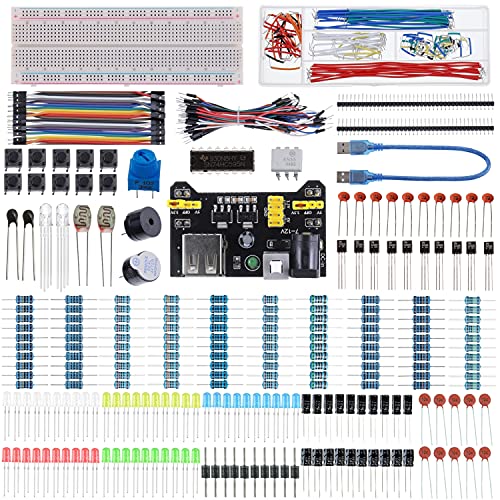
- More than 400 components for basic experiments
- Labeled transparent storage box simplifies part selection
- Includes 830-point breadboard, power module, USB cable, and jumper wire
Best For: Users prioritizing organized storage and solder-free setup
Best Documentation Support
REXQualis Electronics Component Kit
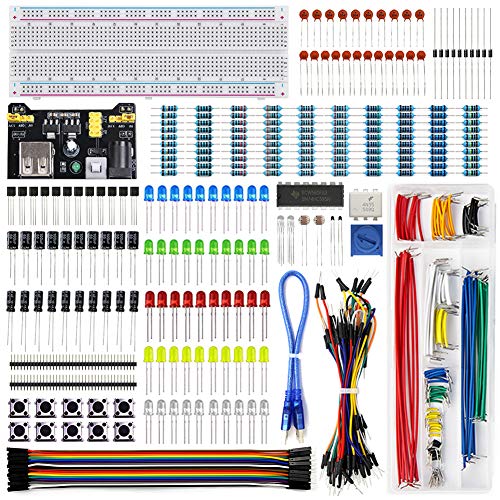
- More than 400 sensors and components
- Labeled packaging for resistors, LEDs, transistors, and ICs
- Datasheets and tutorials available for download
Best For: Learners who want organized parts and extra project guidance
Best All-in-One Assortment – 1530-Piece Electronics Starter Kit
For shoppers comparing large electronics breadboard kits, this set emphasizes component variety alongside a full-size breadboard. It includes 1,530 pieces, organized parts, jumper leads, and common components for beginner experiments and 3.3V or 5V microcontroller projects.
Best For: STEM classrooms, makers, hobbyists, and beginners building LED, timing, switching, or basic Arduino, Raspberry Pi, and ESP32 circuits.
Pros:
- Broad assortment of resistors, capacitors, LEDs, diodes, and transistors.
- Includes an 830-tie breadboard, 60 Dupont leads, and 65 pre-formed jumpers.
- Parts are labeled or organized for easier selection and storage.
Cons:
- Does not list a dedicated breadboard power module.
- Users must observe polarity and handle static-sensitive components carefully.
This is a strong choice when component quantity and variety matter more than included project-specific electronics. The organized case and ready-to-use breadboard make it practical for repeated learning and prototyping.
Best Guided Learning Kit – ELEGOO Fun Kit with Power Supply
This ELEGOO set is one of the more project-oriented large electronics breadboard kits, pairing an 830-point breadboard with a power module and over 300 parts. Its included components support practical experiments such as LED indicators, traffic lights, RGB effects, alarms, and button circuits.
Best For: Beginners and Arduino users who want to learn component functions through repeatable breadboard experiments.
Pros:
- Includes a breadboard power module with selectable 3.3V or 5V rails.
- Supports experiments with a 74HC595, 4N35 optocoupler, PN2222 transistors, and 1N4007 diodes.
- Provides rigid, solderless, and Dupont jumper wiring plus common passive and active parts.
Cons:
- Controller board, programming cable, and wall adapter are not included.
- Power input must be a suitable 6.5–9V DC source and should not exceed 9V.
The power module and experiment-friendly component selection give this kit a clear learning focus. Factor in the need for a compatible controller and power adapter before buying.
Best Large Breadboard Setup – Makeronics 1660-Point Kit
Among large electronics breadboard kits, the Makeronics option stands out for workspace and wiring hardware rather than a large component assortment. It combines 1,660 test points, binding posts, 350 U-shaped copper jumpers, and 65 additional breadboard wires for substantial prototyping setups.
Best For: Arduino shield prototyping, circuit testing, and users who prioritize breadboard capacity and plentiful jumper wires.
Pros:
- Provides 1,660 total tie points across terminal and bus strips.
- Includes 350 U-shaped copper jumpers plus 65 multicolor breadboard wires.
- Binding posts and colored coordinates support organized connections and placement.
Cons:
- The supplied notes do not describe a broad resistor, capacitor, LED, or transistor assortment.
- It is more focused on breadboard infrastructure than an all-in-one electronics lab kit.
This kit is a practical pick for larger circuit layouts and frequent rewiring. If you also need a full inventory of electronic components, plan to source those separately.
Best Multi-Board Value – 1628-Piece DIY Electronics Kit
This 1,628-piece set is a compelling option for shoppers seeking large electronics breadboard kits with multiple build surfaces. It includes four breadboards, four PCB boards, 120 Dupont wires, and substantial quantities of resistors, capacitors, LEDs, diodes, and transistors.
Best For: Students, electronics enthusiasts, and advanced hobbyists who want several boards for simultaneous prototypes or shared learning projects.
Pros:
- Includes four breadboards and four PCB boards for flexible prototyping.
- Offers large quantities of common components, including 600 resistors and 300 ceramic capacitors.
- Parts are packaged by category and marked for easier identification.
Cons:
- The supplied notes do not specify the breadboards’ individual tie-point counts.
- A broad parts assortment may require extra time to sort and manage.
The multiple boards make this kit especially useful for classroom, group, or parallel-project work. It offers broad component coverage, though buyers wanting a specified large breadboard should verify the board details.
Best Guided Project Kit – ELEGOO 235-Piece Arduino Breadboard Bundle
For shoppers comparing large electronics breadboard kits, the ELEGOO Electronic Fun Kit offers a focused 235-piece selection for repeatable beginner and classroom experiments. Its 400-tie-point breadboard, power module, and assortment of active and passive components support projects such as LED indicators, button inputs, traffic-light sequences, and light-sensitive circuits.
Best For: Beginners, classroom demonstrations, and makers who want guided Arduino-compatible breadboard projects.
Pros:
- Includes 235 parts, including a breadboard, jumper wires, LEDs, resistors, capacitors, transistors, buzzers, and light-sensitive components.
- The power module provides selectable 3.3 V or 5 V rails and uses a suitable 6.5–9 V DC input.
- Supports practical experiments with a 74HC595, 4N35 optocoupler, PN2222 transistors, and 1N4007 diodes.
Cons:
- A controller board, programming cable, and wall power adapter are not included.
- The 400-tie-point breadboard is smaller than the 830-point board in some larger starter kits.
This is a well-defined option when you want a manageable component selection and clear learning paths rather than the largest possible assortment. Plan to add a compatible microcontroller separately for coded projects.
Best Large Component Assortment – 2300-Piece Electronics DIY Kit
Among large electronics breadboard kits, this 2300-piece assortment stands out for breadth and storage. It combines breadboards, protoboards, jumpers, ICs, resistors, LEDs, capacitors, diodes, potentiometers, switches, motors, speakers, and other parts in a compartmented transparent box for broad DIY and learning use.
Best For: Beginners, students, and hobbyists who want a broad parts assortment for electronics practice and prototyping.
Pros:
- Includes a wide range of component categories, from resistors and LEDs to ICs, motors, speakers, terminals, and switches.
- The large transparent organizer has multiple small compartments to help separate and locate parts.
- Includes a 30X magnifying glass with jewelry attachments for viewing component markings.
Cons:
- The supplied notes do not specify the breadboard tie-point count or power output details.
- The extensive assortment may require more sorting and identification than a smaller project-focused kit.
This kit is most compelling when variety and inventory depth matter more than a tightly curated learning sequence. Its storage case and magnifying glass add practical value for organizing and inspecting a broad collection of components.
Best Large Breadboard Platform – 380-Piece 830-Point Starter Kit
For large electronics breadboard kits that prioritize workspace, this 380-piece starter kit pairs an 830-point solderless breadboard with a USB power supply module, 65 jumper wires, and more than 200 electronic components. Its selectable 3.3 V and 5 V output suits prototyping with Arduino, ESP32, Raspberry Pi, and STM32 boards.
Best For: Students, educators, and hobbyists building larger 3.3 V or 5 V microcontroller and STEM prototypes.
Pros:
- The 830-point solderless breadboard provides more prototyping space than the 400-tie-point board in many smaller kits.
- USB power can come from a laptop, charger, or power bank, with selectable 3.3 V or 5 V output.
- Includes 65 jumper wires and 200-plus components for Arduino, ESP32, Raspberry Pi, and STM32 projects.
Cons:
- The kit is centered on USB power, so a USB source is needed for the power module.
- The supplied notes do not list the individual component types or quantities in detail.
This is a practical choice when breadboard capacity and convenient USB power are higher priorities than having the biggest component count. The broad board compatibility also makes it adaptable for embedded, robotics, IoT, and classroom work.
Most Comprehensive Kit – Upgraded Electronics Component Fun Kit
For shoppers comparing large electronics breadboard kits, this upgraded Minidodoca set stands out for its broad component selection and included power options. It combines an 830-point breadboard with a 9V adapter, power modules, jumper wires, ICs, displays, passive components, LEDs, sensors, and more.
Best For: Beginners and experimenters who want a large, varied kit for Raspberry Pi- and STM32-compatible projects.
Pros:
- Includes 326 listed items, including an 830-point breadboard and power supply hardware.
- Offers a wide mix of components, such as capacitors, resistors, LEDs, transistors, diodes, buttons, buzzers, and sensors.
- Supports either the included 9V adapter or a separately purchased 9V battery as an input option.
- Components are tested and sorted before packaging, according to the supplied product information.
Cons:
- The battery is not included.
- LEDs require appropriate series resistance, and the 4-digit display has specific common-anode wiring requirements.
- The large component selection may feel overwhelming for first-time users.
This is a strong pick when variety matters most. Its combination of power supplies, ICs, display parts, and basic components gives learners plenty of room to build progressively more involved circuits.
Best Organized Kit – BOJACK 37-Value Component Fun Kit
This BOJACK option is a practical choice among large electronics breadboard kits, offering more than 400 components in a labeled storage box. It also includes an 830 tie-point breadboard, power module, USB data cable, jumper wire, and precision potentiometer for solder-free experiments.
Best For: Users who value organized storage and a straightforward setup for STM32, Raspberry Pi, and Arduino projects.
Pros:
- Provides more than 400 components for simple electrical experiments.
- Components are individually classified, packaged, and labeled in a transparent box.
- Includes a power module and USB data cable for convenient breadboard use.
- Components plug directly into the breadboard, so soldering is not required for the described setup.
Cons:
- The supplied information does not specify the complete component-by-component inventory.
- Only one total USB port is listed in the product details.
- The kit is a component set and does not indicate that a controller board is included.
BOJACK is especially appealing if finding and storing parts efficiently is a priority. The labeled box and included USB-powered accessories make it a convenient foundation for hands-on experimentation.
Best Documentation Support – REXQualis Electronics Component Kit
For buyers seeking large electronics breadboard kits with storage and learning support, the REXQualis kit includes more than 400 sensors and components alongside an 830 tie-point breadboard. Resistors, LEDs, transistors, and integrated circuits are separately packaged and labeled, while downloadable datasheets and tutorials add guidance.
Best For: Learners who want a well-organized component collection with access to datasheets and tutorials.
Pros:
- Includes more than 400 sensors and components for simple electronic projects.
- Separately packaged and labeled resistors, LEDs, transistors, and integrated circuits help with organization.
- Includes a breadboard power supply and USB power cable.
- Datasheets and tutorials are available for download from the manufacturer’s website or through customer service.
Cons:
- The controller board is not included.
- The supplied information does not provide a complete component inventory.
- Users who already have extensive documentation may not need the tutorial support.
This kit is a sensible choice for structured learning. Its labeled packaging and available documentation can make it easier to identify parts and follow beginner-friendly circuit projects without adding a controller board to the package.
How We Picked These Large Electronics Breadboard Kits
We focused on what matters when building and testing circuits without soldering. Each kit was evaluated for breadboard capacity, included component range, jumper-wire quantity, power options, Arduino compatibility, and storage. We also considered whether the assortment is useful for structured learning or flexible enough for repeated prototyping.
Component counts can be difficult to compare because brands may count individual resistors, wires, or small accessories differently. A larger number does not automatically mean better value, so we considered the balance between useful parts and practical organization.
Quick Comparison
| What to Compare | Best For | Why It Matters |
|---|---|---|
| 830-point breadboard | Medium and advanced projects | Provides room for larger circuits and multiple modules |
| Component assortment | Learning and experimentation | Reduces the need to buy resistors, LEDs, capacitors, and transistors separately |
| USB or plug-in power module | Arduino and breadboard work | Makes it easier to power circuits directly on the board |
| Jumper-wire selection | Frequent prototyping | Supports cleaner connections and faster circuit changes |
| Storage case or organizer | Large assortments | Helps prevent small components from becoming difficult to find |
Key Buying Factors for Large Electronics Breadboard Kits
Breadboard Size and Layout
An 830-point solderless breadboard is a useful middle ground for learners and makers. It offers more working space than compact boards while remaining manageable on a desk. Check that the board includes clear power rails and a layout compatible with the modules you plan to use.
Power Compatibility
A power supply module can simplify beginner projects, but verify its input and output options before buying. USB-powered modules are convenient for computer-based Arduino work, while adjustable or dual-voltage supplies provide more flexibility. Always confirm voltage requirements for individual components.
Parts and Electrical Values
Look beyond the total piece count. A useful kit should include a broad range of resistor values, LEDs, diodes, capacitors, transistors, potentiometers, and integrated-circuit accessories. Metal-film resistors and clearly labeled values are especially helpful for learning and troubleshooting.
Organization and Expansion
Large assortments are only convenient when parts are easy to identify. A compartmented box, labeled bags, or a sensible storage case can save time. Also consider whether the kit leaves room to add sensors, displays, motors, and other project-specific parts later.
Who Should Buy Which Large Electronics Breadboard Kits?
Choose a compact Arduino-oriented bundle if you are starting with guided lessons and want a straightforward set of common parts. Select an 830-point breadboard kit with a power module if you expect to build more involved circuits or switch frequently between projects.
High-count component boxes are better for makers, classrooms, and experimenters who want broad coverage and spare parts. Kits with generous jumper-wire selections suit users who prototype often, while a well-organized assortment is the better choice for anyone who values quick setup and easy cleanup. Before ordering, confirm the included parts list, power-module specifications, and whether the kit contains the accessories your planned projects require.