
The right light meter for photography can make exposure decisions faster, more repeatable, and less dependent on your camera’s guesswork. This roundup covers compact digital meters, classic analog tools, advanced flash meters, and budget illuminance testers.
Use the buying guide below to match metering style, lighting workflow, camera compatibility, and budget with the model that best fits your photography.
Best 10 Light Meter for Photography Picks for 2026
Best All-Around Meter

- One-tenth-stop ambient and flash accuracy
- Photo, Cine, and HD Cine modes
- Compact body with broad exposure range
Best For: Photo and video shooters needing versatile exposure metering
Best for Vintage Cameras

- Flexible three-position cold shoe mount
- Clicked aperture and shutter-speed controls
- Lightweight 34-gram aluminum body
Best For: Film camera owners seeking a compact analog-style meter
Best for Photo and Film Sets

- Ambient, reflected, and flash metering
- Dedicated Cine and HD Cine modes
- Lux and foot-candle readouts
Best For: Hybrid photo and filmmaking workflows
Best for Illuminance Readings
UNI-T UT383 Digital Light Meter

- Measures lux and foot-candles across a broad range
- Fast 0.5-second sampling with data hold
- Backlit display with max/min functions
Best For: Studio and environment light-intensity checks
Classic Analog Choice
Sekonic L-398A Studio Deluxe III

- Battery-free ambient-light operation
- Incident and reflected metering capability
- Full analog aperture/shutter dial readout
Best For: Film, studio, and location shooters who prefer tactile controls
Advanced Flash Metering
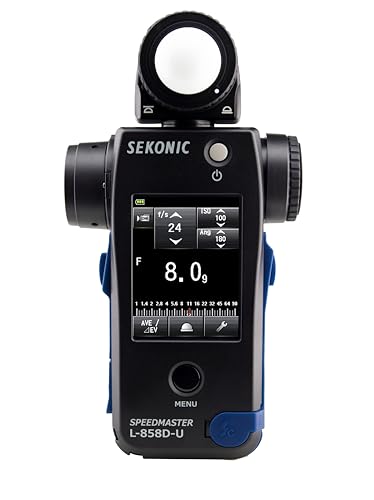
- Incident ambient and flash metering
- 1° spot metering with viewfinder
- Flash-duration measurement and radio-trigger options
Best For: Studio and flash photographers managing complex lighting setups
Compact Digital Retro Meter

- 35° reflective metering with stated ±0.1 EV accuracy
- Four shooting modes and configurable indicators
- Metal body with USB-C rechargeable power
Best For: Leica and film-camera users wanting compact digital convenience
Professional Hybrid Meter
Sekonic LiteMaster Pro L-478D-U
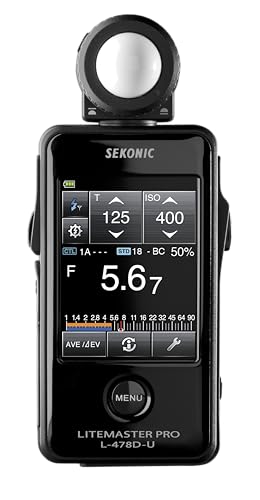
- Incident, flash, and optional spot metering
- Touchscreen interface with cine controls
- Illuminance and luminance measurement modes
Best For: Professional photography, studio lighting, and filmmaking
Everyday Lux Meter
Handheld 200,000-Lux Illuminance Meter
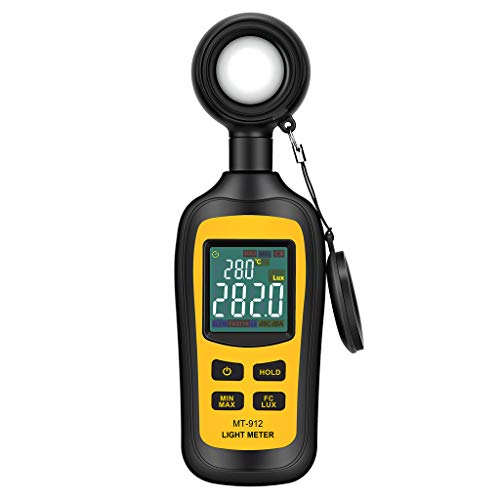
- Measures up to 200,000 lux
- Includes MIN/MAX and data-hold functions
- Compact design with a 2-year warranty
Best For: General brightness checks and basic lighting evaluation
Wide-Range Brightness Tester

- Measures brightness up to 200,000 lux
- Switches between lux and foot-candle units
- Includes backlight, hold, and MAX/MIN modes
Best For: Indoor, outdoor, LED, and grow-light brightness checks
Best All-Around Meter – Sekonic L-308X-U Flashmate
The Sekonic L-308X-U is a versatile light meter for photography that handles ambient and electronic flash readings with one-tenth-stop accuracy. Its compact design and dedicated Photo, Cine, and HD Cine modes make it a practical choice for still photographers, DSLR and mirrorless videographers, and cinema users.
Best For: Photographers and videographers who need one compact meter for ambient light, flash, and cine exposure work.
Pros:
- Measures ambient and flash exposures accurately to one-tenth of a stop.
- Offers Photo, Cine, and HD Cine modes for different shooting workflows.
- Provides a broad ambient EV range and flash range at ISO 100.
- Pocket-sized body with an LCD auto backlight.
Cons:
- Requires two AAA batteries.
- Its range of specialized modes may be more than casual still photographers need.
Choose this model if you want a capable, all-purpose meter rather than a device limited to basic illuminance readings. The broad exposure range and video-focused controls give it strong flexibility across photo and motion projects.
Best for Vintage Cameras – TTARTISAN Light Meter II
The TTARTISAN Light Meter II is a compact light meter for photography designed to complement film cameras. It combines adjustable ISO, aperture, and shutter-speed controls with a flexible cold shoe mount, making it especially convenient for SLRs and rangefinders used in analog photography.
Best For: Film photographers who want a lightweight, retro-styled meter with manual camera-like controls.
Pros:
- Adjustable three-position cold shoe mount fits a range of film cameras.
- Clicked aperture and 23-stop shutter-speed dials help resist accidental changes.
- 45-degree average metering sensor is designed for quick exposure calculations.
- Aircraft-grade aluminum construction weighs about 34 grams.
Cons:
- Battery is not included.
- Designed around analog camera use rather than flash or cine metering.
This is a strong fit for photographers who value a traditional shooting experience and minimal weight. Its cold shoe flexibility and tactile controls make it a natural accessory for vintage camera setups.
Best for Photo and Film Sets – Sekonic FLASHMATE L-308X
Sekonic FLASHMATE L-308X Photographers and Film Makers Exposure Meter - Black/Blue
Check Price On AmazonThe Sekonic FLASHMATE L-308X is a dependable light meter for photography and filmmaking, with support for ambient, reflected, and flash measurements. Its sliding lumisphere, 40-degree reflected-light reception angle, and dedicated Cine and HD Cine modes make it useful both in the studio and on location.
Best For: Photographers and cinematographers who need a compact meter for ambient, reflected, and flash lighting.
Pros:
- Measures ambient and flash light across a wide exposure range.
- Sliding lumisphere supports ambient and reflected-light metering.
- Includes Cine and HD Cine modes for video workflows.
- Displays readings in lux and foot-candles.
Cons:
- Requires AA batteries.
- May be more specialized than necessary for simple still photography.
Consider this meter if your work moves between photography and filmmaking. It offers useful measurement flexibility in a small package, particularly for location scouting and quick on-set readings.
Best for Illuminance Readings – UNI-T UT383 Digital Light Meter
The UNI-T UT383 is a straightforward digital light meter for photography when you need direct illuminance readings in lux or foot-candles. Its large backlit display, quick sampling, data hold, and maximum/minimum functions make it useful for checking lighting in studios, offices, homes, and other environments.
Best For: Photographers and studio users who primarily need to measure light intensity rather than calculate camera exposure settings.
Pros:
- Measures from 0 to 199,900 lux or 0 to 18,500 foot-candles.
- Large four-digit LCD includes a backlight.
- Provides 0.5-second sampling, data hold, and maximum/minimum readings.
- Compact design with automatic shutdown and low-battery indication.
Cons:
- Reports illuminance rather than dedicated aperture, shutter, or flash exposure settings.
- Listed accuracy is ±(4%+8), so it is not positioned as a precision camera exposure meter.
This model makes sense when your priority is measuring the intensity of a light source across a broad range. For camera-specific exposure calculations, a dedicated photography meter may be a better match.
Classic Analog Choice – Sekonic L-398A Studio Deluxe III
The Sekonic L-398A is a practical light meter for photography if you prefer battery-free operation and a clearly visible analog readout. Its incident and reflected metering options, swivel head, and included accessories make it adaptable for studio or location work.
Best For: Photographers and cinematographers who value analog controls, dependable battery-free operation, and flexible incident metering.
Pros:
- Battery-free amorphous photocell operates using ambient light.
- Full dial displays aperture and shutter-speed combinations without electronic menus.
- Swivel head helps position the incident dome while keeping the display visible.
- Includes lumisphere, lumidisc, lumigrid, high slide, strap, case, and manual.
Cons:
- Analog operation may be less convenient for photographers who prefer digital displays.
- Its compact dial-based design may require learning the exposure workflow.
Choose the L-398A for a straightforward, accessory-rich meter that avoids battery management. It is especially appealing when a tactile, full-dial exposure readout suits your shooting style.
Advanced Flash Metering – Sekonic L-858D-U Speedmaster
The Sekonic L-858D-U is a light meter for photography aimed at users who need both ambient and flash measurement. It combines incident metering with 1° spot metering, flash-duration measurement, and optional radio-trigger support for selected systems.
Best For: Flash photographers and advanced lighting users who need precise spot, ambient, and flash measurements.
Pros:
- Measures both incident ambient light and flash.
- 1° spot metering supports targeted exposure readings.
- Measures flash duration for more detailed flash analysis.
- Radio triggers are available for Phottix, Elinchrom, and PocketWizard systems.
Cons:
- Its specialized flash and spot-metering features may be more than casual photographers need.
- Radio-trigger functionality depends on compatible systems and available support.
The L-858D-U is the stronger fit when flash control and precision matter more than simplicity. Its broad measurement capabilities make it a versatile choice for demanding lighting setups.
Compact Digital Retro Meter – LightMate AirPro Light Meter
The LightMate AirPro is a compact light meter for photography designed for Leica and other film cameras. Its 35° reflective metering, independent exposure dials, rechargeable battery, and multiple shooting modes provide a modern digital approach with tactile retro controls.
Best For: Film-camera users who want a small metal-bodied meter with configurable controls and long rechargeable battery life.
Pros:
- 35° wide-angle reflective metering claims ±0.1 EV accuracy.
- Supports aperture-priority, shutter-priority, manual, and EV modes.
- Independent ISO, shutter, and aperture dials offer half-stop adjustment.
- USB-C rechargeable battery provides over 20 hours of stated battery life.
Cons:
- Reflective metering may be less suitable than incident metering for some lighting situations.
- Its many modes and customizable indicators may require setup and familiarization.
- The supplied details also list an AAA battery, while the product description specifies USB-C charging.
The AirPro suits photographers who want a lightweight, tactile meter with flexible digital controls. Its wide-angle reflective design and rechargeable power make it convenient for everyday film-camera use.
Professional Hybrid Meter – Sekonic LiteMaster Pro L-478D-U
The Sekonic LiteMaster Pro L-478D-U is a versatile light meter for photography when you need incident, reflected, and flash exposure measurements in one professional tool. Its touchscreen interface, cine controls, and technical illuminance and luminance modes also suit studio, location, and motion-production workflows.
Best For: Professional photographers, studio lighting setups, filmmakers, and hybrid creators who need advanced exposure and flash analysis.
Pros:
- Measures incident ambient and flash light, including flash-to-ambient analysis.
- Touchscreen color LCD supports quick navigation and clear data visibility.
- Cine controls accommodate frame rate and shutter angle settings.
- Illuminance and luminance modes expand technical measurement options.
Cons:
- Its advanced feature set may be more than casual photographers need.
- Reflected spot metering requires the optional 5° attachment.
Choose this model if you want a feature-rich meter that bridges still photography and motion work. It is particularly compelling for users who regularly balance flash and ambient light or need cine-oriented controls.
Everyday Lux Meter – Handheld 200,000-Lux Illuminance Meter
This handheld illuminance meter is a practical alternative for shoppers seeking a light meter for photography that focuses on measurable brightness rather than camera exposure features. It covers up to 200,000 lux and adds useful functions such as minimum and maximum readings, data hold, and ambient temperature measurement.
Best For: Basic brightness checks for photography setups, offices, homes, factories, set design, and general lighting evaluation.
Pros:
- Measures illumination from 0 to 200,000 lux.
- Offers stated accuracy of ±3% below 10,000 lux and ±4% above it.
- Includes MIN/MAX readings, data hold, auto power-off, and low-battery indication.
- Compact 6.7-ounce design includes a 2-year warranty.
Cons:
- It is an illuminance meter rather than a dedicated incident/reflected photography exposure meter.
- It uses three AAA batteries, which are not listed as included.
This is a sensible choice when your main task is comparing or documenting brightness levels. For camera exposure calculations and flash analysis, a more specialized photography meter would be a better fit.
Wide-Range Brightness Tester – S8608 Digital Lux Meter
The S8608 is a compact digital illuminance meter for photography buyers who need a straightforward way to measure visible brightness. Its 200,000-lux range, automatic ranging, and selectable lux or foot-candle readouts make it useful for indoor, outdoor, LED, grow-light, and general lighting checks.
Best For: Photographers, growers, technicians, and home users checking brightness across varied indoor and outdoor environments.
Pros:
- Measures visible brightness up to 200,000 lux.
- Automatically selects the measurement range.
- Supports lux and foot-candle units.
- Includes MAX/MIN, data hold, backlight, auto power-off, and low-battery functions.
Cons:
- It measures illuminance and does not provide dedicated camera exposure or flash-analysis modes.
- Its broad general-purpose design may not meet the needs of professionals requiring advanced photographic metering.
Consider the S8608 if you prioritize a wide measurement range and simple operation over specialized camera controls. It is a flexible brightness-testing tool, but dedicated exposure meters remain better suited to complex photography workflows.
How We Picked the Best Light Meter for Photography
We compared these 10 meters by metering method, exposure controls, flash and cine support, readability, portability, power requirements, and intended use. Incident meters are useful for measuring light falling on a subject, while reflected meters measure light bouncing toward the camera. Some models offer both approaches; others are better suited to general brightness checks than photographic exposure.
We also separated basic handheld meters from advanced tools with flash analysis, touchscreen controls, frame-rate settings, or shutter-angle support. The best choice depends less on having the most features and more on whether those features match your workflow.
Quick Comparison
| Best For | Look For |
|---|---|
| Film photography | Incident and reflected metering, broad ISO range, clear controls |
| Studio flash | Flash measurement and exposure analysis |
| Video and cinema | Frame rate, shutter angle, and cine modes |
| Travel and everyday use | Compact size, simple operation, and dependable battery life |
| Vintage cameras | Accessory-shoe mounting or a battery-free analog design |
| Room and lighting checks | High lux range and a large, easy-to-read display |
Key Buying Factors for a Light Meter for Photography
Incident Versus Reflected Metering
Incident metering measures the light reaching the subject and can produce consistent readings across different colors and tones. Reflected metering evaluates the subject or scene itself and is useful when you cannot stand beside the subject. If you photograph people, products, or controlled scenes, a model offering both modes provides greater flexibility.
Flash and Cine Features
For studio photographers, flash measurement can be more valuable than extra display features. Filmmakers should prioritize frame-rate, shutter-angle, and cine-specific settings. These capabilities add cost and complexity, so they are worth paying for only when they are part of your regular work.
Controls, Display, and Portability
Look for controls you can operate quickly while holding the meter near a subject or light source. A compact digital meter is convenient for location work, while a larger touchscreen or advanced control layout may be better in a studio. Check whether the display remains readable in the lighting conditions where you usually shoot.
Power and Measurement Range
Battery-powered meters are generally convenient, but battery-free analog designs can be dependable for long-term ownership. For general photography, exposure-oriented controls matter more than an unusually high lux rating. High-range illuminance meters are better suited to measuring room, office, or lighting brightness than replacing a dedicated photographic exposure meter.
Who Should Buy Which Light Meter for Photography?
Choose a compact digital meter if you shoot film, travel frequently, or want straightforward incident and reflected readings without carrying a large accessory. Choose an analog meter if you prefer a classic workflow, need no battery, and are comfortable reading and setting exposure manually.
Choose a flash-capable professional meter for studio portraiture, product photography, or frequent off-camera flash work. Choose a cine-oriented meter if you work with motion-picture cameras and need frame-rate or shutter-angle calculations. Choose a cold-shoe meter if you want a small accessory that can stay attached to a vintage or manual camera.
Finally, select a high-lux digital illuminance meter only when your priority is evaluating ambient brightness or lighting installations. For photographic exposure decisions, confirm that the model supports the metering mode and exposure controls your camera system requires.