
The right light level can make a room more comfortable, help houseplants thrive, and support better work, photography, or DIY projects. A handheld light meter provides a more reliable reading than judging brightness by eye.
We’ve selected 10 digital models with useful home-friendly features, including broad measuring ranges, rotating or split sensors, backlit displays, temperature readings, and lux/foot-candle options.
Best 10 Light Meters for Home Use Picks for 2026
Best Budget Range
Compact 200,000-Lux Home Light Meter
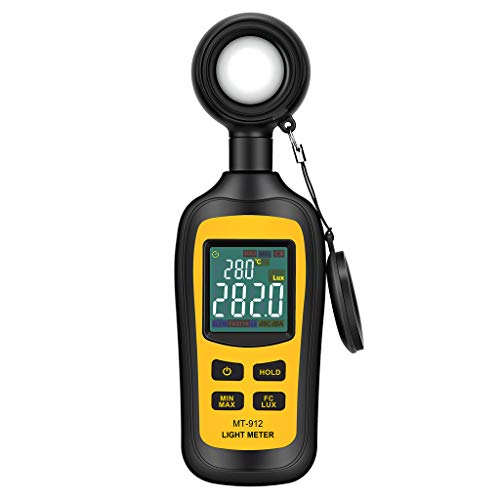
- Measures 0–200,000 lux
- Adds temperature and MIN/MAX functions
- Lightweight design with a 2-year warranty
Best For: Portable household lighting checks
Best for Wide Coverage
BTMETER BT-881D Rotating-Sensor Meter
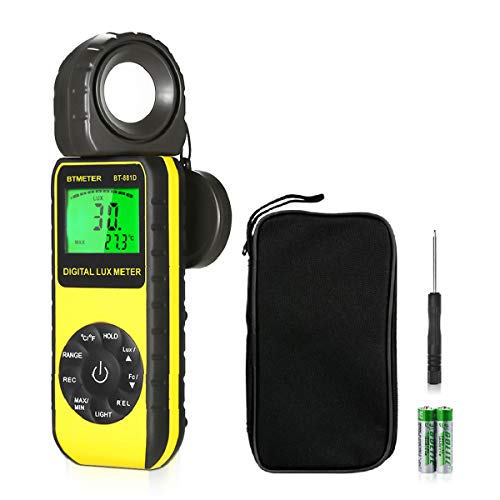
- Covers up to 400,000 lux
- Uses a 270-degree rotating sensor
- Stores 33 sets of readings
Best For: Multi-angle and comparative light measurements
Best Display and Features
TopTes TS-710 Home Light Meter

- Offers a backlit 2.25-inch display
- Measures light, temperature, and humidity
- Includes a rotating probe and MAX/MIN memory
Best For: Feature-rich home, plant, and LED checks
Best Simple Manual Option
Leaton 200,000-Lux Digital Luxmeter

- Measures up to 200,000 lux
- Supports lux and foot-candle units
- Includes hold and auto/manual ranging
Best For: Basic household light-level measurements
Best Split-Sensor Pick
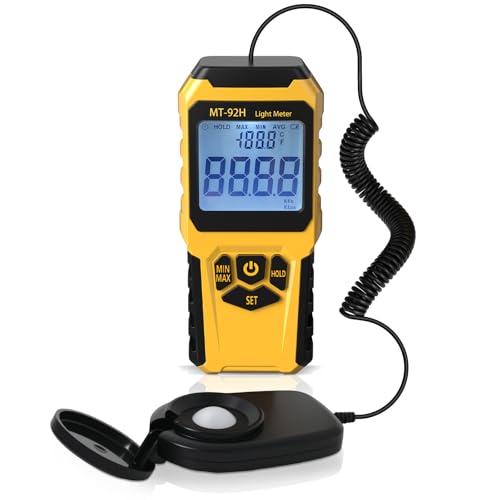
- 0–200,000 lux range with ±3% stated accuracy
- Separate probe and 0.5-second refresh rate
- Backlit display; lux/Fc and °C/°F switching
Best For: Flexible home light measurements and plant areas
Best Straightforward Tester
S8608 Digital Illuminance Meter

- Measures up to 200,000 lux and 18,500 foot-candles
- Large display with automatic range conversion
- Data hold, MAX/MIN, backlight, and auto-off
Best For: Simple indoor and outdoor brightness checks
Best for Peak Readings

- 0–200,000 lux range with two readings per second
- PEAK function captures brief high-intensity pulses
- Lux/FC switching and low-battery alert
Best For: Plant lighting and peak-intensity checks
Best Overall Range
POROMETISTO 200,000-Lux Light Meter

- 0–200,000 lux and 0–20,000 FC range
- Backlit display with digital and bar-graph readings
- Batteries and 2-year warranty included
Best For: Home gardening, indoor lighting checks, and outdoor measurements
Best Budget-Friendly Features
Mcbazel 200,000-Lux Light Meter

- Measures up to 200,000 lux
- Backlit LCD with lux/FC switching
- MIN/MAX, hold, and auto-shutoff functions
Best For: General home, garden, and photography brightness checks
Best for Flexible Sensor Positioning
DANOPLUS Rotating-Sensor Light Meter

- 360-degree rotating sensor
- Four lux ranges up to 200,000
- Two AAA batteries included
Best For: Plants, offices, headlights, and awkwardly positioned light sources
Best Budget Range – Compact 200,000-Lux Home Light Meter
For shoppers comparing light meters for home use, this compact handheld model offers a broad 0–200,000-lux range while also measuring ambient temperature. Its color LCD, hold function, and minimum/maximum readings make routine checks straightforward.
Best For: Home users who want a simple, portable meter for checking room and workspace lighting.
Pros:
- Measures light from 0 to 200,000 lux.
- Includes ambient temperature measurement, MIN/MAX readings, and data hold.
- Lightweight 6.7-ounce design with a 2-year warranty.
Cons:
- Requires three AAA batteries.
- Accuracy varies by range, from ±3% reading ±8 digits below 10,000 lux to ±4% reading ±10 digits above it.
This is a practical choice when portability and broad coverage matter more than advanced logging features. The readable color display and automatic shutoff add convenience for occasional household measurements.
Best for Wide Coverage – BTMETER BT-881D Rotating-Sensor Meter
Among light meters for home use, the BTMETER BT-881D stands out for its exceptionally wide 0.01–400,000-lux range and a sensor that rotates 270 degrees. Its fast sampling and memory functions are useful when comparing several lighting positions.
Best For: Users measuring home lighting, plants, LEDs, or other sources from difficult angles.
Pros:
- Measures up to 400,000 lux and 40,000 foot-candles.
- 270-degree rotating sensor helps with angled measurements.
- Records 33 sets of readings and includes relative measurement mode.
- Samples two to three times per second for quick readings.
Cons:
- The accuracy specification becomes less precise at higher readings.
- Its 8.26-inch length is less compact than some handheld alternatives.
The BT-881D is a strong fit for detailed comparisons rather than occasional spot checks. Its rotating probe and onboard memory can simplify measurements across rooms, plant areas, and indoor or outdoor lighting setups.
Best Display and Features – TopTes TS-710 Home Light Meter
The TopTes TS-710 is a versatile option for light meters for home use, combining a 200,000-lux range with a large backlit display and rotating probe. It also measures temperature and humidity, making it useful for checking rooms, plants, and household LEDs.
Best For: Homeowners who want easy-to-read measurements plus environmental readings and data-hold functions.
Pros:
- Measures 0.1–200,000 lux and 0.1–20,000 foot-candles.
- Features a 180-degree rotating probe and fast 0.5-second sampling.
- Large 2.25-inch backlit LCD is easier to read in low light.
- Measures ambient temperature and humidity, with MAX/MIN and hold functions.
Cons:
- Temperature readings adapt to the surrounding environment over time.
- Auto shutoff occurs after 10 minutes of inactivity.
With its included case and three AAA batteries, the TS-710 is ready for routine household use. It offers a particularly well-rounded feature set for users checking lighting comfort, plant areas, and uneven LED or headlight output.
Best Simple Manual Option – Leaton 200,000-Lux Digital Luxmeter
For straightforward light meters for home use, the Leaton digital luxmeter provides lux and foot-candle readings, automatic or manual ranging, and a hold function. Its range reaches 200,000 lux, making it suitable for checking varied indoor lighting levels.
Best For: Buyers seeking a basic light-level meter for general household measurements.
Pros:
- Measures up to 200,000 lux with 0.1-lux resolution.
- Supports both lux and foot-candle units.
- Offers hold, auto/manual range, low-battery detection, and automatic shutoff.
Cons:
- Requires a 9V battery, which is not included.
- Accuracy is specified at ±4%.
- Auto power-off occurs after approximately 15 minutes.
The Leaton focuses on essential measurement functions without adding temperature, humidity, or data-storage features. It is a sensible choice for occasional room-light checks when simple controls and broad range are the priorities.
Best Split-Sensor Pick – MT-92H Light Meter
For shoppers comparing light meters for home use, the MT-92H stands out when flexible positioning and quick readings matter. It measures from 0 to 200,000 lux, refreshes every 0.5 seconds, and includes a separate probe for easier placement around rooms, plants, or work areas.
Best For: Home users who want fast, high-range readings with a remotely positioned sensor.
Pros:
- Measures 0–200,000 lux with stated ±3% accuracy and 0.1-lux resolution.
- Split-sensor design supports flexible probe placement.
- Switches between lux and foot-candle units, with a backlit display for dark or bright conditions.
- Compact 188-gram design runs on included AAA batteries.
Cons:
- Temperature measurement is limited to 14°F–140°F.
- Uses three AAA batteries rather than a rechargeable power source.
The MT-92H is a practical choice if you need broad measurement range, quick updates, and a display that remains readable in varied lighting. Its separate sensor adds convenience for home inspections and plant areas.
Best Straightforward Tester – S8608 Digital Illuminance Meter
The S8608 is a straightforward option among light meters for home use, offering a large display and automatic range conversion. Its 200,000-lux maximum suits common indoor and outdoor brightness checks, including household spaces and grow-plant setups.
Best For: Home users who want a simple, wide-range meter with useful hold and minimum/maximum functions.
Pros:
- Measures visible brightness up to 200,000 lux and 18,500 foot-candles.
- Automatically converts measurement ranges and switches between lux and foot-candles.
- Includes maximum/minimum recording, data hold, backlight, and auto power-off.
- Low-battery indicator and included AAA batteries support convenient operation.
Cons:
- The supplied notes do not specify accuracy or refresh speed.
- Its feature set is focused on illuminance and does not include the MT-92H’s temperature measurement.
Choose the S8608 when ease of use is more important than detailed performance specifications. The large screen and built-in hold, range, and maximum/minimum features make it suitable for occasional household checks.
Best for Peak Readings – Dr.meter 1330B-V Light Meter
For light meters for home use that need quick response and peak capture, the Dr.meter 1330B-V offers a focused set of practical controls. It measures 0–200,000 lux, updates twice per second, and records the highest brief light pulse with its PEAK function.
Best For: Home gardeners and users who want fast readings plus peak-value recording.
Pros:
- Provides a 0–200,000-lux measurement range with two readings per second.
- Switches between lux and foot-candle units.
- PEAK mode records and displays the highest light pulse value.
- Includes a low-battery alert and a 9V battery.
Cons:
- Uses a 9V battery rather than AAA batteries.
- At 12 ounces, it is heavier than the MT-92H and S8608 listed here.
- The supplied notes do not mention a backlit display or automatic power-off.
The 1330B-V is a sensible pick for plant-light checks and situations where brief intensity spikes matter. Its dedicated PEAK button adds capability beyond ordinary spot measurements, while the lux/foot-candle switch keeps routine readings simple.
Best Overall Range – POROMETISTO 200,000-Lux Light Meter
For shoppers comparing light meters for home use, the POROMETISTO LT01 offers a broad 0–200,000-lux range, quick readings, and practical controls for checking rooms, plants, photography lighting, and outdoor brightness.
Best For: Home gardeners and users who want a versatile meter for both dim indoor areas and bright outdoor light.
Pros:
- Measures up to 200,000 lux and 20,000 foot-candles.
- Displays digital readings and an analog bar graph with a backlight.
- Includes data hold, MAX/MIN recording, low-battery indicator, and auto shutoff.
- Comes with batteries, a sensor cap, lanyard, and a 2-year warranty.
Cons:
- The listed accuracy is specified under standard incandescent lamps.
- The product details show an inconsistency between the package information and battery listing.
Its combination of range, hold functions, and included batteries makes it a convenient all-purpose choice, particularly when measurements may move between dark indoor spaces and strong sunlight.
Best Budget-Friendly Features – Mcbazel 200,000-Lux Light Meter
The Mcbazel is a straightforward option for light meters for home use, with a 200,000-lux maximum, switchable lux and foot-candle units, and useful MIN/MAX and hold functions for everyday brightness checks.
Best For: Home users, plant hobbyists, and photographers who need broad-range readings without advanced positioning features.
Pros:
- Offers a measurement range up to 200,000 lux.
- Samples readings up to twice per second for a fast response.
- Includes backlit LCD, data hold, MIN/MAX readings, auto shutoff, and low-battery indication.
- Suitable for homes, gardens, schools, hospitals, factories, and other settings.
Cons:
- Requires three AAA batteries, which are not included.
- Readings below approximately 2 lux display as zero.
- Accuracy varies by brightness level and includes a stated digit tolerance.
This meter covers common household and hobby measurements well, but its low-light threshold and lack of included batteries are worth considering if you plan to measure very dim spaces or use it immediately after delivery.
Best for Flexible Sensor Positioning – DANOPLUS Rotating-Sensor Light Meter
Among light meters for home use, the DANOPLUS DP-331 stands out for its separate 360-degree rotating sensor, which can help you position the detector toward a light source while keeping the main display easier to handle.
Best For: Home and office users who need to measure light around plants, work areas, headlights, or hard-to-align fixtures.
Pros:
- Rotating sensor adjusts through 360 degrees for flexible positioning.
- Provides four automatic lux ranges from 200 to 200,000, plus a 20,000-FC setting.
- Includes MIN/MAX, data hold, auto power-off controls, and low-battery indication.
- Comes with two AAA batteries.
Cons:
- Its stated accuracy is ±4% ±10 digits, so it is not a laboratory-grade instrument.
- The visible-light spectral range is limited to 400–700 nm.
- The separated sensor may be more equipment than users need for quick, simple readings.
The rotating sensor is the key practical advantage here: it gives you more control over measurement angle, making the DP-331 a useful choice when fixtures or plants are awkwardly positioned.
How We Picked These Light Meters for Home Use
We focused on handheld digital meters that are practical for indoor measurements and easy for nonprofessionals to operate. The selected models generally measure up to 200,000 lux, giving them enough range for dim rooms, desks, workshops, bright windows, and many hobby applications.
We also considered sensor flexibility, display readability, refresh speed, measurement units, portability, and useful extras such as temperature readings or automatic and manual range functions. Because product specifications and included accessories can vary, verify the current listing before buying.
Quick Comparison
| Feature | Why It Matters |
|---|---|
| Measurement range | A wider lux range handles more situations without overloading the meter. |
| Rotating or split sensor | Makes it easier to measure behind furniture, under cabinets, or at awkward angles. |
| Backlit display | Improves readability in dark rooms, though it can use more battery power. |
| Lux and foot-candle modes | Useful when following specifications or instructions that use either unit. |
| Temperature measurement | A convenient bonus for basic environmental checks, but not a substitute for a dedicated thermometer. |
Key Buying Factors for Light Meters for Home Use
Range and Resolution
Most household tasks do not require the maximum available range, but a meter rated to 200,000 lux offers useful headroom near sunny windows and under strong artificial lighting. Resolution matters when comparing small differences between work areas or plant locations.
Sensor Design and Positioning
A fixed sensor is compact and simple. Rotating sensors let you aim the display and probe independently, while a split sensor connected by a cable can reach spaces where the meter body will not fit. Choose the design that matches your rooms and projects.
Display, Controls, and Sampling
Look for a clear four-digit or large LCD readout, intuitive unit selection, and a refresh rate that is fast enough for moving around a room. A backlight helps in dim areas, while data hold can make it easier to record readings.
Accuracy and Repeatability
For home use, consistent readings are often more valuable than laboratory-level precision. Take measurements from the same height and position, avoid blocking the sensor, and compare several points instead of relying on one reading.
Power and Portability
Check the required batteries, auto-off behavior, included case, and overall size. A lightweight meter is easier to keep in a drawer or carry from room to room, but a larger display may be preferable for frequent use.
Who Should Buy Which Light Meters for Home Use?
For general room checks: Choose a straightforward digital lux meter with a broad range, readable LCD, and simple controls.
For awkward spaces: Select a rotating-sensor or split-sensor model for cabinets, shelves, workbenches, and areas behind furniture.
For houseplants: Prioritize repeatable readings, easy positioning, and a wide range so you can compare windows, shelves, and grow-light coverage.
For workshops and DIY projects: A backlit display, fast refresh rate, and lux/foot-candle switching can make repeated measurements more convenient.
For occasional users: Avoid paying for features you will not use. A compact meter with automatic ranging and a clear display is usually enough for checking whether a room, desk, or task area has suitable illumination.