
Urban skies can wash out subtle planetary detail, making the right filter a useful tool for improving contrast and controlling distracting background glow. The best choice depends on your telescope, camera, target, and observing conditions.
This roundup compares 10 filters across broadband, UHC, CLS, multi-band, and narrowband designs so you can choose a model that fits your imaging workflow without overlooking thread size or transmission characteristics.
Best 10 Light Pollution Filters for Planetary Imaging Picks for 2026
Balanced Broadband Control

- Broadband multi-bandpass design
- About 90% transmission at major nebula lines
- 2-inch M48 format with anti-reflection coating
Best For: Broadband astrophotography with controlled light-pollution reduction
Narrowband Nebula Contrast
SVBONY SV220 7nm Dual-Band Filter

- 7nm H-alpha and OIII dual-band design
- Targets moonlight and artificial light
- 1.25-inch format for astronomical cameras
Best For: Emission-nebula imaging with one-shot color cameras
Simple Visual Light Control
Celestron UHC/LPR 1.25" Filter
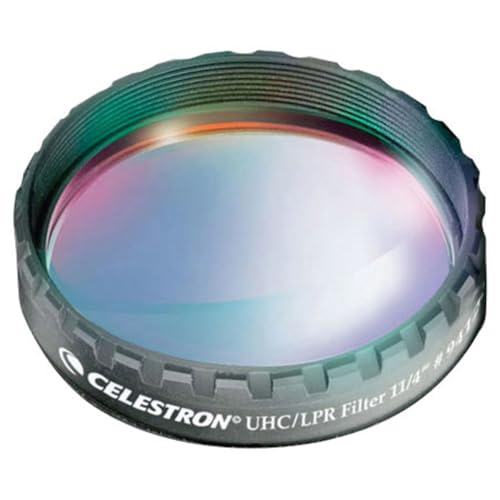
- Reduces selected artificial-light wavelengths
- Designed for darker backgrounds and nebula contrast
- Standard 1.25-inch threaded format
Best For: Visual telescope observing and basic camera use
High-Transmission Starfield Imaging
SVBONY SV260 2" Star Field Filter
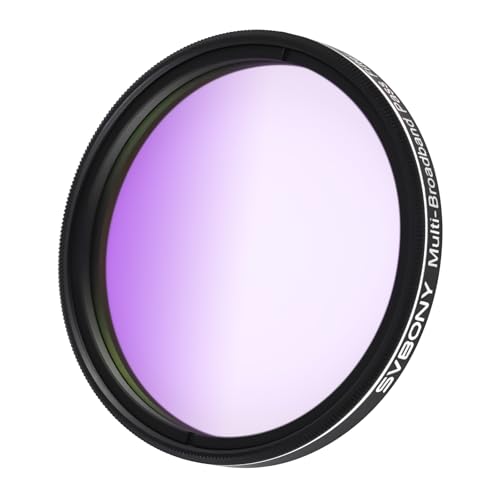
- Five-bandpass broadband design
- Over 90% peak transmittance with OD4 cutoff
- 2-inch M48 format and 300–1000 nm range
Best For: Broadband star-field and deep-sky photography
Color-Preserving Nebula Pick

- Dual-band H-Alpha, H-Beta, and O-III transmission
- Designed for DSLR and color CMOS cameras
- 2-inch M48 filter format
Best For: Color-camera nebula imaging under bright skies
Budget Contrast Upgrade
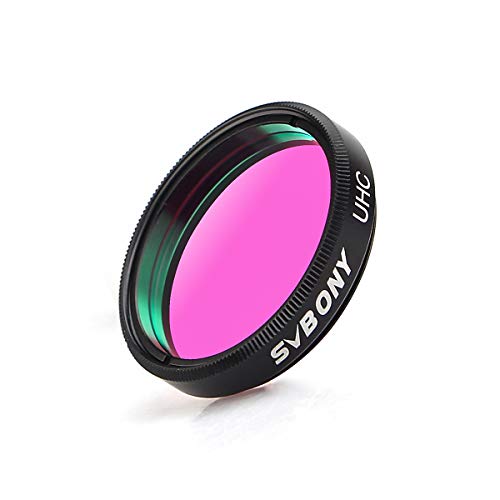
- 1.25-inch standard telescope thread
- Reduces selected artificial-light wavelengths
- Suitable for observing and astrophotography
Best For: City and suburban telescope users seeking better nebula contrast
Maximum Narrowband Contrast
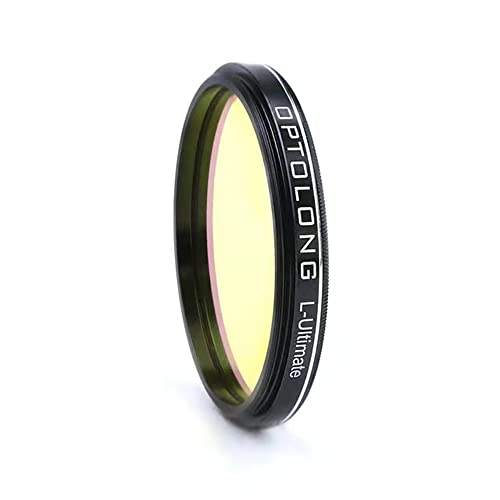
- Dual 3nm H-Alpha and O-III passbands
- Targets darker backgrounds and higher contrast
- Optimized to reduce halos around bright stars
Best For: Emission-nebula imaging under heavy light pollution
Best Multi-Narrowband Pick
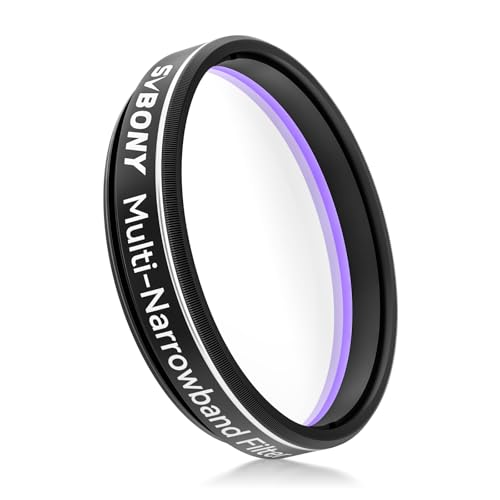
- Passes Ha, OIII, and H-beta emission lines
- Works with OSC cameras in heavy light pollution
- Includes a storage box and NIR passband
Best For: Urban OSC deep-sky astrophotography
Best Broadband Option
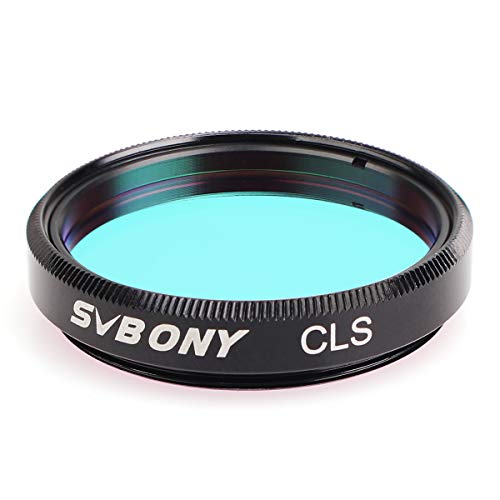
- Transmits major nebula emission lines
- Suppresses sodium and mercury light pollution
- Works with color CCD cameras and unmodified DSLRs
Best For: General urban deep-sky photography and viewing
Best for Nebula Contrast
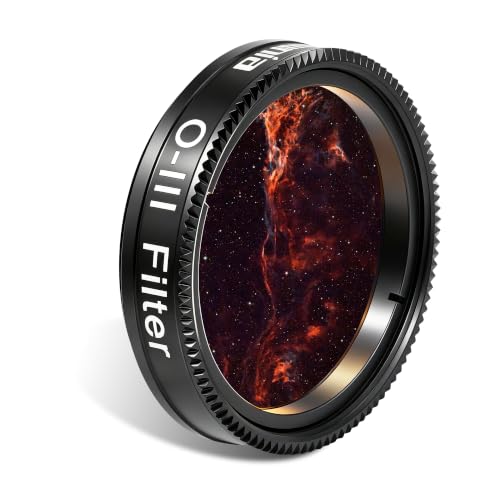
- Passes O-III wavelengths from 496 to 501nm
- Delivers strong contrast for gaseous nebulae
- Fits standard 1.25-inch telescope accessories
Best For: O-III visual observation and nebula imaging
Balanced Broadband Control – Optolong L-Pro 2" Filter
The Optolong L-Pro is a practical choice among light pollution filters for planetary imaging when you want broadband suppression without giving up transmission across important astrophotography wavelengths. Its 2-inch format and M48 threading suit compatible camera and telescope setups.
Best For: Astrophotographers seeking a broadband filter with strong transmission and controlled light-pollution reduction.
Pros:
- Multi-bandpass design targets light-pollution emission lines.
- Approximately 90% transmission at major nebula emission lines.
- Sharp roll-off and multilayer anti-reflection coating help control unwanted light and reflections.
- CNC-machined aerospace-grade aluminum cell has a black anodized finish.
Cons:
- Its 2-inch size may require a compatible filter holder or camera adapter.
- It is not water resistant.
The L-Pro offers a versatile broadband approach for users who want to preserve more of the scene’s natural color while reducing common urban-light interference. Confirm the 48 mm thread and available backfocus before buying.
Narrowband Nebula Contrast – SVBONY SV220 7nm Dual-Band Filter
The SVBONY SV220 uses a 7nm dual-band H-alpha and OIII design to reduce moonlight and artificial light, making it one of the more targeted light pollution filters for planetary imaging and nebula-focused astrophotography. It is sized for 1.25-inch equipment and compatible astronomical cameras.
Best For: One-shot color camera users photographing gaseous or planetary nebulae from bright urban locations.
Pros:
- Dual-band H-alpha and OIII design strongly limits unwanted background light.
- Can support high-contrast imaging under substantial light pollution or a full moon.
- May simplify and reduce post-processing demands.
- Multicoated glass construction is supplied in a compact 1.25-inch format.
Cons:
- Its narrow dual-band design is specialized for emission nebulae rather than general broadband scenes.
- The 1.25-inch format is less suitable for larger imaging trains without an adapter.
The SV220 is a focused solution when contrast on emission nebulae matters more than retaining a broad range of wavelengths. Check your camera’s filter compatibility and the 31.75 mm thread size before ordering.
Simple Visual Light Control – Celestron UHC/LPR 1.25" Filter
The Celestron UHC/LPR filter is a straightforward option among light pollution filters for planetary imaging and telescope observing. It selectively reduces wavelengths associated with artificial lighting while aiming to provide a darker sky background and improved nebula contrast in a widely used 1.25-inch size.
Best For: Visual observers and imaging users with telescopes or cameras using a standard 1.25-inch, 31.75 mm thread.
Pros:
- Designed to reduce selected artificial-light wavelengths.
- Supports enhanced nebula contrast and a darker sky background.
- High-transmission optical coating is intended for visual use.
- Includes a 2-year limited warranty.
Cons:
- It is a general UHC/LPR filter rather than a specialized narrowband filter.
- The 1.25-inch format may not fit larger 2-inch imaging systems.
- It is not water resistant.
Choose this model when you want a familiar, broadly compatible LPR filter for visual observation and basic camera use. Its 31.75 mm threading makes equipment compatibility easy to verify.
High-Transmission Starfield Imaging – SVBONY SV260 2" Star Field Filter
The SVBONY SV260 is a 5-bandpass broadband filter built for star-field and deep-sky photography in light-polluted areas. With over 90% peak transmittance, OD4 cutoff depth, and a 2-inch M48 format, it suits imaging systems that need broad wavelength coverage with reduced unwanted light.
Best For: 2-inch astrophotography setups photographing star fields, galaxies, reflection nebulae, and colorful deep-sky targets.
Pros:
- Five-bandpass design covers a broad 300–1000 nm working range.
- Over 90% peak transmittance helps minimize light loss.
- OD4 cutoff depth provides stronger light-pollution suppression.
- 44 mm clear aperture and M48*0.75 threading suit compatible 2-inch systems.
Cons:
- Its 2-inch format is not intended for compact 1.25-inch filter holders.
- It is designed for star-field and deep-sky imaging, not a specialized narrowband planetary filter.
- It is not water resistant.
The SV260 is a strong fit for photographers who want broad color coverage and high transmission while suppressing unwanted city light. Verify the M48 connection and camera train clearance before purchasing.
Color-Preserving Nebula Pick – Optolong L-eNhance 2" Filter
Optolong 2" L-Enhance Dual Narrowband Light Pollution Filter (H-Alpha and H-Beta/O-III)
Check Price On AmazonFor DSLR, color CMOS, and CCD users seeking light pollution filters for planetary imaging and deep-sky work, the Optolong L-eNhance is a 2-inch dual-band option designed to reduce the effect of bright skies while retaining prominent nebula colors. It passes H-Alpha, H-Beta, and O-III emission lines, with stated maximum transmission of up to 90%.
Best For: Color-camera users imaging emission nebulae from bright, heavily light-polluted locations.
Pros:
- Isolates H-Alpha, H-Beta, and O-III emission lines.
- Designed to block more than 99% of stated light-pollution lines.
- Compatible with 2-inch M48x0.75mm filter setups and several camera types.
- Uses multiple anti-reflective coatings.
Cons:
- Its 2-inch format is not intended for 1.25-inch filter threads without suitable hardware.
- It is optimized for emission-line imaging rather than a general-purpose clear filter.
The L-eNhance is a practical middle ground for color astrophotography: it targets several important nebula lines without limiting transmission to only H-Alpha and O-III. Check your camera and filter-thread compatibility before buying.
Budget Contrast Upgrade – SVBONY 1.25" UHC Filter
The SVBONY UHC is a compact option for shoppers comparing light pollution filters for planetary imaging and telescope use. Its UHC design selectively reduces some artificial-light wavelengths, helping darken the sky background and improve emission-nebula contrast for city, suburban, or darker-sky observing.
Best For: Telescope owners who want an affordable 1.25-inch filter for visual nebula observation with some astrophotography use.
Pros:
- Standard 1.25-inch thread fits compatible eyepieces and accessories.
- Designed to reduce artificial-light wavelengths and improve contrast.
- Can be used for both celestial observation and astrophotography.
- Includes multi-coated optical glass in an aluminum frame.
Cons:
- Its 1.25-inch format is less suitable for 2-inch camera trains.
- The supplied notes do not specify exact transmission bands or blocking percentages.
- It is primarily described for nebula contrast rather than specialized planetary imaging.
This UHC filter makes sense when compatibility and cost matter more than a precisely specified narrowband profile. It is a straightforward choice for 1.25-inch telescope setups, especially for improving nebula contrast from light-polluted locations.
Maximum Narrowband Contrast – Optolong L-Ultimate 2" Filter
For imagers who need aggressive light control, the Optolong L-Ultimate is a 2-inch dual-3nm filter that passes only H-Alpha and O-III emission lines. Among light pollution filters for planetary imaging and astrophotography, its extremely narrow stated bandwidth is aimed at producing a darker sky background, stronger contrast, and improved signal-to-noise in emission-nebula images.
Best For: DSLR, color CMOS, mono CMOS, or CCD users imaging emission nebulae under heavy light pollution.
Pros:
- Uses dual 3nm bandwidths centered on H-Alpha and O-III.
- Designed to eliminate other light-pollution emission lines.
- Promotes darker backgrounds, higher contrast, and improved signal-to-noise.
- Optimized for reduced halo performance around bright stars.
Cons:
- Its narrow passbands are specialized for emission-line nebulae, not broad-spectrum imaging.
- It does not pass H-Beta according to the supplied description.
- Requires a compatible 2-inch filter setup.
The L-Ultimate is the most aggressive option of these three for suppressing a bright sky background. Choose it when maximum emission-line isolation is more important than broader color information, and confirm that your camera and optical system support its 2-inch format.
Best Multi-Narrowband Pick – SVBONY SV240
For photographers seeking light pollution filters for planetary imaging and broader night-sky work, the SVBONY SV240 is a versatile 1.25-inch option. Its multi-narrowband design targets Ha, OIII, and H-beta emissions while supporting full-color imaging with one-shot color cameras, including under heavily light-polluted or moonlit conditions.
Best For: OSC astrophotographers imaging emission nebulae and other deep-sky targets from urban or suburban locations.
Pros:
- Passes key Ha, OIII, and H-beta emission lines to improve contrast and signal-to-noise ratio.
- Supports full-color imaging without changing filters or combining separate exposures.
- Designed for use across skies ranging from Bortle 1 to Bortle 8.
- Includes a PP storage box and supports an NIR passband for infrared-capable setups.
Cons:
- Its multi-narrowband design is aimed primarily at deep-sky targets rather than a dedicated planetary filter.
- Only fits 1.25-inch filter threads.
The SV240 is the most flexible choice here for color-camera deep-sky imaging in difficult skies. It is particularly appealing when you want one filter that can cover several nebular emission lines without building a filter stack.
Best Broadband Option – SVBONY CLS 1.25-Inch
The SVBONY CLS filter is a practical choice for photographers comparing light pollution filters for planetary imaging and general deep-sky photography. It uses a broadband design to suppress major artificial-light wavelengths while retaining strong transmission of important nebula emission lines.
Best For: Color CCD cameras, unmodified DSLRs, and visual observers who want a general-purpose urban-contrast filter.
Pros:
- Advertised 90% transmission of Ha, OIII, SII, and H-beta nebula emission lines.
- Suppresses major artificial-light pollution lines from sodium and mercury lighting.
- Compatible with color CCD cameras and unmodified DSLRs.
- Ion-assisted deposition coating is designed for durability, scratch resistance, and wavelength stability.
Cons:
- Broadband filtration is less selective than the SV240 or O-III designs.
- It is a 1.25-inch filter, limiting compatibility to suitable filter threads.
The CLS is a sensible general-purpose urban filter when you want to preserve a broad range of light while reducing common artificial-light wavelengths. Its camera compatibility makes it a straightforward option for mixed DSLR and color-CCD setups.
Best for Nebula Contrast – Astromania O-III Filter
For observers prioritizing selective nebula contrast, the Astromania O-III is a focused 1.25-inch filter to consider among light pollution filters for planetary imaging and deep-sky use. It passes the O-III lines from 496 to 501nm at a stated 95% transmission while blocking virtually other visible wavelengths.
Best For: Visual observation and imaging of gaseous and planetary nebulae, especially from light-polluted sites or with larger-aperture telescopes.
Pros:
- Passes the key O-III wavelengths at a stated 95% transmission.
- Provides strong selective contrast for gaseous and planetary nebulae.
- Anti-reflection coating helps reduce glare and ghosting.
- Fits standard 1.25-inch eyepieces, Barlow lenses, and camera adapters.
Cons:
- Its narrow O-III passband is specialized and not intended as an all-purpose filter.
- It does not brighten nebulae or eliminate all effects of light pollution.
- Best results are limited to suitable nebular targets rather than broad-spectrum scenes.
The Astromania O-III is the targeted choice for maximizing contrast in emission and planetary nebulae. Choose it when selective O-III performance matters more than maintaining the broader color response of a CLS or multi-narrowband filter.
How We Picked the Best Light Pollution Filters for Planetary Imaging
We evaluated these filters by looking at their filter type, intended use, optical compatibility, advertised bandpass, available size, and likely usefulness under light-polluted skies. The selection includes broadband light-pollution filters, UHC and CLS models, multi-bandpass filters, and more specialized dual-band or narrowband options.
Because planetary imaging is different from deep-sky nebula imaging, we also considered whether a filter is likely to preserve useful planetary color and brightness. Filters designed primarily for emission nebulae can block substantial portions of the visible spectrum, so they are not automatically the best choice for planets.
Quick Comparison
- Broadband filters: A balanced starting point for reducing some artificial sky glow while retaining more natural color.
- UHC and CLS filters: Useful for contrast improvement, though results vary with the planet, camera, and local lighting.
- Multi-band and dual-band filters: More selective designs that are generally better suited to emission nebulae than broadband planetary work.
- Narrowband filters: Highly specialized options that may be inappropriate for most planetary imaging because they restrict light and color.
- 1.25-inch models: A practical fit for many smaller cameras, eyepieces, and visual accessories.
- 2-inch models: Better suited to larger optical trains, filter drawers, wheels, and adapters that use 2-inch threads.
Key Buying Factors for Light Pollution Filters for Planetary Imaging
Filter Type and Spectral Coverage
For planets, prioritize a filter that maintains adequate brightness and a broad enough spectral response for natural color balance. Broadband or moderate-contrast designs are often easier to use than aggressive narrowband filters. Check the manufacturer’s transmission information when available rather than relying only on labels such as “contrast” or “light pollution reduction.”
Thread Size and Imaging Setup
Confirm whether your camera nosepiece, visual back, filter wheel, or adapter accepts 1.25-inch or 2-inch filters. A correctly sized filter still may require a compatible male or female thread, so check the complete optical path before ordering.
Target, Camera, and Exposure
Filters reduce some wavelengths, which can require longer exposures or higher gain. Planetary cameras typically capture short video sequences, so excessive light loss can make focusing and high-frame-rate capture harder. Match the filter to the brightness of the target and the sensitivity of your camera.
Optical Quality and Reflections
Look for multicoated glass, clean edges, and a well-finished cell. Bright planets can reveal halos, reflections, or color shifts caused by poor coatings or internal surfaces. Keep expectations realistic: a filter cannot remove all urban sky glow or compensate for poor seeing.
Who Should Buy Which Light Pollution Filters for Planetary Imaging?
Choose a broadband L-Pro, CLS, or comparable filter if you want the most versatile starting point for general observing and imaging. Choose a UHC filter when contrast improvement is your priority and some color or brightness trade-off is acceptable. Choose a 2-inch model for a larger imaging train or future equipment flexibility, while 1.25-inch filters are usually the economical choice for compact setups.
Dual-band and narrowband models are best reserved for users who also image emission nebulae and understand their limitations for planetary targets. Before buying any of these Light Pollution Filters for Planetary Imaging, compare the filter’s passbands with your camera’s sensitivity, telescope aperture, and the specific planets you plan to capture.