
Light pollution can wash out faint nebulae, reduce contrast, and make urban or suburban observing frustrating. The right filter can selectively block troublesome wavelengths while preserving more detail in emission targets.
Our roundup compares 10 light pollution filters for telescopes, from beginner-friendly 1.25-inch broadband and UHC models to narrower dual-band and multi-bandpass filters for serious deep-sky viewing.
Best 10 Light Pollution Filters for Telescopes Picks for 2026
Urban Contrast Pick
SVBONY 1.25-inch CLS Broadband Filter
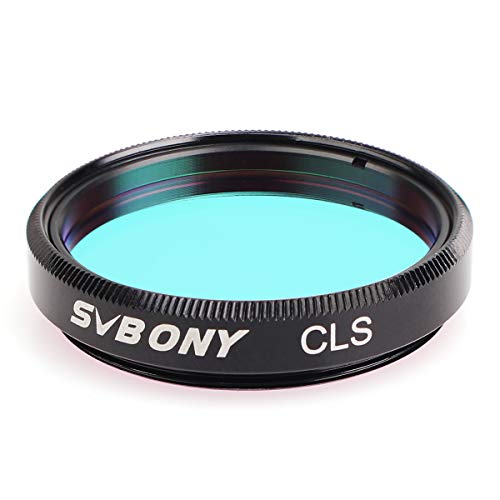
- Targets common sodium and mercury light-pollution lines
- Transmits major nebula emission wavelengths
- Works with color CCD cameras and unmodified DSLRs
Best For: Urban deep-sky observing and compatible astrophotography
Beginner-Friendly UHC
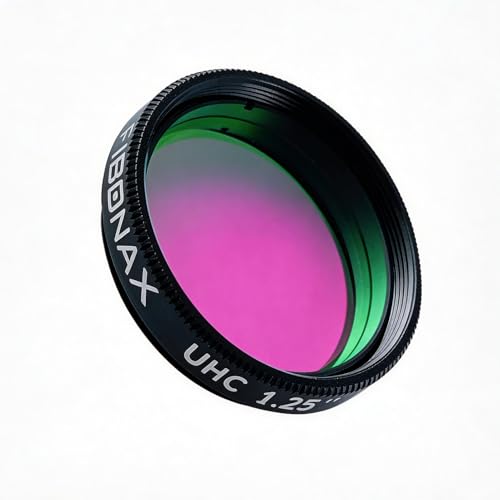
- Suppresses sodium and mercury streetlight glare
- Isolates H-beta and O-III nebula emissions
- Includes stacking threads and a storage case
Best For: Portable urban stargazing and compatible camera use
Deep-Sky Imaging Specialist
SVBONY SV220 2-inch 7nm Dual-Band Filter

- Passes O-III and H-alpha emission lines
- Provides over 94% transmission and strong light rejection
- Designed for color CMOS, CCD, and digital cameras
Best For: Deep-sky astrophotography from light-polluted locations
Established Visual Option
Celestron 1.25-inch UHC/LPR Filter
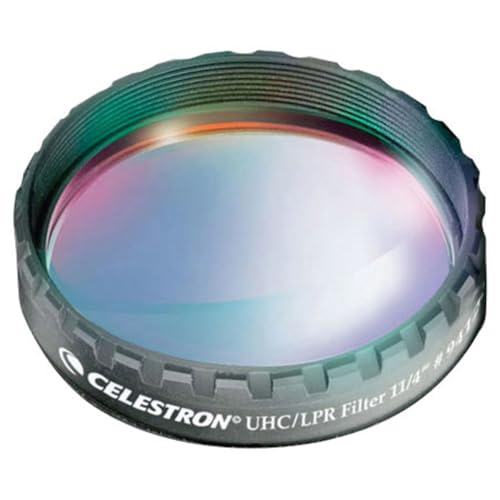
- Reduces selected artificial-light wavelengths
- Designed for darker backgrounds and nebula contrast
- Fits standard 1.25-inch telescope and camera threads
Best For: Visual observing with standard 1.25-inch equipment
Best Dual-Band Choice

- Targets H-Alpha and OIII wavelengths
- Reduces moonlight and artificial light interference
- Designed for 1.25-inch one-shot color camera setups
Best For: Urban deep-sky nebula photography
Best Visual Nebula Filter

- Selectively reduces artificial-light wavelengths
- Boosts contrast in emission nebulae
- Works at city, suburban, and dark-sky sites
Best For: Visual nebula observation with 2-inch equipment
Best Multi-Target Imaging Filter
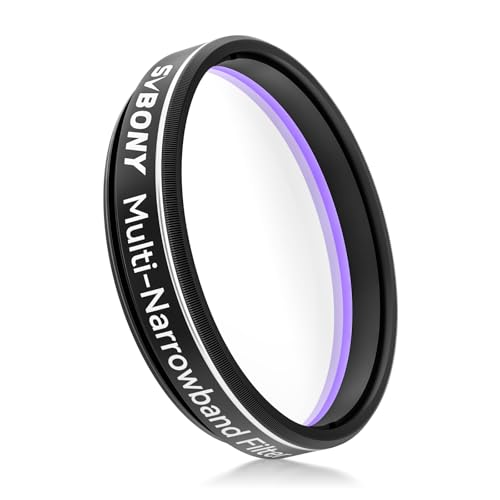
- Supports galaxies, nebulae, and star clusters
- Passes Ha, OIII, and H-Beta emission lines
- Designed for one-shot color imaging in Bortle 1–8 skies
Best For: Versatile urban deep-sky astrophotography
Best Compact UHC Filter
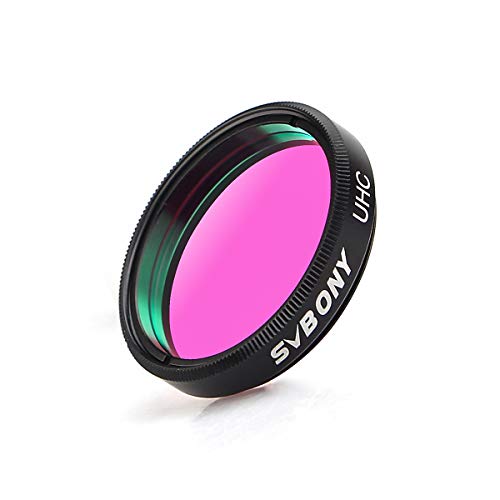
- Improves emission-nebula contrast
- Fits standard 1.25-inch accessories
- Optical glass with aluminum frame
Best For: City and suburban nebula observation
Best for Starfield Astrophotography
SVBONY SV260 2-inch Multi-bandpass Filter
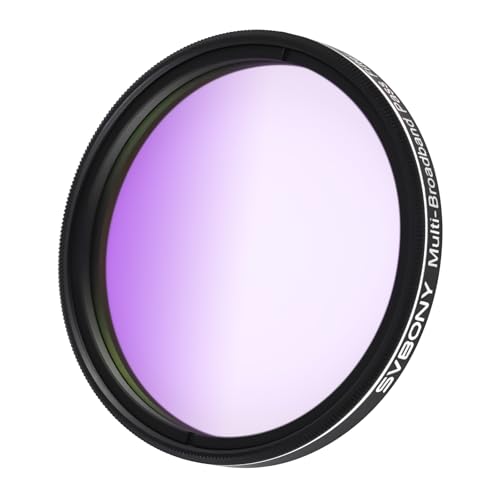
- Over 90% peak transmittance
- OD4 light-pollution cut-off depth
- 300–1000nm working range
Best For: 2-inch starfield and deep-sky photography
Best 2-inch UHC Option
SVBONY Multi-Coated 2-inch UHC Filter
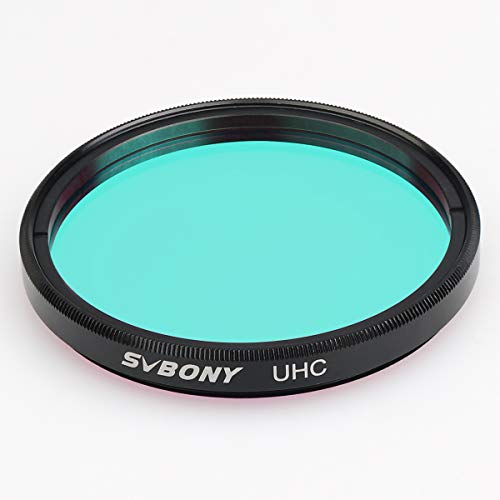
- Improves deep-sky image contrast
- Fits 2-inch eyepieces
- M48×0.75 threaded interface
Best For: Suburban 2-inch nebula observation
Urban Contrast Pick – SVBONY 1.25-inch CLS Broadband Filter
If you need light pollution filters for telescopes that balance nebula visibility with broad compatibility, this 1.25-inch SVBONY CLS filter is a practical option. Its coating is designed for durability and stable performance, while the filter targets common artificial-light wavelengths.
Best For: Urban deep-sky visual observing and astrophotography with color CCD cameras or unmodified DSLRs.
Pros:
- Transmits key nebula emission lines, including H-alpha, O-III, S-II, and H-beta.
- Designed to suppress major sodium and mercury artificial-light lines.
- Ion-assisted, multi-coated construction is intended to resist scratching and temperature-related wavelength shifts.
- Uses a standard 1.25-inch format with a 28.5mm thread.
Cons:
- It is not water resistant.
- Its 1.25-inch format may not suit telescopes or cameras requiring 2-inch filters.
- The supplied notes do not specify suitability for specialized narrowband imaging.
This filter is a versatile broadband choice for observers dealing with city glow. It is especially appealing when you want one filter for both visual use and compatible color-camera photography rather than a dedicated narrowband solution.
Beginner-Friendly UHC – FIBONAX 1.25-inch UHC Filter
This FIBONAX UHC model is among the more approachable light pollution filters for telescopes, combining a standard 1.25-inch size with multi-coated optical glass and dual M28.5×0.6 threads. It is intended to reduce artificial-light glare while improving contrast on nebulae and lunar details.
Best For: Beginners and experienced users seeking a portable 1.25-inch filter for urban stargazing, nebula viewing, and compatible astrophotography cameras.
Pros:
- Designed to block sodium and mercury streetlight glare while isolating H-beta and O-III emissions.
- Claims more than 90% light transmission with reduced reflections.
- Dual M28.5×0.6 threads allow filter stacking.
- Includes a protective storage case and an aluminum frame.
Cons:
- Its 1.25-inch format is not intended for 2-inch filter systems.
- The supplied notes do not provide a specific transmission percentage for each emission line.
- Filter stacking can add complexity and may not be necessary for every observation.
With its standard size, storage case, and stacking threads, the FIBONAX is a flexible entry point for city-based observers. It suits users who want one compact filter for nebulae, lunar details, and several compatible camera setups.
Deep-Sky Imaging Specialist – SVBONY SV220 2-inch 7nm Dual-Band Filter
For astrophotographers searching for light pollution filters for telescopes with stronger wavelength isolation, the SVBONY SV220 uses 7nm dual-band filtration. It passes O-III and H-alpha emission lines while rejecting much of the surrounding artificial light and skyglow.
Best For: Deep-sky astrophotography with color CMOS, CCD, or digital cameras in light-polluted locations or under a full moon.
Pros:
- Passes O-III at 500.7nm and H-alpha at 656.3nm.
- Offers more than 94% transmission with strong out-of-band light rejection.
- Designed to improve contrast and reduce post-processing difficulty for deep-sky images.
- Uses a waterproof optical-glass element in an anodized aluminum 2-inch frame.
Cons:
- Not intended for visual astronomy or solar imaging.
- Not compatible with smart telescopes or telescopes with a focal ratio of f/4 or less.
- The 2-inch M48x0.75 format may require appropriate adapters or accessories.
The SV220 is the most specialized option in this group. Its narrow dual-band design is aimed at camera-based deep-sky work, so it makes the most sense for astrophotographers whose equipment meets the stated focal-ratio and camera requirements.
Established Visual Option – Celestron 1.25-inch UHC/LPR Filter
The Celestron UHC/LPR is a straightforward choice among light pollution filters for telescopes when your priority is visual observing with a standard 1.25-inch setup. It selectively reduces wavelengths associated with artificial lighting while aiming to darken the sky background and improve nebula contrast.
Best For: Visual telescope users who want enhanced nebula contrast and a darker background with 1.25-inch telescopes or compatible cameras.
Pros:
- Designed specifically to reduce wavelengths produced by artificial light.
- Promotes enhanced nebula contrast and a darker sky background.
- Uses high-transmission optical coating.
- Compatible with telescopes and cameras using a standard 1.25-inch or 31.75mm thread.
Cons:
- It is limited to 1.25-inch filter systems.
- The supplied notes do not identify specific passband wavelengths or transmission figures.
- It is not water resistant.
This is a sensible, uncomplicated pick for visual observers who want a branded LPR filter without moving to a larger format or a specialized dual-band imaging design. Its stated emphasis is visual use and improved nebula contrast.
Best Dual-Band Choice – SV220 7nm H-Alpha OIII Filter
For astrophotographers seeking light pollution filters for telescopes, the SVBONY SV220 uses a 7nm dual-band design to target H-Alpha and OIII wavelengths. Its 1.25-inch format is intended for compatible SVBONY electronic and astronomical cameras, including one-shot color setups.
Best For: Deep-sky imaging of gaseous and planetary nebulae with a one-shot color camera in urban skies or under moonlight.
Pros:
- Reduces interference from artificial light pollution and moonlight.
- Enhances nebula-to-sky contrast for visual observation and imaging.
- Can simplify post-processing compared with separate narrowband exposures.
- Multi-coated glass construction with a standard 31.75mm thread.
Cons:
- Its 1.25-inch size may not suit telescopes or cameras requiring a 2-inch filter.
- Designed primarily around H-Alpha and OIII emission targets rather than broad deep-sky imaging.
The SV220 is a focused option for nebula photographers who need stronger contrast from light-polluted locations. It improves perceived contrast rather than making the nebula intrinsically brighter, so it is best matched with compatible camera equipment and emission nebula targets.
Best Visual Nebula Filter – Astromania 2-Inch UHC Filter
The Astromania UHC is one of the more straightforward light pollution filters for telescopes, selectively reducing wavelengths associated with artificial lighting while preserving key nebula emission detail. Its 2-inch standard thread works with compatible eyepieces and telescope accessories.
Best For: Visual observation of emission nebulae such as Orion, Lagoon, and Swan from city, suburban, or dark-sky locations.
Pros:
- Reduces selected artificial-light wavelengths to improve nebula contrast.
- Can reveal faint emission-nebula details that may be difficult to see without filtration.
- Useful at both light-polluted sites and darker observing locations.
- Optical glass, aluminum frame, and anti-reflection coatings support clear views.
Cons:
- The 2-inch format requires compatible 2-inch equipment or a suitable adapter.
- Its benefits are most relevant to emission nebulae rather than every deep-sky object.
- The supplied specifications list the filter as not water resistant.
This UHC filter is a practical choice for observers who want a general-purpose nebula accessory rather than a specialized imaging filter. Its broad compatibility and emphasis on visual contrast make it especially appealing for exploring prominent emission nebulae.
Best Multi-Target Imaging Filter – SV240 Multi-Narrowband Filter
The SVBONY SV240 expands the role of light pollution filters for telescopes by combining multiple narrowband passbands for deep-sky imaging and visual observation. Its 1.25-inch design supports one-shot color imaging across a broad range of targets, including galaxies, reflection nebulae, emission nebulae, and star clusters.
Best For: One-shot color astrophotography in urban or moonlit conditions when you want to work with varied deep-sky targets.
Pros:
- Supports imaging from Bortle 1 through Bortle 8 skies.
- Passes key Ha, OIII, and H-Beta emission lines to improve signal-to-noise ratio and contrast.
- Enables full-color imaging without combining separate filter exposures.
- Includes a plastic storage box and has a standard 1.25-inch format.
Cons:
- Its 1.25-inch thread is not suitable for systems designed only for 2-inch filters.
- The filter is primarily intended for compatible cameras and may require testing for a specific imaging setup.
- The supplied specifications list it as not water resistant.
The SV240 is the most versatile option here for photographers who do not want to limit themselves to emission nebulae. Its multi-narrowband approach is designed to retain color while improving contrast across a wider selection of deep-sky subjects, including challenging urban targets.
Best Compact UHC Filter – SVBONY 1.25-inch UHC Filter
If you need light pollution filters for telescopes that fit common 1.25-inch eyepieces, this SVBONY UHC filter is a practical option. Its optical glass lens and aluminum frame are designed to reduce artificial-light wavelengths, darken the sky background, and improve emission-nebula contrast for city, suburban, and dark-sky observing.
Best For: Visual nebula observing and compatible 1.25-inch telescope eyepieces, with astrophotography use as an added option.
Pros:
- 1.25-inch barrel with a standard filter thread for compatible eyepieces and accessories
- Designed to reduce light pollution and improve emission-nebula contrast
- Multi-coated optical glass lens in an aluminum frame
- Includes a sturdy transparent case
Cons:
- Limited to 1.25-inch eyepiece and accessory compatibility
- Designed for nebula contrast rather than general-purpose viewing of every celestial object
- Not water resistant
This is a straightforward choice for observers who want a compact UHC filter for suburban or city skies. Confirm that your eyepiece or accessory uses a 1.25-inch thread before buying.
Best for Starfield Astrophotography – SVBONY SV260 2-inch Multi-bandpass Filter
For photographers comparing light pollution filters for telescopes, the SVBONY SV260 takes a broadband, multi-bandpass approach. It is designed to suppress unwanted light while maintaining more than 90% peak transmittance across a 300–1000nm working range, supporting starfield, galaxy, and reflection-nebula photography.
Best For: 2-inch astrophotography systems and colorful starfield, galaxy, and reflection-nebula imaging.
Pros:
- More than 90% peak transmittance is designed to minimize light loss
- OD4 cut-off depth provides strong light-pollution suppression
- 300–1000nm working range covers broad multi-band transmission
- M48×0.75 thread and 44mm clear aperture suit compatible 2-inch systems
Cons:
- 2-inch format is not intended for 1.25-inch eyepiece setups
- Its stated compatibility is focused on astrophotography systems and listed SVBONY devices
- Not water resistant
The SV260 is the most photography-focused option here, prioritizing broad transmission, color retention, and light suppression. Check the M48×0.75 thread and your imaging train’s compatibility before ordering.
Best 2-inch UHC Option – SVBONY Multi-Coated 2-inch UHC Filter
This SVBONY UHC filter is a practical pick when your telescope uses 2-inch eyepieces and you want light pollution filters for telescopes aimed at improving deep-sky contrast. Its optical glass lens and aluminum frame are designed to reduce unwanted urban light and produce sharper, clearer views for observation and astrophotography.
Best For: City and suburban observers using 2-inch eyepieces for deep-sky objects and nebula-focused astrophotography.
Pros:
- 2-inch format fits compatible telescope eyepieces and accessories
- M48×0.75 threaded interface
- Designed to improve image contrast and reduce light pollution
- Includes an aluminum frame and plastic storage box
Cons:
- Not suitable for 1.25-inch eyepiece threads without compatible adaptation
- The notes specify transmission around the 400nm line and no Ha or higher transmission
- Not water resistant
This filter makes sense for 2-inch setups where nebula contrast is the priority. Its stated transmission characteristics are specialized, so buyers should consider their target objects and imaging needs rather than treating it as a universal filter.
How We Picked These Light Pollution Filters for Telescopes
We selected filters across the main categories used by visual observers: broadband light-pollution reduction, UHC-style nebula filters, narrowband dual-band filters, and multi-bandpass designs. We also considered filter size, stated bandpass, optical construction, coating claims, and compatibility with common eyepieces, diagonals, and filter wheels.
Because filter performance depends on the target, telescope aperture, sky brightness, and observer expectations, no single model is best for every setup. The most useful choice balances spectral selectivity with the amount of light your telescope can collect.
Quick Comparison
| Filter type | Best for | Typical effect | What to watch for |
|---|---|---|---|
| Broadband or CLS | Moderate light pollution and star fields | Subtle contrast improvement | Limited benefit under severe skyglow |
| UHC | General emission nebula viewing | Stronger nebula contrast | Dims many stars and galaxies |
| Dual-band narrowband | Bright emission nebulae | High contrast against dark skies | Can be too restrictive for some targets |
| Multi-bandpass | Flexible nebula and star-field use | Balanced transmission across selected lines | Check the intended targets and telescope size |
Key Buying Factors
Filter Type and Target
Broadband and CLS filters are the gentlest option for observers who want to retain a more natural field of stars. UHC filters are usually the better starting point for emission nebulae such as the Orion, Lagoon, and Swan Nebulae. Narrower dual-band filters can produce a darker background and stronger contrast on hydrogen- and oxygen-emission regions, but they are less versatile.
Size and Fit
Choose 1.25 inches for standard 1.25-inch eyepieces and accessories, or 2 inches for wide-field 2-inch eyepieces. A 2-inch filter may also be more practical when switching among several 2-inch eyepieces, but it generally costs more. Confirm the thread standard before buying, especially if using adapters or specialized accessories.
Bandwidth, Coatings, and Optical Quality
Narrower bandwidth is not automatically better. It can improve contrast on suitable nebulae, while a wider UHC-style passband can provide a brighter and more forgiving view. Look for clear specifications, threaded metal cells, multi-coating information, and a reputation for consistent transmission. Filters do not restore detail in galaxies, reflection nebulae, or star clusters in the same way they can enhance emission nebulae.
Telescope Aperture and Observing Conditions
Small telescopes often benefit from moderate selectivity because extremely narrow filters can make the view too dim at higher magnifications. Larger apertures can take better advantage of narrowband designs. A filter also works best at a dark observing site; it cannot remove all forms of light pollution or replace dark-adapted vision.
Who Should Buy Which Light Pollution Filters for Telescopes?
- Beginners and suburban observers: Start with a 1.25-inch CLS or UHC filter for broad compatibility and straightforward use.
- Emission-nebula enthusiasts: Choose a UHC filter when you want a versatile improvement across many bright nebulae.
- Observers under heavy light pollution: Consider a dual-band narrowband filter for stronger contrast on hydrogen- and oxygen-rich nebulae.
- Wide-field 2-inch users: Select a 2-inch UHC, multi-bandpass, or dual-band option that matches your eyepiece collection.
- Experienced observers: A multi-narrowband or carefully specified narrow filter can complement, rather than replace, a broader UHC filter.
For most buyers, the best first purchase is a compatible UHC filter. Add a broadband or narrower dual-band model later if your observing targets and sky conditions justify the extra specialization.