
Choosing the right guide scope can improve guiding accuracy without adding unnecessary weight to your astrophotography setup. The best lightweight models balance aperture, focal length, focus control, and mounting flexibility.
This roundup compares compact guide scopes, finder-style options, and an off-axis guider alternative so you can match your equipment to your imaging goals, mount capacity, and camera setup.
Best 10 Lightweight Telescope Guide Scopes Picks for 2026
Premium APO Pick

- 50mm APO doublet with ED glass
- Finder stalk and V-style rail included
- Can become an astrograph with an adapter
Best For: Versatile guiding, observing, and imaging setups
Precision Guiding Alternative

- Guides through the main telescope
- Large prism and 48mm clear aperture
- Includes adapters for several camera types
Best For: SCT and EdgeHD long-exposure imaging
Compact Budget Pick
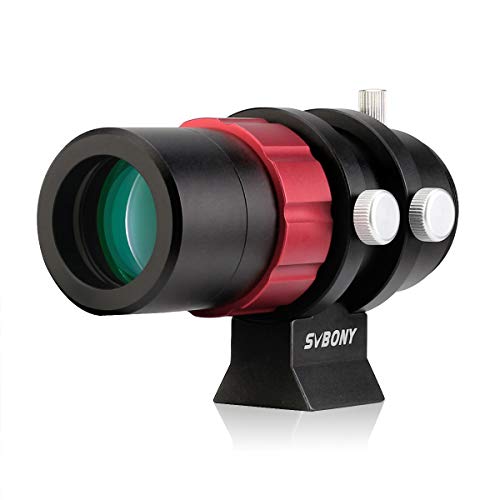
- Weighs 342 grams
- 2.86-degree field of view
- 1.25-inch and M42 interfaces
Best For: Portable setups with compatible guide cameras
Wide-Field 60mm Option

- 60mm bright, wide-field optics
- 1.5-degree field of view
- Adjustable-aim dovetail bracket
Best For: Imaging telescopes up to 1500mm focal length
Bright-View Finder
SV208 8x50 Illuminated Finderscope

- Bright 50mm objective with a 7.3° field of view
- Correct-image prism for natural viewing
- Illuminated glass reticle for dark conditions
Best For: Visual observers seeking bright, easy target acquisition
Precision Guide Setup
Astromania 60mm Helical Guide Scope

- 60mm aperture with 240mm focal length
- Helical focuser supports precise, low-flexure focusing
- Includes rings, dovetail bar, and mounting plate
Best For: Astrophotographers wanting a complete autoguiding setup
Compact Imaging Guide

- Lightweight 40mm guide scope weighs 450g
- Compatible with several 1.25-inch and M42 cameras
- Designed for telescope focal lengths up to 700mm
Best For: Portable astrophotography rigs using compatible guide cameras
Precision Compact Pick
Alstar 50mm Helical Guidescope

- 40mm total focusing range with micro-focus adjustment
- 50mm multi-coated optics with 200mm focal length
- Includes clamps and Synta-style dovetail plate
Best For: Portable astrophotography and visual finder use
Long-Reach Light-Gathering Pick
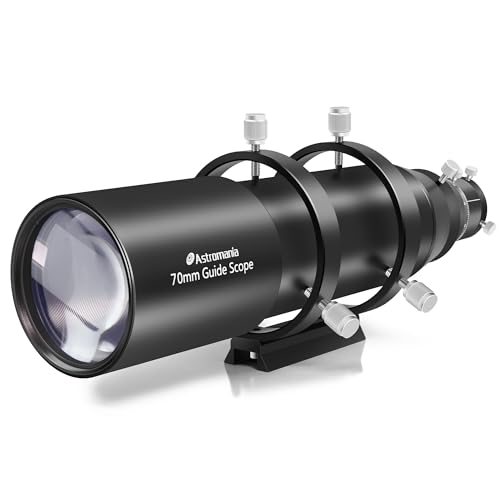
- 400mm focal length with 70mm objective
- 90mm focusing range with micro-focus section
- Includes clamps, mounting plate, and adjustable weight
Best For: Longer-reach guiding and brighter guide-star views
Flexible Mounting Pick
Astromania 50mm Multi-Use Guidescope

- 200mm focal length for telescopes up to 1500mm
- 40mm focusing range with helical micro-adjustment
- Includes rings, dovetail bar, and T-threaded focuser collar
Best For: Flexible finder and autoguider configurations
Premium APO Pick – Sky-Watcher EvoGuide 50DX
For a lightweight telescope guide scopes setup that can also support visual observing, the Sky-Watcher EvoGuide 50DX combines a 50mm apochromatic doublet with a compact design and flexible mounting options. Its 242mm focal length, 1.25-inch helical focuser, and included finder stalk and V-style rail make it adaptable for many astrophotography configurations.
Best For: Astrophotographers who want a lightweight guide scope with higher-end APO optics and the option to use it as a compact astrograph with an additional adapter.
Pros:
- ED glass and apochromatic doublet design are intended to provide contrast-rich views.
- Includes both a finder stalk and Vixen-style mounting plate for flexible installation.
- Built-in T-threads allow astrograph use with an optional adapter.
Cons:
- The 2.7-pound weight is higher than that of smaller mini guide scopes.
- The adapter needed for astrograph use is not included.
The EvoGuide 50DX is a versatile choice when you want more than a basic guide optic. Its mounting flexibility and APO doublet construction make it especially appealing for users balancing guiding, observing, and future imaging applications.
Precision Guiding Alternative – Celestron Off-Axis Guider
Although it is not a separate guide scope, the Celestron Off-Axis Guider is a compelling alternative for lightweight telescope guide scopes because it guides through the main telescope’s optical path. Its large prism, 48mm clear aperture, and included camera adapters are designed for accurate long-exposure astrophotography.
Best For: Schmidt-Cassegrain and EdgeHD users who prioritize guiding accuracy and want to avoid adding a separate guide scope.
Pros:
- Off-axis guiding uses the main telescope’s optical path and requires no separate guide scope.
- Large 12.5mm prism and 48mm clear aperture support broad camera compatibility.
- Fixed-orientation helical focuser enables smooth autoguider focusing.
Cons:
- It is an off-axis guider rather than a standalone guide scope.
- Its listed weight is 0.8 kg, so it may not be the lightest guiding solution.
This model is best viewed as a precision-focused alternative to lightweight telescope guide scopes. It can reduce differential flexure concerns, but its compatibility and setup are most compelling for the SCT, EdgeHD, DSLR, and astronomy-camera combinations listed by Celestron.
Compact Budget Pick – SVBONY SV165 30mm
The SVBONY SV165 is a compact option for lightweight telescope guide scopes, weighing 342 grams and using 30mm f/4 optics. Its 120mm focal length, 2.86-degree field of view, and 45mm back focus are suited to quickly locating targets and pairing with compatible autoguiding cameras.
Best For: Portable astrophotography setups using compatible 1.25-inch or M42 cameras from SVBONY, ZWO, QHY, Orion, and similar systems.
Pros:
- Lightweight 342-gram design helps minimize added equipment weight.
- Wide field of view can make target acquisition easier.
- Includes mounting rings with nylon-tipped thumbscrews to help protect the tube.
- Offers 1.25-inch and M42 mounting interfaces for compatible guide cameras.
Cons:
- Some camera models may require additional accessories to achieve focus.
- It cannot be used with a dielectric mirror star diagonal and still reach focus.
- The 30mm achromatic optics are a more basic design than an APO guide scope.
For a small, camera-focused guiding package, the SV165 emphasizes low weight, broad framing, and straightforward mounting. Confirm your camera and focusing requirements before buying, especially if your setup does not use the listed interfaces.
Wide-Field 60mm Option – MEOPTEX 60mm Guide Scope
The MEOPTEX 60mm Guide Scope offers bright, wide-field optics for users comparing lightweight telescope guide scopes with a larger objective. Its 1.5-degree field of view, 1.25-inch double helical focuser, and adjustable-aim bracket are designed for convenient astrophotography use.
Best For: Astrophotographers who want a 60mm guide scope with a wide field and compatibility with telescopes up to 1500mm focal length.
Pros:
- 60mm objective provides a bright, wide-field view for locating guide stars.
- 1.25-inch double helical focuser supports manual focusing adjustments.
- Adjustable-aim dovetail bracket helps position the scope on an imaging setup.
- Bracket is described as fitting virtually any astrophotography telescope.
Cons:
- At 2.5 pounds, it is heavier than compact 30mm guide scopes.
- The supplied notes do not specify included camera adapters or mounting hardware beyond the guide scope bracket.
The MEOPTEX is a practical choice when a brighter 60mm objective and adjustable aiming matter more than minimizing every ounce. Its stated focal-length suitability makes it a reasonable match for medium-length astrophotography telescopes.
Bright-View Finder – SV208 8×50 Illuminated Finderscope
For shoppers comparing lightweight telescope guide scopes, the SVBONY SV208 is a practical visual-finding option with an 8×50 optical design, a wide 7.3-degree field of view, and a correct-image prism. Its illuminated reticle is especially useful when aiming under dark observing conditions.
Best For: Visual observers who want a bright, upright view and an illuminated crosshair for locating targets.
Pros:
- 50mm objective lens gathers light for a bright image.
- Correct-image prism provides right-side-up, left-to-right-correct views.
- Dark-field red LED illumination helps show the reticle at night.
- Glass reticle and adjustable focus support precise target alignment.
Cons:
- At 632g, it is heavier than compact mini guide scopes.
- Manual focusing and battery-powered illumination require hands-on setup.
The SV208 prioritizes a bright, comfortable finding experience rather than minimum weight. Its large objective and illuminated glass reticle make it a strong choice when easy target acquisition matters more than keeping an imaging rig as compact as possible.
Precision Guide Setup – Astromania 60mm Helical Guide Scope
Among lightweight telescope guide scopes, this Astromania model is a more fully equipped guiding system, combining a 60mm aperture, 240mm focal length, helical focuser, rings, and a dovetail mounting bar. It is designed for both visual finding and autoguiding, with direct T-thread camera attachment.
Best For: Astrophotographers who want a versatile guide scope with precise focusing and included mounting hardware.
Pros:
- Helical focuser provides fine adjustments with zero flexure.
- Male T-threads support secure direct connection to compatible guide cameras.
- Includes guide rings, dovetail bar, and Synta-style mounting plate.
- 45mm total focusing range includes a scaled drawtube and micro-focusing adjustment.
Cons:
- Its 60mm design and included hardware may add more bulk than a mini guide scope.
- Compatibility depends on a guide camera with female T-threads and a suitable mounting base.
- The stated 240mm focal length is intended for astrophotography telescopes up to 1500mm.
This is the most complete option of the three for users building a dedicated guiding setup. The robust metal housing, adjustable rings, and helical focuser favor stable, repeatable operation, though compact-rig shoppers may prefer a smaller model.
Compact Imaging Guide – SV165 40mm Mini Guide Scope
The SVBONY SV165 is a compact choice for lightweight telescope guide scopes, with a 40mm objective, fully multi-coated achromatic optics, and compatibility with several 1.25-inch and M42-threaded guide cameras. It is intended for telescopes with focal lengths within 700mm.
Best For: Portable astrophotography setups using compatible guide cameras on telescopes up to 700mm focal length.
Pros:
- Compact 40mm design weighs 450g.
- Fully multi-coated achromatic optics provide clear, sharp views.
- 1.25-inch and M42 interfaces support SV305 Pro, Orion, ZWO, and QHY guide cameras.
- Scaled front focuser and locking ring help repeat focus settings.
Cons:
- Its recommended telescope focal-length range is limited to 700mm.
- Some eyepiece and camera combinations may require removing the red locking ring and shortening the tube to focus.
- It uses manual focusing rather than an automated focusing system.
The SV165 is the clearest fit for a compact, weight-conscious guiding rig. Its adjustable six-point guide ring helps align it with the main telescope, while the included T2 extension tubes provide additional focusing flexibility with compatible cameras.
Precision Compact Pick – Alstar 50mm Helical Guidescope
For shoppers comparing lightweight telescope guide scopes, the Alstar 50mm combines a compact metal body with a helical focuser and 200mm focal length. Its wide-field design is intended to help locate guide stars while also serving as a visual finder.
Best For: Astrophotographers who want fine manual focusing, a portable setup, and dual finder/guide-scope use.
Pros:
- Helical focuser provides 40mm of focus travel, including 10mm of micro-focusing.
- 50mm fully multi-coated optics support bright, wide-field views.
- Includes pipe clamps and a Synta-style dovetail mounting plate.
- All-metal construction and locking hardware support stable camera or eyepiece positioning.
Cons:
- Manual focusing requires adjustment at the scope.
- At 1.3 pounds, it may not be the lightest option for very weight-sensitive rigs.
The Alstar is a practical middle ground for users who need a durable, adjustable guide scope without moving to a larger 70mm design. Its 200mm focal length is specified for telescopes up to 1500mm, making it particularly suitable for compact and mid-sized imaging systems.
Long-Reach Light-Gathering Pick – Astromania 70mm Guidescope
The Astromania 70mm is a larger option among lightweight telescope guide scopes, pairing a 400mm focal length with a double helical focuser. Its bright, wide-field optics are designed to place more potential guide stars in view for photographic or visual use.
Best For: Imaging setups that benefit from a longer focal length and a larger 70mm objective.
Pros:
- 400mm focal length and 70mm objective provide a longer-reach guiding platform.
- 90mm focusing range includes a 10mm micro-focusing section.
- Brass compression ring and helical focuser help prevent eyepiece or camera rotation.
- Includes matching pipe clamps, mounting plate, and adjustable dovetail weight.
Cons:
- Its 2.5-pound weight is relatively substantial for a lightweight guide-scope setup.
- The longer tube can take more room in an accessory case or on a compact rig.
This model favors reach and light collection over minimum weight. Choose it when the 400mm focal length and 70mm aperture are more valuable to your setup than the portability of a smaller 50mm guide scope.
Flexible Mounting Pick – Astromania 50mm Multi-Use Guidescope
This Astromania 50mm is a versatile choice among lightweight telescope guide scopes, offering a 200mm focal length, helical focusing, and hardware for both finder and autoguiding use. Its threaded focuser collar also supports direct attachment of compatible guide cameras with female T-threads.
Best For: Astrophotographers who prioritize flexible mounting, secure camera connections, and dual visual/imaging use.
Pros:
- Helical focuser provides precise adjustment with a 40mm total focusing range.
- Male T-threads on the focuser collar allow direct connection to compatible guide cameras.
- Includes heavy-duty rings and a Synta-style dovetail mounting bar.
- Teflon ring inlays help reduce scratches and pressure marks on telescope tubes.
Cons:
- Compatibility with direct threaded camera mounting depends on the camera having female T-threads.
- Manual focusing adds an adjustment step during setup.
The 50mm multi-use model stands out for its included mounting hardware and connection flexibility. Its 200mm focal length is specified for astrophotography telescopes up to 1500mm, making it a useful fit for many portable imaging configurations.
How We Picked These Lightweight Telescope Guide Scopes
We focused on guide scopes and guiding accessories that suit portable and weight-conscious astrophotography rigs. Selection factors included optical aperture, focal length, focusing design, mounting convenience, compatibility with common guide cameras, and usefulness for calibration and long-exposure tracking. The list includes compact 30mm and 40mm models, larger 50mm to 70mm scopes, and an off-axis guider for users who want to avoid differential flexure between a guide scope and imaging telescope.
Product descriptions and specifications can vary by seller, so confirm thread standards, included brackets, focuser travel, and camera compatibility before ordering.
Quick Comparison
Compact 30mm and 40mm guide scopes are usually the easiest to carry and are well suited to shorter focal-length imaging systems. A 50mm guide scope provides a useful middle ground, offering more light-gathering capability while remaining relatively manageable. Sixty- and 70mm models may be preferable for longer focal lengths or more demanding guiding, but their extra size and weight require a sturdier mounting arrangement.
The Celestron Off-Axis Guider takes a different approach by redirecting light from the imaging telescope to the guide camera. It can reduce flexure-related errors, although setup and backfocus requirements are more demanding than with a separate guide scope.
Key Buying Factors for Lightweight Telescope Guide Scopes
Aperture and Focal Length
Larger apertures can make it easier for a guide camera to find suitable stars, while focal length affects guiding scale and framing. Match the guide scope to your imaging telescope and guide camera rather than choosing solely by aperture.
Weight and Mounting Stability
A light scope helps preserve mount capacity, but a rigid connection matters just as much. Look for compatible rings, a secure dovetail or finder shoe, and minimal play in the mounting hardware. Flexure can undermine guiding even when the optics are capable.
Focusing and Adjustment
Helical or micro focusers allow precise adjustment, which is helpful when changing cameras or filters. Check whether the focuser locks securely and whether the scope provides enough travel to reach focus with your camera and adapter combination.
Guide-Camera Compatibility
Verify the camera interface, thread size, available backfocus, and whether an adapter is required. A model that accepts your existing guide camera directly can simplify setup and reduce the chance of loose or misaligned connections.
Who Should Buy Which Lightweight Telescope Guide Scopes?
Choose a 30mm or 40mm mini guide scope if portability and low weight are priorities, especially for wide-field imaging and smaller mounts. A 50mm model is a versatile choice for many general-purpose astrophotography systems. Consider a 60mm or 70mm guide scope when you need a brighter guide-star field or are working with a longer imaging focal length and have enough mount capacity.
Choose an off-axis guider when differential flexure is a major concern or when your imaging system demands highly consistent guiding. It is best for users comfortable managing backfocus, prism positioning, and potentially more complex calibration. For every option, prioritize a rigid installation and carefully balance the complete imaging rig before observing.