
Choosing the right starter kit can make the difference between a fun first project and a frustrating pile of parts. The best microcontroller starter kits for beginners pair clear lessons with reliable hardware and enough components to keep learning practical.
Below, we focus on kits that are easy to start with, flexible enough to grow with, and strong on value for new makers, students, and hobbyists.
Best 10 Microcontroller Starter Kits for Beginners Picks for 2026
Arduino Starter Lab
ELEGOO UNO R3 Super Starter Kit

- 22+ guided lessons for core Arduino skills
- Large mix of sensors, motors, LEDs, and displays
- Plug-in modules and breadboard reduce soldering needs
Best For: Families, homeschoolers, and first-time Arduino learners
Wi‑Fi ESP32 Starter
Freenove ESP32 CAM Super Starter Kit
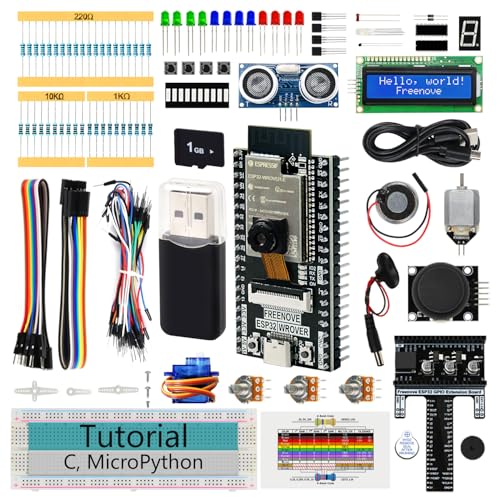
- ESP32 CAM board with Wi-Fi, Bluetooth, and camera
- Supports both MicroPython and C
- 173 items plus a 522-page tutorial
Best For: Beginners who want a connected ESP32 learning kit
Pico Learning Kit
LAFVIN Raspberry Pi Pico Basic Kit

- RP2040-based Raspberry Pi Pico starter platform
- Supports MicroPython, C/C++, and Piper Make
- Includes LCD, servo, RGB LED, buzzer, and sensors
Best For: Students and hobbyists learning the Pico ecosystem
Connected Arduino Kit
ELEGOO UNO R4 WiFi Super Starter Kit

- UNO R4 WiFi board with Wi-Fi, Bluetooth, and LED matrix
- Compatible with Arduino IDE and UNO shields
- 200+ components with step-by-step tutorials
Best For: Beginners and educators who want to grow into wireless projects
Micro:bit Classroom Pick
KEYESTUDIO Microbit Basic Starter Kit
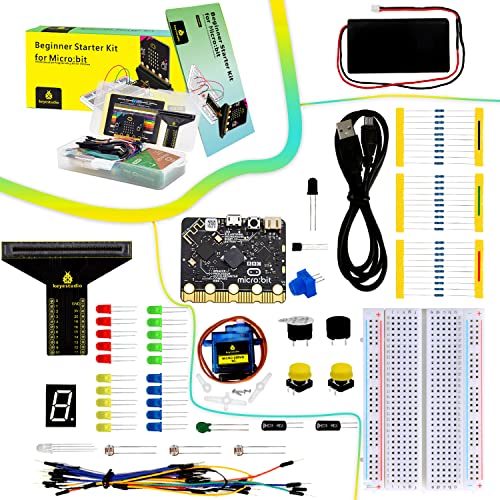
- Includes BBC Micro:bit V2.21 board
- Detailed wiki tutorials and wiring guides
- 18+ starter projects with organized parts
Best For: Beginners wanting a guided micro:bit learning kit
Project-Heavy Arduino Mega Kit
ELEGOO Mega 2560 R3 Starter Kit

- 35+ guided lessons and example code
- Mega board with lots of I/O and memory
- 200+ components for sensors, displays, and motors
Best For: Beginners who want a bigger Arduino kit with lots of expansion
Economical UNO Starter Kit
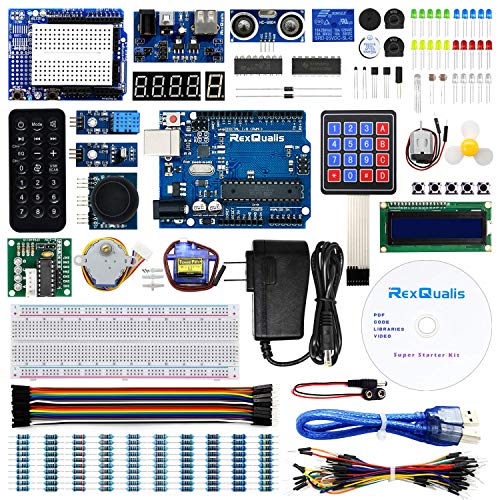
- Arduino IDE compatible UNO R3-style board
- Includes 9V power adapter and PDF tutorial
- Individually packaged, labeled components
Best For: Budget-minded beginners starting with Arduino-compatible parts
Pico W IoT Learning Kit
SunFounder Pico W Ultimate Starter Kit

- 450+ components and 117 projects
- 27 video tutorials by Paul McWhorter
- MicroPython, C/C++, and Piper Make support
Best For: Beginners who want a guided Pico W kit focused on IoT and broad project variety
ESP32 Smart Projects Kit
ELEGOO ESP-32 Super Starter Kit

- ESP-32 board with Wi‑Fi and Bluetooth 4.2
- 35+ modules and components included
- 30+ projects with code and circuit diagrams
Best For: Beginners and makers who want an Arduino IDE-friendly ESP32 IoT starter kit
UNO R3 Complete Classroom Kit
ELEGOO UNO R3 Most Complete Starter Kit

- 200+ components across 63 types
- 30+ guided projects with PDF tutorial
- Organized case and pre-soldered modules
Best For: Classrooms and beginners who want a classic Arduino-based kit with lots of parts
Arduino Starter Lab – ELEGOO UNO R3 Super Starter Kit
If you’re comparing microcontroller starter kits for beginners, this ELEGOO UNO R3 bundle is built around guided practice. It pairs the UNO R3 with 22+ lessons and a wide spread of sensors, motors, and displays so you can move from blinking LEDs to reading temperature, measuring distance, and controlling motion without needing to source extra parts.
Best For: Families, homeschoolers, coding clubs, and first-time Arduino learners who want a structured, all-in-one project kit.
Pros:
- 22+ guided lessons cover core Arduino basics and hands-on projects.
- Includes a broad mix of modules like LCD, ultrasonic sensor, DHT11, joystick, relay, servo, and stepper motor.
- Plug-in modules and a solderless breadboard help beginners start without soldering.
- Included example code supports learning input, output, timing, sensing, and motor control.
Cons:
- Younger learners are advised to work with an experienced adult.
- Setup requires selecting the correct board and computer port in Arduino IDE.
- Power-module input should stay at 9V or below.
This kit is strongest when you want a classic Arduino learning path with plenty of guided project variety. It gives beginners enough hardware to experiment beyond the basics while staying organized enough for classroom or weekend use.
Wi‑Fi ESP32 Starter – Freenove ESP32 CAM Super Starter Kit
For shoppers looking at microcontroller starter kits for beginners who also want wireless features, this Freenove ESP32 kit stands out for its ESP32 CAM board, camera, and built-in Wi-Fi and Bluetooth. It includes 173 items and supports both MicroPython and C, giving learners a path to practice on a modern connected board with a substantial project library.
Best For: Beginners who want to learn on an ESP32 platform with camera, Wi-Fi, and Bluetooth features.
Pros:
- ESP32 CAM board adds camera support, Wi-Fi, Bluetooth, and a USB code uploader.
- Supports two coding approaches: MicroPython and C.
- Includes 173 items for a wide range of electronics experiments.
- Detailed 522-page tutorial is available online or as a download.
Cons:
- No paper tutorial is included in the box.
- The kit is better suited to learners ready for a large component set.
This is a strong choice if you want a beginner kit that goes beyond simple circuits and into connected projects. The tutorial depth and large parts list make it more ambitious than a basic starter pack, but also more flexible for experimentation.
Pico Learning Kit – LAFVIN Raspberry Pi Pico Basic Kit
This LAFVIN bundle is a practical pick for microcontroller starter kits for beginners who want to learn with the Raspberry Pi Pico. It centers on the RP2040 board and mixes display, sensing, output, and control modules, while supporting MicroPython, C/C++, and Piper Make for learners at different stages.
Best For: Students and hobbyists who want a Raspberry Pi Pico starter kit with multiple programming options.
Pros:
- Built around the Raspberry Pi Pico and RP2040 microcontroller.
- Supports MicroPython, C/C++, and Piper Make graphical programming.
- Includes useful modules like LCD1602, SG90 servo, WS2812 RGB LED, buzzer, buttons, and a human body sensing module.
- Comes with detailed tutorials and sample code for setup and project follow-through.
Cons:
- Warranty coverage is only 6 months.
- Best suited to learners already interested in the Pico ecosystem.
If you want a Pico-based learning kit that can grow with your skills, this one is nicely balanced. It covers common beginner experiments while leaving room to move from graphical programming into text-based coding.
Connected Arduino Kit – ELEGOO UNO R4 WiFi Super Starter Kit
If you’re shopping microcontroller starter kits for beginners and want room to grow, this ELEGOO UNO R4 WiFi kit bridges entry-level circuits and connected projects. The board is fully compatible with Arduino IDE and original UNO shields, while the included tutorials guide you from basic wiring into sensors, motors, RFID, and wireless builds.
Best For: Beginners, educators, and hobbyists who want an Arduino-compatible kit with Wi-Fi and Bluetooth.
Pros:
- UNO R4 WiFi board adds built-in Wi-Fi, Bluetooth, USB-C, and a 12 × 8 LED matrix.
- Fully compatible with Arduino IDE and original Arduino shields.
- Includes 200+ components for a wide range of practical projects.
- Step-by-step tutorials cover wiring, sample code, sensors, displays, motors, RFID, and wireless work.
Cons:
- The large parts count may feel overwhelming for absolute first-timers.
- More advanced connectivity features may not be necessary for simple starter projects.
This kit is a smart pick if you want a beginner-friendly Arduino path that can scale into IoT-style projects. It offers a lot of hardware and structured guidance, making it easy to keep learning after the first few circuits.
Micro:bit Classroom Pick – KEYESTUDIO Microbit Basic Starter Kit
If you’re comparing microcontroller starter kits for beginners, this KEYESTUDIO micro:bit set stands out for being centered on the included BBC Micro:bit V2.21 board and a step-by-step tutorial path. It is geared toward teens, new hobbyists, and classroom-style learning, with sensors, LEDs, a breadboard, and project guidance that helps you move from wiring basics to simple builds without guessing.
Best For: Beginners who want a micro:bit-based kit with guided projects and an included controller board.
Pros:
- Includes BBC Micro:bit V2.21 with built-in BLE, accelerometer, compass, buttons, and LED matrix
- Comes with commonly used resistors, LEDs, sensors, display parts, servo, buzzer, and breadboard accessories
- Detailed wiki tutorials cover introduction, wiring diagrams, test code, and example projects
- Individually packaged parts and testing help keep the kit organized and ready to use
Cons:
- Focused on micro:bit learning rather than a larger Arduino-style expansion platform
- Project count is described as at least 18, which is less than some larger kits
Overall, this is a practical entry kit if you want structured learning and a board that already includes core sensors and wireless support. It suits beginners who value clear tutorials and tidy packaging over maximum component count.
Project-Heavy Arduino Mega Kit – ELEGOO Mega 2560 R3 Starter Kit
For shoppers looking at microcontroller starter kits for beginners but expecting room to grow, the ELEGOO Mega 2560 R3 kit is built around a much larger component set and a lesson-driven approach. It combines 35+ guided electronics projects with a Mega board that offers plenty of I/O and memory for sensors, displays, motors, and more ambitious builds.
Best For: Beginners who want a larger Arduino-style kit with more parts and more project variety.
Pros:
- 35+ guided projects span LEDs, RFID, clocks, motion sensing, environmental monitoring, and motor control
- MEGA 2560 R3 offers 54 digital I/O pins, 15 PWM outputs, 16 analog inputs, and 256 KB flash
- Includes 200+ components such as LCD1602, RFID, RTC, DHT11, PIR, ultrasonic sensor, relay, servo, stepper, and DC motor
- Organized storage case and pre-soldered modules help with repeatable learning
Cons:
- Large parts count may feel overwhelming for a true first-time user
- Bulkier than smaller beginner kits
This kit makes sense if you want a beginner-friendly path but do not want to outgrow the hardware too quickly. The wide mix of sensors and actuators makes it especially useful for experimentation after the first few lessons.
Economical UNO Starter Kit – REXQualis Super Starter Kit
If you want a budget-conscious option among microcontroller starter kits for beginners, the REXQualis Super Starter Kit is positioned as an economical way to start programming with Arduino-compatible parts. It includes an UNO R3-compatible board, a 9V power adapter, labeled components, and a free PDF tutorial, making it a straightforward choice for getting set up without much extra shopping.
Best For: Beginners who want an affordable Arduino-compatible starter kit with the basics in one box.
Pros:
- Compatible with Arduino IDE and built around an UNO R3-style base board
- Includes a 9V 1A power adapter, which replaces the need for a 9V battery
- LCD1602 comes with a pin header, so it does not need soldering
- Components and ICs are individually packaged and labeled for easier sorting
Cons:
- Tutorial access is via PDF download rather than built-in guided lessons
- The age metadata is inconsistent with the intended beginner robotics audience
As an entry-level Arduino-style bundle, this kit keeps the focus on low-cost essentials and simple setup. It is a sensible pick if you want the core hardware ready to go and prefer an economical starting point.
Pico W IoT Learning Kit – SunFounder Pico W Ultimate Starter Kit
If you want microcontroller starter kits for beginners that lean heavily into IoT, this SunFounder Pico W bundle is a strong pick. It combines 450+ components, 117 projects, and guided lessons so you can move from simple circuit work to connected builds with Wi‑Fi and Bluetooth support.
Best For: Beginners age 8+ who want a large, guided Pico W kit with IoT-focused projects and multi-language support.
Pros:
- 450+ items and 117 projects give you a very broad hands-on learning path.
- 27 video tutorials from Paul McWhorter add structured beginner guidance.
- Supports MicroPython, C/C++, and Piper Make for flexible learning.
- Includes sensors, actuators, LEDs, LCDs, and other parts for varied builds.
Cons:
- The size of the kit may feel overwhelming if you only want a few simple starter parts.
- Its strongest emphasis is on the Pico W and IoT learning path, not a general-purpose board variety.
This is a well-rounded choice if you value lots of projects and clear instruction over a minimal parts list. The included support, online lessons, and broad component mix make it easy to keep learning as your skills grow.
ESP32 Smart Projects Kit – ELEGOO ESP-32 Super Starter Kit
For microcontroller starter kits for beginners who want to build connected devices fast, this ELEGOO ESP-32 kit is a practical option. It centers on a dual-core ESP-32 board with Wi‑Fi and Bluetooth 4.2, plus more than 35 modules and 30+ tutorial projects to help you learn by doing.
Best For: Beginners and hobbyists who want an ESP32-based starter kit for IoT, Arduino IDE learning, and step-by-step projects.
Pros:
- ESP-32 board offers dual-core processing, Wi‑Fi, and Bluetooth 4.2 for IoT builds.
- More than 35 modules and components cover sensors, displays, motors, and input devices.
- 30+ beginner-friendly tutorials include code, circuit diagrams, and instructions.
- Supports Arduino IDE, making it approachable for first-time programmers.
Cons:
- The project count is lower than some larger all-in-one starter bundles.
- It is best suited to ESP32 learning, so it is less broad than multi-board kits.
If your goal is to learn connected electronics with a modern Wi‑Fi and Bluetooth board, this kit keeps the path straightforward. The included tutorial structure and well-selected modules make it easy to progress from basic circuits to practical IoT projects.
UNO R3 Complete Classroom Kit – ELEGOO UNO R3 Most Complete Starter Kit
If you want microcontroller starter kits for beginners with a classic Arduino path, this ELEGOO UNO R3 bundle is built for hands-on learning. It includes 200+ components, 30+ guided projects, and an organized layout that helps you start building without a lot of setup friction.
Best For: Beginners, classrooms, and hobbyists who want a large UNO R3 kit with guided projects and lots of sensor variety.
Pros:
- 200+ components across 63 types provide plenty of room to experiment.
- 30+ guided projects cover LEDs, sensors, displays, motors, and monitoring tasks.
- Pre-soldered modules, a solderless breadboard, and storage case help keep setup simple.
- Includes a PDF tutorial and example code for Arduino IDE learning.
Cons:
- The UNO R3 platform is more traditional than newer Wi‑Fi/Bluetooth-focused boards.
- Its huge parts list may be more than some casual beginners need.
This kit stands out if you want a broad, classroom-friendly introduction to electronics and coding. The mix of guided lessons, organized parts, and practical accessories makes it easy to move from basic exercises to your own original projects.
How We Picked the Best Microcontroller Starter Kits for Beginners
We looked for Microcontroller Starter Kits for Beginners that reduce setup friction and help new users build confidence fast. The strongest options include a clear tutorial path, broad software support, enough components for multiple projects, and boards with a large community behind them. We also favored kits that balance hands-on learning with room to expand beyond the basics.
Quick Comparison
The main differences usually come down to the board family, included accessories, and learning format. Arduino-based kits are often the easiest entry point for absolute beginners because of simple tooling and abundant examples. ESP32 kits add Wi-Fi and Bluetooth, which is great for connected projects. Raspberry Pi Pico and Pico W kits are attractive for low-cost learning and MicroPython. micro:bit kits are especially friendly for classroom and younger learners thanks to simple coding workflows and built-in educational support.
Key Buying Factors for Microcontroller Starter Kits for Beginners
Board Ecosystem and Compatibility
Choose a platform with software you are comfortable using. Arduino IDE support is a major plus for beginners, while MicroPython can be appealing if you want a gentler programming curve. If you want wireless projects, look for ESP32 or Pico W options.
Tutorial Quality
For first-time users, tutorials matter as much as the hardware. Step-by-step guides, project examples, and clear wiring diagrams help prevent stalled progress and make the kit far more useful.
Component Variety
A good starter kit should include basics like LEDs, resistors, buttons, sensors, a breadboard, jumper wires, and a display or motor component where possible. More parts can mean more project ideas, but only if they are clearly documented.
Expandability
The best kits do not stop at one afternoon of experimentation. Look for boards and accessories that let you move from simple input/output exercises to sensors, displays, servos, and wireless projects.
Who Should Buy Which Microcontroller Starter Kits for Beginners?
If you want the most straightforward path into electronics, an Arduino UNO-based kit is usually the safest choice. If you want wireless connectivity or more modern project possibilities, an ESP32 or Pico W kit is a better fit. If you are buying for a classroom, a younger learner, or a beginner who benefits from a visual and structured environment, a micro:bit kit can be the easiest place to start. For users who want the most parts and the broadest project variety, larger “most complete” kits are worth considering.
In short, the best choice depends on your learning style, your interest in coding versus wiring, and whether you want a simple first win or a kit that can support months of practice.