
Choosing the right kit can make the difference between a smooth first project and a shelf full of unused parts. The best microcontroller starter kits for hobbyists balance clear tutorials, enough components to experiment, and a board that matches your goals.
Whether you want simple Arduino-style builds, Wi-Fi and IoT features, or MicroPython-friendly learning, this roundup focuses on kits that help beginners start fast and keep building.
Best 10 Microcontroller Starter Kits for Hobbyists Picks for 2026
Most Complete Beginner Pick
ELEGOO UNO R3 Project Starter Kit

- 30+ guided Arduino-style projects
- 200+ components across 63 types
- Includes storage case and PDF tutorial
Best For: Beginners who want a broad, guided starter kit
Multi-Language Learning Pick
SunFounder Raspberry Pi Pico Starter Kit
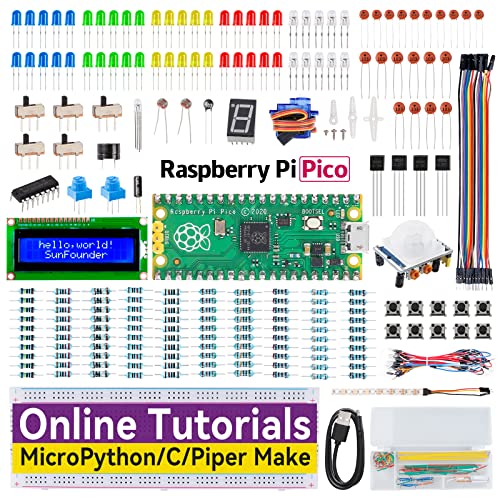
- 40 projects with online tutorials
- Supports MicroPython, C/C++, and Piper Make
- 283 items with Pico and common sensors
Best For: Learners who want flexible coding options on Raspberry Pi Pico
IoT Budget Starter Pick
LAFVIN ESP32 Basic Starter Kit

- ESP32 board with Wi-Fi and Bluetooth
- Includes tutorial with lessons and code
- Covers OLED, sensors, relay, and breadboard
Best For: Beginners starting with ESP32 and simple IoT builds
Advanced Expandable Pick
ELEGOO Mega 2560 Ultimate Starter Kit

- 35+ guided Arduino-compatible projects
- Mega 2560 adds 54 digital I/O pins
- 200+ components with storage case
Best For: Makers who need more I/O and expansion for bigger builds
Pico RP2040 Starter Kit

- RP2040-based Raspberry Pi Pico platform
- Supports MicroPython, C/C++, and Piper Make
- Includes LCD, servo, RGB LED, buzzer, and sensors
Best For: Beginners and hobbyists learning Pico-based projects
ESP32 Camera Mega Kit
Freenove ESP32 Kit Dev CAM Ultimate

- ESP32 CAM board with Wi-Fi, Bluetooth, and camera
- Includes 122 projects and a 795-page tutorial
- Supports MicroPython, C, and Processing (Java)
Best For: Hobbyists wanting a large ESP32 learning kit with camera support
Arduino Project Starter Kit
ELEGOO UNO R3 Super Starter Kit

- UNO R3 board with 22+ guided projects
- Large mix of sensors, motors, displays, and input parts
- Solderless breadboard and plug-in modules simplify setup
Best For: First-time Arduino learners and hobbyists who want lots of guided builds
IoT Learning Kit
Raspberry Pi Pico W Ultimate Starter Kit

- 450+ items and 117 projects
- 27 video tutorials for guided learning
- MicroPython, C/C++, and Piper Make support
Best For: Beginners who want a tutorial-rich Pico W IoT kit
ESP32 IoT Builder

- Dual-core ESP-32 with Wi‑Fi and Bluetooth 4.2
- 35+ modules for varied builds
- 30+ projects with code and diagrams
Best For: Hobbyists who want an ESP32-focused IoT starter kit
Budget Arduino Pack
Super Starter Kit Based on UNO R3
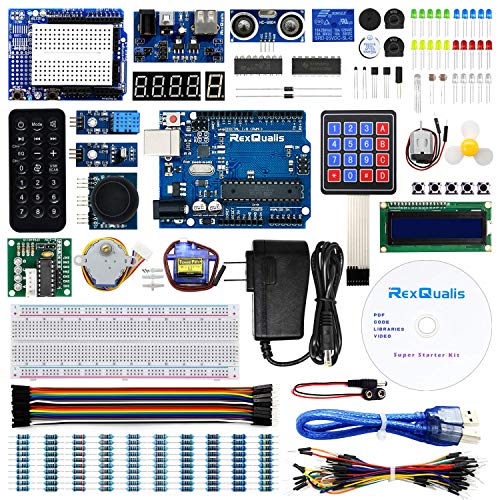
- 120 labeled components in one kit
- Includes 9V 1A power adapter
- Free PDF tutorial and datasheet access
Best For: Beginners who want an economical Arduino UNO R3 kit
Most Complete Beginner Pick – ELEGOO UNO R3 Project Starter Kit
If you want one of the most complete microcontroller starter kits for hobbyists, this ELEGOO UNO R3 bundle makes it easy to move from simple LED exercises to more involved Arduino projects. With 30+ guided lessons, a pre-soldered UNO R3 board, and organized parts storage, it is built to help beginners learn without spending time sourcing extras.
Best For: New hobbyists, STEM learners, coding clubs, and classrooms that want a broad, guided Arduino-style starter kit.
Pros:
- Includes 200+ components across 63 types for a wide range of builds.
- Offers 30+ guided projects covering RFID, motion sensing, displays, motors, and monitoring.
- Comes with a solderless breadboard, pre-soldered modules, and organized storage to speed setup.
- Includes PDF tutorial and example code for learning and modification.
Cons:
- Uses an Arduino-compatible UNO R3 board, so it is centered on that ecosystem.
- Contains many parts, which may feel overwhelming if you only want a very small starter set.
This is a strong all-in-one choice if you want a structured learning path with lots of room to experiment. The mix of sensors, motors, displays, and power accessories makes it especially useful for hobbyists who want to grow beyond basic circuits.
Multi-Language Learning Pick – SunFounder Raspberry Pi Pico Starter Kit
This SunFounder kit is a practical option for microcontroller starter kits for hobbyists who want to learn across different languages and project styles. It includes a Raspberry Pi Pico, online tutorials, and 40 projects that step through circuit concepts, example code, and progressively harder builds.
Best For: Hobbyists who want a Pico-based kit with tutorials in MicroPython, C/C++, and Piper Make.
Pros:
- Includes 40 projects with step-by-step online tutorials.
- Supports MicroPython, C/C++, and Piper Make for flexible learning.
- Comes with 283 items and components such as an I2C LCD, RGB LED strip, servo, and PIR sensor.
- Includes the Raspberry Pi Pico pre-soldered board for faster setup.
Cons:
- Best suited to users interested in the Pico ecosystem rather than Arduino-only projects.
- Online tutorials mean much of the learning flow depends on digital guidance.
For hobbyists who want to compare coding approaches while building real circuits, this kit offers a lot of range. The mix of component variety and multi-language support makes it a versatile learning platform rather than a single-purpose box.
IoT Budget Starter Pick – LAFVIN ESP32 Basic Starter Kit
If your goal is to try connected projects, this ESP32 kit is a straightforward entry point among microcontroller starter kits for hobbyists. It is positioned as beginner-friendly, includes a tutorial, and focuses on simple assemblies with common modules like an OLED display, sensors, and relays.
Best For: Beginners who want an ESP32 kit for basic electronics and simple Wi-Fi or Bluetooth projects.
Pros:
- Built around an ESP32 development board with Bluetooth and Wi-Fi connectivity.
- Includes a tutorial with codes and lessons for assembly and learning.
- Comes with useful beginner parts like an OLED, DHT11, PIR sensor, relay, and breadboard.
- Compatible with Arduino IDE for a familiar programming workflow.
Cons:
- Provides a more basic component set than the larger all-in-one kits.
- Best for introductory learning rather than very expansive project collections.
This kit makes sense if you want to explore ESP32-based builds without a huge parts list. It gives hobbyists the essentials for learning module control and starting connected projects in a manageable package.
Advanced Expandable Pick – ELEGOO Mega 2560 Ultimate Starter Kit
For hobbyists who want more room to build bigger projects, this is one of the most capable microcontroller starter kits for hobbyists in the Arduino family. The Mega 2560 board adds more I/O, more memory, and more hardware serial ports, which helps when lessons turn into multi-sensor or motor-heavy builds.
Best For: Makers who want a larger Arduino-compatible kit for more complex projects and expansion.
Pros:
- 35+ guided projects cover LEDs, RFID, clocks, motion, distance sensing, and monitoring.
- Mega 2560 offers 54 digital I/O pins, 16 analog inputs, and 4 hardware serial ports.
- Includes 200+ components for prototyping, including sensors, displays, motors, and a breadboard.
- Comes with a storage case and pre-soldered modules for easier repeatable learning.
Cons:
- Better suited to users ready for a larger, more complex kit.
- May be more than needed if you only want very basic starter experiments.
If you expect to outgrow a small starter board quickly, this kit gives you more headroom. The larger Mega platform and broad parts selection make it a strong choice for longer-term hobby experimentation and classroom-style projects.
Pico RP2040 Starter Kit – LAFVIN Pico Basic Starter Kit
If you’re comparing microcontroller starter kits for hobbyists, this LAFVIN Pico-based set is a practical entry point for learning GPIO, basic electronics, and code-driven projects. It centers on the Raspberry Pi Pico RP2040 board and includes a mix of display, input, sensing, and output parts, so beginners can move from simple exercises to small builds without needing to source extra modules.
Best For: Beginners, students, and hobbyists who want to learn with MicroPython, C/C++, or graphical programming on Raspberry Pi Pico.
Pros:
- Uses the RP2040-based Raspberry Pi Pico development board.
- Supports MicroPython, C/C++, and Piper Make graphical programming.
- Includes useful starter modules like an LCD1602, SG90 servo, WS2812 RGB LED, buzzer, buttons, and sensing parts.
- Comes with detailed tutorials and sample code for setup and project completion.
Cons:
- Focused on beginner learning rather than advanced project complexity.
- Best fit for people who specifically want to work with Raspberry Pi Pico.
Overall, this kit stands out as a guided learning platform more than a parts-only bundle, which makes it a sensible choice if you want structured practice and clear project progression. For hobbyists starting with embedded development, the mix of tutorials and common modules is especially helpful.
ESP32 Camera Mega Kit – Freenove ESP32 Kit Dev CAM Ultimate
For hobbyists who want one of the more feature-rich microcontroller starter kits for hobbyists, this Freenove ESP32 set combines an onboard camera, wireless connectivity, and a large project library. The kit is built around a dual-core ESP32 CAM board and comes with a wide mix of parts, making it a strong pick if you want to explore connected projects, camera-based builds, and step-by-step electronics practice.
Best For: Hobbyists who want a large, guided ESP32 kit with Wi-Fi, Bluetooth, and camera support.
Pros:
- ESP32 CAM board includes a dual-core 240 MHz microcontroller, Wi-Fi, Bluetooth 4.2, and an onboard camera.
- Comes with 122 projects and a detailed 795-page tutorial.
- Supports MicroPython, C, and Processing (Java).
- Includes 240 items, plus a memory card and card reader for camera-related use.
Cons:
- No paper tutorial is included; the guide is digital.
- The breadth of parts may be more than a casual beginner needs.
This is a strong all-in-one option if you want a broad learning path and plenty of hardware to experiment with. The camera and wireless features make it especially appealing for hobby projects that go beyond basic LED and sensor exercises.
Arduino Project Starter Kit – ELEGOO UNO R3 Super Starter Kit
This ELEGOO kit is a classic choice among microcontroller starter kits for hobbyists because it pairs the UNO R3 board with a wide range of beginner-friendly parts and guided lessons. With 22+ projects covering LEDs, sensors, motors, displays, and input devices, it gives new builders a structured way to learn Arduino basics and then adapt the examples into their own projects.
Best For: First-time Arduino learners, families, and hobbyists who want a broad beginner kit with lots of guided projects.
Pros:
- Includes 22+ guided lessons and downloadable tutorial/code support.
- Comes with an UNO R3 controller and a large assortment of sensors, motors, displays, and components.
- Uses a solderless breadboard and plug-in modules, which helps beginners start without soldering.
- Covers core Arduino learning areas like input, output, sensing, timing, motor control, and display functions.
Cons:
- Designed for basic learning rather than advanced or compact builds.
- Younger learners should use it with an experienced adult.
If you want a well-organized starter kit with a lot of project variety, this one is easy to recommend. It is especially useful for learners who want to understand the logic behind Arduino projects before moving on to custom experiments.
IoT Learning Kit – Raspberry Pi Pico W Ultimate Starter Kit
If you want microcontroller starter kits for hobbyists that lean heavily into guided learning, this Raspberry Pi Pico W bundle is built to keep beginners busy for a long time. It includes 450+ items, 117 projects, and video lessons that walk through MicroPython, C/C++, and Piper Make while introducing Wi‑Fi and Bluetooth-based IoT ideas.
Best For: Beginners and hobbyists who want a large, tutorial-driven Pico W kit with IoT projects.
Pros:
- 450+ components support a wide range of experiments and builds.
- 117 projects plus 27 video tutorials provide a structured learning path.
- Supports MicroPython, C/C++, and Piper Make for flexible programming practice.
- Includes sensors, actuators, LEDs, LCDs, and other common parts for hands-on use.
Cons:
- Designed around learning and experimentation, so it may be more than needed for simple one-off builds.
- Requires working through tutorials to get the most value from the full component set.
This is a strong pick if you prefer a highly guided kit with lots of parts and clear project structure. The Pico W platform and online lessons make it especially appealing for hobbyists who want to explore microcontroller programming and IoT step by step.
ESP32 IoT Builder – ESP-32 Super Starter Kit
For hobbyists comparing microcontroller starter kits for hobbyists, this ELEGOO ESP-32 bundle stands out for its connected-device focus. The kit centers on a dual-core ESP-32 board with Wi‑Fi and Bluetooth 4.2, and it includes 35+ modules plus a step-by-step online tutorial with 30+ projects.
Best For: Makers and students who want an ESP32 kit for beginner-friendly IoT projects.
Pros:
- ESP-32 board adds Wi‑Fi, Bluetooth 4.2, and dual-core processing.
- 35+ modules and components cover sensors, displays, motors, and input devices.
- 30+ tutorial projects include code, circuit diagrams, and step-by-step guidance.
- Compatible with Arduino IDE for approachable programming.
Cons:
- Smaller component count than larger all-in-one starter kits.
- Focuses on ESP-32 and IoT learning, so it is less of a general-purpose parts pack.
Overall, this kit is a practical choice if you want a compact but capable ESP32 introduction with solid tutorial support. It should fit well for hobbyists who want to move from simple circuits into connected projects like smart home or sensor-based builds.
Budget Arduino Pack – Super Starter Kit Based on UNO R3
If you are shopping for microcontroller starter kits for hobbyists on a budget, this REXQualis Arduino UNO R3-based set is aimed squarely at beginners. It comes with 120 items, a tutorial and datasheet access, and a 9V 1A power adapter, making it a straightforward way to start learning Arduino IDE projects.
Best For: Budget-minded beginners who want an Arduino UNO R3-compatible starter kit.
Pros:
- 120 items provide a broad introductory parts selection.
- Includes a 9V 1A power adapter instead of relying on a battery.
- UNO R3-compatible board works with Arduino IDE.
- Free PDF tutorial and datasheet access support learning.
Cons:
- Tutorial is PDF-based rather than an expanded online lesson system.
- Built around Arduino-compatible basics rather than newer wireless features.
As a value-focused starter kit, this one is best for hobbyists who want lots of basics without overpaying. The included adapter, labeled parts, and beginner-friendly documentation make it a practical entry point for Arduino-style projects.
How We Picked the Best Microcontroller Starter Kits for Hobbyists
We focused on Microcontroller Starter Kits for Hobbyists that offer a strong mix of beginner guidance, useful components, and broad project potential. Priority went to kits with clear tutorials, common development ecosystems, and enough included hardware to complete multiple builds without extra purchases.
We also favored kits that support widely used platforms such as Arduino IDE, MicroPython, and ESP32 or Raspberry Pi Pico-based workflows, since these make it easier to find community help and expand later.
Quick Comparison: What Matters Most
Before buying, compare the board family, supported programming language, and the type of projects you want to learn. Arduino-based kits are usually the easiest for complete beginners. ESP32 kits are better if you want Wi-Fi, Bluetooth, or IoT experimentation. Raspberry Pi Pico kits tend to be a good middle ground for low-cost learning and MicroPython practice.
Key Buying Factors for Microcontroller Starter Kits for Hobbyists
Tutorial Quality
A good starter kit should include step-by-step lessons, not just a parts list. Look for project guides that teach wiring, code upload, and troubleshooting in a structured way.
Board Compatibility
Make sure the board works with your preferred tools. Some kits are built around Arduino IDE, while others emphasize MicroPython or C/C++. If you are unsure, Arduino-compatible kits are typically the most forgiving for first-time users.
Component Variety
Useful kits include sensors, LEDs, displays, buttons, servos, and breadboard parts. More variety gives you room to practice core skills like reading inputs, driving outputs, and understanding circuits.
Project Count and Progression
More projects are not always better, but they can help if they are well sequenced. Look for kits that start simple and gradually introduce more advanced concepts like serial output, PWM, communication protocols, and wireless control.
Expandability
Choose a kit that leaves room to grow. Hobbyists often benefit from a platform with easy access to shields, modules, add-ons, and an active online community.
Who Should Buy Which Microcontroller Starter Kits for Hobbyists?
If you want the simplest path into electronics, an Arduino UNO-style kit is usually the safest choice. If your goal is IoT, wireless control, or app-connected projects, an ESP32-based kit is a smarter pick. If you want to learn with modern, low-cost hardware and enjoy MicroPython, a Raspberry Pi Pico kit can be excellent.
For tinkerers who want a broader project library and more advanced options, larger kits with extra components and deeper tutorials are worth the higher price. The best choice depends on whether you value ease of learning, wireless features, or maximum project variety. For most hobbyists, the ideal kit is the one that matches your first few projects and keeps you motivated to build more.