
The best microscopes for hobbyists make small details easier to explore, whether you are studying specimens, inspecting coins, repairing electronics, or examining materials up close.
This roundup includes compound, digital, handheld, and LCD-equipped models so you can match magnification, working space, imaging, and ease of use to your projects.
Best 10 Microscopes for Hobbyists Picks for 2026
Best Research-Grade Pick
SWIFT SW380B Binocular Compound Microscope

- 40X–2500X magnification range
- Rotatable binocular Siedentopf head
- Mechanical stage with precise focusing
Best For: Advanced hobbyists and detailed slide work
Best All-Purpose Digital Pick
Andonstar AD246S-M 3-Lens Microscope

- Three lenses for repair, specimens, and general viewing
- 2160P video with HDMI output
- Adjustable boom arm and 7-inch LCD
Best For: Mixed hobby work and electronics repair
Best Simple Optical Value
AmScope M150C-MS Compound Microscope

- 40X–1000X magnification range
- Mechanical stage with coaxial focusing
- All-metal frame and LED illumination
Best For: Beginners and biological slide viewing
Best for Coin Collectors

- 7-inch LCD with 12MP camera
- Stable metal stand for close-up inspection
- Adjustable LEDs and gooseneck lighting
Best For: Coins, crafts, electronics, and surface details
Best Binocular Option
Herwicm 40X-2500X Compound Microscope

- Binocular wide-angle viewing
- Dual top and bottom LED lighting
- Mechanical stage with coarse and fine focus
Best For: Adult hobbyists and students doing traditional slide-based observations
Best Portable Digital Pick
Skybasic Wireless Handheld Microscope

- WiFi and USB device connectivity
- Eight adjustable LED lights
- Portable photo and video capture
Best For: Casual outdoor observation and sharing images on phones or computers
Best Complete Starter Kit
PalliPartners Compound Microscope

- 100X–2000X stated magnification range
- 28 slides included
- Phone adapter and Bluetooth shutter
Best For: Home education, family science projects, and beginner hobbyists
Versatile Workbench Pick
Andonstar AD210 Digital Microscope

- 10.1-inch IPS display with 12MP photos
- Flexible stand for coins and soldering
- Top, side, and bottom LED lighting
Best For: Multi-purpose hobby workbenches
Portable Inspection Pick
Celestron Labs 5MP Handheld Microscope
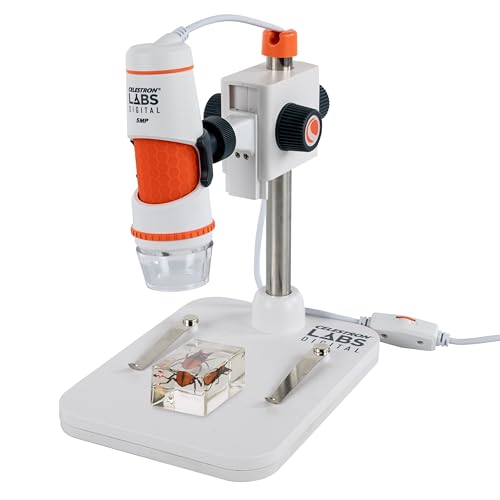
- 20X–200X magnification with 5MP imaging
- Polarizing filter reduces surface glare
- Stand and software support measurements
Best For: Computer-based inspection and documentation
Collector-Focused Pick

- Built-in scale with 0.1g resolution
- 10X–200X zoom on a 4.3-inch IPS screen
- Battery-powered design for portable use
Best For: Coin, jewelry, and collectible inspection
Best Research-Grade Pick – SWIFT SW380B Binocular Compound Microscope
For hobbyists who want a traditional optical instrument with room for detailed slide work, the SWIFT SW380B is a serious choice among microscopes for hobbyists. Its binocular design, achromatic objectives, mechanical stage, and broad 40X–2500X range suit users ready for more precise observation.
Best For: Advanced hobbyists, shared use, biological slide viewing, and users who prefer binocular optical viewing.
Pros:
- Binocular Siedentopf head rotates for shared viewing and supports interpupillary adjustment.
- Includes interchangeable wide-field 10X and 25X glass eyepieces.
- Mechanical stage and ultra-precise focusing support controlled slide movement.
- 30-degree ergonomic tilt can help reduce neck strain.
Cons:
- Its 11-pound metal construction and larger footprint make it less portable.
- AC power and traditional eyepiece viewing may be less convenient than a digital setup.
The SW380B is a strong fit if optical clarity, stable slide handling, and comfortable shared viewing matter more than compactness or built-in recording.
Best All-Purpose Digital Pick – Andonstar AD246S-M 3-Lens Microscope
The Andonstar AD246S-M stands out for hobbyists who want one setup for electronics, coins, plants, and biological slides. With three interchangeable lenses, a 7-inch display, 2160P recording, HDMI output, and a boom-arm stand, it is one of the most versatile microscopes for hobbyists.
Best For: Electronics repair, soldering, coin inspection, demonstrations, and mixed hobby projects.
Pros:
- Three lenses cover soldering, general inspection, and biological slide viewing.
- 2160P video, HDMI output, photo capture, and included 32GB Micro SD card support documentation.
- Adjustable metal boom arm provides a larger work envelope for repair tasks.
- Eight LED brightness levels, remote control, and Windows measurement software add convenience.
Cons:
- Changing lenses requires removing and installing screws.
- Its broad feature set may be more than users need for simple slide viewing.
This is a practical choice for hobbyists who regularly switch between inspection and repair tasks and want a shared screen rather than conventional eyepieces.
Best Simple Optical Value – AmScope M150C-MS Compound Microscope
The AmScope M150C-MS is a straightforward option for hobbyists who want a traditional compound microscope without digital extras. Its 40X–1000X range, monocular head, mechanical stage, and all-metal construction make it a practical entry point for routine biological slide observation.
Best For: Beginners, students, and hobbyists focused on conventional biological slide work.
Pros:
- Five magnification powers reach up to 1000X.
- Mechanical stage makes slide positioning easier to control.
- Coaxial coarse and fine focusing supports incremental adjustments.
- Metal framework, optical glass lenses, and LED illumination provide a sturdy basic setup.
Cons:
- The monocular head is less comfortable for extended shared viewing than a binocular design.
- It lacks the recording, display, and connectivity features of digital models.
Choose the M150C-MS if dependable optical basics matter most. It keeps the controls familiar and the feature set focused on examining prepared slides.
Best for Coin Collectors – TOMLOV DM9 Digital Microscope
The TOMLOV DM9 is designed around close-up inspection, making it especially appealing to coin collectors and DIY users. Its 7-inch LCD, 12MP camera, 1080P video, adjustable lighting, and stable metal stand give microscopes for hobbyists a convenient format for examining and recording small surface details.
Best For: Coin collecting, error-coin inspection, jewelry, crafts, small components, and light soldering tasks.
Pros:
- Built-in 7-inch screen supports comfortable direct viewing and demonstrations.
- 12MP photos, 1080P video, and included 16GB card help document findings.
- Metal base and adjustable stand provide a stable platform for close-up work.
- Eight built-in LEDs and two gooseneck lights help manage shadows and glare.
Cons:
- Its digital, stand-mounted design is oriented toward surface inspection rather than conventional biological slides.
- The 1200X rating does not describe a single fixed optical viewing level; height and focus affect the usable view.
The DM9 is a convenient pick when viewing comfort, surface detail, and image capture are more important than a traditional eyepiece-based microscope.
Best Binocular Option – Herwicm 40X-2500X Compound Microscope
For hobbyists who want a traditional viewing experience, this Herwicm compound microscope combines binocular eyepieces, glass optics, dual LED illumination, and a mechanical stage. Its adjustable lighting and coaxial focusing controls make it a practical choice for extended home observations.
Best For: Adult hobbyists, amateur scientists, and students exploring biological specimens with a binocular microscope.
Pros:
- Binocular wide-angle eyepieces are designed for a larger, more comfortable field of view.
- Top and bottom LED lights support observation of different specimen types.
- Coarse and fine focus knobs plus a mechanical stage allow more controlled adjustments.
- Includes 4X, 10X, and 40X objectives with WF10X and WF25X eyepieces.
Cons:
- Requires a corded power connection.
- The relatively large body may be less convenient for storage or travel.
- Its traditional optical design does not provide built-in digital imaging.
This is a strong fit among microscopes for hobbyists who prioritize binocular comfort and hands-on slide work. The dual illumination and mechanical stage add useful flexibility for regular home experiments.
Best Portable Digital Pick – Skybasic Wireless Handheld Microscope
This Skybasic handheld microscope is a convenient choice for hobbyists who want to inspect objects and view results on a phone, tablet, or computer. WiFi and USB connectivity, adjustable LEDs, and one-button image capture make it suited to quick observations at home or outdoors.
Best For: Casual hobbyists, children, and families examining plants, insects, minerals, and other surface details.
Pros:
- Connects wirelessly to Android and iOS devices or by USB to Windows and Mac computers.
- Eight adjustable LED lights help illuminate the viewing area.
- Supports photo and video capture, with up to 1080P images on smartphones.
- Small, lightweight design is convenient for trips and outdoor activities.
Cons:
- It is a fixed-focus magnifying camera rather than a traditional compound microscope.
- Sharpness depends on maintaining a 3–60 mm working distance.
- Software installation and device camera settings may require troubleshooting.
Choose this model when portability and digital sharing matter more than conventional slide microscopy. It is useful for exploration and documentation, but the supplied notes specifically caution that it is not intended for serious biological work.
Best Complete Starter Kit – PalliPartners Compound Microscope
The PalliPartners compound microscope is designed as an all-in-one starting point for hobbyists, students, and home science projects. Along with 4X, 10X, and 40X objectives, it includes prepared and blank slides, a phone adapter, and a remote shutter for basic specimen work and photography.
Best For: Families, homeschoolers, students, and hobbyists who want a ready-to-use educational microscope kit.
Pros:
- Offers stated magnification settings from 100X to 2000X using included lenses.
- Includes 10 prepared slides and 18 blank slides for immediate and DIY activities.
- Top and bottom LED illumination supports opaque and translucent specimens.
- Phone adapter and Bluetooth remote enable convenient digital photography.
Cons:
- Its educational focus may be limiting for advanced or professional microscopy.
- The compact body may provide less working room than larger laboratory models.
- Phone photography depends on compatible smartphone setup and alignment.
For buyers comparing microscopes for hobbyists, this model stands out for its included accessories and approachable educational focus. It offers a fuller first-time setup than a scope sold without slides or phone support.
Versatile Workbench Pick – Andonstar AD210 Digital Microscope
If you want one of the more adaptable microscopes for hobbyists, the Andonstar AD210 combines a large screen, adjustable working distance, multiple lights, and accessories for coin collecting, soldering, and slide viewing. Its roomy stand is particularly useful for hands-on projects.
Best For: Hobbyists who want a screen-based microscope for coins, electronics repair, and basic biological slide observation.
Pros:
- Large 10.1-inch IPS display with 1080p video and 12MP photo capture.
- Adjustable 1cm-to-26cm working distance and a tall, reinforced stand.
- Top, side, and bottom LED illumination support different specimen types.
- Includes a 32GB memory card, remote control, slide kit, and bottom light stage.
Cons:
- The larger stand and monitor make it less portable than a handheld model.
- Its broad feature set may be more than casual users need.
The AD210 is a strong all-purpose choice when flexibility matters more than compact size. It is especially practical for hobby benches where coin inspection, soldering, and slide viewing share the same workspace.
Portable Inspection Pick – Celestron Labs 5MP Handheld Microscope
The Celestron Labs 5MP Handheld is a practical option among microscopes for hobbyists who want computer-connected inspection without committing to a large desktop setup. It can be handheld or mounted in its adjustable stand, making it useful for varied objects and viewing positions.
Best For: Hobbyists inspecting coins, circuit boards, textiles, insects, and other small objects with a Windows or Mac computer.
Pros:
- 20X–200X magnification with a 5MP digital sensor.
- Built-in polarizing filter helps reduce glare on shiny or wet surfaces.
- Adjustable stand includes specimen clips and a 180-degree rotating arm.
- Software supports viewing, image capture, measurement, and annotation.
Cons:
- It requires a computer connection for its digital viewing workflow.
- A tripod for the 1/4-inch-20 mount is sold separately.
This model balances portability and stability well. Its polarizing filter, calibration ruler, and measurement software make it more useful for documented inspections than a basic magnifier.
Collector-Focused Pick – TOMLOV DM4W Coin Microscope
The TOMLOV DM4W stands out among microscopes for hobbyists by pairing digital magnification with a built-in precision scale. It is designed for examining and weighing coins, gemstones, and other small valuables, while its battery and compact design support use away from a power outlet.
Best For: Coin collectors, jewelers, and students who want inspection and weighing in one device.
Pros:
- Built-in scale measures in grams, ounces, and carats with 0.1g resolution.
- 10X–200X zoom and a bright 4.3-inch IPS display.
- Eight-inch stand provides extra working room and stability.
- Built-in battery supports cordless, portable use.
Cons:
- The integrated scale is specialized and may be unnecessary for general viewing.
- The 4.3-inch screen is smaller than the display on some desktop models.
For collectors, the DM4W offers a distinctive data-oriented workflow: inspect an item, view its details, and weigh it without switching equipment. Its portability adds convenience for field checks and classroom use.
How We Picked the Best Microscopes for Hobbyists
We focused on the features that matter most for home use: useful magnification ranges, optical or digital image quality, lighting, focusing control, stage stability, working distance, and ease of setup. The selection covers traditional compound microscopes for slides, digital models for inspection and documentation, and portable options for flexible viewing.
We also considered the type of hobby each model suits. A microscope designed for biology is not automatically the best choice for soldering or coin collecting, where a larger working distance, display, or adjustable stand can be more valuable than extreme magnification.
Quick Comparison
| Best For | Look For | Recommended Type |
|---|---|---|
| Slides and specimens | Compound optics, mechanical stage, fine focus | Binocular or monocular compound microscope |
| Soldering and electronics | Working distance, bright illumination, screen output | Digital LCD microscope |
| Coins and collectibles | Surface detail, stable stand, easy image capture | Digital inspection microscope |
| Field use and quick checks | Battery or USB power, compact design, wireless viewing | Handheld digital microscope |
Key Buying Factors for Microscopes for Hobbyists
Optical Versus Digital Magnification
Compound microscopes use optical magnification and are generally the stronger choice for prepared slides and transparent specimens. Digital microscopes display an enlarged image on a screen, making them convenient for surface inspection, photos, and shared viewing. Be cautious with very high advertised digital magnification: usable detail depends on the sensor, lens, lighting, and screen resolution.
Working Distance and Focus
For soldering, repairs, and three-dimensional objects, choose a model that leaves room beneath the lens for tools and hands. Fine-focus controls and a stable stand help maintain a clear image at higher magnifications. Slide work benefits more from precise stage movement and dependable focus across the specimen.
Lighting and Image Quality
Adjustable LED lighting is useful for changing subjects and reflective surfaces. Coin collectors may benefit from angled or adjustable illumination that reveals texture, while biological samples usually need even transmitted light. For digital models, check camera resolution, display size, HDMI or USB connectivity, and whether still images or video can be saved.
Ease of Use and Accessories
Consider how quickly the microscope can be assembled, whether it includes suitable eyepieces or a mechanical stage, and how easy it is to clean and store. A large built-in display can simplify group viewing, while wireless or handheld designs are convenient for inspections away from a desk.
Who Should Buy Which Microscopes for Hobbyists?
Choose a compound model if your priority is biology, prepared slides, or educational study. Pick a digital LCD microscope for coins, soldering, crafts, and demonstrations where a screen and generous working distance are useful. A handheld Wi-Fi or USB microscope is best for portability and quick inspections. If you want one flexible setup for several hobbies, prioritize adjustable lighting, a stable stand, multiple viewing options, and a broad but realistic magnification range.