
The best microscopes with cameras make it easier to inspect small details, capture evidence, and share discoveries on a larger screen. This roundup covers classroom-friendly compound models, portable digital units, coin microscopes, and camera upgrades for existing lab equipment.
Before choosing, consider the type of samples you’ll view, the magnification you actually need, image quality, connection options, and whether you prefer an integrated display or computer-based workflow.
Best 10 Microscopes with Cameras Picks for 2026
Lab-Ready Trinocular Pick
High-Power Microscope With USB Camera

- Trinocular design with HD USB electronic eyepiece
- Achromatic optics and dual mechanical stage
- Includes slides, coverslips, and specimen accessories
Best For: Home laboratories, science teaching, and detailed biological observation
Coin-Inspection Favorite
Elikliv 4.3-Inch Digital Microscope

- Built-in 4.3-inch 720P display
- Eight adjustable LED lights and adjustable stand
- USB connection for Windows or MacBook viewing
Best For: Coin collecting, repairs, electronics, and surface-detail inspection
Student Science Starter
Compound Microscope With Phone Adapter

- 100X–2000X claimed magnification
- Includes 28 slides and smartphone adapter
- Top and bottom LED illumination
Best For: Homeschooling, student biology, and beginner science projects
Portable Wireless Pick
Skybasic WiFi Handheld Camera Microscope

- WiFi for iOS and Android devices
- USB support for Windows and Mac
- 1080P smartphone capture with eight LEDs
Best For: Portable exploration, STEM activities, and quick surface inspections
Best Coin-Collecting Microscope

- 7-inch screen with PC connectivity
- 12MP photos and 1080P video
- Stable stand with adjustable lighting
Best For: Coin collectors, hobbyists, and electronics inspection
Best 4K Microscope Camera

- 4K resolution at 30 frames per second
- HDMI display and Type-C computer connection
- Remote control with capture and recording
Best For: Lab, teaching, clinical demonstration, and industrial use
Best Eyepiece Microscope Camera
SWIFT EP2M 2MP Digital Eyepiece

- 1080p live view at 30 frames per second
- Measurement and annotation software included
- Fits 23.2 mm eyepieces and many trinocular tubes
Best For: Teaching, lab reviews, and quality-control inspection
Industrial Inspection Camera

- 1080P 60FPS output for smooth inspection viewing
- HDMI and USB connectivity with conversion adapter
- Metal body and adjustable image controls
Best For: Industrial quality control and electronics inspection
Portable Learning Microscope
40X-1000X USB Microscope Camera
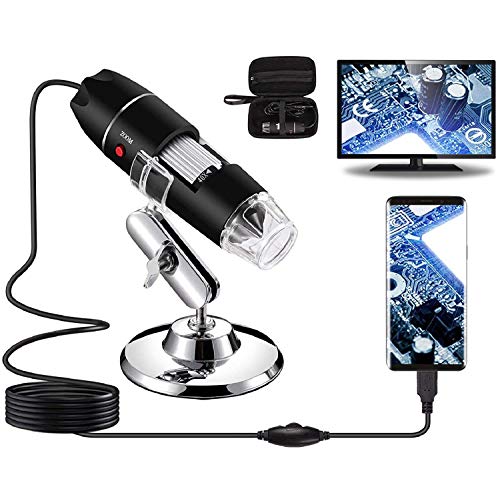
- 40X-1000X magnification for varied close-up subjects
- Adjustable eight-LED lighting with diffuser
- Stand, ruler, OTG adapter, and carrying case included
Best For: Students, hobbyists, collectors, and Windows users
Universal Handheld Microscope
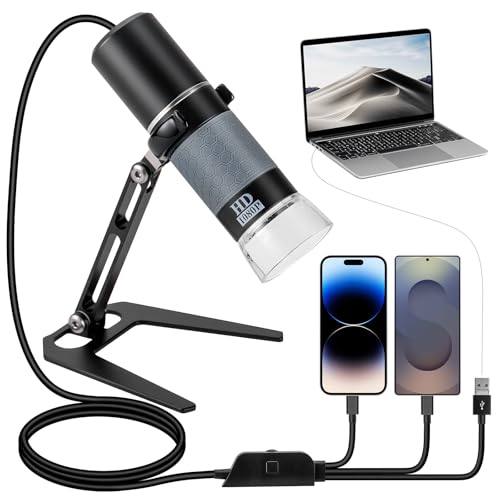
- Four-in-one cable for USB-C, Lightning, Micro-USB, and USB-A
- 1080P imaging with real-time viewing and recording
- Adjustable eight-LED lighting and metal stand
Best For: Cross-device inspection, education, repairs, and hobbies
Lab-Ready Trinocular Pick – High-Power Microscope With USB Camera
For buyers seeking microscopes with cameras for serious classroom or laboratory-style work, this trinocular model combines a compound optical system with an HD USB electronic eyepiece. Its achromatic objectives, mechanical stage, adjustable LED illumination, and claimed 40X–5000X range make it a feature-rich choice for detailed biological observation.
Best For: Home laboratories, science teaching, biological experiments, and users who want extensive magnification and included accessories.
Pros:
- Trinocular design supports camera-based viewing alongside eyepiece observation.
- Includes dual WF10X and WF25X eyepieces, achromatic objectives, and dual coarse/fine focusing.
- Large accessory kit includes slides, coverslips, specimen tools, and a phone holder.
- Adjustable interpupillary distance, viewing angle, and LED lighting improve usability.
Cons:
- The extensive 40X–5000X specification may require careful setup and technique at higher magnifications.
- Its corded, laboratory-style design is less portable than handheld digital microscopes.
This is the most equipment-oriented option in the group, prioritizing optical flexibility, mechanical controls, and expandability over portability. It is a strong fit when you want a camera-equipped microscope for structured experiments rather than casual inspection.
Coin-Inspection Favorite – Elikliv 4.3-Inch Digital Microscope
This compact Elikliv is a practical choice among microscopes with cameras for inspecting coins, jewelry, circuit boards, stamps, and other surface details. The built-in 4.3-inch display provides a direct view, while USB connectivity lets you enlarge images on a Windows PC or MacBook.
Best For: Coin collectors, electronics inspection, jewelry and stamp viewing, repairs, and portable STEM activities.
Pros:
- 4.3-inch 720P display offers a comfortable live viewing experience.
- Eight adjustable LEDs help illuminate small details in low-light conditions.
- Height-adjustable stand supports different camera-to-object distances and viewing angles.
- Rechargeable battery provides up to three hours of continuous use.
Cons:
- A memory card is required for photo and video storage but is not included.
- Actual magnification depends on screen size and camera-to-object distance.
- Its surface-inspection format is not a replacement for a compound biological microscope.
The built-in screen and adjustable stand make this model especially convenient for hands-on inspection. Choose it when easy viewing and portability matter more than traditional microscope optics or high-resolution biological work.
Student Science Starter – Compound Microscope With Phone Adapter
For families and students comparing microscopes with cameras, this PalliPartners compound microscope offers a traditional optical setup with simple smartphone capture. It combines 4X, 10X, and 40X objectives with a WF25X eyepiece and 2X lens, plus dual LED illumination for both biological and opaque specimens.
Best For: Homeschooling, middle- and high-school science, beginner biology experiments, and adults who want a ready-to-use educational kit.
Pros:
- 100X–2000X claimed magnification covers beginner and intermediate observations.
- Includes 28 slides, a phone adapter, Bluetooth shutter, and power adapter.
- Top and bottom LED illumination accommodates opaque and translucent specimens.
- Coaxial coarse and fine focus controls support more precise adjustment.
Cons:
- Phone photography depends on the user’s smartphone and adapter alignment.
- It is an educational compound microscope rather than a dedicated integrated-camera system.
- Adult supervision is recommended for younger users.
This model is a well-rounded educational package for buyers who want conventional microscope viewing plus occasional phone images. Its included slides and dual lighting reduce the need to purchase basic accessories separately.
Portable Wireless Pick – Skybasic WiFi Handheld Camera Microscope
This Skybasic handheld is one of the most flexible microscopes with cameras for quick inspections away from a desk. It connects wirelessly to iPhone, Android, and iPad devices, or by USB to Windows and Mac computers, and captures images or video through its companion app or connected computer.
Best For: Outdoor exploration, children’s STEM activities, plant and insect viewing, crafts, and quick surface inspections.
Pros:
- WiFi connectivity supports iOS and Android devices without a direct cable.
- USB compatibility extends use to Windows and Mac computers.
- Eight adjustable LEDs and a 2MP sensor support up to 1920×1080 smartphone images.
- Lightweight handheld design is easy to carry and includes an adjustable stand.
Cons:
- It is a fixed-focus-style magnifying camera, not a traditional professional microscope.
- Sharpness requires keeping the object approximately 3–60 mm from the lens.
- Computer and mobile connections require app, camera-permission, or software setup.
This is the best match for convenience and shared digital viewing rather than laboratory precision. Its wireless operation makes it appealing for exploring specimens, objects, and surfaces wherever you find them.
Best Coin-Collecting Microscope – TOMLOV DM9 Digital Microscope
If you want microscopes with cameras for coin collecting and hands-on inspection, the TOMLOV DM9 combines a built-in 7-inch display, 12MP imaging, and 1080P video recording. Its adjustable stand, metal base, onboard storage, and PC connectivity make it practical for examining coins, electronics, jewelry, and other small subjects.
Best For: Coin collectors, hobbyists, DIY electronics users, and anyone who wants a self-contained digital microscope with a large viewing screen.
Pros:
- Built-in 7-inch LCD screen supports comfortable, shared viewing.
- 12MP camera and 1080P video capture support collection records and project documentation.
- Stable metal base and adjustable 8.5-inch stand help reduce shaking during inspection.
- Adjustable LEDs and flexible gooseneck lights help illuminate details from different angles.
Cons:
- The 1200X specification depends on adjusting the stand height and focus for the subject.
- Its feature set is oriented toward close-up hobby and inspection work rather than a conventional laboratory eyepiece setup.
The DM9 is a well-rounded choice when convenience matters: you can view details on the included screen, save findings to the included 16GB card, or connect to a Windows or Mac computer. It is especially appealing for coin documentation and light electronics work.
Best 4K Microscope Camera – BTER 4K HDMI Digital Camera
Among microscopes with cameras, the BTER Digital Microscope Camera stands out for its 4K HDMI output and remote-controlled operation. It is designed to connect to a display for live viewing, while USB Type-C and memory-card support add options for computer use, image capture, and recording.
Best For: Lab, instructional, clinical demonstration, and industrial users who need high-resolution display output and remote menu control.
Pros:
- Records and displays 3840 × 2160 video at 30 frames per second through HDMI.
- Remote control supports menu operation and more convenient shooting or viewing.
- Supports photos, videos, measurement, memory-card capture, and computer connectivity.
- Aluminum-alloy enclosure and LED light-source compatibility suit practical inspection environments.
Cons:
- Computer use requires connecting through Type-C and downloading the software.
- The camera is a component for a microscope setup, so a suitable display and compatible optical arrangement may be needed.
The BTER is a strong fit when 4K output and presentation flexibility are more important than an integrated screen. Its HDMI connection, remote, and recording functions make it useful for showing microscope images to larger audiences or documenting inspection work.
Best Eyepiece Microscope Camera – SWIFT EP2M 2MP Digital Eyepiece
The SWIFT EP2M is a practical option among microscopes with cameras when you already own a compatible microscope. This 2MP digital eyepiece camera provides 1920 × 1080 live viewing at 30 frames per second, along with Windows and macOS support and software for measuring, annotating, and exporting observations.
Best For: Teaching, lab reviews, quality-control inspection, and users with a microscope that accepts a 23.2 mm eyepiece or compatible trinocular phototube.
Pros:
- Full HD 1920 × 1080 live view at 30 frames per second supports classroom and lab display.
- S-Viewer software enables calibration, measurements, annotations, photo capture, video capture, and report exports.
- Compatible with Windows 7–11 and macOS.
- Includes a USB cable, software drive, and manual, with separate electrical and mechanical warranty coverage.
Cons:
- Some microscopes may require an adapter, sold separately.
- Its 2MP resolution is lower than the 4K output offered by some dedicated microscope cameras.
- It is not intended for medical use.
The EP2M makes the most sense as an upgrade for an existing optical microscope rather than a standalone inspection system. Its measurement and annotation tools are particularly useful when observations need to be documented or shared on a computer or projector.
Industrial Inspection Camera – 37MP 1080P 60FPS C-Mount
For buyers comparing microscopes with cameras for professional inspection, this industrial C-mount model emphasizes high-frame-rate viewing, flexible connectivity, and adjustment controls. It is designed to integrate with monitors and computers for real-time observation, recording, and analysis.
Best For: Industrial quality control, electronics inspection, laboratories, and material analysis.
Pros:
- 1080P at 60FPS supports smooth viewing of circuit boards, microcomponents, and surfaces.
- HDMI and USB connectivity allows integration with monitors, computers, and other devices.
- Metal construction is suited to demanding daily inspection environments.
- Offers brightness, RGB color, digital zoom, freeze, TF card, and remote-support features.
Cons:
- Its C-mount design is more specialized than a simple handheld microscope.
- The feature set may be more than casual users need for basic observation.
This is the strongest fit for a dedicated inspection setup where smooth video, mounting flexibility, and control over image presentation matter more than portability.
Portable Learning Microscope – 40X-1000X USB Microscope Camera
This USB model is a practical choice among microscopes with cameras for students, hobbyists, and hands-on inspection. It connects to supported computers, Macs, Linux systems, or Android devices, while the included stand and carrying case make setup and transport straightforward.
Best For: Students, children, collectors, hobbyists, and Windows-based measurement tasks.
Pros:
- 40X-1000X magnification covers coins, hair, skin, PCBs, and other small objects.
- Eight adjustable LED lights provide controllable illumination with a diffuser.
- Can capture screenshots and record video through installed software.
- Includes a metal stand, OTG adapter, ruler, driver, and carrying case.
Cons:
- It does not work with iPhone or iPad devices.
- Measurement software is limited to Windows users.
- Android use requires a compatible OTG-capable device.
Choose this model if you want an accessible, travel-friendly microscope camera with useful accessories and broad non-iOS compatibility, especially for learning and everyday close-up viewing.
Universal Handheld Microscope – 1080P 50X-1000X USB Camera
For shoppers seeking microscopes with cameras that work across multiple device types, this Bysameyee handheld model offers 1080P imaging and a four-in-one cable. Its adjustable LED lighting, metal stand, and broad application range make it suitable for both casual exploration and practical inspection.
Best For: Users who want one USB microscope camera for compatible iPhone, Android, Windows, and Mac devices.
Pros:
- Four-in-one cable supports USB-C, Lightning, Micro-USB, and USB-A connections.
- 1080P imaging is designed for sharp, smooth, true-to-color viewing and recording.
- 50X-1000X magnification accommodates objects from collectibles to circuit boards.
- Eight adjustable LED lights provide even illumination for extended viewing.
Cons:
- Connected mobile devices must support OTG, which may require enabling the feature.
- Controls are built into the cable rather than on the microscope body.
- It is USB-powered rather than independently powered.
This is a versatile option for households, classrooms, repair benches, and hobby work when cross-device connectivity and a compact handheld format are priorities.
How We Picked These Microscopes with Cameras
We selected models across several common use cases rather than treating magnification as the only measure of quality. The lineup includes complete compound microscopes for prepared slides, handheld units for coins and repairs, display-based systems for easy viewing, and dedicated cameras designed to connect with compatible microscopes.
Our comparison emphasizes camera resolution, focusing and stage control, lighting, connection methods, operating-system compatibility, included accessories, and overall practicality. Stated magnification ranges are considered alongside optical design because very high digital magnification does not necessarily reveal more useful detail.
Quick Comparison
| Best For | Look For | Most Convenient Setup |
|---|---|---|
| Students and families | Simple controls, built-in lighting, prepared-slide compatibility | Integrated screen or USB connection |
| Coins, stamps, and objects | Top-down stand, adjustable LEDs, working distance | Digital display microscope |
| Electronics repair | Stable metal stand, smooth focus, generous clearance | HDMI or low-latency camera |
| Lab imaging | Optical compatibility, accurate color, measurement software | Dedicated eyepiece or C-mount camera |
| Portable inspection | Compact design, wireless viewing, rechargeable power | Wi-Fi or handheld USB model |
Key Buying Factors for Microscopes with Cameras
Optical Magnification and Sample Type
Compound microscopes are generally the better choice for transparent slides and cellular specimens. Digital inspection microscopes are more suitable for opaque surfaces such as circuit boards, coins, rocks, and mechanical parts. A claimed 1,000x or higher range may rely heavily on digital enlargement, so prioritize sharp optics and a stable image.
Camera Resolution and Viewing Method
USB cameras work well with computers and are often the most flexible for saving images or using measurement software. HDMI models can provide a more responsive live view on a monitor. Built-in-screen microscopes are convenient for beginners, while wireless models add portability but may introduce app or connection limitations.
Stand, Focus, and Lighting
A rigid metal stand helps prevent vibration, especially at high magnification. Look for fine focus, a mechanical stage for slide work, or adjustable height and working distance for larger objects. Even, adjustable LED lighting is important; reflected light suits solid objects, while transmitted illumination is needed for many prepared slides.
Compatibility and Accessories
Check whether the camera supports your computer, phone, monitor, or operating system before buying. Dedicated eyepiece and C-mount cameras also require matching dimensions or adapters. Included stands, carrying cases, remote controls, slides, and software can significantly affect the real value.
Who Should Buy Which Microscopes with Cameras?
Students and beginners: Choose a straightforward compound microscope or integrated digital model with simple controls and a stable stand.
Coin and hobby collectors: A display-based digital microscope with adjustable top lighting makes quick inspection and image capture easy.
Electronics technicians: Favor a rigid stand, smooth focusing, ample clearance, and HDMI or USB connectivity for a responsive live workspace.
Teachers and families: Look for easy sharing, broad compatibility, and included accessories rather than the highest advertised magnification.
Researchers and experienced users: A dedicated 4K, 37MP, or eyepiece/C-mount camera may be the best upgrade when paired with compatible optics and measurement software.