
The best oscilloscopes for electronics repair make it easier to see faults that a multimeter can miss, from unstable power rails and noisy signals to timing problems and intermittent connections.
This roundup compares 10 portable models across bandwidth, channel count, sampling performance, built-in tools, and repair-friendly features so you can choose the right scope for your bench or field kit.
Best 10 Oscilloscopes for Electronics Repair Picks for 2026
Best All-in-One Value
FNIRSI 2C53T 3-in-1 Oscilloscope

- 50 MHz, two-channel scope with 250 MSa/s sampling
- 19,999-count multimeter and 50 kHz signal generator
- Portable design with 3000 mAh battery and waveform export
Best For: Automotive repair, hobbyists, schools, and mobile electronics testing
Best Budget Component Tester
DEWIN 3-in-1 Handheld Oscilloscope

- 10 MHz bandwidth with 48 MSa/s sampling
- Automatic transistor, diode, triode, and FET testing
- 13-waveform generator with 0–50 kHz range
Best For: Beginners and repair work involving quick component identification
Best Advanced Handheld
FNIRSI 2D15P 100MHz Oscilloscope

- 100 MHz, two-channel scope with 500 MS/s sampling
- Up to 1 M memory depth plus math and cursor analysis
- 4.3-inch touchscreen, TRMS multimeter, and 5000 mAh battery
Best For: Technicians and serious hobbyists needing detailed portable analysis
Best Pocket Option
BTMETER Mini 250 kHz Oscilloscope

- Pocket-size scope weighing approximately 100 g
- 250 kHz bandwidth with 2.5 MSa/s sampling
- AUTO, Normal, and Single trigger modes with 2.8-inch LCD
Best For: Beginners, students, and low-frequency field troubleshooting
Versatile Repair Workbench
FNIRSI 2C53P 3-in-1 Oscilloscope

- Two-channel, 50MHz scope with 250MS/s sampling
- 19999-count multimeter and 10MHz DDS generator
- Touchscreen, FFT, X-Y mode, and waveform export
Best For: Multifunction electronics repair and bench troubleshooting
Component Testing Specialist
FNIRSI DSO-TC4 Handheld Oscilloscope

- 10MHz scope with 48MSa/s sampling
- Automatic testing for diodes, transistors, FETs, and passives
- 13-waveform generator plus NEC IR decoding
Best For: Component-level diagnostics and remote-control repair
High-Speed Automotive Choice
ZT-703S 3-in-1 Handheld Oscilloscope

- Up to 280MSa/s sampling and 50MHz bandwidth
- 25000-count multimeter with broad measurement support
- Dual-channel scope with auto recognition and signal generator
Best For: Automotive diagnostics and faster handheld waveform testing
Best with Extra Features
FNIRSI DST-210 3-in-1 Oscilloscope

- 10 MHz scope with 48 MSa/s sampling
- 19,999-count multimeter included
- DDS generator outputs 13 waveforms
Best For: Portable circuit and automotive repair
Best Two-Channel Option
HANMATEK HO52 Handheld Oscilloscope
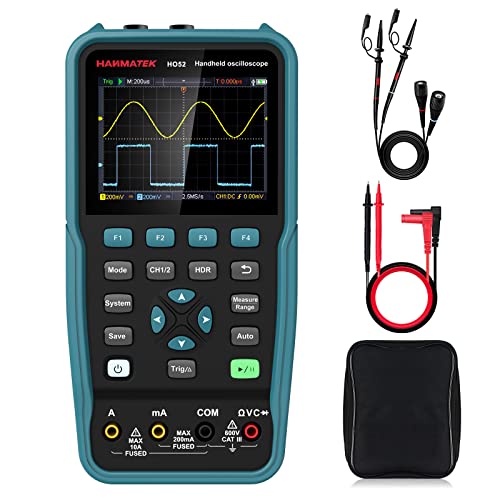
- 50 MHz bandwidth and 250 MSa/s sampling
- Two oscilloscope channels with auto measurements
- Saves images, CSV, and reference waveforms
Best For: Detailed electronics and automotive troubleshooting
Best Compact Signal-Test Combo
FNIRSI DSO-510 Handheld Oscilloscope

- Compact 10 MHz scope with 48 MS/s sampling
- Infinite afterglow and waveform image export
- DDS generator supports 13 waveforms to 50 kHz
Best For: Portable waveform testing and signal simulation
Best All-in-One Value – FNIRSI 2C53T 3-in-1 Oscilloscope
For shoppers comparing oscilloscopes for electronics repair, the FNIRSI 2C53T combines a two-channel, 50 MHz oscilloscope with a multimeter and DDS signal generator in one portable instrument. Its automatic measurements, waveform storage, and automotive-oriented accessories make it versatile for bench or field work.
Best For: Automotive repair, hobbyists, schools, and technicians who want several core test tools in one handheld unit.
Pros:
- 50 MHz bandwidth, 250 MSa/s sampling, and two channels
- Integrated 19,999-count multimeter with voltage, current, resistance, capacitance, and continuity functions
- 50 kHz signal generator with 13 waveform types
- Built-in 3000 mAh battery, storage case, and USB-C waveform export
Cons:
- Its 1 Kpts record depth is modest for more detailed waveform capture
- The 2.8-inch display is smaller than the touchscreen on some advanced handheld models
The 2C53T is a strong space-saving choice when an oscilloscope, multimeter, and basic signal source are all useful. It offers broad functionality without requiring separate instruments, though users needing deeper memory or a larger display may prefer a higher-end model.
Best Budget Component Tester – DEWIN 3-in-1 Handheld Oscilloscope
The DEWIN is a practical entry-level option among oscilloscopes for electronics repair, pairing a 10 MHz scope with a component tester and signal generator. Its automatic semiconductor identification can simplify quick checks during DIY projects, electrical troubleshooting, and automotive work.
Best For: Beginners and repair users who prioritize component identification and straightforward handheld testing.
Pros:
- 48 MSa/s real-time sampling and 10 MHz bandwidth
- Automatically detects types and pin configurations for components such as transistors, diodes, triodes, and FETs
- Signal generator supports 13 waveforms and output frequencies from 0 to 50 kHz
- Rugged, shock-resistant housing with a 2.8-inch color display
Cons:
- 10 MHz bandwidth is more limited than the other multi-function models in this roundup
- The included 1500 mAh battery is smaller than those in several competing handheld units
The DEWIN makes sense when automatic component testing is central to your workflow. It covers basic waveform observation and signal generation, but its lower bandwidth is best matched with relatively low-frequency repair and educational tasks.
Best Advanced Handheld – FNIRSI 2D15P 100MHz Oscilloscope
The FNIRSI 2D15P is the most capable choice here for demanding oscilloscopes for electronics repair. It provides two channels, 100 MHz bandwidth, 500 MS/s sampling, selectable deep memory, a TRMS multimeter, and a touchscreen interface for more detailed troubleshooting.
Best For: Technicians and serious hobbyists who need deeper waveform analysis, stronger sampling performance, and extended portable operation.
Pros:
- 100 MHz bandwidth and 500 MS/s sampling across two channels
- Selectable 10 K, 100 K, and 1 M memory depths for waveform capture
- 19,999-count TRMS multimeter with curve view and min/max display
- 4.3-inch IPS touchscreen, 5000 mAh battery, and waveform export
Cons:
- Its 10 MHz DDS generator output is less extensive than the oscilloscope bandwidth
- At 907 g, it is heavier than the smaller handheld options
The 2D15P is the strongest fit for users who expect more from a portable repair instrument, especially when memory depth and signal analysis matter. Its larger battery and touchscreen add convenience, while the heavier body makes it less pocket-friendly.
Best Pocket Option – BTMETER Mini 250 kHz Oscilloscope
For basic oscilloscopes for electronics repair, the BTMETER Mini focuses on portability and simple signal checks rather than advanced analysis. Its 250 kHz bandwidth, one-touch auto setup, and lightweight pocket-size housing suit low-frequency troubleshooting, education, and toolkit use.
Best For: Students, beginners, and field users checking common low-frequency analog or digital signals.
Pros:
- Compact 103 × 73 × 25 mm design weighing approximately 100 g
- Simple AUTO, Normal, and Single trigger modes with rising or falling edge selection
- 2.8-inch 320×240 LCD and built-in 1 kHz calibration signal
- Rechargeable battery provides up to 3 hours of portable operation
Cons:
- 250 kHz bandwidth and 2.5 MSa/s sampling limit it to basic, lower-frequency work
- Input limits are ±40 V in X1 mode, or up to ±400 V in X10 mode when probe-dependent
- It does not include the multimeter or signal-generator functions offered by the 3-in-1 models
The BTMETER is an easy-to-carry starter scope for observing everyday signals and learning basic triggering. Choose it for convenience and simplicity, not for high-frequency circuits or multi-instrument functionality.
Versatile Repair Workbench – FNIRSI 2C53P 3-in-1 Oscilloscope
For anyone comparing oscilloscopes for electronics repair, the FNIRSI 2C53P combines a two-channel, 50MHz oscilloscope with a 19999-count multimeter and DDS signal generator. Its 250MS/s sampling rate, touchscreen, FFT analysis, and X-Y mode make it a versatile choice for troubleshooting analog and digital circuits.
Best For: Repair technicians and electronics hobbyists who want oscilloscope, multimeter, and signal-generator functions in one handheld instrument.
Pros:
- Two channels with 250MS/s sampling and 50MHz bandwidth.
- Built-in 19999-count multimeter with minimum and maximum displays.
- Includes FFT, X-Y mode, waveform storage/export, and a 12-waveform generator.
- 4.3-inch IPS touchscreen and approximately four-hour battery life.
Cons:
- The signal generator’s maximum output frequency is 10MHz, below the oscilloscope bandwidth.
- Battery life is listed at about four hours.
The 2C53P is the strongest all-around option here when repair work benefits from integrated electrical measurements and waveform analysis. It is especially useful for users who want more functionality than a basic handheld scope provides.
Component Testing Specialist – FNIRSI DSO-TC4 Handheld Oscilloscope
The FNIRSI DSO-TC4 is a compact option among oscilloscopes for electronics repair, adding automatic component identification to basic waveform work. Along with its 10MHz bandwidth and 48MSa/s sampling rate, it tests diodes, transistors, FETs, capacitors, and resistors, making it practical for component-level diagnostics.
Best For: DIY repairers and technicians who frequently test loose components or troubleshoot remote-control electronics.
Pros:
- Automatically identifies component pins and parameters for several component types.
- Includes a 10MHz oscilloscope with 48MSa/s sampling and waveform storage/export.
- Offers a 13-waveform DDS generator with output up to 50kHz.
- Adds NEC IR decoding, continuity, voltage, and sensor-testing functions.
Cons:
- Its 10MHz bandwidth and 48MSa/s sampling rate are more limited than the other listed scopes.
- The 1500mAh battery is smaller than the 4000mAh battery in the FNIRSI 2C53P.
The DSO-TC4 favors component identification and repair convenience over higher-speed waveform capture. Choose it when transistor testing, IR decoding, and compact portability matter more than broad oscilloscope bandwidth.
High-Speed Automotive Choice – ZT-703S 3-in-1 Handheld Oscilloscope
The ZT-703S is a dual-channel handheld option for shoppers seeking oscilloscopes for electronics repair with automotive-oriented versatility. It combines a digital multimeter, signal generator, and scope, with a high-speed mode that reaches 280MSa/s and 50MHz bandwidth for faster waveform measurements.
Best For: Automotive diagnostics and general electronics work requiring dual-channel measurements, multimeter functions, and adjustable operating speeds.
Pros:
- Dual-channel scope with up to 50MHz bandwidth and 280MSa/s sampling in high-speed mode.
- 25000-count multimeter measures resistance, capacitance, continuity, diodes, and current.
- Automatic waveform recognition helps simplify measurements of unfamiliar signals.
- Signal generator outputs sine, square, triangle, and other waveforms.
Cons:
- High-speed mode uses more power than normal mode.
- Normal mode reduces performance to 30MHz bandwidth and 200MSa/s sampling.
- The manufacturer advises reading the manual because of its multiple functions.
The ZT-703S is a good fit when faster capture and a high-count multimeter are priorities. Its switchable modes let users trade measurement performance for lower power consumption during routine troubleshooting.
Best with Extra Features – FNIRSI DST-210 3-in-1 Oscilloscope
For electronics repair, the FNIRSI DST-210 combines a 10 MHz oscilloscope, 19,999-count multimeter, and DDS signal generator in one handheld tool. Its waveform export, auto-ranging measurements, and rechargeable design make it practical for circuit diagnosis and automotive work.
Best For: Repairers who want one portable instrument for waveform testing, multimeter measurements, and basic signal simulation.
Pros:
- Combines oscilloscope, multimeter, and signal generator functions.
- Offers 48 MSa/s sampling, waveform saving/export, and up to 400 V measurement capability.
- Includes 13 DDS waveforms up to 50 kHz and a 3,000 mAh rechargeable battery.
Cons:
- The 10 MHz bandwidth is more limited than higher-bandwidth bench scopes.
- The signal generator amplitude range is limited to 0.1–3.0 V.
The DST-210 is a versatile choice when portability and multiple repair functions matter more than advanced oscilloscope bandwidth. It is particularly convenient for field service and automotive diagnostics.
Best Two-Channel Option – HANMATEK HO52 Handheld Oscilloscope
The HANMATEK HO52 is a practical pick among oscilloscopes for electronics repair when two-channel viewing and broader bandwidth are priorities. It pairs a 50 MHz, 250 MSa/s oscilloscope with an independent multimeter input and useful waveform storage features.
Best For: Electronics and automotive repairers who need two-channel measurements, automatic readings, and saved waveform data.
Pros:
- Provides two oscilloscope channels, 50 MHz bandwidth, and 250 MSa/s real-time sampling.
- Supports cursor measurements, seven automatic measurements, XY mode, and one-key setup.
- Can save images, CSV waveforms, reference waveforms, and instrument settings.
- Includes a 4½-digit true-effective-value multimeter with auto-ranging.
Cons:
- Its 8k-dot recording length is modest for extended waveform captures.
- The unit weighs about 2.6 lb, making it less lightweight than smaller handheld scopes.
With two independent scope channels and extensive measurement and storage functions, the HO52 is well suited to troubleshooting signals while comparing related points in a circuit. USB-C connectivity also supports charging, power-bank use, and computer waveform access.
Best Compact Signal-Test Combo – FNIRSI DSO-510 Handheld Oscilloscope
The FNIRSI DSO-510 is a compact option for electronics repair tasks that call for both waveform observation and signal generation. Its 10 MHz scope includes infinite afterglow, one-key automatic setup, waveform export, and a DDS generator with 13 output waveforms.
Best For: Portable repair work requiring a small oscilloscope and basic signal simulation in one device.
Pros:
- Compact 10 MHz oscilloscope supports 48 MS/s sampling and 50 ns–20 s time bases.
- Infinite afterglow helps display signal characteristics, while scaling and image export support analysis.
- DDS generator provides 13 waveforms up to 50 kHz.
- One-key AUTO simplifies setup for periodic analog and non-periodic digital signals.
Cons:
- Its 10 MHz bandwidth is intended for less demanding signals than wider-band scopes.
- The built-in 1,000 mAh battery is smaller than the DST-210’s battery.
The DSO-510 emphasizes portability and straightforward operation. It is a good fit when a repair kit needs a compact scope-generator combination rather than a full-featured bench instrument.
How We Picked the Best Oscilloscopes for Electronics Repair
We focused on practical repair needs rather than headline specifications alone. The selected models cover compact entry-level scopes, dual-channel handheld instruments, and multifunction units that combine an oscilloscope with a digital multimeter and DDS signal generator. We compared stated bandwidth, sampling rate, channel count, input limits, display usability, triggering options, and the convenience of portable operation.
Because these instruments vary widely, a higher bandwidth rating does not automatically make one model better for every repair task. A simple, stable scope may be more useful than a feature-heavy unit if you mainly troubleshoot low-frequency circuits, audio equipment, power supplies, or automotive electronics.
Quick Comparison
- Best all-around capability: Look for a 50MHz dual-channel model with an integrated multimeter and signal generator.
- Best for faster digital signals: A 100MHz option provides more headroom for observing quicker edges and higher-frequency waveforms.
- Best for basic troubleshooting: A 10MHz handheld scope can handle many audio, sensor, control, and low-speed power tests.
- Best for portability: Mini scopes with built-in screens and rechargeable batteries are convenient for field service and quick checks.
- Best for simple measurements: A low-bandwidth model with auto, normal, and single triggering may be sufficient for occasional diagnostics.
Key Buying Factors for Oscilloscopes for Electronics Repair
Bandwidth and Sampling Rate
Bandwidth determines the highest frequency the scope can display accurately, while sampling rate affects how well it captures waveform detail. For general repair, 10MHz to 50MHz is often adequate. Choose more bandwidth when working on faster digital circuits, switching supplies, or sharp signal edges.
Channels and Input Protection
Two channels let you compare an input and output, clock and data line, or supply rail and ground reference at the same time. Check the input-voltage rating and probe attenuation before connecting to unfamiliar circuits. A scope with a stated ±40V X1 limit, for example, should not be treated as suitable for higher-voltage work without the correct probe and safety procedure.
Triggering and Display
Auto triggering is convenient for quick checks, but normal and single modes are more useful for intermittent faults and one-time events. A clear display, adjustable time base, visible measurements, and responsive controls can save more time than extra automated functions.
Built-In Tools
Integrated multimeters and signal generators are valuable for portable repair kits, reducing the number of instruments you need to carry. However, multifunction devices may compromise on scope controls, measurement accuracy, or generator output compared with dedicated bench equipment.
Who Should Buy Which Oscilloscopes for Electronics Repair?
Choose a 10MHz handheld model if you repair audio gear, basic electronics, sensors, hobby circuits, or low-speed control boards. Choose a 50MHz dual-channel unit if you regularly compare signals or work on automotive and mixed analog-digital systems. Choose a 100MHz model when faster edges and higher-frequency circuits are part of your routine. Choose a mini 250kHz scope for simple, low-frequency checks where portability and low cost matter most.
Before buying, confirm the included probes, battery and charging arrangement, warranty, software requirements, and return policy. For mains-connected equipment or high-energy circuits, use appropriate isolation, rated probes, and safe measurement practices; a handheld scope is not a substitute for electrical safety equipment.