
The best oscilloscopes for home workshops make it easier to diagnose circuits, inspect signals, and learn electronics without filling your bench with specialized equipment.
This roundup compares 10 practical models across bandwidth, channel count, portability, resolution, and built-in tools so you can choose the right scope for your projects and budget.
Best 10 Oscilloscopes for Home Workshops Picks for 2026
Best Value
Rigol DS1054Z 50MHz 4-Channel Oscilloscope

- Four channels and up to 1GSa/s sampling
- Deep memory and fast waveform capture
- Serial decode, FFT, LAN, and USB connectivity
Best For: Multi-signal electronics troubleshooting and embedded projects
Budget Lab Pick
Hantek DSO2D15 150MHz 2-Channel Oscilloscope

- 150MHz bandwidth in a cost-effective design
- Arbitrary waveform output included
- 14 trigger modes and five serial decoders
Best For: Affordable general-purpose bench testing
High-Bandwidth Choice
Siglent SDS1202X-E 200MHz Oscilloscope
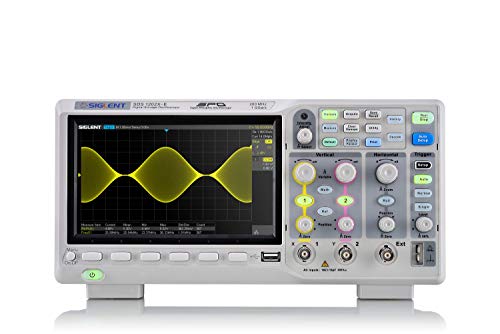
- 200MHz bandwidth with 1GSa/s real-time sampling
- 14Mpts record length for longer captures
- Decodes I2C, SPI, UART, RS232, CAN, and LIN
Best For: Higher-frequency and embedded-system troubleshooting
Portable All-in-One
FNIRSI 2C53T Oscilloscope Multimeter

- Oscilloscope, multimeter, and DDS generator in one
- 250MSa/s sampling with 50MHz bandwidth
- Battery-powered design with Type-C export
Best For: Portable automotive repair and space-conscious benches
Best Deep-Memory Bench Scope
RIGOL DS1202Z-E 200MHz Oscilloscope

- 200 MHz bandwidth with 1 GSa/s sampling
- 24 Mpts memory and 30,000 wfms/s capture
- RS232/UART, I2C, and SPI decode support
Best For: Embedded debugging and detailed bench analysis
Best Portable Multimeter Combo
HANMATEK HO52 Handheld Oscilloscope
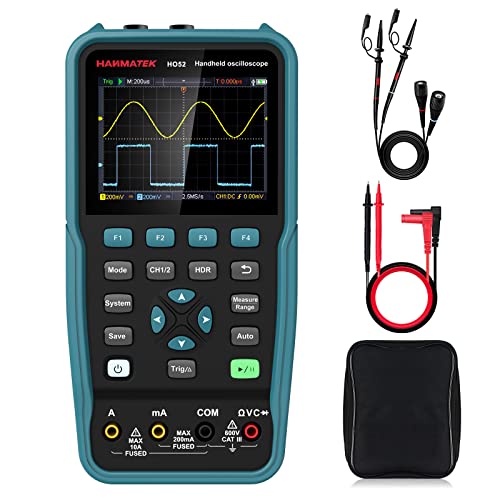
- 50 MHz bandwidth with two scope channels
- Built-in multimeter and automatic measurements
- Battery powered with USB-C and CSV saving
Best For: Portable automotive and general troubleshooting
Best Value Bench Scope
RIGOL DS1102Z-E 100MHz Oscilloscope

- 100 MHz bandwidth and 1 GSa/s sampling
- 24 Mpts memory with fast waveform capture
- Serial decode plus USB and LAN connectivity
Best For: General home-bench electronics debugging
Best All-Around Bench Scope

- 70 MHz, 12-bit resolution, and 25 Mpts memory
- Serial decoding, FFT, and fast glitch capture
- LAN SCPI control plus USB and HDMI connectivity
Best For: Embedded, power-supply, and general bench troubleshooting
Best Multifunction Portable Scope
FNIRSI DPOS350P 350 MHz 4-in-1

- 350 MHz bandwidth with two channels and 1 GSa/s
- Includes spectrum and frequency response analyzers
- DDS generator, touchscreen, and 8000 mAh battery
Best For: Portable signal analysis, filter testing, and waveform generation
Best Simple DIY Bench Scope

- 100 MHz bandwidth and 1 GSa/s sampling
- 32 automatic measurements plus FFT
- Large 7-inch display and USB waveform storage
Best For: General electronics repair and DIY circuit diagnostics
Best Value – Rigol DS1054Z 50MHz 4-Channel Oscilloscope
For shoppers comparing oscilloscopes for home workshops, the Rigol DS1054Z offers four analog channels, a 50MHz bandwidth, and up to 1GSa/s sampling for examining multiple signals at once. Its deeper memory and fast waveform capture are useful when troubleshooting intermittent behavior or reviewing longer events.
Best For: Electronics debugging, embedded projects, teaching labs, and home benches that benefit from four channels and strong capture tools.
Pros:
- Four analog channels with up to 1GSa/s single-channel sampling
- Up to 24 Mpts standard memory and up to 30,000 wfms/s capture rate
- Serial triggering and decoding for RS232/UART, I2C, and SPI
- USB, LAN, AUX output, FFT, filters, and waveform recording/playback
Cons:
- Its 50MHz bandwidth is lower than some two-channel alternatives
- Memory depth decreases when using multiple channels
- At 6.6 pounds, it is less portable than handheld instruments
The DS1054Z is a practical choice when a home workshop needs channel capacity, long captures, and bench connectivity rather than a compact all-in-one meter.
Budget Lab Pick – Hantek DSO2D15 150MHz 2-Channel Oscilloscope
The Hantek DSO2D15 is a cost-conscious option for oscilloscopes for home workshops, combining 150MHz bandwidth with two channels. Its arbitrary waveform output and broad trigger selection make it suitable for general bench work and commissioning tasks.
Best For: Budget-minded hobbyists, general electronics testing, and projects that need waveform generation alongside scope functions.
Pros:
- 150MHz bandwidth for higher-frequency bench measurements
- Arbitrary waveform output adds basic signal-generation capability
- Fourteen trigger modes support varied troubleshooting tasks
- Includes five serial protocol trigger and decode options
Cons:
- Only two channels are available
- The supplied notes do not specify sampling rate or record length
- Its feature set is positioned as an economy solution
Choose the DSO2D15 when bandwidth and value matter more than extensive channel count or fully specified deep-memory features.
High-Bandwidth Choice – Siglent SDS1202X-E 200MHz Oscilloscope
For home workshops that need more bandwidth, the Siglent SDS1202X-E provides 200MHz performance across two channels. Its 1GSa/s real-time sampling and 14Mpts record length support detailed waveform inspection, while built-in serial decoding helps with digital interfaces.
Best For: Hobbyists and technicians working on faster analog signals or embedded systems with common serial buses.
Pros:
- 200MHz bandwidth supports higher-frequency measurements
- Up to 1GSa/s real-time sampling rate
- 14Mpts record length for capturing longer waveform segments
- Serial triggering and decoding for I2C, SPI, UART, RS232, CAN, and LIN
Cons:
- Two channels provide less simultaneous visibility than four-channel models
- The supplied notes do not mention waveform generation or LAN connectivity
- Its listed dimensions are relatively large for a compact home bench
The SDS1202X-E is a strong fit when measurement bandwidth and protocol coverage are priorities, especially for embedded and communication-focused troubleshooting.
Portable All-in-One – FNIRSI 2C53T Oscilloscope Multimeter
The FNIRSI 2C53T takes a different approach to oscilloscopes for home workshops by combining a two-channel, 50MHz oscilloscope with a multimeter and DDS signal generator. Its battery-powered handheld design is convenient for automotive repair, field checks, and benches where space is limited.
Best For: Hobbyists and technicians who want portable oscilloscope, multimeter, and signal-generator functions in one device.
Pros:
- Three-in-one design with oscilloscope, 4.5-digit multimeter, and signal generator
- 50MHz bandwidth, 250MSa/s sampling, and automatic measurements
- Signal generator outputs 13 waveforms up to 50kHz
- Built-in 3000mAh battery, storage case, and Type-C image export
Cons:
- Its 1Kpts record depth is modest compared with bench scopes offering deep memory
- Two channels limit simultaneous signal comparisons
- The 2.8-inch display is smaller than a conventional bench oscilloscope screen
The 2C53T is best viewed as a flexible portable troubleshooting tool: it sacrifices record depth and screen size for integrated measurements, battery operation, and easy transport.
Best Deep-Memory Bench Scope – RIGOL DS1202Z-E 200MHz Oscilloscope
For home workshops that need strong signal visibility and room to investigate intermittent problems, the RIGOL DS1202Z-E is a capable choice among oscilloscopes for home workshops. Its 200 MHz bandwidth, deep memory, fast waveform capture, and serial-bus decoding support make it suited to electronics, embedded, and power troubleshooting.
Best For: Hobbyists and students who want a full-size bench oscilloscope for embedded debugging, longer captures, and detailed waveform analysis.
Pros:
- 200 MHz bandwidth, two analog channels, and up to 1 GSa/s real-time sampling.
- Up to 24 Mpts of memory and 30,000 waveforms per second help capture intermittent events.
- Supports RS232/UART, I2C, and SPI triggering and decoding, with USB and LAN connectivity.
- Seven-inch WVGA display with intensity-graded color helps show jitter and noise.
Cons:
- Its desktop design is less convenient to carry than a handheld scope.
- The supplied details identify one included probe, so additional probing may require extra accessories.
The DS1202Z-E is the strongest fit here when capture depth, display size, and protocol troubleshooting matter more than portability. It also includes a three-year main-unit warranty according to the supplied details.
Best Portable Multimeter Combo – HANMATEK HO52 Handheld Oscilloscope
The HANMATEK HO52 combines a two-channel oscilloscope with a multimeter in a compact, battery-powered format. For oscilloscopes for home workshops, it is a practical option when portability, quick measurements, and USB-C charging are more important than deep memory or high bandwidth.
Best For: Mobile troubleshooting, automotive work, machine repair, and workshop users who want scope and meter functions in one handheld tool.
Pros:
- Two-channel, 50 MHz scope with 250 MSa/s real-time sampling and up to 8k-dot recording.
- Built-in multimeter measures voltage, current, resistance, diode, continuity, and capacitance.
- Battery-powered design weighs about 2.6 pounds and supports USB-C charging and computer connection.
- Can save settings, reference waveforms, images, and CSV waveform data.
Cons:
- Its 8k-dot record length is substantially less than the deep memory offered by the RIGOL models.
- The 50 MHz bandwidth is better suited to general troubleshooting than higher-frequency work.
- The supplied details do not specify a warranty term.
The HO52 stands out for convenience: it can travel to the problem instead of keeping every test at the bench. Its independent oscilloscope and multimeter inputs, automatic measurements, and saved CSV files add useful flexibility for home and automotive projects.
Best Value Bench Scope – RIGOL DS1102Z-E 100MHz Oscilloscope
The RIGOL DS1102Z-E offers the same practical bench-oriented feature set as its higher-bandwidth sibling while using a 100 MHz front end. For oscilloscopes for home workshops, it balances deep memory, fast capture, serial decoding, and a large display for everyday electronics debugging.
Best For: Home-workshop users, students, and electronics hobbyists who need a capable two-channel bench scope for general debugging and embedded projects.
Pros:
- 100 MHz bandwidth, two analog channels, and up to 1 GSa/s real-time sampling.
- Up to 24 Mpts memory and 30,000 wfms/s capture support longer and intermittent-event captures.
- Provides RS232/UART, I2C, and SPI trigger and decode functions.
- Includes a seven-inch WVGA display plus USB, LAN, and AUX connectivity.
Cons:
- It has less bandwidth than the 200 MHz DS1202Z-E.
- Its desktop form factor is not intended for field portability.
- The supplied details list an 8.83-pound item weight, which may limit easy repositioning.
The DS1102Z-E is a sensible middle ground for a permanent home-workshop bench. Its deep memory and protocol tools provide room to grow, while the 100 MHz bandwidth covers a broad range of hobby electronics and embedded troubleshooting tasks.
Best All-Around Bench Scope – RIGOL DHO802
For home workshops that need a capable everyday instrument, the RIGOL DHO802 combines 70 MHz bandwidth, two analog channels, 12-bit resolution, and deep memory in a compact digital oscilloscope. Its touchscreen, fast waveform capture, serial decoding, and remote-control support make it well suited to troubleshooting both analog and embedded projects.
Best For: Home workshop users working on power supplies, embedded boards, and CAN, UART, I2C, or SPI signals.
Pros:
- 12-bit resolution, 1.25 GSa/s sampling, and up to 25 Mpts memory support detailed and extended captures.
- Fast UltraAcquire mode, waveform search, event tables, and peak detection help locate intermittent glitches.
- Includes serial trigger/decode, FFT, LAN-based SCPI control, USB connectivity, and HDMI output.
Cons:
- Its two analog channels may be limiting for projects requiring several simultaneous signal measurements.
- The feature-rich interface may be more than beginners need for basic waveform checks.
The DHO802 is a strong choice when measurement detail, long captures, and protocol troubleshooting matter more than having the simplest possible control layout.
Best Multifunction Portable Scope – FNIRSI DPOS350P 350 MHz 4-in-1
The FNIRSI DPOS350P stands out among oscilloscopes for home workshops by combining a 350 MHz oscilloscope with a spectrum analyzer, frequency response analyzer, and DDS signal generator. Its rechargeable battery and touchscreen make it useful when you want one portable tool for bench work, field checks, and signal experiments.
Best For: Makers and technicians who want waveform testing, EMI inspection, Bode-plot work, and signal generation in one portable unit.
Pros:
- Provides 350 MHz bandwidth, 1 GSa/s sampling, two channels, and selectable 8- to 16-bit resolution.
- Built-in FFT spectrum analysis includes harmonic markers and real-time 2D/3D waterfall views.
- Frequency response analyzer and DDS generator add gain/phase testing, filter tuning, and custom waveform output.
- 8000 mAh battery, USB-C charging, waveform storage, and screenshot storage support mobile use.
Cons:
- The 47 Kpts memory depth is modest compared with instruments designed for very long acquisitions.
- Its many integrated functions may take time to learn compared with a basic oscilloscope.
This is the most versatile option in the group for users who value portability and integrated analysis tools, especially when a separate generator or analyzer would be inconvenient.
Best Simple DIY Bench Scope – Hantek DSO5102P 100 MHz
The Hantek DSO5102P is a straightforward 100 MHz, two-channel digital storage oscilloscope for home workshops, electronics repair, and DIY diagnostics. Its 7-inch display, 32 automatic measurements, FFT, and USB storage provide the core tools needed to inspect circuits without an especially complicated setup.
Best For: Home users, electronics enthusiasts, and DIY repairers checking appliances, cars, stereos, and circuit boards.
Pros:
- 100 MHz bandwidth and 1 GSa/s sampling cover a broad range of common workshop signals.
- Offers 32 automatic measurements plus FFT and manual, tracking, and cursor measurement modes.
- USB storage can hold more than 1,000 waveform records and supports computer communication and remote control.
- Large 7-inch 800 × 480 display and folding handle make bench viewing and storage convenient.
Cons:
- It has only two channels, which may not suit more complex multi-signal debugging.
- The supplied notes do not indicate advanced serial-bus decoding or a built-in signal generator.
The DSO5102P is a practical pick for traditional waveform measurement and repair work, particularly if you prefer physical controls, a large screen, and uncomplicated USB-based storage.
How We Picked the Best Oscilloscopes for Home Workshops
We focused on specifications that matter in a real home workshop: bandwidth, sample rate, channel count, waveform memory, display usability, probe support, portability, and overall value. The selection includes traditional benchtop scopes, compact handheld units, and multifunction devices with multimeters or signal generators.
Bandwidth claims are useful, but they are not the only measure of performance. A scope should also provide a comfortable interface, stable triggering, adequate memory, and enough input protection for the work you plan to do. We also considered whether each model suits beginners, hobbyists, repair work, or more demanding embedded and power-electronics projects.
Quick Comparison
| What to Compare | Why It Matters | Good Starting Point |
|---|---|---|
| Bandwidth | Determines the highest-frequency signal detail the scope can display accurately. | 50–100MHz for general hobby work |
| Channels | Allows simultaneous comparison of input, output, clock, power, or control signals. | Two channels for most home projects |
| Sample rate | Controls how finely the instrument captures changing waveforms. | 1GSa/s offers useful flexibility |
| Extra functions | Built-in meters, generators, decoding, and portability can reduce equipment costs. | Useful when bench space or budget is limited |
Key Buying Factors for Oscilloscopes for Home Workshops
Bandwidth and Sample Rate
For Arduino, Raspberry Pi, audio, automotive sensors, power supplies, and general troubleshooting, 50MHz to 100MHz is often sufficient. Choose 200MHz or more if you work with faster digital buses, RF-related circuits, or want additional headroom. A higher sample rate helps capture short transients, but real-world performance also depends on memory depth and acquisition modes.
Channel Count and Triggering
Two channels cover most repairs and hobby projects. Four channels are more useful when comparing several related signals, such as clock, data, enable, and supply lines. Look for straightforward edge triggering, adjustable trigger levels, and single-shot capture if you need to find intermittent faults.
Form Factor and Features
Benchtop models generally offer larger displays, easier controls, and better connectivity. Handheld scopes are convenient for field work and crowded benches, while combination instruments can replace a separate multimeter or signal generator. Check the included probes, input ratings, battery arrangements, and computer connectivity before buying.
Who Should Buy Which Oscilloscopes for Home Workshops?
- Beginners: Choose an affordable two-channel scope with clear controls and around 50–100MHz bandwidth.
- General electronics hobbyists: A benchtop 100–200MHz model provides a strong balance of visibility, flexibility, and upgrade room.
- Portable repair users: A handheld or compact multifunction scope is easier to carry and can combine several basic tools.
- Advanced hobbyists: Prioritize higher bandwidth, deeper memory, reliable triggering, decoding options, and better waveform analysis.
- Budget-conscious buyers: Compare included accessories and built-in functions, not just the advertised bandwidth.
Before ordering, verify the latest specifications, firmware features, included probes, warranty, and electrical safety ratings. The right oscilloscope is the one that matches your signal speeds and working style without paying for capabilities you will rarely use.