
Finding the best oscilloscope under $500 means balancing bandwidth, channel count, sampling performance, usability, and extra measurement features. The right choice depends on whether you need a dependable bench instrument, a portable troubleshooting tool, or an all-in-one device.
We selected 10 affordable oscilloscopes for electronics hobbyists, students, technicians, and makers, covering practical options from compact handheld units to capable four-channel digital scopes.
Best 10 Oscilloscopes Under 500 Picks for 2026
Best Value Bench Scope
Rigol DS1054Z 50MHz 4-Channel Oscilloscope

- Four channels and up to 1 GSa/s sampling
- Deep memory for long waveform captures
- Serial decoding, FFT, LAN, and USB connectivity
Best For: Bench debugging, labs, and embedded projects
Best Pocket Option
FNIRSI DSO152 200kHz Handheld Oscilloscope

- Lightweight 10.2-ounce portable design
- 2.5 MS/s sampling and 200 kHz bandwidth
- Auto setup, three trigger modes, and USB-C
Best For: Field maintenance and basic waveform checks
Best High-Bandwidth Choice
Siglent SDS1202X-E 200MHz Oscilloscope
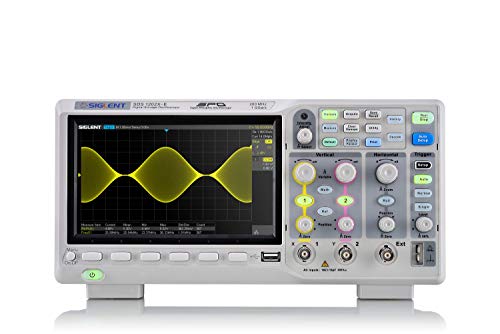
- 200 MHz bandwidth with two channels
- Up to 1 GSa/s real-time sampling
- Decodes I2C, SPI, UART, RS232, CAN, and LIN
Best For: Higher-speed signal and serial-bus troubleshooting
Best Touchscreen Portable Scope
FNIRSI 1013D Plus 100MHz Oscilloscope

- 100 MHz bandwidth and 1 GSa/s sampling
- Large seven-inch touchscreen display
- Portable storage, FFT, Lissajous, and cursor tools
Best For: Portable two-channel waveform analysis
Best High-Resolution Bench Scope

- 70 MHz bandwidth with 12-bit resolution
- Up to 25 Mpts memory and 1,000,000 wfms/s capture
- Serial decode, FFT, LAN control, and SCPI
Best For: Embedded, power, and serial-bus troubleshooting
Best Portable 3-in-1 Tool

- 50 MHz, two-channel oscilloscope
- 19,999-count multimeter and 10 MHz DDS generator
- Battery-powered design with FFT and X-Y modes
Best For: Portable electronics and automotive testing
Best 100 MHz Value Scope

- 100 MHz bandwidth and up to 1 GSa/s sampling
- Up to 24 Mpts memory and 30,000 wfms/s capture
- Serial decode, recording, USB, and LAN connectivity
Best For: Bench debugging, embedded work, and education
Best Portable Starter
FNIRSI DSO-510 Handheld Oscilloscope

- 10 MHz bandwidth and 48 MS/s sampling
- Built-in DDS generator with 13 waveforms
- Compact design with rechargeable battery
Best For: Portable hobby, automotive, and basic electronics testing
Best Bench-Top Value
HANMATEK DOS1102 110 MHz Oscilloscope
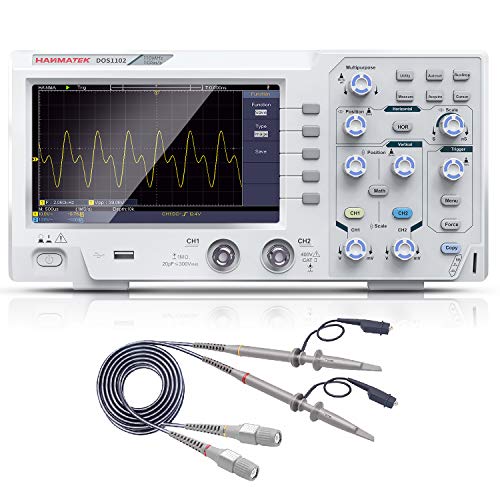
- 110 MHz bandwidth with dual channels
- 500 MS/s sampling per channel
- 7-inch display and 30 automatic measurements
Best For: Bench testing, troubleshooting, and detailed waveform analysis
Best All-in-One Tool
FNIRSI 2C53T 3-in-1 Oscilloscope

- 50 MHz two-channel oscilloscope
- Integrated 19,999-count multimeter
- DDS generator and 3000mAh battery
Best For: Portable electronic, automotive, and multifunction testing
Best Value Bench Scope – Rigol DS1054Z 50MHz 4-Channel Oscilloscope
For shoppers comparing oscilloscopes under 500, the Rigol DS1054Z stands out as a capable bench instrument with four analog channels, deep memory, and useful capture and decoding tools. It is well suited to electronics troubleshooting where channel count and long waveform captures matter.
Best For: Electronics debugging, teaching labs, and power or embedded bring-up.
Pros:
- Four analog channels with up to 1 GSa/s single-channel sampling.
- Up to 24 Mpts of standard memory for extended captures.
- 30,000 wfms/s capture rate, waveform recording, FFT, filters, and serial decoding.
- USB, LAN, and AUX interfaces support bench integration and documentation.
Cons:
- Lower memory depth is available when using multiple channels simultaneously.
- At 6.6 pounds and bench-oriented dimensions, it is less portable than handheld options.
The DS1054Z is a strong all-around choice when you want a traditional four-channel scope with unusually helpful capture depth and analysis features in the oscilloscopes under 500 category.
Best Pocket Option – FNIRSI DSO152 200kHz Handheld Oscilloscope
Among oscilloscopes under 500, the FNIRSI DSO152 focuses on portability and simple measurements rather than advanced bench analysis. Its 200 kHz bandwidth, one-key setup, and built-in battery make it convenient for quick checks in the field or workshop.
Best For: Portable maintenance, automotive checks, basic electronics work, and education.
Pros:
- Compact 10.2-ounce design with a 2.8-inch HD display.
- 2.5 MS/s real-time sampling rate and 200 kHz bandwidth.
- Auto, normal, and single trigger modes support periodic and aperiodic signals.
- Built-in 1,000 mAh battery provides about four hours of use and charges through USB-C.
Cons:
- Its 200 kHz bandwidth and 2.5 MS/s sampling rate limit it to lower-frequency work.
- It is a single handheld instrument rather than a multi-channel bench scope.
The DSO152 is best viewed as a lightweight troubleshooting companion. Choose it when convenient one-handed measurements matter more than deep memory, multiple channels, or advanced decoding.
Best High-Bandwidth Choice – Siglent SDS1202X-E 200MHz Oscilloscope
For buyers seeking oscilloscopes under 500 with more bandwidth, the Siglent SDS1202X-E offers 200 MHz operation, two channels, and up to 1 GSa/s real-time sampling. Its record length and broad serial-bus decoding support make it suitable for more demanding digital troubleshooting.
Best For: Two-channel electronics debugging and serial communication analysis.
Pros:
- 200 MHz bandwidth supports faster signals than the other listed scopes.
- Up to 1 GSa/s real-time sampling rate.
- Record length reaches 14 Mpts for extended waveform captures.
- Serial trigger and decode support covers I2C, SPI, UART, RS232, CAN, and LIN.
Cons:
- Only two channels are provided, which is fewer than four-channel alternatives.
- The supplied notes do not specify additional connectivity or display features.
The SDS1202X-E is an appealing pick when bandwidth and protocol coverage are higher priorities than channel count. It offers a focused feature set for faster, more complex signal work.
Best Touchscreen Portable Scope – FNIRSI 1013D Plus 100MHz Oscilloscope
The FNIRSI 1013D Plus is a practical contender among oscilloscopes under 500 for users who want a portable two-channel scope with a large touchscreen. Its 100 MHz bandwidth, 1 GSa/s sampling, storage tools, and battery operation support convenient measurements away from a traditional bench.
Best For: Portable electronics work, visual waveform analysis, and users who prefer touchscreen controls.
Pros:
- Two channels with 100 MHz bandwidth and 1 GSa/s sampling.
- Seven-inch 800 × 480 touchscreen provides a large viewing area.
- Built-in storage holds up to 1,000 screenshots and 1,000 waveform data sets.
- Includes cursor measurements, Lissajous display, FFT viewing, and a 6,000 mAh battery.
Cons:
- It has two channels rather than four.
- Battery operation is listed at about four hours.
- FFT viewing is described as a rough estimation of harmonic content.
The 1013D Plus combines a large, easy-to-read interface with useful portable analysis features. It is a good fit when touchscreen operation and waveform storage are more important than maximum channel count.
Best High-Resolution Bench Scope – RIGOL DHO802
For oscilloscopes under 500, the RIGOL DHO802 is a strong choice when waveform detail, memory depth, and serial-bus troubleshooting matter. Its 70 MHz bandwidth, 12-bit resolution, 1.25 GSa/s sampling, and up to 25 Mpts memory support both routine debugging and closer inspection of ripple, noise, and intermittent events.
Best For: Embedded bring-up, power-supply ripple analysis, and CAN, UART, I2C, or SPI troubleshooting.
Pros:
- 12-bit resolution, 1.25 GSa/s sampling, and up to 25 Mpts memory.
- Up to 1,000,000 wfms/s capture rate with intensity grading and waveform search.
- Includes serial triggering and decoding, FFT analysis, LAN control, and SCPI automation.
- 7-inch touch display with USB and HDMI connectivity.
Cons:
- Limited to two analog channels.
- Its advanced features may be more than needed for basic signal viewing.
The DHO802 stands out for users who want a modern, detail-focused oscilloscope with useful analysis and automation features in a compact 3.92-pound design.
Best Portable 3-in-1 Tool – FNIRSI 2C53P
Among oscilloscopes under 500, the FNIRSI 2C53P is appealing when portability and multiple test functions are more important than high-end bench performance. It combines a two-channel, 50 MHz oscilloscope with a 19,999-count multimeter and a DDS signal generator in a battery-powered handheld format.
Best For: Mobile electronics work, automotive testing, and users who want oscilloscope, multimeter, and signal-generator functions in one device.
Pros:
- Combines a 50 MHz oscilloscope, multimeter, and DDS generator.
- 250 MS/s sampling, 4.3-inch IPS touchscreen, and one-key AUTO operation.
- Supports waveform storage and export, X-Y mode, FFT analysis, and multiple trigger modes.
- Built-in 4000 mAh battery provides about four hours of operation.
Cons:
- Its 50 MHz bandwidth and 250 MS/s sampling are lower than the listed RIGOL models.
- Battery life is approximately four hours.
- The compact screen may be less suitable for extended bench sessions than a larger display.
The 2C53P is a practical all-in-one option for field work and general troubleshooting, especially when reducing the number of instruments you need to carry is a priority.
Best 100 MHz Value Scope – RIGOL DS1102Z-E
For shoppers comparing oscilloscopes under 500, the RIGOL DS1102Z-E offers a useful balance of bandwidth, sampling speed, memory, and capture tools. Its 100 MHz bandwidth, two channels, up to 1 GSa/s sampling, and deep memory suit electronics debugging, education, and longer waveform captures.
Best For: Bench electronics work, embedded development, power troubleshooting, and education labs.
Pros:
- 100 MHz bandwidth with up to 1 GSa/s real-time sampling.
- Up to 24 Mpts standard memory, or 12 Mpts in dual-channel operation.
- Up to 30,000 wfms/s capture rate and recording/playback for up to 60,000 frames.
- Includes serial decoding for RS232/UART, I2C, and SPI, plus USB and LAN interfaces.
Cons:
- Limited to two analog channels.
- It weighs 8.83 pounds, making it less convenient for portable use.
- The supplied notes list fewer decoded bus types than the DHO802.
The DS1102Z-E is a solid traditional bench instrument for users who value 100 MHz bandwidth, deep-memory captures, and practical recording and decoding features over handheld portability.
Best Portable Starter – FNIRSI DSO-510 Handheld Oscilloscope
If you want one of the more compact oscilloscopes under 500 for basic electronics, automotive troubleshooting, or signal experimentation, the FNIRSI DSO-510 combines a 10 MHz oscilloscope with a DDS signal generator. Its handheld design, automatic setup, and rechargeable battery make it convenient for portable testing.
Best For: Hobbyists and technicians who need a compact oscilloscope with basic waveform-generation capabilities.
Pros:
- Handheld design with a built-in 1000mAh rechargeable battery
- 10 MHz bandwidth, 48 MS/s sampling rate, and voltage measurement up to 400 V
- DDS generator supports 13 waveforms with output frequencies up to 50 kHz
- One-key AUTO function and infinite afterglow help simplify waveform viewing
Cons:
- Its 10 MHz bandwidth and 48 MS/s sampling rate are more limited than those of larger bench models
- The 2.8-inch, 320×240 display provides less viewing space for detailed analysis
The DSO-510 is a practical choice when portability and versatility matter more than advanced bandwidth. It is best suited to routine low-frequency measurements, basic signal simulation, and field diagnostics.
Best Bench-Top Value – HANMATEK DOS1102 110 MHz Oscilloscope
For shoppers comparing oscilloscopes under 500, the HANMATEK DOS1102 offers substantially more bandwidth and screen area than compact handheld units. Its dual channels, 500 MS/s per-channel sampling rate, 7-inch display, and broad measurement toolkit make it suited to more detailed bench testing.
Best For: Electronics workbenches, troubleshooting, and users who want dual-channel measurements with extensive automatic analysis.
Pros:
- 110 MHz bandwidth and 500 MS/s real-time sampling rate per channel
- Dual-channel design with a large 7-inch, 800×480 TFT-LCD display
- Includes 30 automatic measurement functions, cursor measurements, and a built-in frequency meter
- Supports waveform storage, USB connectivity, LABVIEW communication, and SCPI specifications
Cons:
- At 2.4 pounds and with a DC power design, it is less convenient for handheld or field use
- The supplied notes do not specify a built-in battery
The DOS1102 is the strongest fit here for users who prioritize bandwidth, screen readability, and bench-oriented features. Its storage and communication options also give it room to support more structured testing workflows.
Best All-in-One Tool – FNIRSI 2C53T 3-in-1 Oscilloscope
The FNIRSI 2C53T stands out among oscilloscopes under 500 by combining a two-channel oscilloscope, digital multimeter, and DDS signal generator in one handheld unit. With 50 MHz bandwidth, 250 MSa/s sampling, and a 4.5-digit multimeter, it is designed for users who want broad measurement coverage without carrying several instruments.
Best For: Professionals, students, hobbyists, and automotive users who need oscilloscope and multimeter functions in a portable package.
Pros:
- Combines a 50 MHz, two-channel oscilloscope with a 4.5-digit, 19,999-count multimeter
- Measures AC/DC voltage, AC/DC current, resistance, capacitance, and continuity
- DDS generator provides 13 waveforms and output frequencies up to 50 kHz in 1 Hz steps
- Features math, cursor, persistence, XY modes, waveform storage, and a 3000mAh battery
Cons:
- The 2.8-inch display is relatively small for comparing multiple waveforms or detailed traces
- Its 1 Kpts record depth is more modest than the storage-oriented features of some bench instruments
The 2C53T is the most versatile option in this group. Choose it when integrated multimeter functionality and portability are more valuable than a large screen or the highest bandwidth available in a bench-style design.
How We Picked the Best Oscilloscopes Under 500
We focused on specifications that affect real troubleshooting work rather than headline features alone. Our comparison considers bandwidth, sample rate, channel count, display quality, portability, controls, waveform memory, and included functions such as signal generation or multimeter testing.
We also included different instrument types because the best oscilloscope for a permanent workbench may not be the best option for field service. Bench models generally offer more inputs and deeper controls, while handheld and multifunction scopes trade some performance for convenience and flexibility.
Quick Comparison
- Best value bench scope: Rigol DS1054Z, with four channels and a strong feature set for general electronics work.
- Best for higher bandwidth: Siglent SDS1202X-E and Rigol DS1102Z-E, both suited to faster signals than entry-level handheld models.
- Best portable options: Rigol DHO802, FNIRSI 1013D Plus, and HANMATEK DOS1102.
- Best multifunction tools: FNIRSI 2C53P and 2C53T, which combine oscilloscope, multimeter, and DDS generator functions.
- Best compact budget tools: FNIRSI DSO152 and DSO-510 for basic signal checks and portable diagnostics.
Key Buying Factors for Oscilloscopes Under 500
Bandwidth and Sample Rate
Choose bandwidth based on the fastest signal you expect to measure. A 50MHz or 100MHz scope is suitable for many analog, digital, microcontroller, audio, and power-electronics projects, while lower-bandwidth handheld models are better for slower signals. Sample rate also matters: higher rates capture more detail and reduce the risk of missing short transitions.
Channels and Resolution
Two channels are sufficient for many tasks, such as comparing an input and output. Four channels are more useful when debugging multi-stage circuits, clocks, buses, or power rails simultaneously. Resolution affects how clearly small voltage changes appear; newer 12-bit models can show finer amplitude detail than typical 8-bit instruments.
Controls, Display, and Portability
A large screen and dedicated controls can make a bench scope faster to operate than a small touchscreen or handheld design. For field work, battery operation and compact size may matter more. Check probe quality, input protection, connectivity, and whether the interface is easy to navigate before buying.
Extra Functions
Integrated waveform generators and multimeters can reduce the number of tools on your bench. They are especially useful for hobby projects and service work, but do not assume a multifunction instrument matches a dedicated scope in every measurement category.
Who Should Buy Which Oscilloscopes Under 500?
Choose a four-channel bench scope if you regularly troubleshoot complex circuits or need to observe several signals at once. Choose a 70MHz to 110MHz two-channel model for general-purpose electronics, embedded development, and faster digital signals. Choose a portable scope if you work away from a bench or need convenient on-site diagnostics.
Choose a multifunction FNIRSI model if portability and tool consolidation are priorities. For occasional low-frequency checks, a compact entry-level unit may be sufficient, but buyers working with faster clocks, switching circuits, or detailed transient behavior should prioritize bandwidth, sampling performance, and waveform memory over the lowest price.