
The best physics experiment sets for classrooms turn abstract formulas into observable results. This roundup compares 10 hands-on kits spanning mechanics, circuits, magnetism, optics, forces, and simple machines.
Use the guide below to match each set with your students’ age range, lesson goals, available classroom time, and preferred level of teacher support.
Best 10 Physics Experiment Sets for Classrooms Picks for 2026
Best All-Around Electricity & Magnetism Kit
EUDAX Electricity Discovery Lab
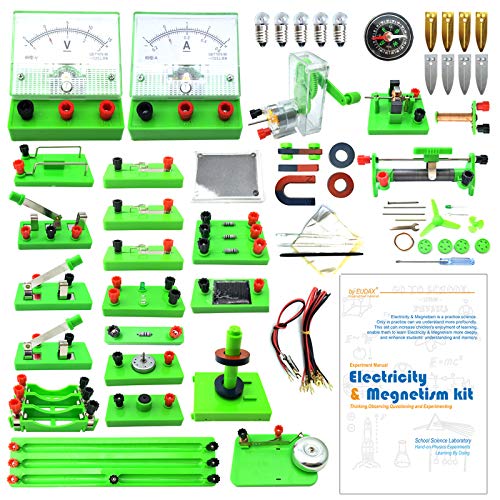
- 79-piece electricity and magnetism set
- Includes color manual and storage bag
- Requires three AA batteries
Best For: Grades 9–11 electricity and magnetism lessons
Best for Classical Mechanics Labs
26-Experiment Physics Mechanics Kit

- Includes equipment for 26 experiments
- Covers forces, motion, pressure, and buoyancy
- Includes manual and storage box
Best For: Middle and high school mechanics instruction
Best Introductory Magnetism Set
Sntieecr Junior Science Magnetism

- 14-piece magnetism activity set
- Includes compass, magnetic cars, and iron filings box
- Designed for ages 8 and up
Best For: Beginner magnetism stations and small-group activities
Best for Simple Machines Modeling

- 26 model-building exercises
- Explores six classic simple machines and gears
- Includes a force-measuring spring scale
Best For: Hands-on engineering and simple machines lessons
Best Introductory Circuit Kit

- Builds series and parallel circuits
- Includes English instructions
- Storage box keeps components organized
Best For: Grades 7–9 electricity lessons and STEM activities
Best for Motion and Newton’s Laws
United Scientific Dynamics Carts

- Explores velocity and acceleration
- Includes spring and rubber bumpers
- Designed for classroom or home labs
Best For: Motion, collisions, and Newton’s laws
Best Optics Demonstration Set
Multifunction Physics Optical Kit

- Includes lenses, mirrors, and prism
- Demonstrates reflection and refraction
- Comes with adjustable light source
Best For: Optics lessons for students aged 14 and up
Magnet Exploration Pick
Magnetic Science & Engineering Set
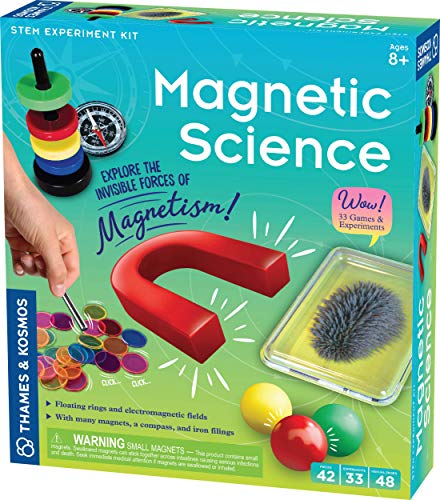
- 33 experiments and games
- Explores fields and electromagnets
- Includes 60-page color manual
Best For: Ages 8–15 learning introductory magnetism
Full Mechanics Lab Pick

- Supports 30+ mechanics experiments
- Includes balances, pulleys, ramps, and gauges
- Comes with a detailed manual
Best For: Junior-school mechanics classes and labs
Electromagnetism Classroom Pick
38-Piece Magnet Experiment Set

- 38 pieces for magnetism lessons
- Includes electromagnet and levitation gear
- Supports field, compass, and attraction tests
Best For: Ages 15+ studying magnetism and electromagnetism
Best All-Around Electricity & Magnetism Kit – EUDAX Electricity Discovery Lab
For classrooms seeking physics experiment sets for classrooms that connect electrical theory with hands-on building, this EUDAX kit covers introductory electricity, magnetism, and basic electronics. Its 79 pieces, color manual, and storage bag support projects such as series and parallel circuits, fruit batteries, electromagnets, electric bells, and hand-crank generators.
Best For: Grades 9–11 classrooms and STEM learners exploring foundational electricity and magnetism.
Pros:
- Supports a broad range of electricity and magnetism experiments.
- Includes 79 items, repair tools, a color manual, and storage bag.
- Encourages students to build models and investigate principles hands-on.
Cons:
- Requires three AA batteries, which are not included.
- The wide topic range may require teacher guidance for younger students.
This is a versatile choice when one classroom kit needs to cover both circuit fundamentals and introductory electromagnetism. Teachers should plan for batteries and supervised activities.
Best for Classical Mechanics Labs – 26-Experiment Physics Mechanics Kit
This mechanics kit is a practical option for physics experiment sets for classrooms focused on forces, motion, and simple machines. It includes equipment for 26 experiments, including a trolley and ramp, pulleys, lever ruler, tray balance, spring dynamometer, and U-tube pressure gauge.
Best For: Middle and high school classrooms teaching Newton’s laws, kinematics, gravity, pressure, buoyancy, pulleys, and levers.
Pros:
- Covers a wide set of core classical mechanics topics.
- Includes multiple measuring and demonstration tools in one kit.
- Comes with a professional manual and organized storage box.
- Metal and plastic components are described as durable and smooth-edged.
Cons:
- Recommended for ages 14 and up, limiting use with younger classes.
- The set may require teacher setup and instruction across its 26 experiments.
With its broad equipment selection and storage-focused design, this set can serve as a central mechanics resource for older students. It is especially useful when lessons need tangible demonstrations of force, pressure, and motion.
Best Introductory Magnetism Set – Sntieecr Junior Science Magnetism
For teachers looking for accessible physics experiment sets for classrooms, this compact magnetism set provides a straightforward introduction to magnetic forces and Earth’s magnetism. The 14-piece assortment includes bar, U-shaped, and ring magnets, a compass, magnetic cars, and an iron filings box.
Best For: Students ages 8 and up beginning classroom or home investigations of magnetism.
Pros:
- Provides several magnet shapes for comparing magnetic behavior.
- Includes a compass, magnetic cars, and iron filings box for varied activities.
- Supports observation, questioning, and creative experiment design.
- Uses common household items such as paper, pens, and rulers for additional activities.
Cons:
- Additional experiment materials are not included.
- Its focus is limited primarily to introductory magnetism.
- The compact plastic set may be better suited to small-group work than large demonstrations.
This is a simple, flexible choice for introducing magnetic fields and forces without requiring a large laboratory setup. It works well as a station activity or an entry-level supplement to broader physics lessons.
Best for Simple Machines Modeling – T&K Simple Machines Set
This T&K set is a strong option among physics experiment sets for classrooms that emphasize construction and engineering. Across 26 model-building exercises, students investigate gears and all six classic simple machines while using the included spring scale to observe changes in force direction and magnitude.
Best For: Students ages 8 and up learning levers, pulleys, wheels and axles, inclined planes, screws, and wedges.
Pros:
- Includes 26 hands-on model-building exercises.
- Covers all six classic simple machines plus gears.
- Spring scale supports direct force measurement.
- Full-color, 32-page manual provides step-by-step instructions.
Cons:
- Plastic construction pieces may require sorting and assembly time.
- The set focuses on simple machines rather than a broad range of physics topics.
This kit makes abstract mechanical advantage and force-direction concepts more tangible through building and measurement. Its modular construction approach also suits classrooms that value iterative engineering activities and guided projects.
Best Introductory Circuit Kit – EUDAX Basic Electricity Set
For classrooms looking for physics experiment sets for classrooms, the EUDAX Basic Electricity Circuit Kit offers a straightforward way to introduce current, series circuits, and parallel circuits. Its English instructions and storage box support organized, hands-on activities for middle-school learners.
Best For: Grades 7–9, science clubs, STEM activities, science fairs, and introductory electricity lessons.
Pros:
- Supports series and parallel circuit experiments.
- Helps reinforce textbook concepts through hands-on work.
- Includes English instructions and a plastic storage box.
- Can encourage problem-solving, creativity, and electrical awareness.
Cons:
- Two AA batteries are not included.
- The supplied notes identify it as a basic introductory kit rather than an advanced circuit system.
This is a practical choice when a classroom needs a compact, beginner-friendly electricity activity set with simple organization and clear assembly guidance.
Best for Motion and Newton’s Laws – United Scientific Dynamics Carts
Among physics experiment sets for classrooms, the United Scientific Dynamics Carts provide a focused way to investigate motion through collisions and cart-based demonstrations. The set is designed around velocity, acceleration, friction, Newton’s laws, and conservation of momentum.
Best For: Classroom or home lab lessons on motion dynamics, collisions, and Newtonian mechanics.
Pros:
- Covers several core motion and dynamics concepts.
- Includes two carts with low-friction snap-in wheels and weight wells.
- Spring steel and rubber bumpers allow varied collision experiments.
- Comes with experiment suggestions to help begin activities.
Cons:
- The set is focused on dynamics rather than electricity or optics.
- Only two carts are included, which may require student groups to share equipment.
Choose this kit when your lesson plans center on observable motion and collision behavior. Its interchangeable bumpers make it more adaptable than a basic cart-only set.
Best Optics Demonstration Set – Multifunction Physics Optical Kit
This multifunction optical set is one of the more specialized physics experiment sets for classrooms, combining lenses, mirrors, a triangular prism, and an adjustable linear light source. It supports demonstrations of refraction, reflection, and related light behavior with an English color-page manual.
Best For: Optics lessons covering lenses, mirrors, prisms, refraction, and reflection for learners aged 14 and up.
Pros:
- Supports experiments with convex and concave lenses and mirrors.
- Includes a triangular prism for prismatic refraction activities.
- Features a three-way linear light source with adjustable direction.
- Comes with a multifunction reflector and English manual.
Cons:
- Two AAA batteries are required and not included.
- Its focus on optics makes it less suitable for non-optics units.
- The set is recommended for ages 14 and up.
This kit is a useful pick for teachers who want multiple introductory optics demonstrations in one compact package, especially when visual light-path experiments are central to the lesson.
Magnet Exploration Pick – Magnetic Science & Engineering Set
For classrooms seeking physics experiment sets for classrooms focused on magnetism, the T&K Magnetic Science set offers a compact, age-appropriate way to explore magnetic fields, electromagnets, and related STEM concepts. It includes 33 experiments and games, plus a 60-page full-color manual.
Best For: Elementary and middle-school learners ages 8–15 studying introductory magnetism and hands-on STEM concepts.
Pros:
- Includes 33 experiments and games.
- Explores magnets, invisible magnetic fields, and electromagnets.
- Includes a 60-page full-color manual.
- Designed for ages 8 and up.
Cons:
- Its subject focus is primarily magnetism rather than broad mechanics.
- The supplied details do not specify the full contents of every experiment.
This is a focused choice for teachers who want an accessible introduction to magnetic science. Its experiment count and included manual make it useful for guided lessons, enrichment, or small-group exploration.
Full Mechanics Lab Pick – Physics Mechanics Lab Kit
Among physics experiment sets for classrooms, this mechanics lab kit stands out for its broad selection of measurement, motion, pressure, buoyancy, lever, pulley, and energy-conversion equipment. It is designed for junior-school teaching, laboratory work, and teacher demonstrations.
Best For: Junior-school classrooms and labs needing a versatile kit for more than 30 classic mechanics experiments.
Pros:
- Includes balances, weights, pulleys, a lever ruler, pressure gauge, spring scale, trolley, ramp, and other accessories.
- Supports experiments involving measurement, density, friction, pressure, buoyancy, levers, pulleys, and energy conversion.
- Comes with a detailed manual containing operating steps and physics explanations.
- Designed for repeated classroom use, with compact storage and portability.
Cons:
- The supplied age information lists the range as adult, despite its stated junior-school applications.
- The large assortment may require organized storage and setup before lessons.
This is the most comprehensive option of the three for broad mechanics instruction. Teachers can use it for demonstrations or structured student experiments, though its many components make preparation and inventory management important.
Electromagnetism Classroom Pick – 38-Piece Magnet Experiment Set
For physics experiment sets for classrooms centered on magnetism and electromagnetism, the EXBEPE 38-piece kit provides varied demonstration materials, including magnets, an electromagnet, magnetic levitation equipment, a compass, magnet shavings, wires, and a battery box.
Best For: Teacher-led magnetism and electromagnetism demonstrations, especially for learners aged 15 and up.
Pros:
- Includes 38 pieces covering magnetic fields, attraction and repulsion, levitation, and electromagnetism.
- Offers horseshoe, bar, ring, and small ring magnets for comparing magnetic behavior.
- Includes classroom-friendly accessories such as a compass, magnet shavings, cars, wires, pins, and cotton thread.
- Supports step-by-step experiments using diagrams.
Cons:
- The manufacturer-recommended age is 15 years and up.
- Its focus is limited mainly to magnetism and electromagnetism rather than general physics.
This kit is a practical fit when the lesson objective is visual, hands-on exploration of magnetic fields and electromagnetic effects. The range of magnet types and levitation equipment can support demonstrations as well as guided student investigation.
How We Picked These Physics Experiment Sets for Classrooms
We selected kits across the main introductory physics topics: force and motion, Newton’s laws, pulleys, balance and measurement, electricity, circuits, magnetism, electromagnetism, optics, and simple machines. We also considered whether a set appears suited to individual exploration, small-group lab work, or teacher-led demonstrations.
Because classroom needs vary, this list includes both focused kits and broader lab sets. Before buying, confirm the included components, recommended age range, experiment instructions, and whether batteries, power supplies, stands, or other consumables are required.
Quick Comparison
| Best for | Recommended kit type | Topics covered |
|---|---|---|
| Introductory mechanics | Mechanics lab kit | Force, pulleys, balance, measurement |
| Motion and Newton’s laws | Dynamics cart set | Acceleration, collisions, momentum, force |
| Electricity lessons | Basic circuit kit | Conductors, circuits, current, components |
| Magnetism and electromagnetism | Magnet or electromagnet set | Magnetic fields, attraction, coils, induction |
| Light and lenses | Optics experiment set | Reflection, refraction, prisms, lenses |
| Engineering applications | Simple-machines set | Levers, pulleys, mechanical advantage |
Key Buying Factors for Physics Experiment Sets for Classrooms
Curriculum Fit and Experiment Range
Choose a focused kit when you are teaching one unit and a broader set when you need reusable equipment throughout the year. A clearly defined experiment list makes lesson planning easier and helps prevent unused components.
Student Age and Complexity
Junior learners generally benefit from large, visible parts and straightforward activities. Older students can work with measurements, circuit diagrams, force calculations, and controlled variables. Match the kit’s complexity to your students’ reading, math, and lab-safety skills.
Group Size and Duplication
Check how many students can work at once. One kit may suit a demonstration, while several identical sets are better for rotating stations or groups of two to four. Buying duplicate high-use components can be more practical than purchasing one large mixed kit.
Durability, Storage, and Safety
Classroom equipment should tolerate repeated handling and store neatly between lessons. Look for organized cases or trays, sturdy connectors, and parts that are easy to inventory. Review electrical ratings, sharp edges, small parts, and supervision requirements before use.
Included Instructions and Missing Accessories
Teacher guidance, diagrams, worksheets, and experiment prompts can significantly reduce preparation time. Confirm whether the kit includes batteries, cables, light sources, weights, magnets, or measuring tools needed for the planned activities.
Who Should Buy Which Physics Experiment Sets for Classrooms?
Choose a mechanics kit or dynamics carts for lessons centered on motion, force, acceleration, pulleys, and Newton’s laws. Select a basic electricity circuit kit for introductory wiring and electrical-conduction activities. Magnet and electromagnet sets are a good fit for magnetic fields and STEM demonstrations, while a dedicated optics set is better for reflection, refraction, prisms, and lenses. For engineering-focused units, simple-machines kits connect physics concepts with practical design challenges.
For a mixed middle- or high-school lab, combine one broad mechanics set with focused electricity, magnetism, or optics kits. For younger classes, prioritize visible, low-complexity activities and provide close supervision. The best choice is the set that aligns with your next lessons, supports your group size, and can be reused safely across the school year.