
Physics becomes easier to understand when children can test ideas with their own hands. The best physics experiment sets for elementary students turn concepts such as magnetism, electricity, motion, and light into practical activities.
This roundup compares 10 hands-on kits with different difficulty levels, materials, and learning goals so parents, teachers, and gift-givers can choose a set that fits the child and the setting.
Best 10 Physics Experiment Sets for Elementary Students Picks for 2026
Build-and-Test Motion Lab

- Build six working motion models
- Covers inertia, friction, and circular motion
- Includes theory, experiments, quiz, and 3D app
Best For: Hands-on builders ages 9 and up
Magnetism Discovery Station

- Includes 16 magnet experiment pieces
- Explores attraction, repulsion, and fields
- Recommended for ages 8 and up
Best For: Introductory magnetism activities
Electricity & Magnetism Workshop

- Includes 18 hands-on experiments
- Covers circuits, electromagnetism, and magnetism
- Comes with a 40-page full-color manual
Best For: Older elementary learners exploring circuits
Light & Lens Explorer
Physics Optical Experiment Set

- Explores reflection and refraction
- Includes lenses, mirrors, prism, and light source
- Recommended for ages 14 and up
Best For: Supervised optics demonstrations
Best Hands-On Variety
7-in-1 STEM Science Circuit Kit

- Seven build-and-test STEM projects
- Covers circuits, motion, and aerodynamics
- Designed for ages 8-13
Best For: Families and classrooms seeking varied physics activities
Best for Structured Labs
Electricity and Magnetism Discovery Kit
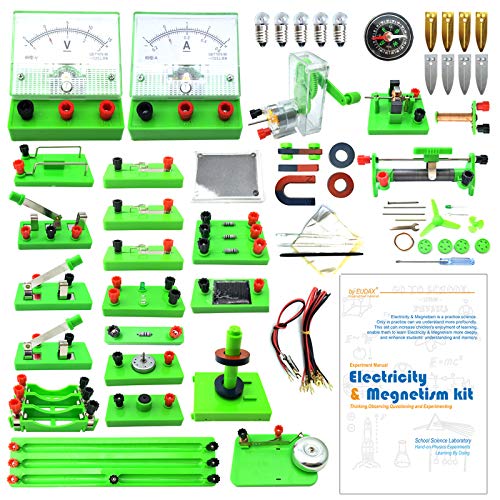
- 79 listed components and a color manual
- Covers circuits, Ohm’s law, and electromagnets
- Recommended for ages 8-18
Best For: Guided electricity and magnetism lessons
Best for Magnetism
Magnets and Iron Filings Experiment Kit

- Multiple magnet shapes and accessories
- Iron filings reveal magnetic field patterns
- Recommended for ages 8 and up
Best For: Visual magnetism lessons and classroom demonstrations
Magnetism Starter

- 14-piece magnetism-focused activity set
- Includes compass, magnetic cars, and iron filings
- Recommended for ages 8 and up
Best For: Beginning hands-on magnetism activities at home or school
Electricity Builder
Electromagnet and Circuit Model Kit

- Combines circuits and electromagnetism
- Builds simple, series, and parallel circuits
- Includes a full-color project manual
Best For: Guided electricity and electromagnet projects with supervision
Circuit Exploration
Electricity and Magnetism Upgrade Kit

- 27-piece electricity and magnetism kit
- Builds circuits, generators, LEDs, and electromagnets
- Recommended for grades 7–11
Best For: Older students and classroom circuit exploration
Build-and-Test Motion Lab – Engino Physics Laws Kit
For families seeking physics experiment sets for elementary students, this Engino kit offers a construction-focused introduction to inertia, friction, and circular motion. Children ages 9 and up can build six working models, including a rocket launcher, crash test rig, and sharpening wheel, while using the included theory, experiments, and quiz materials.
Best For: Elementary-age learners who enjoy building models and connecting physics concepts to motion-based projects.
Pros:
- Builds six working physics models.
- Includes theory, experiments, facts, and a four-page quiz.
- Interactive 3D app adds a virtual building option.
- Supports construction, critical thinking, and other STEM skills.
Cons:
- Recommended for ages 9 and up, so it may be advanced for younger elementary students.
- Its focus is primarily motion and model building rather than a broad range of physics topics.
This is a strong choice when hands-on construction is the main priority. The combination of physical models, guided explanations, and review questions gives children several ways to engage with the same physics ideas.
Magnetism Discovery Station – EUDAX Junior Magnet Set
This EUDAX set is a compact option among physics experiment sets for elementary students, with 16 magnet-related pieces for investigating attraction, repulsion, magnetic fields, and compasses. Recommended for children ages 8 and up, it supports simple activities that turn basic magnetism concepts into observable experiments.
Best For: Elementary students learning introductory magnetism through short, observation-based activities.
Pros:
- Includes bar, ring, horseshoe, and compass magnets.
- Supports activities such as testing attraction and repulsion.
- Introduces magnetic fields, Earth’s magnetism, and interactive forces.
- Its 16-piece format is manageable for classroom or home use.
Cons:
- The set is focused specifically on magnets rather than general physics.
- Notes do not indicate a large collection of guided apparatus or extended projects.
Choose this kit for a straightforward introduction to magnetism. Its simple components make it useful for asking questions, making observations, and reinforcing concepts introduced in an elementary physics lesson.
Electricity & Magnetism Workshop – Teenii 50-Piece Physics Kit
For families wanting physics experiment sets for elementary students with a broad project range, this Teenii kit combines electricity and magnetism in one 50-piece set. Designed for ages 8 to 18, it includes an illustrated 40-page manual and 18 hands-on experiments, from fruit batteries and electric bells to a hand-crank generator.
Best For: Older elementary students who are ready to build circuits and explore electricity, electromagnetism, and simple machines with adult guidance as needed.
Pros:
- Offers 18 hands-on experiments and a 40-page full-color manual.
- Includes meters, switches, bulbs, wires, resistors, magnets, and motor components.
- Covers both electrical circuits and magnetism.
- Supports parent-child science activities and observation skills.
Cons:
- The many components and concepts may require organization and supervision for younger users.
- Its recommended range begins at age 8, making it less suitable for early elementary children.
This is the most comprehensive option in the group for electricity and magnetism. It offers enough equipment for varied experiments, making it suitable for a child who wants to progress beyond one introductory activity.
Light & Lens Explorer – Physics Optical Experiment Set
This optical set gives older students a hands-on way to study light, reflection, and refraction. Although it is listed for ages 14 and up, it may suit advanced learners comparing physics experiment sets for elementary students, especially when an adult or teacher provides guidance. The kit includes lenses, a prism, reflector, and adjustable three-way light source.
Best For: Advanced students, teachers, or supervised demonstrations focused on introductory optics.
Pros:
- Supports experiments with lenses, prisms, mirrors, and light paths.
- Covers refraction, plane-mirror reflection, diffuse reflection, and curved-mirror reflection.
- Includes an English color-page manual.
- Compact acrylic components are supplied in a color box.
Cons:
- The manufacturer recommends it for ages 14 and up, beyond typical elementary age.
- Two AAA batteries are required for the light source and are not included.
- Optics activities may need more explanation or supervision than simpler elementary experiments.
This kit is best treated as an advanced optics demonstration set rather than a general elementary starter kit. Its varied lenses, mirrors, and prism make it valuable when the goal is specifically to visualize how light behaves.
Best Hands-On Variety – 7-in-1 STEM Science Circuit Kit
For shoppers comparing physics experiment sets for elementary students, this kit offers a broad mix of build-and-test activities for children ages 8 and up. Projects include Newton’s Cradle, a telegraph, a fruit battery, a color wheel, a spin art machine, and flying saucers, with a focus on circuits, energy conversion, and aerodynamics.
Best For: Families, classrooms, and homeschool settings that want varied physics and STEM activities in one kit.
Pros:
- Includes seven listed STEM projects spanning motion, circuits, color, and aerodynamics.
- Supports hands-on problem-solving, creativity, and motor-skill development.
- Provides step-by-step instructions and durable components for guided assembly.
- Suitable for children ages 8-13 according to the product description.
Cons:
- Several activities share one electric motor kit, so they may not operate simultaneously.
- The project range may require adult guidance for younger elementary students.
This is a flexible choice when variety matters more than a narrowly focused lesson. Its combination of building and experimenting can help keep children engaged while introducing several foundational physics concepts.
Best for Structured Labs – Electricity and Magnetism Discovery Kit
This EUDAX set is a more structured option among physics experiment sets for elementary students, though its recommended range extends from age 8 through 18. It includes components and a color manual for exploring series and parallel circuits, fruit batteries, Ohm’s law, electromagnets, Oersted’s experiment, electric bells, and hand-crank generators.
Best For: Older elementary students, middle-school learners, and guided lessons focused on electricity and magnetism.
Pros:
- Includes 79 listed items, including 56 electricity pieces and 21 magnetism pieces.
- Offers a broad set of practical electricity and magnetism investigations.
- Comes with a full-color manual and storage bag.
- Supports building simple electrical and magnetic models.
Cons:
- Batteries are not included; three AA batteries are required.
- The breadth and high-school-oriented experiments may be advanced for younger children without supervision.
Choose this kit when you want a lesson-oriented set with substantial component coverage. It is especially useful for progressing from simple circuits to more involved electromagnetism investigations.
Best for Magnetism – Magnets and Iron Filings Experiment Kit
For a focused introduction to magnetism, this kit gives elementary learners a collection of magnets and demonstration tools. It includes horseshoe and bar magnets, ring magnets, magnetic cars, a compass, a suspension base, and a jar of iron filings for making magnetic fields and poles easier to observe.
Best For: Elementary science lessons and hands-on exploration of attraction, magnetic fields, and poles.
Pros:
- Includes multiple magnet styles for comparing magnetic behavior.
- One pound of iron filings helps reveal magnetic field patterns.
- Includes a compass, magnetic cars, suspension base, and other experiment accessories.
- Recommended for children ages 8 and up.
Cons:
- Iron filings can create cleanup needs despite the included shaker-lid storage jar.
- The larger horseshoe magnet is brittle and should be protected from drops.
- This kit focuses primarily on magnetism rather than circuits or broader physics topics.
This is a strong pick for visual, tactile lessons where students need to see magnetic fields rather than only read about them. Its focused contents make it easier to build a dedicated magnetism activity station.
Magnetism Starter – Junior Magnet Science Set
For families and classrooms seeking physics experiment sets for elementary students, this compact magnetism kit offers a focused way to explore attraction, repulsion, magnetic fields, and simple earth-magnetism concepts. It includes magnets, a compass, magnetic cars, and an iron-filings box, while everyday items such as paper, rulers, and pens can extend the activities.
Best For: Elementary learners ages 8 and up who are beginning hands-on magnetism and STEM activities.
Pros:
- Includes 14 magnetism-focused pieces, including bar, U-shaped, ring, and ceramic magnets.
- Provides a compass, magnetic cars, and an iron-filings box for varied demonstrations.
- Supports observation, questioning, and connections between textbook ideas and real life.
- Compact 6.3 x 4.5 x 2.2-inch format is practical for home or classroom storage.
Cons:
- The set focuses primarily on magnetism rather than a broad range of physics topics.
- Some activities require additional household tools and creative setup.
- The supplied notes describe the compass as plastic.
This is a straightforward choice when the goal is introductory magnetism rather than a full laboratory curriculum. Its varied magnetic components and suggested activities give younger students a tangible starting point for physics exploration.
Electricity Builder – Electromagnet and Circuit Model Kit
This EUDAX kit is one of the more project-oriented physics experiment sets for elementary students, combining basic electricity with electromagnetism. Its full-color manual guides learners through projects such as simple, series, and parallel circuits, an electromagnet, and a magnet car.
Best For: Young learners completing guided electricity and electromagnet projects with adult or teacher supervision.
Pros:
- Introduces both basic circuits and electromagnet principles in one set.
- Supports multiple builds, including a magnet car, homemade electromagnet, series circuit, and parallel circuit.
- Includes a full-color manual to help students follow steps and connect experiments to basic principles.
- Designed to develop practical, exploratory, and thinking skills.
Cons:
- Instructions specifically require careful battery installation and short-circuit avoidance.
- The notes do not provide a detailed component count or list of all included parts.
- Some projects may benefit from teacher or adult guidance.
Choose this model kit if you want a guided introduction to the relationship between electricity and magnetism. The project variety makes it more engaging than a single-demonstration set, but careful adherence to the instructions is important.
Circuit Exploration – Electricity and Magnetism Upgrade Kit
For older students moving beyond introductory demonstrations, this upgrade kit provides a broader selection of physics experiment sets for elementary students and advancing learners. It covers electricity and magnetism through hands-on builds such as series and parallel circuits, a hand-crank generator, a wind-power car, an electromagnet, and LED projects.
Best For: Students in grades 7–11, teachers, and learners ready for more varied electricity and magnetism experiments.
Pros:
- Offers 27 components, including switches, wires, bulbs, and LEDs.
- Supports a wide range of projects, from basic circuits to generators, traffic lights, and a wind-power car.
- Includes a full-color manual for learning core electricity and magnetism concepts.
- Parts store in a transparent box for organization.
Cons:
- Requires two AA batteries, which are not included.
- The manufacturer recommends it for ages 14–17, making it less suitable for younger elementary children.
- The broader project range may require more guidance than a basic starter kit.
This is the strongest option here for structured circuit variety and continued experimentation. Its stated age range and project complexity make it better suited to older students or supervised classroom use than to early elementary learners.
How We Picked These Physics Experiment Sets for Elementary Students
We focused on kits that support active experimentation rather than simple demonstration. The selection includes sets covering circuits, magnets, electromagnetism, motion, friction, optics, and refraction. We also considered the likely age range, variety of included components, educational value, project potential, and whether the kit can support guided activities at home or in a classroom.
Because product complexity varies, adults should check the recommended age and supervise experiments involving electricity, small parts, sharp components, or strong magnets.
Quick Comparison
| Best For | Look For |
|---|---|
| Motion and mechanics | Ramps, friction, inertia, and circular-motion activities |
| Magnetism | Bar, ring, horseshoe, compass, and iron-object experiments |
| Electric circuits | Battery holders, wires, switches, bulbs, motors, or buzzers |
| Electromagnetism | Coils, cores, magnets, and circuit-building components |
| Light and optics | Prisms, lenses, mirrors, reflectors, and a light source |
Key Buying Factors
Age and Difficulty
Choose a kit that matches the child’s reading ability, patience, and prior experience. Younger elementary students usually benefit from clearly illustrated, short activities, while older children can handle multi-step circuits and experiments requiring measurement or troubleshooting.
Learning Focus
Decide whether the goal is broad STEM exploration or deeper study of one topic. Magnet sets are often an accessible introduction, whereas electricity and optics kits can provide more structured lessons but may require greater adult guidance.
Completeness and Usability
Check what is included and whether everyday supplies are needed. A kit with labeled parts, clear instructions, and several experiments is generally easier to use than one that provides components without much guidance. Storage also matters when a set contains many small pieces.
Safety and Supervision
Look for low-voltage designs and age-appropriate materials. Never allow children to connect experiments directly to household power. Keep small magnets away from very young children and anyone who could swallow them, and inspect components before each activity.
Who Should Buy Which Physics Experiment Sets for Elementary Students?
For a first introduction to physics, a junior magnetism set is a simple choice with quick visual results. Families seeking broader hands-on learning should consider a multi-topic STEM kit or a set combining circuits and magnets. Children especially interested in building and testing moving systems may prefer a mechanics-focused engineering kit.
For classroom use, choose a durable kit with repeatable activities and enough variety to support demonstrations or small groups. Older elementary students who enjoy technical challenges may be ready for basic electricity or electromagnetism sets, while optics kits are a better fit for learners curious about light, lenses, and color. Match the kit to the child’s interests first, then consider how much adult instruction and setup time it requires.