
Hands-on experiments can make physics concepts easier to understand, remember, and apply. The right kit turns topics such as electricity, magnetism, forces, motion, and optics into practical lab activities for classroom or home use.
This roundup compares 10 physics experiment sets for high school students, with options for structured coursework, STEM projects, demonstrations, and independent exploration. Use the guide below to match a kit’s experiments, equipment, age range, and learning goals to the student.
Best 10 Physics Experiment Sets for High School Students Picks for 2026
Best Electricity & Magnetism Starter
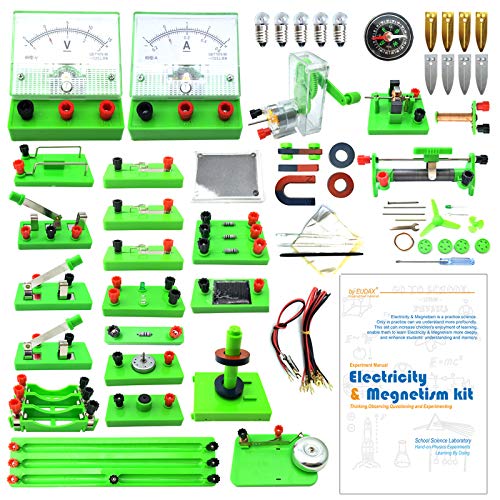
- 79 items for electricity and magnetism experiments
- Includes manual, tools, and storage bag
- Build circuits, electromagnets, and generators
Best For: Grades 9–11 beginners exploring electricity and magnetism
Best Mechanics-Focused Set

- Includes equipment for 26 mechanics experiments
- Covers forces, motion, pressure, and buoyancy
- Comes with a professional manual and storage box
Best For: Students 14+ studying classical mechanics
Best Optics Demonstration Set
Multifunctional Physics Optical Kit

- Includes lenses, mirrors, prism, and light source
- Demonstrates reflection and refraction concepts
- Comes with an English color-page manual
Best For: Introductory optics lessons and teacher demonstrations
Best Comprehensive Electromagnetism Kit

- Includes 79 pieces for electricity and magnetism
- Features ammeter, voltmeter, generator, and solar panel
- Provides a full-color manual and storage case
Best For: Ages 8–16 progressing toward advanced electromagnetism
Best Comprehensive E&M Kit
High School Electricity & Magnetism Lab Set

- 77 components spanning electricity and magnetism
- Manual supports guided and independent experiments
- Storage case keeps parts organized
Best For: Junior and senior high school electricity and magnetism coursework
Best for Motion Demonstrations
Inertia, Friction & Circular Motion Builder

- Builds six working physics models
- Covers inertia, friction, and circular motion
- Includes theory, experiments, quizzes, and a 3D app
Best For: Younger learners and introductory mechanics activities
Best Compact Circuit Kit
Upgrade Electricity & Magnetism Set

- Builds series, parallel, and switch circuits
- Includes electromagnet and generator projects
- Color manual and transparent storage box included
Best For: Grades 7–11 introductory circuit and magnetism lessons
Most Comprehensive Electromagnetism Kit
55-Piece Electricity & Magnetism Set

- Includes 55 items and 50+ experiments
- Covers circuits, electromagnets, and magnetism
- Comes with an illustrated manual and storage case
Best For: High school students exploring multiple electricity and magnetism concepts
Best for Guided Electromagnet Projects
DIY Electromagnet & Circuit Kit

- Builds electromagnets and basic circuits
- Includes series, parallel, and magnet-car projects
- Uses a full-color instructional manual
Best For: Students practicing core electromagnetism and circuit concepts
Best Basic Circuit Starter
Electricity Learning Circuit Kit

- Focuses on series and parallel circuits
- Includes English assembly instructions
- Stores 17 components in a plastic box
Best For: Introductory circuit lessons, science fairs, and STEM activities
Best Electricity & Magnetism Starter – EUDAX School Physics Lab Kit
For shoppers comparing physics experiment sets for high school students, this EUDAX kit focuses on practical electricity and magnetism activities. It includes 79 items, a color-page manual, and components for building circuits, testing electromagnetism, and exploring energy conversion. Note that three AA batteries are required and are not included.
Best For: Grades 9–11 students beginning hands-on electricity and magnetism studies.
Pros:
- Covers series and parallel circuits, fruit batteries, Ohm’s law, electromagnets, and more.
- Includes 56 electricity items, 21 magnetism items, and two repair tools.
- Comes with a color manual and storage bag.
Cons:
- Requires three AA batteries, which are not included.
- The supplied age recommendation spans 8–18, so advanced students may want additional resources.
This is a broad introductory set for students who learn best by assembling models and testing principles directly. Its mix of electricity and magnetism activities makes it a versatile starting point for a home or classroom lab.
Best Mechanics-Focused Set – Physics Mechanics Lab Kit
This mechanics kit is a strong option among physics experiment sets for high school students who need equipment for classical mechanics. Its 26-experiment design includes a trolley, ramp, pulleys, lever ruler, balance, force gauge, and pressure gauge for investigating forces and motion.
Best For: Students aged 14 and up studying Newton’s laws, kinematics, gravity, and simple machines.
Pros:
- Supports experiments involving force balance, friction, pressure, buoyancy, pulleys, and levers.
- Includes a detailed manual with operating steps and principle explanations.
- Metal and plastic components are described as sturdy, smooth-edged, and wear-resistant.
- Storage organization helps keep the equipment together.
Cons:
- Its focus is classical mechanics rather than electricity, magnetism, or optics.
- The notes do not specify the exact contents of all 26 experiments.
Choose this set when the priority is tangible mechanics work rather than a general-purpose physics collection. The included hardware supports classroom demonstrations, independent study, and family lab activities.
Best Optics Demonstration Set – Multifunctional Physics Optical Kit
Students studying light and lenses may prefer this optics-focused option among physics experiment sets for high school students. It combines acrylic lenses, a triangular prism, mirrors, a tile, and a three-way linear light source for demonstrating reflection, refraction, and related optical effects.
Best For: Teacher-led demonstrations and student practice in introductory physical optics.
Pros:
- Supports refraction, lens behavior, prism refraction, and several types of reflection.
- Includes three biconvex lenses, concave and convex lenses, a prism, and a multifunction reflector.
- Provides an English color-page manual and a compact color box.
Cons:
- Two AAA batteries are needed for the light source and are not included.
- The light source direction requires screwdriver adjustment.
- The set is specialized for optics rather than broad physics coverage.
This kit makes optics concepts easier to visualize because students can compare multiple lenses, mirrors, and a prism in one setup. It is particularly useful when the lesson calls for clear demonstrations of light paths and image behavior.
Best Comprehensive Electromagnetism Kit – 79-Piece Magnet Science Lab
For families seeking physics experiment sets for high school students with extensive electrical and magnetic components, this 79-piece lab offers a wide range of build-and-measure activities. The kit includes ammeters, a voltmeter, resistors, diodes, switches, magnets, a generator, a solar panel, and a full-color manual.
Best For: Ages 8–16, especially students progressing from introductory circuits to more advanced electricity and magnetism investigations.
Pros:
- Supports circuit building, electromagnetic induction, and energy-conversion activities.
- Includes measurement tools such as an ammeter, voltmeter, and sensitive galvanometer.
- Also provides a hand-crank generator, solar panel, electric bell, magnets, LEDs, and rheostats.
- Comes with a durable storage case and illustrated manual.
Cons:
- The broad age range means younger users may need supervision with advanced activities.
- The supplied notes do not state whether batteries are included.
- Its primary focus is electricity and magnetism, not mechanics or optics.
This is a practical choice for learners who want more than simple circuit assembly. The variety of measurement instruments and energy-conversion components gives students room to develop from basic experiments toward more involved STEM projects.
Best Comprehensive E&M Kit – High School Electricity & Magnetism Lab Set
For shoppers comparing physics experiment sets for high school students, this kit is designed around electricity, magnetism, and introductory electronics. Its 77 components, guided manual, and organized storage case support both structured coursework and independent projects.
Best For: Junior and senior high school students studying circuits, electromagnetism, and basic electronics.
Pros:
- Includes 55 electrical and 22 magnetism components.
- Supports projects such as series and parallel circuits, fruit batteries, electromagnets, and hand-crank generators.
- Includes a detailed manual with experiment steps and equipment lists.
- Double-layer storage box keeps components organized and portable.
Cons:
- Requires three AA batteries, which are not included.
- Its focus is primarily electricity, magnetism, and elementary electronics rather than mechanics.
This is a strong option when a student needs a broad, reusable lab set for high school electricity and magnetism practice, especially with instructor-guided or self-directed experiments.
Best for Motion Demonstrations – Inertia, Friction & Circular Motion Builder
Among physics experiment sets for high school students, this building-focused option emphasizes motion concepts through working models. It is aimed at younger learners, but its theory pages, experiments, quiz section, and model-building activities can also suit introductory physics practice.
Best For: Students age 9 and up who learn best by constructing models related to inertia, friction, and circular motion.
Pros:
- Builds six working models, including a rocket launcher, crash test rig, and sharpening wheel.
- Includes 12 pages of theory, facts, experiments, and a four-page quiz section.
- Interactive 3D app provides an additional virtual building experience.
- Develops construction, creative, logical-thinking, and critical-thinking skills.
Cons:
- Recommended for ages 9 and up, so it may be less advanced than a dedicated high school lab kit.
- Concentrates on selected motion laws rather than electricity, magnetism, or a broad physics curriculum.
This kit works best as a hands-on introduction to mechanics or as a supplemental activity set, particularly for students who enjoy building before reviewing the underlying physics.
Best Compact Circuit Kit – Upgrade Electricity & Magnetism Set
This compact EUDAX set is a practical choice for physics experiment sets for high school students focused on building circuits. It includes switches, wires, bulbs, LEDs, and other parts for simple electrical and magnetic models, with full-color guidance and a transparent storage box.
Best For: Grades 7–11 students and teachers introducing basic electricity and magnetism through circuit-building projects.
Pros:
- Supports simple, series, parallel, and stair double-switch circuits.
- Projects include electromagnets, hand-crank generators, wind-power cars, traffic lights, and LED activities.
- Full-color manuals explain basic principles and guide experiments.
- Parts store in a transparent box for easier organization.
Cons:
- Requires two AA batteries, which are not included.
- Its 27-piece component count is smaller than some broader lab kits.
- The recommended age range in the notes is 14–17, despite the stated grades 7–11 audience.
Choose this kit when straightforward circuit construction and accessible electricity demonstrations matter more than a large component assortment or advanced measurements.
Most Comprehensive Electromagnetism Kit – 55-Piece Electricity & Magnetism Set
If you want physics experiment sets for high school students that cover more than basic circuits, this Mysterystone kit offers a broad introduction to electricity and magnetism. It includes 55 items, more than 50 suggested experiments, and an illustrated manual covering topics such as electromagnets, circuit boards, magnetic switches, LED light control, and Joule’s first law.
Best For: High school students seeking a wide-ranging, hands-on electricity and magnetism project set.
Pros:
- Includes 55 components and more than 50 DIY experiments.
- Covers both electricity and magnetism, including electromagnets and circuit projects.
- Illustrated manual explains the experiments and the underlying principles.
- Solid storage case keeps each component organized for transport.
Cons:
- The broad selection may be more than needed for a single basic-circuit lesson.
- Its plastic, metal, and silicone components require careful handling and organized storage.
With its extensive project range and portable case, this is the strongest choice here for students who want to explore several introductory physics topics rather than repeat only a few circuit builds.
Best for Guided Electromagnet Projects – DIY Electromagnet & Circuit Kit
Among physics experiment sets for high school students, the EUDAX DIY kit is a compact option focused on foundational electromagnetism and electricity. Its manual guides learners through projects such as a finished electromagnet, magnet car, homemade electromagnet, simple circuit, series circuit, and parallel circuit.
Best For: Students who need a small, structured kit for practicing electromagnet and basic-circuit concepts.
Pros:
- Targets both electromagnets and basic electricity circuits.
- Supports several project types, including series, parallel, and magnet-car builds.
- Full-color instructions encourage students to follow principles and experiment steps.
- Lightweight design weighs about 0.22 kg.
Cons:
- Its compact format may offer less project variety than larger experiment sets.
- Instructions emphasize avoiding short circuits and using the batteries correctly.
- The listed manufacturer recommendation is for ages 0–10, so older students may want more advanced material.
This kit makes sense when the goal is focused practice rather than a large collection of experiments, especially for learners building confidence with electromagnets and circuit layouts.
Best Basic Circuit Starter – Electricity Learning Circuit Kit
For shoppers comparing physics experiment sets for high school students, this EUDAX basic kit keeps the focus on assembling and understanding simple electrical circuits. The English instructions cover series and parallel circuit projects, making it suitable for introductory lessons, science fairs, clubs, camps, and home-school study.
Best For: Students in introductory science classes who need a straightforward series-and-parallel circuit kit.
Pros:
- Designed to reinforce basic electricity and current concepts.
- Includes instructions for building series and parallel circuits.
- Useful for science projects, fairs, clubs, summer camps, and teaching aids.
- Accessories come in a plastic storage box.
Cons:
- It is a basic kit and does not provide the broader electromagnetism coverage of the larger set.
- Two AA batteries are not included.
- The listed contents total 17 pieces, limiting project variety.
This is a practical pick for learners who want a low-complexity way to build and compare series and parallel circuits, provided they already have the required AA batteries.
How We Picked These Physics Experiment Sets for High School Students
We focused on kits that support meaningful, hands-on physics work rather than simple novelty demonstrations. The selection covers core high school topics including circuits, electromagnetism, mechanics, forces, motion, magnetism, and geometric optics. We also considered whether the included components can support repeatable experiments, measurements, and follow-up questions.
Because kits vary widely in complexity, we included both focused lab sets and broader STEM collections. Buyers should still check the listing for a complete component inventory, experiment instructions, and any required extras such as batteries, bulbs, rulers, or safety equipment.
Quick Comparison
- Electricity and circuits: Best for learning current flow, switches, series and parallel circuits, resistance, and basic troubleshooting.
- Magnetism and electromagnetism: Useful for exploring magnetic fields, coils, electromagnets, and the relationship between electricity and magnetism.
- Mechanics: Look for pulleys, force gauges, balances, levers, and other equipment for studying force, work, motion, and mechanical advantage.
- Optics: Lens, mirror, prism, and light-source sets support experiments involving reflection, refraction, and image formation.
- Broad STEM kits: Multi-topic sets can be engaging for beginners, though they may provide less depth in any one physics unit.
Key Buying Factors
Match the Kit to the Curriculum
Choose experiments that align with the student’s current lessons. A circuit-focused kit is more useful during an electricity unit, while a mechanics set may be better for forces and motion. For general enrichment, a mixed kit offers more variety.
Check the Difficulty and Instructions
High school students benefit from clear diagrams, measured variables, and explanations of the underlying principles. Beginners may need guided activities, while advanced students may prefer adaptable components for designing their own investigations.
Review Equipment Quality and Completeness
Prioritize secure connectors, readable scales, durable wires, stable stands, and components that can be reused. Confirm what is included and whether consumables, batteries, or specialized tools must be purchased separately.
Consider Safety and Supervision
Low-voltage circuit kits are generally more suitable for classroom and home learning than experiments involving mains electricity. Follow the manufacturer’s instructions, avoid short circuits, and supervise younger students or unfamiliar activities.
Who Should Buy Which Physics Experiment Sets for High School Students?
For electricity lessons: Choose a dedicated circuit or electricity-and-magnetism kit with reusable components and several circuit configurations.
For mechanics coursework: Select a set with a pulley, balance, force gauge, or similar measurement tools rather than a project-only kit.
For optics practice: Pick a kit containing a light source, mirrors, lenses, and a prism so students can compare multiple optical effects.
For beginners or families: A broad magnetism or STEM kit can provide an accessible introduction, especially when activities are clearly explained.
For classrooms: Favor durable, repeatable sets with enough components for demonstrations, small groups, or multiple lab sessions. The best choice is the one that fits the student’s current level while leaving room to measure results, explain observations, and build on each experiment.