
The best portable 3D scanners make it easier to capture physical objects for 3D printing, design work, inspection, and digital archiving. The right model depends on more than headline accuracy: tracking, scanning range, software, lighting performance, and workflow compatibility can matter just as much.
We’ve gathered 10 notable options ranging from approachable entry-level scanners to advanced blue-laser systems. Use the guide below to narrow the list by project type, object size, portability, and the level of detail you need.
Best 10 Portable 3d Scanners Picks for 2026
Best Wireless Precision Scanner

- 260g wireless design with Wi-Fi 6
- Up to 0.03mm accuracy
- AI-assisted model cleanup
Best For: Portable precision scanning and reverse engineering
Best Entry-Level Medium-Format Scanner

- Beginner-friendly scanning system
- 0.07mm accuracy and 0.10mm resolution
- Markerless AI relocking
Best For: Hobbyists and first-time 3D scanner users
Best Portable Scanner for Large Objects

- Scans objects from 0.8 to 78 inches
- 0.05mm accuracy at up to 30fps
- No spray needed for dark or metal surfaces
Best For: Large-part scanning, reverse engineering, and color models
Best Premium All-Weather Scanner
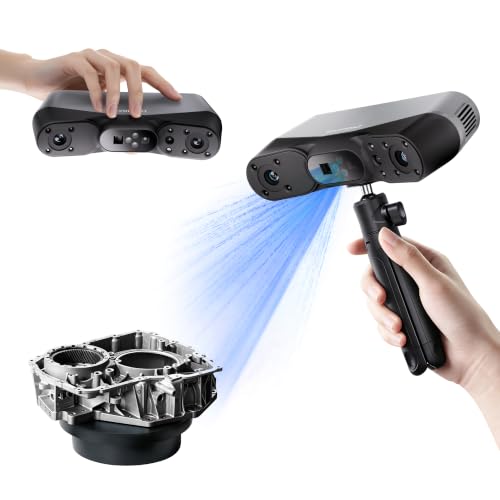
- Up to 0.03mm single-frame accuracy
- Five modes for varied surfaces and sizes
- Wi-Fi 6 with up to four hours of scanning
Best For: Professional fieldwork, reverse engineering, and precision modeling
Best Portable Value

- Dual scanning modes for large and detailed objects
- Up to 0.1 mm accuracy with 0.16 mm resolution
- Full-color capture and power-bank compatibility
Best For: Makers needing a portable, color-capable scanner
Best for Precision Work

- Blue laser scanning reaches 0.01 mm precision
- Four scanning modes cover varied surfaces
- Automated dual-axis turntable scanning
Best For: Industrial measurement and reverse-engineering workflows
Best Lightweight Detail Scanner

- 0.05 mm accuracy with 0.10 mm resolution
- AI visual tracking simplifies model capture
- Lightweight 250 g design supports portable use
Best For: Creators scanning medium objects for 3D printing
Best Outdoor-Capable Scanner

- Wireless Wi-Fi 6 scanning and streaming
- Dual scanning modes with up to 0.05 mm accuracy
- Color capture and outdoor scanning up to 20,000 lux
Best For: Outdoor scanning, reverse engineering, and detailed 3D printing
Best Beginner-Friendly Scanner
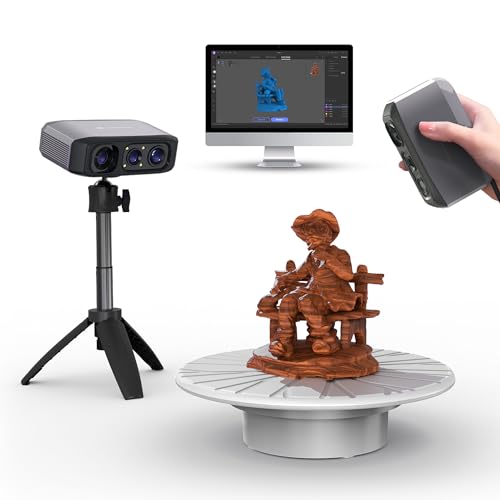
- AI visual tracking supports automated model repair
- Optical anti-shake helps steady handheld scans
- Marker-free scanning with lifetime software updates
Best For: Beginners who want a simplified handheld scanning process
Best Fast Wireless Scanner

- 30FPS scanning with up to 0.1 mm accuracy
- Wi-Fi 6 wireless transmission for compatible devices
- Full-color scanning and OBJ, STL, and PLY export
Best For: Fast mobile scanning, color capture, and flexible file workflows
Best Wireless Precision Scanner – Creality Pika
For shoppers comparing portable 3D scanners, the Creality Pika stands out as a lightweight, wireless option that combines blue-laser detail capture with NIR structured-light scanning. Its 0.03mm accuracy, marker-free wired-PC scanning, and support for objects ranging from small parts to full-body subjects make it versatile for home workshops and mobile projects.
Best For: Portable precision scanning, reverse engineering, 3D printing, and full-body projects.
Pros:
- Compact 260g design with Wi-Fi 6, a touchscreen, and dual swappable batteries.
- Up to 0.03mm accuracy and 0.1mm resolution for detailed parts and collectibles.
- Dual scanning modes cover small objects, large subjects, and full-body scans.
- AI body completion, retexturing, and hole filling simplify model cleanup.
Cons:
- The full feature set may require switching between scanning modes and supported devices.
- Its one-year warranty is shorter than some buyers may prefer for professional equipment.
The Pika is a strong choice when portability and precision matter equally. It is especially appealing for users who want wireless operation, broad size coverage, and built-in AI tools without carrying a larger scanner.
Best Entry-Level Medium-Format Scanner – 3DMakerpro Fox
The 3DMakerpro Fox is one of the more approachable portable 3D scanners for beginners and hobbyists. It pairs 0.07mm accuracy with 0.10mm resolution and uses markerless AI visual tracking to help recover a scan if the scanner moves too quickly.
Best For: Beginners, hobbyists, 3D printing, modeling, and practical object digitization.
Pros:
- Entry-level design makes medium-format 3D scanning more accessible.
- 0.07mm accuracy and 0.10mm resolution support useful detail for printing and measurement.
- Markerless AI tracking can relock onto an object without restarting the scan.
- JMStudio combines scanning, editing, and optimization in one software workflow.
Cons:
- It is less precise on paper than the 0.03mm and 0.05mm scanners in this roundup.
- The supplied notes do not specify wireless operation, battery life, or supported export formats.
Fox makes the most sense for users who want a straightforward path into handheld scanning. Its tracking and integrated software are useful conveniences, though buyers seeking advanced connectivity or maximum precision may want a higher-tier model.
Best Portable Scanner for Large Objects – Creality Otter Lite
The Creality Otter Lite Basic is a practical option among portable 3D scanners for users who need to move from tiny objects to large components. Its quad-camera design, 0.05mm accuracy, no-spray capture for dark and metallic surfaces, and 24-bit color scanning support both technical and presentation-focused work.
Best For: Scanning parts, machinery, vehicles, figurines, and other objects from 0.8 to 78 inches.
Pros:
- Quad-camera system covers both fine details and larger areas.
- Scans dark and metallic surfaces without powder or spray.
- Captures 24-bit color textures with an RGB camera and LED fill lights.
- Supports marker, geometry, and texture alignment plus several export formats.
Cons:
- The optional Scan Bridge handle costs extra.
- Its 30fps rate is lower than the fastest scanners in this roundup.
- Outdoor operation is specified for up to 30,000 lux, below some competing models.
Otter Lite is a well-rounded choice for buyers who value size flexibility and surface compatibility. It is particularly compelling for reverse engineering and larger scans, while its color capture adds value for figurines, artwork, and product displays.
Best Premium All-Weather Scanner – Revopoint POP 4
The Revopoint POP 4 is a premium pick for shoppers who need portable 3D scanners with broad scanning modes and strong outdoor capability. It offers up to 0.03mm single-frame accuracy, laser and structured-light modes, AI object segmentation, and wireless scanning through Wi-Fi 6.
Best For: Precision modeling, fieldwork, reverse engineering, and users scanning varied object sizes and surfaces.
Pros:
- Up to 0.03mm single-frame accuracy with multiple scanning modes.
- Supports objects from 10mm to 2m, including dark and highly reflective surfaces.
- High frame rates and point capture support faster scanning workflows.
- Wi-Fi 6 and a 5500mAh battery grip provide wireless operation for up to four hours.
Cons:
- AI object segmentation is limited to Windows according to the supplied notes.
- Its premium feature set may be more than casual hobbyists need.
- Some advanced capabilities depend on the appropriate scanning mode and conditions.
POP 4 is the strongest fit for demanding users who want one scanner for small precision parts, larger objects, and outdoor work. Its combination of accuracy, mode flexibility, wireless operation, and AI processing makes it a capable premium option.
Best Portable Value – Creality CR-Scan Ferret
For shoppers comparing portable 3D scanners, the Creality CR-Scan Ferret offers a practical handheld design with dual scanning modes, full-color capture, and flexible power options. Its wide-range mode handles larger coverage, while high-accuracy mode reaches up to 0.1 mm precision and 0.16 mm resolution for more detailed work.
Best For: Hobbyists and makers who want a lightweight scanner for 3D printing, color capture, and on-the-go scanning with a compatible Android device or computer.
Pros:
- Dual modes support both larger objects and fine-detail scans.
- ASIC processing enables up to 30 FPS point-cloud capture and smoother tracking.
- Built-in RGB camera captures full-color textures.
- Can be powered by a 5V power bank for portable use.
Cons:
- Mobile scanning is limited to compatible Android devices; iOS support depends on the Ferret Pro model.
- Requires relatively modern hardware and at least 8GB RAM for Windows, macOS, or Android use.
The Ferret is a flexible entry point for portable 3D scanning, especially if you value color models and simple handheld operation. Check device compatibility carefully before buying.
Best for Precision Work – Revopoint MetroX Pro
Among portable 3D scanners, the Revopoint MetroX Pro stands out for precision-focused workflows. Its blue laser and structured-light modes are designed to capture detailed geometry, including shiny, dark, flat, and feature-rich surfaces, while multiple tracking options support inspection and reverse-engineering tasks.
Best For: Industrial measurement, precision modeling, prototyping, reverse engineering, and users who need automated turntable scanning.
Pros:
- Reaches up to 0.01 mm single-frame precision and 0.02 mm single-frame accuracy.
- Multiple laser and structured-light modes suit varied surfaces and object types.
- Cross-line and parallel-line modes can scan shiny or dark surfaces without scanning spray.
- Dual-axis turntable supports one-click automated scanning.
Cons:
- At 14.82 pounds, the package is substantially less travel-friendly than lightweight handheld options.
- Revo Design and Revo Measure are paid separately and support Windows only.
The MetroX Pro is the most measurement-oriented choice in this group. Its precision and scanning modes are compelling for technical work, but the larger package and Windows-focused paid software may matter to mobile or budget-conscious buyers.
Best Lightweight Detail Scanner – 3DMakerpro Moose Lite
The 3DMakerpro Moose Lite Premium Kit is a lightweight option for shoppers seeking portable 3D scanners with detailed output. Blue-light scanning provides up to 0.05 mm accuracy and 0.10 mm resolution, while AI visual tracking and integrated JMStudio software are designed to simplify capture, editing, and optimization.
Best For: Creators and 3D-printing users scanning medium-sized objects across Android, iOS, Windows, or macOS systems.
Pros:
- Up to 0.05 mm accuracy and 0.10 mm resolution preserve fine details.
- AI visual tracking and point-cloud processing help create refined models.
- Supports scan ranges from 15 mm to 1,500 mm.
- Lightweight, quiet design weighs about 250 g.
Cons:
- Its 10 FPS scanning speed is lower than faster scanner options.
- The supplied notes identify it for medium objects, so it may be less suitable for very large subjects.
Moose Lite balances portability, quiet operation, and strong stated accuracy. It is a sensible fit for detail-conscious makers who want broad device compatibility without carrying a heavier industrial scanner.
Best Outdoor-Capable Scanner – Revopoint INSPIRE 2
The Revopoint INSPIRE 2 is one of the more versatile portable 3d scanners for users who need wireless operation, color capture, and reliable scanning across varied surfaces. Its lightweight 190 g design, dual scanning modes, and outdoor capability make it suitable for mobile scanning, 3D printing, and detailed modeling.
Best For: Outdoor scanning, reverse engineering, 3D printing, and users who want color texture capture.
Pros:
- Built-in Wi-Fi 6 supports wireless mobile scanning and interactive PC-to-mobile streaming.
- Dual infrared structured-light and multi-line laser modes handle different object sizes and materials.
- Offers accuracy up to 0.05 mm and precision up to 0.03 mm, with a high-precision calibration board.
- Captures full-color textures and can scan in outdoor lighting up to 20,000 lux.
Cons:
- Revo Design scan-to-CAD software is sold separately and supports Windows only.
- Listed computer requirements include relatively powerful hardware, such as an Intel i7 13th Gen or Ryzen 7 5800 system with 16 GB of RAM.
The INSPIRE 2 stands out when portability and feature flexibility matter more than a basic entry-level workflow. Its included calibration board, filters, tripod, and turntable help users get started, while optical zoom and dual scanning modes add control for detailed projects.
Best Beginner-Friendly Scanner – 3DMakerpro Moose Lite Premium
The 3DMakerpro Moose Lite Premium is a handheld option among portable 3d scanners, designed to make scanning easier for beginners. AI visual tracking, optical anti-shake hardware, marker-free scanning, and the ability to resume interrupted scans simplify the process for users who want less setup.
Best For: Beginners seeking marker-free scanning and a forgiving handheld workflow.
Pros:
- AI Visual Tracking can detect vulnerabilities and support automated 3D model repair.
- Optical anti-shake modules help compensate for unsteady hand movements.
- Marker-free technology reduces preparation time before scanning.
- JMStudio includes lifetime free over-the-air software upgrades.
Cons:
- The supplied notes do not specify outdoor-lighting performance or file-export formats.
- Its listed package weight is 3.65 pounds, which may be less convenient for extended handheld use than a lighter scanner.
Moose Lite Premium focuses on reducing the friction that can make handheld scanning difficult. Anti-shake assistance, scan resumption, and marker-free operation make it a practical choice for newcomers, though buyers wanting detailed outdoor or export specifications should verify those requirements before purchasing.
Best Fast Wireless Scanner – Creality CR-Scan Ferret Pro
The Creality CR-Scan Ferret Pro is a practical pick among portable 3d scanners for users who value fast capture and wireless mobility. It combines 30FPS scanning, Wi-Fi 6 transmission, anti-shake tracking, full-color scanning, and support for iOS, Android, Mac, and Windows workflows.
Best For: Fast mobile scanning, full-color models, and users who want wireless support with compatible phones.
Pros:
- Scans at up to 30FPS with up to 0.1 mm accuracy and 0.16 mm resolution.
- Wi-Fi 6 transmission provides higher bandwidth than Wi-Fi 5 for a smoother wireless workflow.
- Supports outdoor scanning in ambient light up to 30,000 lux.
- Exports OBJ, STL, and PLY files for 3D printing, design, and reverse engineering.
Cons:
- Optimal results require avoiding highly reflective, transparent, or extremely dark surfaces.
- Wireless scanning on phones requires compatible devices, including iPhone 11 or newer and Android 10 or newer.
- The scanner weighs 2.81 pounds according to the supplied details.
The Ferret Pro is well suited to users who want a quick, flexible scanning workflow across mobile devices and computers. Its format support and outdoor rating add practical versatility, while anti-shake tracking can make handheld scanning more approachable.
How We Picked These Portable 3d Scanners
We focused on scanners suited to real-world handheld use, prioritizing published accuracy, scanning speed, tracking technology, supported object sizes, connectivity, software compatibility, and intended user level. We also considered whether a scanner is designed primarily for 3D printing, reverse engineering, color capture, outdoor work, or more demanding inspection tasks.
Specifications can vary by scan mode and conditions, so treat accuracy claims as a useful comparison point rather than a guarantee. Surface texture, lighting, operator movement, calibration, and post-processing all affect the final mesh.
Quick Comparison
| Best For | Look For | Models In This Roundup |
|---|---|---|
| Entry-level 3D printing | Simple software, flexible tracking, reasonable price | 3DMakerpro Fox, Revopoint INSPIRE 2 |
| Portable everyday scanning | Lightweight design, fast capture, phone or computer support | Creality CR-Scan Ferret, Moose Lite |
| Wireless use | Wi-Fi connectivity and stable handheld tracking | CR-Scan Ferret Pro |
| Fine detail and precision | Higher claimed accuracy and structured-light or laser modes | Creality Pika, Revopoint MetroX Pro |
| Color scanning | Integrated color cameras and full-color workflows | Creality Otter Lite, CR-Scan Ferret |
Key Buying Factors for Portable 3d Scanners
Accuracy and Resolution
Accuracy describes how closely captured measurements represent the object, while resolution affects how much surface detail the scanner can distinguish. For basic replacement parts and hobby projects, moderate accuracy may be sufficient. Choose a higher-precision model for fitted components, engineering references, or detailed prototypes.
Tracking and Scan Range
Reliable tracking helps prevent alignment errors as you move around an object. Check whether the scanner uses markers, geometry, texture, infrared sensing, structured light, or laser scanning. Also match the scanner’s recommended object size to your projects; a model optimized for medium objects may be inconvenient for very small parts or full-body scans.
Lighting, Color, and Surface Handling
Dark, reflective, transparent, or textureless surfaces can challenge many scanners. Some products offer color capture, improved tracking, or modes designed for difficult surfaces, while others may require scanning spray or added markers. Outdoor scanning capability is useful, but bright sunlight can still affect projected light and tracking.
Software and Connectivity
Confirm compatibility with your Windows, macOS, Android, or iOS setup before buying. Wireless bridges and phone support improve portability, while desktop software may provide stronger editing and export tools. Check supported file formats and whether the workflow fits your preferred CAD, mesh-editing, or slicing software.
Who Should Buy Which Portable 3d Scanners?
Choose an entry-level model if you are learning 3D scanning, creating printable replicas, or want a lower-cost introduction. Choose a compact wireless scanner if you expect to scan away from a desk or use a phone-based workflow. Choose a color-capable model for props, art, digital archives, or applications where appearance matters as much as shape.
Choose a higher-precision laser or structured-light scanner for reverse engineering, detailed mechanical parts, and more demanding dimensional work. If you regularly scan outdoors, prioritize a model that explicitly supports outdoor use and consider how its software handles changing light. Finally, budget for calibration, a stable scanning technique, and post-processing time—those factors can influence results as much as the scanner itself.