
Choosing the right portable light meter makes it easier to verify whether a workspace, growing area, display, or photography setup has the illumination it needs. The models in this roundup cover common features such as broad lux ranges, rotating sensors, backlit displays, and compact handheld designs.
Use the guide below to compare practical differences before buying, including measurement range, sensor positioning, display readability, and the type of lighting checks each meter handles best.
Best 10 Portable Light Meters Picks for 2026
Best Compact Value
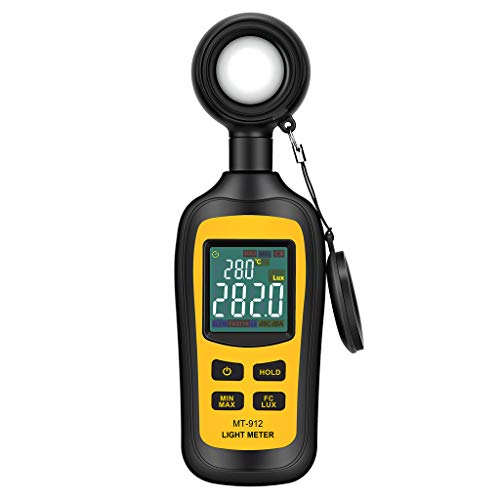
- Measures up to 200,000 lux
- Includes temperature, MIN/MAX, and data hold
- Compact body with a 2-year warranty
Best For: General-purpose home, office, factory, and set measurements
Best Wide-Range Option
BTMETER BT-881D Rotating-Sensor Meter
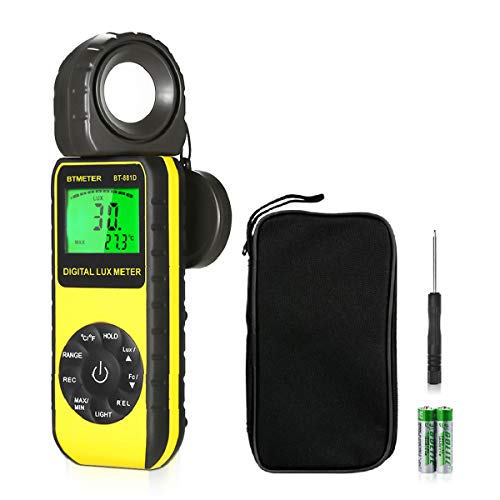
- Covers up to 400,000 lux
- 270-degree rotating sensor
- Stores 33 reading sets
Best For: Broad-range testing and repeated light comparisons
Best Display Features

- Backlit 2.25-inch display
- Measures light, temperature, and humidity
- Includes rotating probe, case, and batteries
Best For: Plants, LEDs, headlights, and general indoor measurements
Best Simple Professional Pick

- Measures up to 199,900 lux
- Backlit display with 0.5-second sampling
- Compact design with MAX/MIN and data hold
Best For: Routine studio, office, household, and agriculture checks
Best for Easy Setup
S8608 200,000-Lux Digital Light Meter

- Measures up to 200,000 lux
- LUX/FC conversion with MAX/MIN and hold
- Backlit display; three AAA batteries included
Best For: General indoor, outdoor, plant, and photography light checks
Fast-Reading Pick
Dr.meter 0-200,000-Lux Illuminance Meter

- Samples readings twice per second
- FC/LUX conversion and PEAK recording
- 9V battery and low-battery alert included
Best For: Plant, workplace, sunlight, and brief high-intensity light measurements
Feature-Rich Compact
POROMETISTO LT01 Handheld Light Meter

- 0-200,000 lux with stated incandescent-lamp accuracy
- Backlit digital and analog bar-graph display
- Hold, MAX/MIN, auto-off, accessories, and two-year warranty
Best For: Grow lights, photography, warehouse, office, and outdoor lamp checks
Best Wide-Range Value
Mcbazel Digital Illuminance Light Meter

- Measures up to 200,000 lux
- Lux and foot-candle modes
- Backlit display with hold and min/max
Best For: General brightness checks, plants, and photography
Best Rotating-Sensor Design

- 360-degree rotating sensor
- Four lux ranges up to 200,000
- Includes two AAA batteries
Best For: Measurements requiring flexible sensor positioning
Best for Plants and Photography
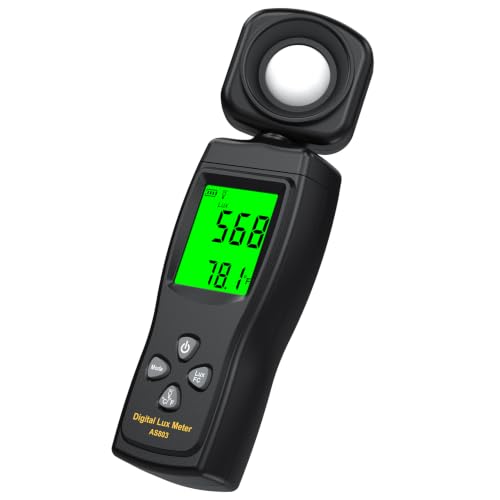
- 0–200,000 lux measurement range
- 180-degree rotating sensor
- Adds temperature and rapid sampling
Best For: Plant monitoring and photography lighting setups
Best Compact Value – Handheld 200,000-Lux Meter
For shoppers comparing portable light meters, this compact handheld model offers a practical combination of broad measurement range, basic logging controls, and ambient temperature measurement. Its lightweight design and simple display make it suitable for routine checks around a home, office, factory, or set.
Best For: General-purpose light measurements where portability, a 200,000-lux range, and straightforward controls matter.
Pros:
- Measures illumination from 0 to 200,000 lux.
- Includes MIN/MAX readings and data hold.
- Measures ambient temperature and has a color LCD screen.
- Compact 6.7-ounce design with a 2-year warranty.
Cons:
- Requires three AAA batteries.
- Accuracy varies by measurement range, from ±3% plus 8 digits below 10,000 lux to ±4% plus 10 digits above it.
This is a well-rounded choice for everyday illuminance checks rather than specialized field logging. The combination of portability, temperature measurement, and useful hold and maximum/minimum functions makes it easy to use across several environments.
Best Wide-Range Option – BTMETER BT-881D Rotating-Sensor Meter
Among portable light meters, the BTMETER BT-881D stands out for its exceptionally wide 0.01-to-400,000-lux measurement range and fast sampling. Its 270-degree rotating sensor helps you position the probe without turning the entire meter, which is useful when measuring lights from awkward angles.
Best For: Users who need a very broad measurement range, quick readings, and stored measurement sets for comparisons.
Pros:
- Measures from 0.01 to 400,000 lux and 0.01 to 40,000 foot-candles.
- Samples two to three times per second for a 0.4-second response.
- 270-degree rotating sensor simplifies measurements from different angles.
- Stores 33 sets of readings and includes a relative measuring mode.
Cons:
- The listed accuracy is ±4% for lower readings and ±5% plus 10 digits at higher ranges.
- Its dimensions are larger than some compact light-meter options.
The BT-881D is a strong fit for comparing lighting conditions across plants, offices, schools, and indoor or outdoor installations. Its rotating probe and memory functions add practical flexibility for repeated measurements.
Best Display Features – TopTes TS-710 Light Meter
The TopTes TS-710 is one of the more feature-rich portable light meters for checking plants, LEDs, headlights, and general indoor lighting. It combines a 180-degree rotating probe with a large backlit display, fast 0.5-second sampling, and included AAA batteries.
Best For: Plant, home, office, workshop, and vehicle-lighting checks where display visibility and extra environmental readings are helpful.
Pros:
- Measures 0.1 to 200,000 lux and 0.1 to 20,000 foot-candles.
- Large 2.25-inch backlit LCD and 180-degree rotating sensor improve usability.
- Measures ambient temperature and humidity in addition to light.
- Includes MAX/MIN recording, data hold, soft case, and three AAA batteries.
Cons:
- The temperature sensor adapts to new environments over time.
- Auto shut-off occurs after 10 minutes of inactivity.
Choose the TS-710 if you want more than a basic lux reading. Its backlit screen, rotating probe, environmental measurements, and included accessories make it especially convenient for frequent checks in changing conditions.
Best Simple Professional Pick – UNI-T UT383 Lux Meter
For buyers seeking portable light meters with a compact professional-style design, the UNI-T UT383 provides lux and foot-candle readings in a straightforward format. It offers a backlit four-digit LCD, 0.5-second sampling, and practical controls for holding or checking maximum and minimum values.
Best For: Photography, studios, offices, agriculture, household checks, and other routine illuminance measurements.
Pros:
- Measures from 0 to 199,900 lux and 0 to 18,500 foot-candles.
- Provides lux or foot-candle readings with 0.5-second sampling.
- Includes backlight, MAX/MIN, data hold, overload indication, and low-battery warning.
- Compact 5-ounce body with automatic shutdown for power saving.
Cons:
- Its maximum lux range is lower than the 400,000-lux BTMETER option.
- The supplied notes specify a paper manual and downloadable e-manual rather than a carrying case.
The UT383 is a sensible everyday meter when compact size and clear, essential functions take priority. It covers a wide range of common lighting tasks while remaining easy to carry and operate.
Best for Easy Setup – S8608 200,000-Lux Digital Light Meter
If you need portable light meters for general indoor or outdoor brightness checks, the S8608 offers a broad measuring range and a large display. It measures visible brightness up to 200,000 lux and supports both LUX and FC readings.
Best For: Home, school, hospital, factory, airport, plant, and photography lighting checks.
Pros:
- Measures light levels up to 200,000 lux.
- Supports LUX and FC unit conversion.
- Includes MAX/MIN, data hold, backlight, auto-off, and low-battery functions.
- Compact 4.6-ounce design with three AAA batteries included.
Cons:
- The supplied notes do not specify a stated accuracy rating.
- Requires three AAA batteries for operation.
Its wide range and practical measurement features make this a flexible choice when you want one handheld meter for everyday brightness testing across multiple settings.
Fast-Reading Pick – Dr.meter 0-200,000-Lux Illuminance Meter
Among portable light meters, the Dr.meter stands out for fast sampling and a dedicated PEAK function. Its 0-200,000-lux range, selectable FC/LUX units, and battery-powered design suit both routine lighting checks and brief high-intensity measurements.
Best For: Plant lighting, sunlight checks, offices, factories, and measuring brief light pulses.
Pros:
- Provides readings twice per second for fast response.
- Switches between FC and LUX measurements.
- PEAK mode records the highest light pulse value.
- Includes a low-battery alert and 9V battery.
Cons:
- Its 12-ounce weight is heavier than some compact handheld options.
- Uses a 9V battery rather than AAA or AA cells.
- The supplied notes do not list an accuracy specification.
The PEAK button gives this model a useful edge for capturing short, intense light events, while the broad range keeps it suitable for everyday indoor and outdoor readings.
Feature-Rich Compact – POROMETISTO LT01 Handheld Light Meter
The POROMETISTO LT01 is a practical option when portable light meters need to cover dim interiors through bright outdoor conditions. It combines a 200,000-lux range with a backlit dual display, data hold, MAX/MIN recording, and a pocket-sized handheld design.
Best For: Grow-light placement, photography studios, warehouses, offices, and outdoor lamp inspections.
Pros:
- Measures 0-200,000 lux and 0-20,000 FC with stated accuracy of ±(3% + 5 lux) under standard incandescent lamps.
- Uses a digital display and analog bar graph with two readings per second.
- Includes backlight, data hold, MAX/MIN recording, auto-off, and low-battery indicator.
- Comes with a sensor cap, lanyard, two batteries, and a two-year warranty.
Cons:
- The supplied details conflict on battery type: the feature notes say AAA, while the specifications list AA.
- Accuracy is specifically stated under standard incandescent lamps, not every light source.
With its clear backlit display, bar graph, recording modes, and included accessories, the LT01 is well suited to users who want more feedback than a basic brightness meter provides.
Best Wide-Range Value – Mcbazel Digital Illuminance Light Meter
For shoppers comparing portable light meters, the Mcbazel stands out with a broad 0–200,000 lux range and a straightforward handheld design. It supports both lux and foot-candle readings, while the backlit LCD, hold function, and min/max measurements make readings easier to capture in different settings.
Best For: Growers, photographers, hobbyists, and general indoor brightness checks that require a wide measurement range.
Pros:
- Measures illumination up to 200,000 lux.
- Switches between lux and foot-candle units.
- Includes backlight, data hold, and minimum/maximum readings.
- Automatic shutoff and low-battery indication help conserve power.
Cons:
- Requires three AAA batteries, which are not included.
- Readings below approximately 2 lux display as zero.
- Listed accuracy varies by illumination level.
The Mcbazel is a practical all-purpose option when measurement range and basic usability matter most. Its low-light threshold is worth noting if you need to measure very dim environments.
Best Rotating-Sensor Design – DANOPLUS Handheld Lux Meter
The DANOPLUS is one of the more flexible portable light meters for awkward measurement angles. Its separate 360-degree rotating sensor can be positioned toward the light source, while auto-ranging, a four-digit LCD, and selectable lux or foot-candle units simplify routine readings.
Best For: Home, office, school, hospital, and workplace measurements where sensor positioning is important.
Pros:
- Rotating sensor adjusts through 360 degrees for flexible positioning.
- Offers four lux ranges from 200 to 200,000 and a foot-candle mode.
- Provides auto-ranging, min/max, data hold, and low-battery indication.
- Two AAA batteries are included.
Cons:
- The stated accuracy is ±4% plus 10 digits.
- Measures visible light within a 400–700nm spectral range.
- Its feature set is focused on illuminance rather than additional environmental measurements.
Choose the DANOPLUS if you frequently measure light from changing directions or in confined spaces. The rotating sensor is its defining advantage, while the included batteries make it ready to use sooner.
Best for Plants and Photography – Ohcans AS803 Light Meter
Among portable light meters, the Ohcans AS803 adds useful versatility for plant care and lighting setups. It measures up to 200,000 lux, samples readings every 0.5 seconds, and combines a 180-degree rotating sensor with temperature readings in Celsius or Fahrenheit.
Best For: Growers, photographers, and users who want illuminance readings alongside basic temperature monitoring.
Pros:
- Measures from 0 to 200,000 lux with stated accuracy of ±4% plus 10.
- 180-degree rotating sensor supports flexible measurement angles.
- Backlit LCD and rapid 0.5-second sampling aid real-time monitoring.
- Also displays temperature in °C or °F and records min/max values.
Cons:
- Requires three AAA batteries, although they are included.
- The sensor rotates 180 degrees, less than a full-circle design.
- Its extra temperature feature may be unnecessary for users seeking only light readings.
The AS803 is a strong choice when you want more than a basic lux meter. Its temperature sensing and quick sampling are especially useful for plant environments and photography work, while the rotating sensor improves positioning flexibility.
How We Picked These Portable Light Meters
We selected models based on the features that matter most during real-world illumination checks: measurement range, sensor flexibility, display visibility, portability, and ease of operation. Most options measure up to 200,000 lux, making them suitable for ordinary indoor testing as well as brighter environments. We also considered rotating sensors and backlit screens because they can make readings easier when the meter is positioned awkwardly or used in dim conditions.
Because specifications and included accessories can vary by listing, confirm the current product description before purchasing. Pay particular attention to stated accuracy, battery requirements, measurement units, and whether the meter includes useful functions such as data hold, maximum readings, or automatic ranging.
Quick Comparison
| Feature | What to look for | Why it matters |
|---|---|---|
| Measurement range | Up to 200,000 lux | Provides flexibility for both indoor and brighter lighting checks |
| Sensor movement | 180°, 270°, or 360° rotation | Helps aim the sensor without twisting your wrist or repositioning the meter |
| Display | Large, backlit, or high-contrast LCD | Makes readings easier to see in poorly lit areas |
| Units | Lux and foot-candles | Useful when working with different lighting specifications |
| Portability | Handheld body and simple controls | Convenient for repeated checks across rooms or locations |
Key Buying Factors for Portable Light Meters
Range and Resolution
A wide range is useful if you expect to measure everything from offices and homes to grow lights or brightly illuminated work areas. Resolution matters when comparing small changes, so look for a meter that displays sufficiently fine increments at the levels you normally test.
Sensor Design
A rotating sensor can improve positioning, especially when measuring ceiling fixtures, shelves, workbenches, or hard-to-reach corners. A fixed sensor may be perfectly adequate for straightforward tabletop measurements and is often simpler to use.
Readability and Controls
Choose a large or backlit display if you will work in dark rooms or need to read values quickly. Straightforward buttons, data hold, maximum readings, and automatic ranging can also reduce handling time during repeated measurements.
Units and Practical Accuracy
Lux is the standard choice for many lighting checks, while foot-candles may be required by particular guides or workplace specifications. For professional calibration or compliance work, verify the manufacturer’s accuracy claims and consider whether a certified instrument is more appropriate than a general-purpose handheld meter.
Who Should Buy Which Portable Light Meters?
For general home and office checks: Choose a compact model with a clear display, automatic ranging, and a broad range. These features are usually more valuable than advanced controls.
For awkward measurement locations: Prioritize a model with a 180°, 270°, or 360° rotating sensor. Flexible positioning can make ceiling, shelf, and equipment measurements substantially easier.
For plant and grow-light testing: A meter reaching 200,000 lux offers useful headroom, but remember that lux does not directly measure every horticultural lighting metric. Use a dedicated PAR or PPFD meter when plant-light measurements require that level of precision.
For photography or lighting setup: Look for quick readings, easy-to-see controls, and data-hold functionality. A portable meter is useful for comparing locations, though dedicated photographic meters may provide more specialized exposure features.