
The right breadboard kit makes electronics experiments easier by combining a reusable prototyping board, jumper wires, components, and a convenient power source. The ten kits in this roundup cover beginner practice, Arduino-compatible projects, and more flexible multi-voltage setups.
Before choosing, consider the included component range, breadboard layout, power input, voltage options, and whether the kit matches your preferred controller or project style.
Best 10 Power Supply Electronics Breadboard Kits Picks for 2026
Most Complete Component Collection
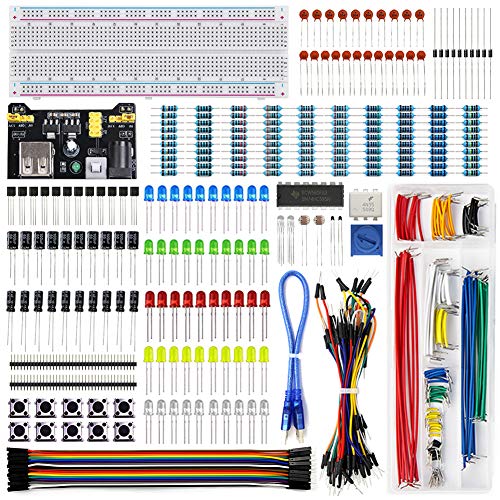
- 400+ sensors and components
- 830-point breadboard with USB power
- Labeled parts, tutorials, and storage box
Best For: Broad Arduino, Raspberry Pi, and STM32 experimentation
Best Multi-Board Setup
LONELY BINARY USB-C Breadboard Kit

- Two 830-point and two 400-point boards
- Four switchable 3.3V/5V USB-C modules
- 500mA PPTC protection and storage case
Best For: Classrooms and multi-project ESP32 prototyping
Best for Guided Experiments
ELEGOO Upgraded Electronics Fun Kit

- 300+ parts and an 830-point breadboard
- Selectable 3.3V/5V power module
- Supports varied component-learning projects
Best For: Guided Arduino-compatible electronics learning
Best Flexible Power Input

- 830- and 400-point breadboards included
- USB or 6.5–12V DC input
- Switchable 3.3V/5V output and jumper wires
Best For: General DIY prototyping with flexible power options
Most Comprehensive Component Collection
REXQualis 300+ Piece Electronics Kit

- More than 300 sensors and components
- USB breadboard power supply included
- Individually labeled parts in a sturdy box
Best For: Beginners and hobbyists needing broad component variety
Best All-in-One Starter Set
Aurevita 380-Piece Breadboard Kit

- 830-point solderless breadboard
- Selectable 3.3V/5V USB power module
- Works with Arduino, ESP32, Raspberry Pi, and STM32
Best For: Students and hobbyists starting low-voltage prototypes
Best Power-Focused Bundle
Minidodoca 9V Adapter Breadboard Kit
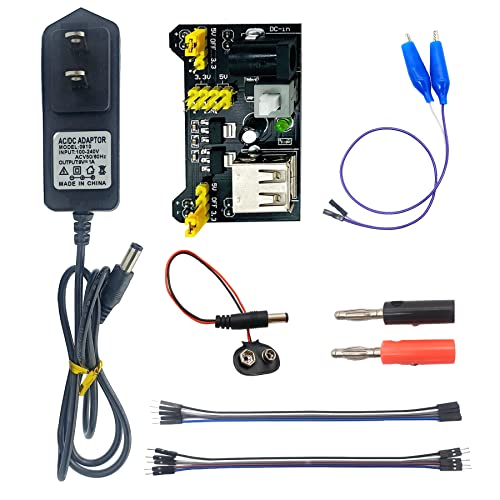
- 9V 1A adapter included
- Selectable 0V, 3.3V, and 5V outputs
- Includes test leads, banana plugs, and DuPont cables
Best For: Existing breadboard setups needing flexible power and testing
Most Complete Starter Kit
Upgraded Electronics Component Fun Kit

- 326 assorted components and an 830-point breadboard
- 3.3V/5V power module with 9V adapter
- Compatible with Raspberry Pi and STM32
Best For: Broad beginner electronics experiments
Best Simple Power Setup
HJ Garden MB-102 Breadboard Kit

- 830-point solderless breadboard included
- 5V/3.3V output with independent controls
- 12V adapter and 65 jumper wires included
Best For: Basic powered Arduino breadboard projects
Best Organized Component Set
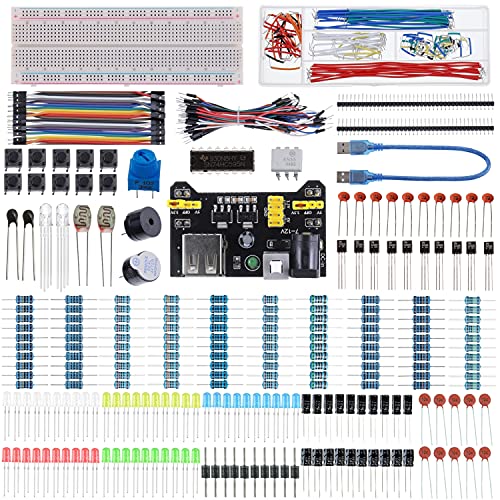
- More than 400 components across 37 values
- Labeled transparent storage box
- Includes breadboard power module and USB cable
Best For: Organized solderless learning projects
Most Complete Component Collection – REXQualis Electronics Fun Kit
For shoppers comparing power supply electronics breadboard kits, the REXQualis Electronics Component Fun Kit stands out for its broad selection of more than 400 sensors and components. It includes an 830-point breadboard, jumper wires, a breadboard power supply with USB cable, and individually labeled parts in a sturdy box.
Best For: Hobbyists and learners who want a large assortment of parts for Arduino, Raspberry Pi, STM32, and general electronics experiments.
Pros:
- Includes more than 400 sensors and electronic components.
- Parts are individually packaged, labeled, and stored in a sturdy box.
- Includes a breadboard power supply and USB power cable.
- Datasheets and tutorials are available for download.
Cons:
- Controller board is not included.
- The large assortment may be more than beginners need for a single project.
This is a strong choice when variety and organization matter most. It offers the components and breadboard power hardware for many experiments, but you will need to provide a compatible controller board separately.
Best Multi-Board Setup – LONELY BINARY USB-C Breadboard Kit
This LONELY BINARY kit is designed for flexible prototyping, combining two 830-point breadboards, two 400-point breadboards, and four USB-C power modules. Each module offers selectable 3.3V or 5V output, LED status indication, and resettable overcurrent protection.
Best For: STEM classrooms, shared workspaces, and makers who need several breadboards and power modules for ESP32, Arduino, Raspberry Pi, STM32, or Micro:bit projects.
Pros:
- Provides two full-size and two half-size breadboards.
- Four USB-C power modules support switchable 3.3V and 5V output.
- PPTC protection limits current to 500mA per module.
- Includes a storage container for organization and portability.
Cons:
- USB or another external power source is required; batteries are not included.
- This is primarily a breadboard-and-power set rather than a component assortment.
With multiple boards and power modules, this is particularly practical for simultaneous experiments or group learning. Its modern USB-C connectivity and protective features add convenience, though components and power sources must be supplied separately.
Best for Guided Experiments – ELEGOO Upgraded Electronics Fun Kit
The ELEGOO Upgraded Electronics Fun Kit combines an 830-point breadboard, 300-plus parts, jumper wires, and a selectable 3.3V/5V power module. It is geared toward hands-on projects such as LED indicators, traffic-light sequences, RGB effects, buzzers, transistor switching, and signal-isolation experiments.
Best For: Beginners and intermediate learners building repeatable Arduino-compatible circuits while studying common components and circuits.
Pros:
- Includes more than 300 parts for repeatable experiments.
- 830-point breadboard provides room for larger circuits.
- Power module supports selectable 3.3V and 5V rails.
- Includes components such as a 74HC595, 4N35 optocoupler, PN2222 transistors, and 1N4007 diodes.
Cons:
- Controller board, programming cable, and wall adapter are not included.
- The power module requires a suitable 6.5–9V DC input and must not exceed 9V.
This kit offers a useful balance of parts, breadboard space, and instructional potential. It is well suited to structured learning, provided you already have—or plan to purchase—a compatible controller and correctly rated power adapter.
Best Flexible Power Input – 830/400-Point Breadboard Kit
For basic power supply electronics breadboard kits, this option provides both 830- and 400-point breadboards, jumper wires, a battery clip, and a power module with USB or 6.5–12V DC input. The module switches between 3.3V and 5V output and supports output below 700mA.
Best For: DIY users who want a straightforward breadboard setup with multiple input options for general circuit prototyping.
Pros:
- Includes both 830-point and 400-point breadboards.
- Accepts USB or 6.5–12V DC input.
- Power module switches between 3.3V and 5V output.
- Includes jumper wires in several lengths and a battery clip.
Cons:
- Maximum output current is listed as below 700mA.
- Uses a Micro USB connector rather than USB-C.
- The notes do not indicate that a component assortment or controller board is included.
This kit is a practical foundation for general-purpose, solderless circuit work. Its mix of board sizes and flexible input options makes it convenient for DIY projects, although users seeking a large component library will need additional parts.
Most Comprehensive Component Collection – REXQualis 300+ Piece Electronics Kit
For shoppers comparing power supply electronics breadboard kits, this REXQualis set emphasizes component variety. It includes more than 300 sensors and components, a solderless breadboard power supply with USB cable, jumper wires, and individually packaged parts for organized project work.
Best For: Beginners and hobbyists who want a broad assortment of labeled components for simple electronics projects.
Pros:
- Includes more than 300 sensors and components.
- Parts such as resistors, LEDs, transistors, and integrated circuits are individually labeled and packaged.
- Includes a breadboard power supply and USB power cable.
- Datasheet availability can support component identification and learning.
Cons:
- The controller board is not included.
- The large component assortment may be more than needed for a very focused project.
This is a strong choice when variety and organized storage matter more than receiving a complete microcontroller development system. Verify the included parts against your planned project before buying.
Best All-in-One Starter Set – Aurevita 380-Piece Breadboard Kit
This Aurevita kit combines the essentials for power supply electronics breadboard kits in one beginner-friendly package. It pairs an 830-point solderless breadboard with a USB power module, jumper wires, and more than 200 electronic components for reusable prototyping.
Best For: Students, educators, and hobbyists building Arduino, ESP32, Raspberry Pi, or STM32 breadboard projects.
Pros:
- Includes an 830-point solderless breadboard with standard 2.54 mm pitch.
- Power module offers selectable 3.3V and 5V output.
- Can be powered from a laptop, USB charger, or power bank.
- Compatible with Arduino, ESP32, Raspberry Pi, and STM32 projects.
Cons:
- It is intended for USB-powered prototyping rather than a standalone mains-powered setup.
- The listed component count and selection may not cover specialized projects.
With its larger breadboard and selectable low-voltage outputs, this kit is a practical starting point for classroom experiments and general prototyping. Its two-year warranty is an added consideration for new builders.
Best Power-Focused Bundle – Minidodoca 9V Adapter Breadboard Kit
For buyers who already have components and need a practical power setup, this minidodoca bundle focuses on breadboard power and testing accessories. It includes a 9V, 1A adapter, a 3.3V/5V breadboard power module, battery clip, alligator leads, banana plugs, and DuPont cables.
Best For: Arduino, Raspberry Pi, STM32, and MB-102 breadboard users who need flexible power and test connections.
Pros:
- Includes a 9V DC, 1A adapter for devices drawing up to 1A.
- Power module provides independently controlled 0V, 3.3V, and 5V outputs.
- Includes alligator clip leads, banana plugs, battery clip, and DuPont cables.
- Supports MB-102 breadboards and common Arduino-style experiments.
Cons:
- This is primarily a power and connection bundle, not a full component starter kit.
- The power module is rated for up to 700mA output.
- Alligator clip colors may vary.
This bundle makes sense when the main requirement is powering and probing an existing breadboard setup. Its included adapter and varied test leads offer more flexibility than a power module alone, but component-heavy projects will require additional parts.
Most Complete Starter Kit – Upgraded Electronics Component Fun Kit
For shoppers seeking power supply electronics breadboard kits with a broad selection of parts, this upgraded Minidodoca set combines an 830-point breadboard, power modules, jumper wire, an adapter, and assorted components. It is designed for hands-on projects involving compatible Raspberry Pi and STM32 boards.
Best For: Beginners and experimenters who want a large, varied component collection alongside breadboard power supplies.
Pros:
- Includes 326 items, including LEDs, capacitors, resistors, transistors, diodes, buttons, a buzzer, and ICs.
- Offers 3.3V and 5V power-module outputs.
- Supports either the included 9V 1A adapter or a separately purchased 9V battery through the battery clip.
- Components are tested and divided before shipment according to the supplied notes.
Cons:
- The battery must be purchased separately.
- LEDs may require a series buck resistor to help avoid damage.
- The four-digit display is common anode, so wiring requires attention.
This is the strongest choice when variety matters as much as breadboard power. Its extensive parts list is useful for exploring many basic circuits, though beginners should follow the voltage and wiring guidance carefully.
Best Simple Power Setup – HJ Garden MB-102 Breadboard Kit
This HJ Garden kit is a straightforward option among power supply electronics breadboard kits, pairing an 830-point MB-102 solderless breadboard with a power module, 65 jumper wires, and a 12V 1A adapter. It focuses on supplying a practical foundation for Arduino, Raspberry Pi, STM32, UNO, and MEGA2560 projects.
Best For: Makers who already have electronic components and mainly need a breadboard, regulated power module, and connecting wires.
Pros:
- Includes an 830 tie-point solderless breadboard.
- Power module supports 5V and 3.3V output with two-way independent control.
- Accepts DC 6.5–12V or USB power and provides up to 700mA output.
- Includes a 12V 1A, 12W power adapter and 65 colorful jumpers.
Cons:
- Does not include the broad assortment of electronic components found in fuller starter kits.
- The power module’s listed maximum output is 700mA.
Choose this kit if your priority is a clean, basic breadboard power arrangement rather than a complete parts library. Its dual-voltage selection and independent controls make it a practical base for compatible microcontroller projects.
Best Organized Component Set – BOJACK 37-Value Fun Kit
The BOJACK kit suits shoppers looking for power supply electronics breadboard kits with a sizable parts assortment and organized storage. It includes more than 400 components, an 830-point breadboard, jumper wire, a power module, USB data cable, and a precision potentiometer for solderless experiments.
Best For: Learners and makers who value labeled component storage and a broad selection for simple electrical experiments.
Pros:
- Includes more than 400 components across 37 values.
- Components are sorted in a transparent box with clear labels.
- Includes a power module, USB cable, jumper wire, precision potentiometer, and 830-point breadboard.
- Designed for solderless breadboard use with STM32, Raspberry Pi, and Arduino.
Cons:
- The supplied information does not specify the complete list of remaining component types.
- Only a USB data cable is identified as the included power connection; an AC adapter is not specified.
This is a sensible middle ground for users who want many parts without sacrificing organization. Confirm the included component details and power arrangement if your project requires a particular adapter or specialty part.
How We Picked These Power Supply Electronics Breadboard Kits
We focused on kits that combine a solderless breadboard with a dedicated power supply module and a useful selection of components. We also considered breadboard capacity, included jumper wires, voltage outputs, power-input options, compatibility with common development boards, and the practical value of the component assortment.
Because kit contents vary widely, the best choice depends less on the highest piece count and more on whether the included parts support the circuits you plan to build. A well-organized kit with reliable power options can be more useful than a larger assortment of duplicate components.
Quick Comparison
- Best for broad beginner coverage: Choose a component fun kit with LEDs, resistors, capacitors, diodes, transistors, potentiometers, and jumper wires.
- Best for multiple workstations: Kits with two or more breadboards are useful for parallel experiments or collaborative learning.
- Best for USB-powered projects: Look for a module with USB input, especially if you will prototype with a computer, power bank, Arduino, or ESP32 setup.
- Best for flexible voltage testing: Select a power module offering selectable 3.3V and 5V rails.
- Best for beginners on a budget: An 830-point breadboard kit with basic components and jumper wires usually provides the strongest starting point.
Key Buying Factors
Breadboard Size and Layout
An 830-tie-point board gives you room for larger circuits, while 400-point boards are easier to carry and can be sufficient for simple experiments. Check whether the board has clearly marked power rails and a removable or separable design.
Power Input and Voltage Selection
USB-powered modules are convenient for desk projects, but some kits also include DC adapters, battery clips, or banana-plug and alligator-clip accessories. Confirm the connector type and input limits before connecting a supply. Selectable 3.3V and 5V outputs are particularly useful for working with both modern microcontrollers and traditional logic components.
Component Variety
Prioritize useful quantities of common resistors, LEDs, capacitors, diodes, transistors, potentiometers, and switches. Sensor-heavy kits can be valuable for Arduino or Raspberry Pi projects, but they may be less useful if your goal is to learn basic circuit behavior.
Compatibility and Organization
Check pin spacing, module fit, jumper-wire types, and stated compatibility with Arduino, ESP32, Raspberry Pi, or STM32 boards. A storage case or labeled component assortment can save time and reduce mistakes during repeated experiments.
Who Should Buy Which Power Supply Electronics Breadboard Kits?
New learners should choose a straightforward 830-point kit with a power module, jumper wires, and core components. Arduino and ESP32 users should favor USB power, 3.3V/5V selection, and sensor or module compatibility. Teachers and shared workspaces may benefit from kits containing multiple breadboards or large component assortments. Experienced hobbyists should focus on connector flexibility, dependable power delivery, and whether the kit fills gaps in an existing parts collection.
Whichever kit you choose, verify the included accessories and inspect voltage settings before powering a circuit. These precautions help prevent damaged components and make the kit more useful for long-term prototyping.