
Choosing the right bench supply can save time, protect your projects, and make troubleshooting far easier. The best programmable units give you precise control over voltage, current, and output behavior.
Below, we’ve focused on practical options for bench testing, repair work, and development setups, with an eye toward accuracy, usability, and value.
Best 10 Programmable Bench Power Supplies Picks for 2026
Programmable Precision Pick

- USB interface with Modbus support
- 4-digit readout with time display
- OVP, OCP, OPP, OTP protection
Best For: Programmable single-output bench testing with quick presets
Triple-Output Workhorse
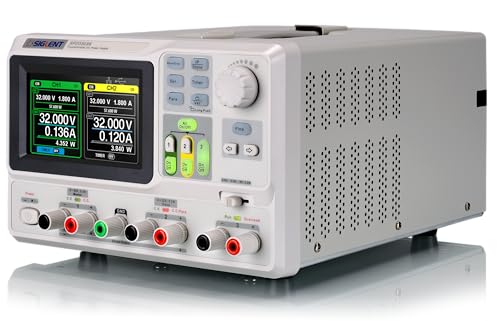
- Three independent isolated outputs
- Series, parallel, and timing modes
- 220W total power for bench use
Best For: Multi-output lab setups with flexible channel configuration
Four-Channel Lab Choice

- Four channels for flexible bench work
- 1mV/1mA resolution and high accuracy
- 328W maximum power output
Best For: Precision testing that benefits from multiple programmable channels
Compact Control Pick

- Encoder knob for precise digit adjustments
- Output enable/disable button for safer use
- 4-digit display with CV/CC modes
Best For: Compact adjustable bench use with simple, precise controls
High-Power Automated Test Pick
60V 10A Bench Supply with IPS Screen

- 0–60V, 0–10A output with 300W constant power
- USB + SCPI control for automated testing
- List mode and M1–M4 presets simplify repeat jobs
Best For: users who need automation-ready bench power with higher output headroom
Wide-Range Compact Pick
OWON SPE8205 80V 20A Programmable Supply
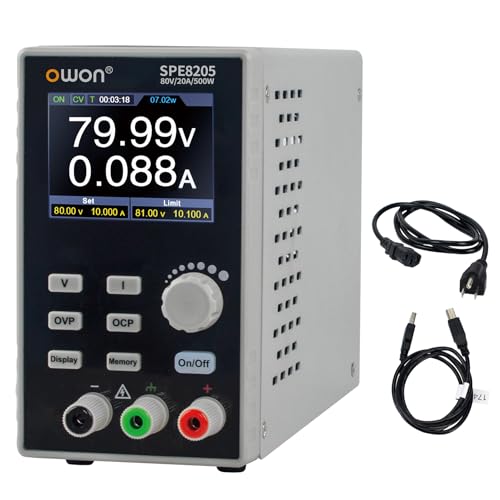
- 0–80V and 0–20A output within 500W
- LCD shows set and actual values, power, runtime, status
- USB PC control plus waveform and timing editing
Best For: buyers who want a compact supply with a broader voltage/current range
Portable Small-Bench Pick
FNIRSI DPS-150 30V 5A Programmable Supply

- 30V, 5A, 150W output in a compact body
- PC programmable with 6 preset groups
- IPS flip screen and multiple connector options
Best For: portable bench setups and lighter-duty electronic testing
High-Voltage Programming Pick
NICE-POWER 200V 1A Bench Supply

- 200V, 1A regulated output
- Windows PC control via RS232/USB
- 4 memory presets with lock button
Best For: Users needing high-voltage programmable control with stored presets
Repair-Friendly Desktop Choice
SKY TOPPOWER 32V 10A USB-C PSU

- Dual display shows set and actual output
- USB-C PC control with parameter logging
- 18W Type-C fast charging plus OCP
Best For: Phone repair and bench testing with USB-C control
Modern Lab Workhorse
SKY TOPPOWER 32V 10A Dual Display PSU

- Dual display with real-time set/actual output
- USB-C PC control and recording support
- 1mV/1mA encoder adjustment with OCP
Best For: Labs and repair benches needing precise USB-C control
Programmable Precision Pick – HANMATEK HM310T 0-30V 0-10A
If you want a programmable bench power supply with USB control and practical protection features, the HANMATEK HM310T is built for lab-style testing and repeatable setups. It offers 0-30V and 0-10A output, 4-digit readouts for voltage, current, power, and time, plus programmable sequence output and six quick-save parameter groups.
Best For: Users who want a compact programmable DC supply with PC software support, quick presets, and solid protection features.
Pros:
- Supports Modbus programming instructions and USB PC software control.
- 4-digit display shows voltage, current, power, and time with fine resolution.
- Includes OVP, OCP, OPP, OTP, and short-circuit protection.
- Front 5V/1.5A USB charging ports add extra convenience.
Cons:
- Single-output design is less flexible than multi-channel lab supplies.
- Cooling fan only engages automatically above 45°C.
Overall, the HM310T focuses on programmable control and safety in a straightforward bench format. It is a strong fit if you want dependable variable DC output with useful automation and memory features.
Triple-Output Workhorse – Siglent SPD3303X-E 220W
For buyers comparing programmable bench power supplies, the Siglent SPD3303X-E stands out with three independently controlled isolated outputs and flexible operating modes. It provides dual 32V/3.2A channels plus a selectable 2.5V/3.3V/5V output, along with independent, series, and parallel modes for more adaptable bench work.
Best For: Electronics users who need a programmable triple-output supply with timing output and mode flexibility.
Pros:
- Three isolated outputs support a wide range of test setups.
- Independent, series, and parallel modes increase versatility.
- Timing output function and trending graphs help with repeatable testing.
- 220W total power is suitable for many general lab applications.
Cons:
- Lower per-channel current than higher-amperage single-output units.
- Linear design may be bulkier than compact switching models.
The SPD3303X-E is a good choice when you need multiple outputs more than maximum current from one channel. Its strength is in flexible bench workflow rather than simple high-power delivery.
Four-Channel Lab Choice – UNI-T UDP3305S 328W
The UNI-T UDP3305S is a programmable linear DC laboratory power supply for users who want more channels and fine control in a bench power supply. With four channels, 328W total output, and 1mV/1mA resolution, it is aimed at precise work where small adjustments and accurate readings matter.
Best For: Users who need a four-channel programmable bench supply with high resolution and tight accuracy specs.
Pros:
- Four channels provide more flexibility than typical dual-output supplies.
- 1mV/1mA resolution supports precise voltage and current adjustments.
- Voltage accuracy under 0.03% + 10mV is strong for lab use.
- 328W maximum power gives it solid overall capacity.
Cons:
- Listed current output is 5A, so it is not the best fit for high-current single-load tasks.
- Details provided are lighter on usability features than some competing models.
This model makes sense if you value channel count and resolution over simple single-channel amperage. It is a capable bench option for more demanding, measurement-focused workflows.
Compact Control Pick – NANKADF 30V 10A Black
If you want a programmable bench power supply with straightforward controls, the NANKADF 30V 10A model adds an encoder adjustment knob, output enable/disable button, and a clear 4-digit LED display. It covers the essentials for variable DC use while also including USB fast charging and short-circuit alarm protection.
Best For: Buyers who want a compact adjustable bench supply with precise knob control and easy output switching.
Pros:
- Encoder knob allows digit-by-digit voltage and current adjustment.
- Output enable/disable button helps prevent accidental load damage.
- 4-digit display shows 0.01V and 0.001A precision with CV/CC modes.
- 18W USB fast-charging port adds extra utility.
Cons:
- More compact and basic than higher-end programmable lab supplies.
- Only the supplied notes mention a short-circuit alarm, with fewer advanced automation details.
This is a practical pick if you care more about easy day-to-day operation than deep programmability. It combines helpful protection, good display precision, and a simple user experience.
High-Power Automated Test Pick – 60V 10A Bench Supply with IPS Screen
If you’re comparing programmable bench power supplies for lab debugging, burn-in tests, or repeatable production checks, this 300W unit stands out for its 0–60V, 0–10A constant-power design and USB/SCPI control. The 10mV/1mA resolution, list mode, and memory presets make it easy to move from manual tuning to automated workflows without losing precision.
Best For: Bench users who want a high-power programmable supply with PC control, list-mode testing, and quick-recall presets.
Pros:
- Supports 0–60V and 0–10A output with 300W constant-power operation.
- USB control with SCPI support for automated test systems and data logging.
- List mode offers up to 10 editable steps, plus M1–M4 memory presets.
- IPS display includes real-time curve view for easier monitoring during testing.
Cons:
- Front USB auxiliary output is limited to 5V/2A or 9.5V/1A.
- Built-in controls and automation features add complexity if you only need simple manual adjustment.
Overall, this is a capable choice if you need a programmable bench power supply that can handle both everyday lab work and structured test routines. Its protection features and smart cooling also make it better suited to longer sessions than basic entry-level units.
Wide-Range Compact Pick – OWON SPE8205 80V 20A Programmable Supply
For buyers shopping programmable bench power supplies with a wide operating range, the OWON SPE8205 offers 0–80V and 0–20A output within a 500W constant-power design. Its 2.8-inch TFT LCD shows set and actual voltage/current, output power, runtime, and channel status, making it practical for monitoring dynamic test work at a glance.
Best For: Users who want a compact programmable bench supply with a wide voltage/current range and clear status monitoring.
Pros:
- Wide 0–80V, 0–20A range with up to 500W output.
- TFT LCD shows set/actual voltage, current, power, runtime, and status.
- USB port supports firmware updates and PC software control.
- Includes four shortcut memory groups plus waveform and timing output editing.
Cons:
- Package warranty is listed as only 1 month.
- At 500W, it still requires careful load planning within its rated power range.
This model makes sense if you want a space-saving programmable supply that still offers advanced control features. The added waveform editing and timing groups give it flexibility for more structured bench testing than a basic adjustable unit.
Portable Small-Bench Pick – FNIRSI DPS-150 30V 5A Programmable Supply
If you want programmable bench power supplies in a small, portable format, the FNIRSI DPS-150 is built around a 30V, 5A, 150W output with PC programmable control and preset storage. It adds a 2.8-inch IPS color screen with 90° flip support, so the output status and curve view stay readable from different bench angles.
Best For: Portable bench work where preset-based control, multiple input options, and a compact footprint matter most.
Pros:
- 30V, 5A, 150W output with 0.01V and 0.001A display resolution.
- Supports PC programmable output and 6 preset parameter groups.
- Multiple connection options include banana heads, U-shaped terminals, and fine copper wires.
- Eight safety protections help guard against overvoltage, current, short circuit, and overheating issues.
Cons:
- Lower power capacity than larger bench supplies in this roundup.
- Battery charging use calls for an added reverse-current protection module.
For smaller electronics tasks, this is a practical programmable supply with good interface flexibility and portability. It is not the highest-power choice here, but its preset control and compact size make it appealing for lighter bench setups.
High-Voltage Programming Pick – NICE-POWER 200V 1A Bench Supply
If you need programmable bench power supplies for higher-voltage work, this NICE-POWER unit is built around fine adjustment, PC control, and memory storage. It adds RS232/USB computer control, an encoder knob for precise voltage and current tuning, and an output switch that helps protect the load during setup.
Best For: Bench users who want a compact programmable supply for high-voltage testing, stored presets, and Windows PC control.
Pros:
- RS232/USB PC control with software for adjusting voltage/current and exporting data
- Encoder knob plus push-to-select digit control for precise setting changes
- 4 memory storage buttons for quickly recalling common settings
- Multiple protections including overload, overheat, and overvoltage protection
Cons:
- Software is for Windows only
- Only 1A output current, so it is not suited to higher-current loads
This is a practical pick if your priority is controlled high-voltage output and saved presets rather than raw current. The color screen, lock button, and included USB control make it especially useful for repeat bench tasks.
Repair-Friendly Desktop Choice – SKY TOPPOWER 32V 10A USB-C PSU
Among programmable bench power supplies, this 32V 10A model focuses on real-time visibility and modern USB-C PC control. The dual display shows set value and actual output side by side, while the encoder knob, OCP shortcut, and lock function support precise day-to-day bench use.
Best For: Phone repair, battery work, and bench testing where quick USB-C computer control and real-time output monitoring matter.
Pros:
- Dual display shows set value and actual output simultaneously
- USB-C PC control supports adjustment and real-time parameter logging
- One-key OCP and lock function help protect projects and settings
- Includes 18W Type-C fast charging for phones, tablets, and headphones
Cons:
- Fan cooling may be less appealing for quiet workspaces
- Best suited to moderate-voltage work up to 32V rather than high-voltage use
This supply stands out for mixed bench and charging use, especially if you want a modern USB-C connection instead of older PC interfaces. Its feature set is well matched to repair benches, DIY labs, and battery-related testing.
Modern Lab Workhorse – SKY TOPPOWER 32V 10A Dual Display PSU
If you want programmable bench power supplies with a cleaner interface and practical test features, this SKY TOPPOWER model keeps the focus on precision and workflow. It combines dual display monitoring, USB-C communication for PC control, and 1mV/1mA encoder adjustment for tight control during testing and repair.
Best For: Lab, education, and repair users who want precise adjustment, USB-C computer control, and simple overcurrent protection.
Pros:
- Dual display shows set value and actual output in real time
- USB-C communication supports PC-based adjustment and recording
- 1mV/1mA encoder control enables very fine tuning
- 18W fast-charging port adds convenience for workshop devices
Cons:
- Fan cooling is included, so it is not a silent supply
- Feature set is oriented toward bench use rather than portability
For users comparing programmable bench power supplies, this one lands in a useful middle ground: modern connectivity, fine control, and basic protection features without unnecessary complexity. It should fit well in a lab, classroom, or service bench where repeatability matters.
How We Picked These Programmable Bench Power Supplies
Our shortlist emphasizes the features that matter most in real-world use: stable output, fine adjustment steps, clear displays, useful protection features, and a control interface that won’t slow you down. We also considered output range, channel count, programmability, and whether a unit is better suited to electronics hobbyists, repair benches, or more demanding lab workflows.
Quick Comparison
When comparing Programmable Bench Power Supplies, start with the basics: maximum voltage, maximum current, and total power. Then look at resolution and accuracy, since a supply that reaches the right number but cannot hold it precisely is less useful for sensitive work. Multi-output models are helpful for mixed-voltage projects, while single-output units often offer better simplicity and value.
Key Buying Factors for Programmable Bench Power Supplies
Output Range and Power Rating
Choose a supply that comfortably exceeds your typical load requirements. Extra headroom improves flexibility and reduces the chance of running at the limit for long periods.
Resolution, Accuracy, and Regulation
Fine voltage and current resolution matters for testing modern electronics, charging batteries safely, and validating circuit behavior. Good regulation helps maintain steady output when the load changes.
Programming and Control Options
Some Programmable Bench Power Supplies offer front-panel presets, memory channels, remote PC control, or software automation. If you repeat the same tests often, these features can save significant time.
Display, Interface, and Usability
A readable display and intuitive controls make daily use much easier. Encoder knobs, output enable buttons, and clearly labeled menus are especially helpful in fast-paced bench environments.
Protection Features
Look for overcurrent, overvoltage, and thermal protections. These are essential if you work with prototypes, unknown loads, or delicate components.
Who Should Buy Which Programmable Bench Power Supplies?
If you mainly repair consumer electronics or build small circuits, a compact 30V/10A supply is often the best balance of cost and capability. If you need multi-rail testing or more advanced workflows, consider a triple-output or multi-channel model. For higher-voltage experiments, battery systems, or broader lab use, a supply with a larger voltage range and PC control is the better fit.
In short, the best choice depends on whether you value compact simplicity, multi-output flexibility, or advanced programmability. Matching the supply to your typical projects is more important than chasing the highest numbers on the spec sheet.