
Choosing the right telemetry sensor can make a big difference in how safely and efficiently your RC setup performs. The best options help you track current draw, spot power issues early, and make smarter battery and motor decisions.
In this roundup, we focus on practical, transmitter-friendly picks for pilots and drivers who want reliable live data without unnecessary complexity.
Best 10 Rc Current Telemetry Sensors Picks for 2026
ADV 100A Current Sensor
FrSky FAS100 ADV Smart Port and FBUS Sensor

- 0-100A current measurement
- Up to 14S battery voltage support
- FBUS and Smart Port compatible
Best For: FrSky builds needing a 100A-capable current and voltage sensor
Real-Time Telemetry OSD
Radiolink PRM-03 Flight Data Module

- Shows voltage, GPS, RSSI, altitude, and more
- Works with Mini Pix, PIXHAWK, Crossflight, and APM
- Very small and lightweight module
Best For: Radiolink pilots wanting detailed live flight telemetry
ADV 40A Current Sensor
FrSky FAS40 ADV Smart Port and FBUS Sensor

- 0-40A current measurement
- Up to 6S battery voltage support
- FBUS and Smart Port compatible
Best For: FrSky models needing a compact 40A telemetry sensor
RC Telemetry Sensor Set
Slash 68077-4 RPM, Temperature, and Voltage

- Includes RPM and temperature/voltage sensors
- Built for Slash 4x4 Ultimate and Rustler 4x4
- Temperature sensor rated to 120 °C
Best For: Traxxas Slash and Rustler 4x4 telemetry monitoring
Integrated Telemetry Receiver
Dual 2.4GHz Long-Range Glider Receiver with Vario
- Built-in variometer telemetry sensor
- Dual 2.4GHz with redundant SBUS
- Eight PWM outputs and OTA updates
Best For: RC gliders needing onboard altitude telemetry
Traxxas Link Sensor
Temperature and Voltage Sensor for Traxxas Link

- Shows battery voltage and temperature
- Long version with mounting screw
- Designed for Traxxas Link compatibility
Best For: Traxxas drivers needing basic temp and voltage data
GPS Telemetry Add-On
Compact Multi GPS Telemetry Sensor

- Compact GPS telemetry sensor
- ±5 meter accuracy rating
- Digital panel-mount design
Best For: Spektrum setups needing compact GPS location telemetry
FlySky Voltage Module
FS-CVT01 Voltage Sensor Module

- 0.1V measurement accuracy
- Works with FSi6/FSi10 and iA-series receivers
- For car, boat, and aircraft use
Best For: FlySky users needing basic voltage telemetry
Spektrum Aircraft Sensor
Spektrum 20-inch Voltage Sensor

- 20-inch external voltage sensor
- For electric and gas aircraft batteries
- Requires TM1000 and telemetry transmitter
Best For: Spektrum aircraft pilots with TM1000 telemetry
Spektrum 2-Pin Sensor
Spektrum SPMA9570A 2-Pin Voltage Sensor

- 2-pin aircraft telemetry sensor
- Electrical signal output
- Lightweight plastic construction
Best For: Spektrum pilots needing a 2-pin voltage sensor
ADV 100A Current Sensor – FrSky FAS100 ADV Smart Port and FBUS Sensor
If you need rc current telemetry sensors for a higher-power build, the FrSky FAS100 ADV is built for measuring battery current and voltage in setups that reach up to 100A and 14S. It supports both FrSky Smart Port and FBUS, which makes it easier to integrate with compatible receivers while keeping the wiring straightforward between the battery and ESC.
Best For: FrSky pilots who want a 100A-capable current and voltage sensor for higher-voltage RC models.
Pros:
- Measures 0-100A current and voltage up to 14S
- Supports both FBUS and Smart Port compatibility
- Uses an XT90 anti-spark connector for the power path
- Compact 65 x 23 x 18 mm design at 30 g
Cons:
- Requires receivers with FrSky Smart Port or FBUS support
- Designed for current and voltage monitoring, not broader flight data
This is a strong fit if your setup needs a sensor with more headroom than smaller current monitors can offer. The ADV protocol support is the main advantage here, especially if you want simpler pairing with a compatible receiver.
Real-Time Telemetry OSD – Radiolink PRM-03 Flight Data Module
Among rc current telemetry sensors and related telemetry add-ons, the Radiolink PRM-03 stands out for showing real-time flight data on compatible transmitters and OSD-style setups. It can report voltage, speed, climb, throttle, GPS position, RSSI, altitude, flight mode, attitude, and distance when used with supported flight controllers and receivers, making it a practical choice for pilots who want more than basic battery monitoring.
Best For: Radiolink users who want live telemetry data on transmitter screens and compatible flight controllers.
Pros:
- Reports a wide range of telemetry data including GPS, RSSI, voltage, and distance
- Works with Mini Pix, PIXHAWK, Crossflight, and APM flight controllers
- Supports Radiolink AT10II, AT10, AT9S Pro, AT9S, and AT9 transmitters
- Very small and lightweight at 1.06 x 0.51 inches and 0.21 oz
Cons:
- Depends on compatible transmitters, receivers, and flight controllers
- Not a standalone current sensor
If your priority is detailed real-time telemetry rather than just current measurement, the PRM-03 offers a lot of information in a tiny package. It is best viewed as a telemetry module for supported Radiolink and autopilot ecosystems.
ADV 40A Current Sensor – FrSky FAS40 ADV Smart Port and FBUS Sensor
If you are shopping rc current telemetry sensors for a smaller power system, the FrSky FAS40 ADV is made for measuring current and voltage in setups up to 40A and 6S. Like the larger ADV sensor, it supports both FrSky Smart Port and FBUS, so it can slot into compatible builds with less setup friction.
Best For: FrSky RC models that need a compact 40A current and voltage sensor.
Pros:
- Measures 0-40A current and voltage up to 6S
- Supports both FBUS and Smart Port protocols
- Compact 65.24 x 15.7 x 16.6 mm size
- Lightweight at 15 g
Cons:
- Limited to 40A maximum safe current
- Only compatible with receivers that support FrSky Smart Port or FBUS
This sensor makes sense for lower-current builds where you still want proper current and voltage telemetry. It keeps the installation simple while staying inside the FrSky ADV ecosystem.
RC Telemetry Sensor Set – Slash 68077-4 RPM, Temperature, and Voltage
For Traxxas owners comparing rc current telemetry sensors and similar monitoring gear, the Slash 68077-4 kit focuses on RPM, temperature, and voltage feedback for compatible 4×4 Ultimate and Rustler 4×4 setups. It is a straightforward sensor set if you want to track vehicle conditions without adding a lot of complexity.
Best For: Traxxas Slash and Rustler 4×4 owners who want RPM, temperature, and voltage telemetry.
Pros:
- Includes RPM sensor support and a temperature/voltage sensor
- Designed for Slash 4×4 Ultimate and Rustler 4×4 use
- High measurement accuracy and flange mount construction
- Temperature sensor rated up to 120 °C
Cons:
- Specific to compatible Traxxas models and related parts
- Does not provide the broad telemetry data found in OSD modules
This is a good choice if you want vehicle-specific telemetry rather than a general-purpose RC sensor. The set focuses on the essentials: RPM, temperature, and voltage.
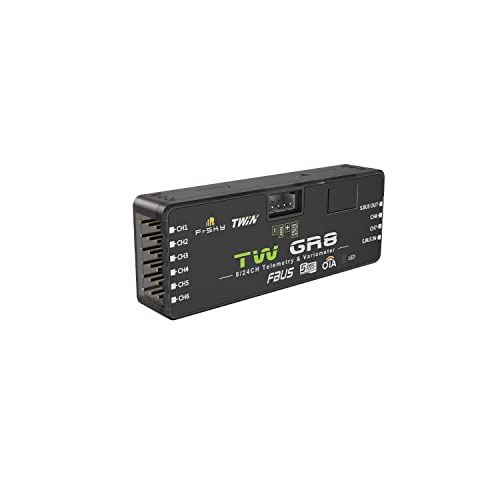
Integrated Telemetry Receiver – Dual 2.4GHz Long-Range Glider Receiver with Vario
If you want rc current telemetry sensors built into a receiver rather than added on separately, the FrSky TW GR8 is aimed squarely at long-range glider setups. It combines dual 2.4GHz control, eight PWM outputs, SBUS in/out, and a built-in variometer, so you can keep an eye on altitude and vertical speed while still running a clean, compact install.
Best For: RC gliders and telemetry-focused pilots who want an integrated receiver with built-in altitude data.
Pros:
- Built-in high-precision variometer telemetry sensor with altitude and vertical speed readouts
- Dual 2.4GHz TW mode with redundant SBUS support for added signal resilience
- Eight PWM outputs plus SBUS in/out for flexible receiver wiring
- OTA firmware updates and basic black box data recording
Cons:
- Designed around FrSky telemetry ecosystems and glider use cases
- Operating voltage range requires proper supply planning
- Telemetry features may be more than casual fixed-wing setups need
This is a strong pick if you want a receiver that does more than control channels and also serves as a telemetry hub. The integrated variometer and long-range features make it especially practical for glider pilots who value in-flight altitude awareness.
Traxxas Link Sensor – Temperature and Voltage Sensor for Traxxas Link
For rc current telemetry sensors that focus on simple health monitoring, the Traxxas 6521 sensor adds temperature and battery voltage readouts through the Traxxas Link system. It is a long-style replacement sensor with a mounting screw, making it a straightforward option if you are replacing a worn or damaged unit in a compatible Traxxas vehicle.
Best For: Traxxas owners who want basic battery voltage and temperature monitoring through Traxxas Link.
Pros:
- Displays battery voltage and temperature in the Traxxas Link system
- Long sensor version for compatible Traxxas setups
- Includes a mounting screw for replacement use
- Simple digital output and maintenance-focused design
Cons:
- Only works with the Traxxas Link ecosystem
- Single-purpose sensor with limited telemetry scope
- No additional advanced tuning or logging features listed
This sensor is best viewed as a practical replacement part rather than a broad telemetry upgrade. If you mainly need voltage and temperature data in a Traxxas-compatible setup, it covers the essentials without adding complexity.
GPS Telemetry Add-On – Compact Multi GPS Telemetry Sensor
If you are comparing rc current telemetry sensors and need location data instead of power readings, the Spektrum SPMA95871 GPS Telemetry Sensor is a compact option for compatible setups. It is a digital, panel-mount sensor with a stated accuracy of ±5 meters, which makes it useful when you want basic GPS tracking in a small package.
Best For: Spektrum users who want a compact GPS telemetry add-on for compatible models.
Pros:
- Provides GPS telemetry in a small, lightweight form factor
- Digital output for Spektrum-compatible telemetry systems
- Panel-mount design for tidy installation
- Moderate ±5 meter accuracy rating for general positioning
Cons:
- GPS data only, not a current or voltage sensor
- Requires a compatible Spektrum telemetry setup
- No extra features such as logging or multi-sensor readings are listed
This is a focused sensor for pilots who want location telemetry more than electrical monitoring. It makes sense when you need compact GPS data and already run a Spektrum system.
FlySky Voltage Module – FS-CVT01 Voltage Sensor Module
If you need a simple way to add rc current telemetry sensors-style voltage monitoring to an FPV or radio-controlled setup, the FS-CVT01 is built for straightforward pack voltage collection. It’s a compact telemetry data collection module with a stated 0.1V measurement accuracy and support for car, boat, and aircraft use.
Best For: FSi6 and FSi10 users who want a basic voltage telemetry module for RC models.
Pros:
- Designed for FSi6, FSi10, iA6B, and iA10 receiver setups
- Measures voltage with 0.1V accuracy
- Suitable for car, boat, and aircraft applications
- Compact telemetry data collection module format
Cons:
- Maximum supply voltage is limited to 6.5 volts
- Voltage monitoring only, based on the supplied product details
- May be too basic if you need more advanced telemetry data
This is a practical fit if your priority is compatible, no-frills voltage telemetry rather than a feature-heavy sensor. Its value comes from keeping battery monitoring simple for supported FlySky receiver ecosystems.
Spektrum Aircraft Sensor – Spektrum 20-inch Voltage Sensor
For rc current telemetry sensors buyers focused on battery voltage checks, this Spektrum flight pack sensor is made for electric-powered aircraft and ignition batteries in gas engine aircraft. It uses a 20-inch external lead and requires a TM1000 plus a telemetry-capable transmitter to function.
Best For: Aircraft pilots who need an external voltage sensor for Spektrum telemetry systems.
Pros:
- External 20-inch voltage sensor lead
- Works with electric flight packs and ignition batteries
- Designed for TM1000 telemetry setups
- Lightweight plastic construction
Cons:
- Requires a TM1000 and telemetry-capable transmitter
- Voltage sensing only, based on the listed product type
- Specific to aircraft telemetry applications
This is a focused sensor for Spektrum aircraft users who already have the required telemetry hardware. It makes sense when you want a dedicated external battery voltage reading rather than a general-purpose RC sensor.
Spektrum 2-Pin Sensor – Spektrum SPMA9570A 2-Pin Voltage Sensor
If you’re comparing rc current telemetry sensors for aircraft, this Spektrum 2-pin voltage sensor is a straightforward option for flight pack monitoring. The supplied details identify it as an aircraft telemetry flight pack voltage sensor with a 2-pin connection, modern plastic build, and electrical signal output.
Best For: Spektrum aircraft users who want a 2-pin flight pack voltage sensor.
Pros:
- 2-pin aircraft telemetry voltage sensor
- Electrical signal output for telemetry use
- Compact and lightweight plastic design
- Backed by a stated free-from-manufacturer-defects warranty
Cons:
- Listed for aviation use rather than general RC applications
- No batteries included or required
- Primarily a voltage sensor, not a broader telemetry module
This model is best if your setup calls for a simple Spektrum-compatible 2-pin sensor rather than a more elaborate telemetry accessory. It’s a clean, purpose-built pick for flight pack voltage monitoring.
How We Picked the Best Rc Current Telemetry Sensors
We looked for sensors and telemetry modules that balance accuracy, compatibility, and ease of installation. Priority went to products that support common RC ecosystems, provide useful real-time data, and fit a range of use cases from airplanes and gliders to cars and FPV-style builds.
Because not every telemetry accessory measures current directly, we favored options that either provide current telemetry or sit alongside power-monitoring workflows in a way that meaningfully helps with voltage, power, and system health tracking.
Quick Comparison
For high-current aircraft and larger power systems, choose a dedicated current sensor with enough amperage headroom. For radio ecosystems that value broader telemetry, modules with voltage, GPS, RSSI, temperature, or redundant receiver support can be a better fit if your setup needs more than amperage alone. For surface RC, sensor bundles that track temperature and RPM may be more useful than a pure current sensor.
Key Buying Factors for Rc Current Telemetry Sensors
Current Rating and Headroom
Match the sensor to your maximum expected draw, then add margin. A sensor near its limit can reduce measurement reliability and may not suit upgrades later.
Receiver and Transmitter Compatibility
Check whether your system uses Smart Port, FBUS, S.Port, SBUS, or a brand-specific telemetry protocol. Compatibility matters more than raw specs if you want plug-and-play installation.
Data You Actually Need
If your main goal is battery safety and efficiency, current and voltage are the priority. If you also fly long-range or need system diagnostics, GPS, RSSI, temperature, and distance can be just as valuable.
Installation and Wiring
Look for sensors that fit your power lead size, battery connector style, and available space. Clean routing and secure connectors reduce noise, voltage drop, and installation mistakes.
Application Type
Aircraft, gliders, cars, and FPV rigs place different demands on telemetry. Airborne setups often benefit from lighter, more integrated modules, while surface vehicles may prioritize durability and environmental sensing.
Who Should Buy Which Rc Current Telemetry Sensors?
If you run a high-power aircraft or large multirotor, a dedicated current sensor with generous amperage capacity is the safest starting point. If you want a broader telemetry picture, choose a module that adds voltage, GPS, and link-quality data alongside power monitoring. Surface RC users should focus on sensors that support temperature and speed-related feedback, since those metrics are often more actionable than current alone.
For hobbyists building a mixed fleet, the most versatile choice is usually the sensor that matches your transmitter ecosystem first, then gives you the specific telemetry data you’ll actually use every session.