
Resin printing can produce exceptionally detailed miniatures, models, prototypes, and display pieces, but the right printer makes the learning curve far more manageable.
We compared 10 resin printers for beginners across resolution, build volume, ease-of-use features, sensors, speed, and overall value to help you choose a practical first machine.
Best 10 Resin Printers for Beginners Picks for 2026
High-Resolution Starter

- 7-inch 10K LCD with 17 × 17 μm pixels
- Beginner-friendly four-point leveling
- Power-resume printing and laser-engraved platform
Best For: Beginners prioritizing fine detail and simple setup
Large-Format Upgrade

- 10-inch 12K mono LCD for detailed models
- Large build volume for batch printing
- Wi-Fi transfer with 2.4G and 5G support
Best For: Beginners needing larger prints or higher productivity
Efficient Detail Pick

- 7-inch 10K LCD with 17 × 17 μm pixels
- 1.5-second single-layer exposure times
- Pre-tested design with power-resume support
Best For: Users wanting detailed prints and an efficient workflow
Lowest-Setup Choice
ELEGOO Mars 5 Resin 3D Printer
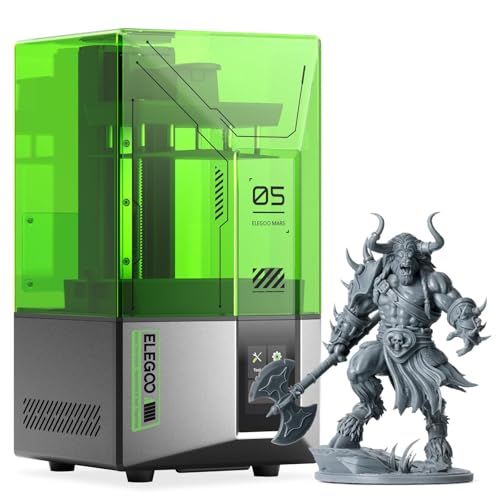
- One-click automatic leveling
- Self-check and residue-detection features
- 4K mono LCD with overheating protection
Best For: First-time users seeking guided setup and safeguards
Best High-Resolution Pick

- 10K LCD with 17×17μm pixels
- Self-check functions simplify operation
- Up to 120mm/h with high-speed resin
Best For: Beginners who want highly detailed models
Best Easy-Start Pick

- Automatic leveling for simpler setup
- Sensors monitor common printing issues
- 4K monochrome LCD with 35×35μm XY resolution
Best For: First-time users who want guided setup
Best Advanced Large-Format Pick

- Tilt-release printing reaches up to 150mm/h
- One-touch automatic leveling
- AI camera and power-outage resume
Best For: Beginners with space for a larger automated printer
Best Beginner Speed Pick
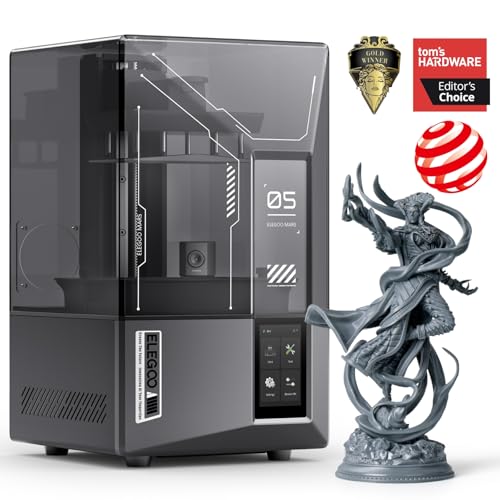
- 9K LCD with 18 μm XY resolution
- Up to 150 mm/h with tilt release
- AI camera and smart alerts
Best For: Beginners seeking fast, detailed prints with monitoring features
Best Large-Format Detail Pick

- 16K resolution for intricate models
- 30 °C smart tank heating
- Auto-leveling and AI monitoring
Best For: Beginners wanting premium detail and easier setup
Best Connected Beginner Pick

- 9K LCD with 18 μm XY resolution
- Wi-Fi file transfer and cluster printing
- One-click calibration with issue alerts
Best For: Beginners who want wireless control and automated assistance
High-Resolution Starter – ANYCUBIC Photon Mono 4
For beginners seeking detailed resin printers for beginners, the ANYCUBIC Photon Mono 4 combines a sharp 7-inch 10K screen with a straightforward four-point leveling process. Its compact build area suits everyday models while the platform is designed for dependable adhesion.
Best For: Beginners who want highly detailed prints without repeatedly leveling the printer.
Pros:
- 7-inch 10K mono LCD delivers 9024 × 5120 resolution and 17 × 17 μm pixels.
- Four-point leveling is designed to avoid repeat leveling after initial setup.
- Laser-engraved platform helps reduce lifting and warping while keeping model removal manageable.
- Power-resume functionality can reduce wasted resin after an outage.
Cons:
- Anycubic APP service is not supported.
- Its build volume is smaller than the larger Saturn 3 Ultra.
The Photon Mono 4 is a practical entry point when detail and relatively simple setup matter more than maximum print capacity or app connectivity.
Large-Format Upgrade – ELEGOO Saturn 3 Ultra 12K
The ELEGOO Saturn 3 Ultra is one of the more capable resin printers for beginners who expect to print larger models or several smaller pieces together. Its 12K screen, Wi-Fi transfer, and one-time four-point leveling make the larger machine easier to manage.
Best For: New users who need a generous build volume and want detailed, efficient batch printing.
Pros:
- 10-inch 12K mono LCD provides 11520 × 5120 resolution.
- Large 218.88 × 122.88 × 260 mm build volume supports bigger models or multiple prints.
- Wi-Fi transfer works on both 2.4G and 5G networks.
- Four-point leveling and a laser-engraved build plate simplify setup and removal.
Cons:
- At 30 pounds, it is substantially heavier than the compact options.
- Its larger footprint requires more workspace.
This is a strong choice for beginners who already know they need scale, though its size and weight make it less convenient for a small desk.
Efficient Detail Pick – ANYCUBIC Photon Mono 4
The ANYCUBIC Photon Mono 4 is a sensible option among resin printers for beginners who want fine detail and a familiar, uncomplicated workflow. Its 10K display, 1.5-second single-layer exposure time, and pre-tested assembly help shorten the path from unboxing to printing.
Best For: Novice and experienced users seeking detailed prints, stable adhesion, and efficient operation.
Pros:
- 7-inch 10K mono LCD offers 9024 × 5120 resolution and 17 × 17 μm pixels.
- LighTurbo matrix lighting is designed to reduce layer lines and rasterization.
- Single-layer exposure times can be as low as 1.5 seconds.
- Pre-assembled, calibrated, and tested before shipment, with power-resume support.
Cons:
- The build volume is moderate rather than suited to very large models.
- It still requires initial leveling before printing.
With its detailed screen and efficiency-focused features, this Photon Mono 4 is a well-rounded pick for users who want to start printing quickly without giving up resolution.
Lowest-Setup Choice – ELEGOO Mars 5 Resin 3D Printer
The ELEGOO Mars 5 stands out among resin printers for beginners because automatic leveling and one-click self-checks reduce common setup concerns. It also monitors for residue, resin shortages, and leveling problems, making it a reassuring choice for first-time users.
Best For: Beginners who value automated setup, printer checks, and protective safety features.
Pros:
- One-click automatic leveling simplifies initial calibration.
- One-click self-check helps verify component function before printing.
- Residue detection and resin-shortage alerts can help prevent failed prints and screen damage.
- 4K mono LCD with COB light source supports detailed models.
Cons:
- Its 4K screen offers less stated resolution than the 10K and 12K alternatives.
- Automatic safeguards may halt printing when overheating or detected issues occur.
The Mars 5 is especially approachable for newcomers who prefer guided setup and built-in checks over manually managing every calibration step.
Best High-Resolution Pick – Photon Mono 4 Ultra
For beginners seeking resin printers for beginners with especially fine detail, the Anycubic Photon Mono 4 Ultra combines a 10K LCD, guided self-checks, and a straightforward touchscreen interface. Its fast-printing features also help reduce waiting time as you learn the workflow.
Best For: Beginners who prioritize highly detailed models and a guided setup experience.
Pros:
- 10K resolution with 17×17μm pixels for detailed prints.
- 360° self-check functions help identify setup issues.
- Up to 120mm/h printing speed with high-speed Resin 2.0.
- 4.3-inch touchscreen supports eight languages.
Cons:
- Its 15×15×27-inch footprint may require dedicated space.
- The highest stated speed depends on high-speed Resin 2.0.
The Mono 4 Ultra is a strong choice when print detail matters most. Its self-check system and simple interface make the advanced 10K hardware more approachable for new users.
Best Easy-Start Pick – ELEGOO Mars 5
The ELEGOO Mars 5 is one of the more approachable resin printers for beginners, thanks to automatic leveling, a mechanical sensor, and a build plate designed for adhesion. It offers 4K detail and a relatively compact feature set for learning the basics.
Best For: First-time users who want automatic leveling and built-in safety checks.
Pros:
- Automatic leveling helps reduce initial setup work.
- Mechanical sensors detect low resin, foreign objects, and overheating.
- 6.6-inch 4K monochrome LCD provides 35×35μm XY resolution.
- COB lighting offers 92% light uniformity.
Cons:
- Its stated maximum speed is 70mm/h, slower than the other listed options.
- Successful printing still requires correct settings and properly supported models.
- Users need to clean the resin tank promptly after printing.
With automatic leveling and practical sensor-based alerts, the Mars 5 is a sensible starting point for new resin users. Its 4K screen provides detailed results without making setup unnecessarily complicated.
Best Advanced Large-Format Pick – ELEGOO Saturn 4 Ultra
The ELEGOO Saturn 4 Ultra gives beginners access to advanced convenience features, including one-touch automatic leveling, tilt-release printing, and AI-assisted monitoring. It is a substantial 40-pound machine, so it suits users prepared to dedicate more room to resin printing.
Best For: Beginners who want fast printing and extensive automated monitoring in a larger machine.
Pros:
- Tilt-release technology supports speeds up to 150mm/h.
- One-touch automatic leveling removes manual leveling work.
- AI camera provides failure detection and real-time monitoring.
- Power-outage resume and startup self-check add convenience.
Cons:
- At 40 pounds, it is considerably heavier than the other listed printers.
- Its 24×16×16-inch dimensions require substantial workspace.
- AI detection results can vary with the environment, model, and resin type.
The Saturn 4 Ultra is appealing if you want speed and automation from the outset. Its size and weight make it less suitable for a small desk, but the monitoring and leveling features can reduce routine setup and supervision.
Best Beginner Speed Pick – ELEGOO Mars 5 Ultra
For beginners comparing resin printers for beginners, the ELEGOO Mars 5 Ultra combines detailed 9K printing with a fast workflow and helpful monitoring features. Its tilt-release system supports speeds up to 150 mm/h, while the AI camera and smart sensors can help identify common print problems.
Best For: Beginners who want high-resolution prints, fast production, and extra automation in a compact resin printer.
Pros:
- 9K monochrome LCD delivers 18 μm XY resolution for intricate details.
- Tilt-release technology supports printing speeds up to 150 mm/h.
- AI camera, residue detection, and resin-shortage alerts provide useful monitoring.
- Wi-Fi cluster printing supports control of multiple compatible printers.
Cons:
- AI detection results may vary with the environment, model, and resin type.
- Its feature set may be more than beginners need for occasional printing.
The Mars 5 Ultra is a strong starting point for users who value speed and fine detail without giving up beginner-friendly safeguards. Its 7-inch screen and automated alerts make it a practical choice for learning resin printing.
Best Large-Format Detail Pick – ELEGOO Saturn 4 Ultra 16K
The ELEGOO Saturn 4 Ultra 16K is a compelling option for beginners who want an easy start and exceptionally fine model detail. Automatic leveling, smart tank heating, and AI monitoring simplify the process, while the larger Saturn-series design is suited to more ambitious projects.
Best For: New users who prioritize maximum detail, temperature-controlled resin, and a more capable printer for larger or more demanding projects.
Pros:
- 16K resolution is designed for smooth surfaces and highly detailed models.
- Smart tank heating maintains resin at 30 °C for better fluidity and layer adhesion.
- Auto-leveling provides a plug-and-play setup with no manual adjustment.
- AI camera, chamber light, and time-lapse features support monitoring and documentation.
Cons:
- At 35.5 pounds, it is substantially heavier than the Mars models listed here.
- The advanced feature set may be excessive for simple, occasional prints.
- AI detection results can vary based on the environment, model, and resin type.
With automatic leveling and heated resin management, the Saturn 4 Ultra removes several setup concerns that can challenge first-time users. It is the better fit when print detail and expanded capability matter more than a smaller footprint.
Best Connected Beginner Pick – ELEGOO Mars 5 Ultra 9K MSLA
The ELEGOO Mars 5 Ultra 9K MSLA is a practical choice among resin printers for beginners who want wireless file transfer and built-in assistance. Its 9K monochrome screen supports detailed models, while one-click calibration, interruption recovery, and AI monitoring help make the printing process easier to manage.
Best For: Beginners who want Wi-Fi convenience, detailed prints, and sensors that alert them to common printing issues.
Pros:
- 9K LCD and 18 μm XY resolution support detailed, lifelike models.
- Wi-Fi transfers files at 6–10 Mbps over compatible 2.4G and 5G networks.
- Smart mechanical sensor supports one-click calibration and issue alerts.
- AI camera adds real-time monitoring and time-lapse photography.
Cons:
- AI camera detection may vary depending on conditions, models, and resin.
- Wi-Fi cluster printing requires compatible printers on the same local network.
This Mars 5 Ultra is especially appealing if you prefer sending files wirelessly instead of using a USB drive. Its combination of 9K detail, automated checks, and interruption recovery gives beginners a convenient path to more consistent printing.
How We Picked the Best Resin Printers for Beginners
We focused on current MSLA resin printers from Anycubic and ELEGOO, emphasizing features that matter when you are learning rather than simply chasing the highest specification. Our comparison considers LCD resolution, usable build volume, setup and leveling demands, exposure and monitoring features, print speed, replacement-part availability, and price positioning.
Because resin printing involves liquid resin, washing, curing, and post-processing, we also gave weight to practical convenience features such as smart sensors, failure detection, reliable release mechanisms, and straightforward operating interfaces. A high-resolution screen is useful, but it is only one part of a beginner-friendly setup.
Quick Comparison
| What to Compare | Best For | What to Look For |
|---|---|---|
| Resolution | Fine details | 9K, 10K, 12K, or 16K mono LCDs |
| Build volume | Larger batches | Saturn models generally offer more room than Mars models |
| Ease of use | First-time owners | Simple leveling, sensors, guided controls, and dependable vat design |
| Speed | Frequent printing | Fast exposure systems and stable release mechanics |
| Value | Learning on a budget | Lower upfront cost plus affordable replacement parts |
Key Buying Factors for Resin Printers for Beginners
Resolution and Print Detail
Higher pixel counts can improve small lettering, facial features, and miniature surfaces, but results also depend on resin, exposure settings, orientation, and support placement. A well-tuned 9K or 10K printer can be a better first choice than an unnecessarily expensive higher-resolution model.
Build Size and Intended Projects
Compact Mars-class printers are easier to place and typically suit miniatures, tabletop parts, jewelry patterns, and small prototypes. Saturn-class machines provide a larger platform for multiple models or bigger components, but they use more resin and require more workspace.
Setup, Leveling, and Monitoring
Beginners should prioritize clear instructions and features that reduce setup mistakes. Smart mechanical sensors, automatic checks, dependable leveling systems, and failure alerts can save resin and frustration. Even with these features, confirm the build plate is secure and follow the manufacturer’s setup process.
Resin Safety and Post-Processing
Resin is not a casual desktop material. Plan for ventilation, nitrile gloves, eye protection, a covered work area, washing equipment, and a UV curing method. Keep uncured resin away from skin, children, pets, food surfaces, and drains, and follow the resin manufacturer’s disposal guidance.
Who Should Buy Which Resin Printers for Beginners?
Choose a Mars model if you want a compact, approachable printer for miniatures, small figures, and learning the resin workflow. Look toward the Mars 5 or Mars 5 Ultra range when convenience, sensors, and newer usability features are priorities.
Choose a Photon Mono 4 if you want a straightforward, high-detail entry point with a smaller footprint and strong everyday value. It is a sensible fit for hobbyists who want detailed prints without moving immediately to a larger machine.
Choose a Saturn 3 or Saturn 4 Ultra if you plan to print batches, larger models, or multiple parts at once. The larger platform can improve productivity, although you should budget for additional resin, a sturdier workspace, and more post-processing capacity.
Finally, compare the complete setup rather than the printer alone. A wash-and-cure station, spare film, replacement screen costs, compatible resin, ventilation supplies, and protective equipment can materially affect the total cost of ownership.