
Fine miniatures, tabletop figures, jewelry prototypes, and display models demand more than basic 3D printing. The right resin printer can capture small features, crisp edges, and smooth surfaces with far less visible layer texture.
Our 2026 roundup covers compact, fast, large-format, and beginner-friendly options so you can match print detail, workflow, and budget to the projects you plan to make.
Best 10 Resin Printers for Detailed Models Picks for 2026
Fast Detail Specialist
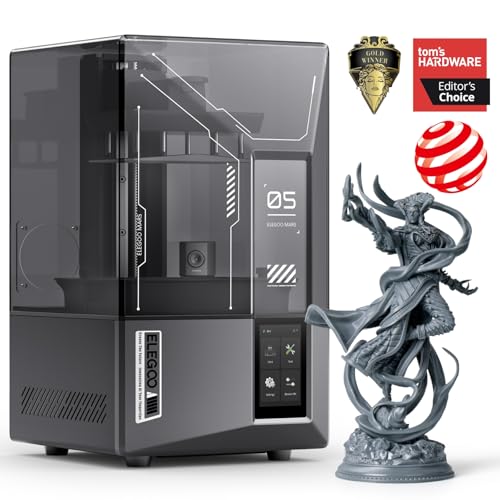
- 9K mono LCD with 18 μm XY resolution
- Up to 150 mm/h with tilt release
- AI monitoring and Wi-Fi cluster printing
Best For: Detailed models and productive multi-printer workflows
High-Resolution Speed Leader

- 14K monochrome LCD for fine detail
- Up to 170 mm/h with high-speed resin
- Temperature control and automated resin handling
Best For: Fine-detail printing with high production efficiency
Large-Format Detail Workhorse

- 16K screen with 14 × 19 μm XY resolution
- Large 8.33 × 4.66 × 8.66-inch build area
- Heated tank, AI camera, and auto-leveling
Best For: Large, intricate models and reliable repeat printing
Accessible Detail Value

- 10K LCD with 17 μm pixel size
- Compact 6.04 × 3.42 × 6.49-inch build volume
- Beginner-friendly four-point leveling
Best For: Hobbyists seeking detailed prints and simple setup
High-Resolution Bundle
Saturn 4 Ultra 16K with Mercury Plus V3.0

- 16K resin printing for detailed models
- Large build volume and 30°C tank heating
- Includes a 7.5-liter wash-and-cure station
Best For: Makers wanting high-resolution printing with post-processing equipment included
Precision Speed Pick
Reflex RS Turbo Resin 3D Printer

- High-contrast amber screen for crisp details
- Automated leveling, slicing, and defect repair
- Force sensing helps protect prints from failures
Best For: Users seeking automated, repeatable detail printing at high speed
Beginner-Friendly Detailer
UniFormation GK3T 16K Resin Printer

- 16K resolution with 14 × 19 µm pixels
- Factory pre-leveling simplifies setup
- Heating and remote monitoring support consistent use
Best For: Beginners wanting detailed prints with convenient automation
Best Detail Value

- 10K display with 17-micron pixels
- COB lighting with at least 90% uniformity
- Up to 120 mm/h with high-speed resin 2.0
Best For: Detailed hobby models and easy everyday operation
Best Automated Precision

- 14K mono LCD with 16.8 x 24.8-micron pixels
- Factory-calibrated automatic leveling
- Handles resins up to 8,000 cps
Best For: Detailed prints with reduced setup and advanced resin support
Fast Detail Specialist – ELEGOO Mars 5 Ultra
For shoppers comparing resin printers for detailed models, the ELEGOO Mars 5 Ultra combines a 9K mono LCD, 18 μm XY resolution, and a fast tilt-release system. Its AI camera and smart sensors also add practical oversight for everyday printing.
Best For: Detailed model makers who want fast printing, automated monitoring, and Wi-Fi control across multiple printers.
Pros:
- 9K resolution and 18 μm XY resolution reproduce intricate details.
- Tilt-release technology supports speeds up to 150 mm/h.
- AI camera, residue detection, and resin-shortage alerts help monitor prints.
- Wi-Fi cluster printing can control multiple Mars 5 Ultra printers.
Cons:
- AI detection results may vary with the environment, model, and resin type.
- Its feature set may be more than needed for occasional basic printing.
The Mars 5 Ultra is a strong choice when detail and productivity matter equally. Its 9K screen supports fine work, while the monitoring and networking features help streamline repeat projects.
High-Resolution Speed Leader – ANYCUBIC Photon Mono M7 PRO
The ANYCUBIC Photon Mono M7 PRO is designed for shoppers seeking resin printers for detailed models without giving up speed. Its 14K display, fine XY resolution, and temperature-managed resin system target demanding, efficient workflows.
Best For: Users who prioritize very fine detail, fast production, and automated resin handling.
Pros:
- 14K resolution and 16.8 × 24.8 μm XY resolution support highly detailed prints.
- Prints up to 170 mm/h with high-speed resin and 130 mm/h with standard resin.
- Temperature-controlled resin vat helps maintain printing conditions.
- Auto-fill, one-key recycling, and six intelligent detection functions simplify operation.
Cons:
- The highest stated speed depends on using high-speed resin.
- At 33.3 pounds, it is heavier than the Photon Mono 4.
With its unusually high resolution and extensive automation, the M7 PRO suits detail-focused users who also value throughput. The intelligent checks and resin management features can reduce hands-on intervention during longer jobs.
Large-Format Detail Workhorse – ELEGOO Saturn 4 Ultra 16K
For larger intricate projects, the ELEGOO Saturn 4 Ultra 16K stands out among resin printers for detailed models with its 16K screen and generous build area. Automatic resin heating, leveling, and monitoring are aimed at improving consistency.
Best For: Makers printing large, highly detailed models who want automatic setup and temperature support.
Pros:
- 16K resolution and 14 × 19 μm XY resolution support fine model detail.
- Build volume measures 8.33 × 4.66 × 8.66 inches for larger prints.
- Automatic heated resin tank activates below 25°C.
- AI camera, automatic leveling, Wi-Fi transfer, and power-on resume support easier operation.
Cons:
- Its 35.4-pound weight makes it less portable.
- The larger format requires more workspace than compact resin printers.
The Saturn 4 Ultra 16K is the most suitable option here for combining large prints with extremely fine resolution. Its heated tank and automated checks are especially useful when print consistency is a priority.
Accessible Detail Value – ANYCUBIC Photon Mono 4
The ANYCUBIC Photon Mono 4 offers a straightforward entry point for shoppers comparing resin printers for detailed models. Its 10K LCD, 17 μm pixel size, balanced light source, and beginner-friendly leveling system support precise everyday work.
Best For: Beginners and hobbyists who want detailed prints in a compact, easy-to-level machine.
Pros:
- 10K resolution with 17 × 17 μm pixels supports detailed models.
- LighTurbo matrix lighting helps reduce layer lines and rasterization.
- 6.04 × 3.42 × 6.49-inch build volume handles many daily projects.
- Four-point leveling and power-resume functionality simplify ownership.
Cons:
- It does not support the Anycubic app service.
- Its build volume is smaller than the Saturn 4 Ultra 16K.
The Photon Mono 4 is a practical choice for users who want high-detail output without stepping into a larger, heavier machine. Its simple leveling process and compact design make it approachable for routine hobby printing.
High-Resolution Bundle – Saturn 4 Ultra 16K with Mercury Plus V3.0
ELEGOO Saturn 4 Ultra 16K Resin 3D Printer and ELEGOO Mercury Plus V3.0 Wash and Cure Station
Check Price On AmazonFor resin printers for detailed models, this ELEGOO bundle combines a 16K Saturn 4 Ultra printer with a Mercury Plus V3.0 wash and cure station. Its large build area, heated resin tank, and fast claimed print speed make it suited to detailed models when you also want a dedicated post-processing setup.
Best For: Makers who want a high-resolution printer and wash-and-cure workflow in one purchase.
Pros:
- 16K resin printing for fine model detail.
- Large 8.33 × 4.66 × 8.66-inch printing size.
- Smart tank heating maintains resin at 30°C.
- Mercury Plus V3.0 includes a 7.5-liter capacity.
Cons:
- The bundle is larger and heavier than a printer-only setup.
- Its 150 mm/h speed is a claimed maximum rather than a guarantee for every model.
This is a practical choice if detailed output and a streamlined wash-and-cure workflow matter more than keeping the setup compact. The included station adds convenience for regular resin printing.
Precision Speed Pick – Reflex RS Turbo Resin 3D Printer
The Reflex RS Turbo is aimed at users comparing resin printers for detailed models who also want speed and process automation. Its high-contrast amber screen, precision motion hardware, defect detection, and automated leveling are designed to support crisp, consistent results.
Best For: Experienced users and production-focused makers prioritizing detail, repeatability, and automated print protection.
Pros:
- 566:1 claimed screen contrast supports sharper model details.
- One-click slicing can repair several model defects and generate supports.
- Force sensors can detect resin residue and automatically pause prints.
- C5 ball-screw Z-axis is tested for up to 2 µm repeat positioning accuracy.
Cons:
- At 50.6 pounds, it is a substantial printer to position.
- Its advanced features may be more than occasional hobbyists need.
- Performance claims depend on suitable resin and process settings.
With detailed monitoring and motion-control features, the Reflex RS Turbo stands out for users who value repeatable precision and faster workflows. It is best considered when the extra automation justifies the larger, more specialized setup.
Beginner-Friendly Detailer – UniFormation GK3T 16K Resin Printer
The UniFormation GK3T is a strong option among resin printers for detailed models when ease of use is a priority. Its 16K LCD, factory pre-leveling, resin heating, remote monitoring, and workflow-focused hardware are designed to reduce setup and day-to-day handling.
Best For: Beginners and hobbyists who want high-resolution printing with guided setup and remote monitoring.
Pros:
- 15,120 × 6,230 resolution and 14 × 19 µm pixels target fine detail.
- Factory pre-leveling supports a plug-and-play setup.
- Built-in heating supports resin fluidity in temperatures as low as 0°C.
- App and slicing-software controls provide remote monitoring and print management.
Cons:
- At 52.8 pounds, it is not especially portable.
- The all-in-one workflow still requires compatible wash-and-cure equipment for post-processing.
- The feature set and larger footprint may be unnecessary for simple projects.
The GK3T balances fine resolution with convenience-oriented features, making it appealing if you want less manual setup. Its heating and remote-control functions are particularly useful for users printing regularly in variable conditions.
Best Detail Value – Anycubic Photon Mono 4 Ultra
For shoppers comparing resin printers for detailed models, the Anycubic Photon Mono 4 Ultra combines a 10K display, a COB light source, and precision motion components in a relatively compact design. Its 17-micron pixels and stated tolerance range of +/- 0.01-0.05 mm make it well suited to models where crisp surface detail matters.
Best For: Hobbyists who want highly detailed models, straightforward operation, and faster printing with compatible high-speed resin.
Pros:
- 10K resolution with 17 x 17-micron pixels for fine detail.
- COB light source and Fresnel lens provide at least 90% light uniformity.
- ACF film and intelligent release algorithms support speeds up to 120 mm/h with high-speed resin 2.0.
- Self-check functions and a multilingual 4.3-inch touchscreen simplify operation.
Cons:
- Its build dimensions are more limited than those of a large-format printer.
- The stated 120 mm/h maximum depends on using high-speed resin 2.0.
The Mono 4 Ultra is a practical choice when detail is the priority but you still want a user-friendly machine and relatively quick print cycles. Its 7-inch screen and compact 15-inch-wide footprint make it easier to accommodate than the larger printers in this roundup.
Best Large-Format Detail – ELEGOO Jupiter 2
The ELEGOO Jupiter 2 is aimed at buyers who need both high resolution and substantial capacity. With a 302.4 x 161.98 x 300 mm build volume and 16K resolution, it is one of the most capable resin printers for detailed models when you want to print large pieces or several smaller models together.
Best For: Creators producing large models, batches of miniatures, or projects that benefit from automated resin handling and monitoring.
Pros:
- Large build volume supports bigger objects and multiple models in one job.
- 16K resolution and 20 x 26-micron XY resolution target highly detailed results.
- Auto leveling, tank heating, and automated resin replenishment reduce setup demands.
- Camera monitoring, safety sensors, Wi-Fi, and power-loss recovery add convenience.
Cons:
- At 63.8 pounds, it is substantially heavier and less portable than smaller printers.
- Its large 27.95 x 20.08 x 19.29-inch footprint requires considerable workspace.
- The feature-rich system may be more printer than casual users need.
The Jupiter 2 stands out when scale and workflow automation matter as much as fine detail. Its large enclosure and extensive safety and monitoring features make it a strong fit for serious production, provided you have enough room for the machine.
Best Automated Precision – Anycubic Photon P1
The Anycubic Photon P1 pairs a 14K mono LCD with automatic leveling and inspection features, making it a compelling option for resin printers for detailed models when consistent setup is important. Its stable ball-screw structure and precision guide rails are designed to reduce vibration while preserving fine detail.
Best For: Advanced hobbyists and creators who want crisp 14K output, automated checks, and support for high-viscosity industrial resins.
Pros:
- 14K resolution, 16.8 x 24.8-micron pixels, and a stated minimum aperture of 0.3 mm support fine features.
- Factory-calibrated Smart Leveling 3.0 removes the need for manual bed leveling.
- Wave Release Technology reduces release force by 60% according to the supplied specifications.
- Supports resins up to 8,000 cps, with resin-level and residue monitoring.
Cons:
- Its 16.93 x 24.41 x 16.54-inch dimensions require a dedicated workspace.
- At 29.7 pounds, it is less convenient to move than a compact resin printer.
- The advanced resin capability may be unnecessary for basic standard-resin projects.
The Photon P1 is a strong middle ground for users who want detailed output without giving up automation. Its 14K screen and inspection systems are especially useful for creators focused on repeatable results and more demanding resin types.
How We Picked the Best Resin Printers for Detailed Models
We focused on the features that most affect fine resin printing: LCD resolution and pixel size, exposure consistency, build volume, print speed, leveling and calibration, supported workflow features, and the availability of washing and curing equipment. We also considered whether each printer suits beginners, frequent hobby printing, or larger production runs.
Higher resolution can reveal finer features, but it is not the only measure of quality. Optics, screen uniformity, exposure settings, resin choice, support placement, and post-processing all influence the finished model.
Quick Comparison
| What to Compare | Best Fit | Why It Matters |
|---|---|---|
| Compact 8K–10K class printers | Miniatures and small parts | Sharp detail with a smaller footprint and lower material use |
| 14K–16K printers | High-detail hobby work | More screen pixels can improve tiny facial features, textures, and lettering |
| Large-format printers | Oversized models and batches | More build area reduces the need to split larger designs |
| Fast printers | Frequent printing | Shorter cycles can increase output, provided supports and exposure settings are tuned |
| Wash-and-cure bundles | Simpler workflows | Combines printing, washing, and curing equipment in one purchase |
Key Buying Factors for Resin Printers for Detailed Models
Resolution and Pixel Size
Look beyond the headline 10K, 14K, or 16K label. Pixel size, screen quality, and the printer’s optical design determine how much detail reaches the model. Smaller pixel sizes are generally preferable for tiny features, but proper exposure calibration remains essential.
Build Volume and Model Orientation
Choose enough height and platform area for your typical models, supports, and batches. A compact printer may be ideal for miniatures, while a larger machine can save time when printing multiple pieces or oversized parts. Remember that resin printers need clearance for the vat, platform, and surrounding ventilation setup.
Speed, Reliability, and Usability
Advertised speeds are usually maximum figures rather than guaranteed results for every resin. Useful convenience features include automatic leveling, sensors, stable platform mechanisms, failure detection, and a straightforward touchscreen interface. These can matter as much as raw speed when you print regularly.
Resin, Ventilation, and Post-Processing
Resin requires careful handling, adequate ventilation, gloves, and suitable cleaning supplies. Budget for washing and curing equipment, isopropyl alcohol or an appropriate cleaning solution, replacement films, and disposable materials. A wash-and-cure bundle can simplify setup, but confirm that its capacity suits the printer and your models.
Who Should Buy Which Resin Printers for Detailed Models?
Choose a compact high-resolution model if you primarily print tabletop miniatures, busts, jewelry patterns, or small mechanical parts. Choose a fast 14K-class printer if you want detailed output while reducing turnaround time for regular projects. Choose a 16K or large-format machine if you print larger figures, multiple components, or production batches and have room for the equipment.
Beginners should prioritize dependable leveling, clear controls, an active support community, and a manageable post-processing routine. Experienced users may prefer larger build volume, higher throughput, or advanced calibration options. Whichever printer you select, use the manufacturer’s recommended resin settings as a starting point and calibrate before committing to valuable or complex models.