
Choosing among resin printers for prototypes is easier when you focus on the details that affect iteration speed: resolution, build volume, release reliability, cleanup, and material compatibility.
This roundup compares 10 current options across compact, mid-size, large-format, and multi-material categories so you can match a printer to your prototype workflow and budget.
Best 10 Resin Printers for Prototypes Picks for 2026
Fast Detail Specialist
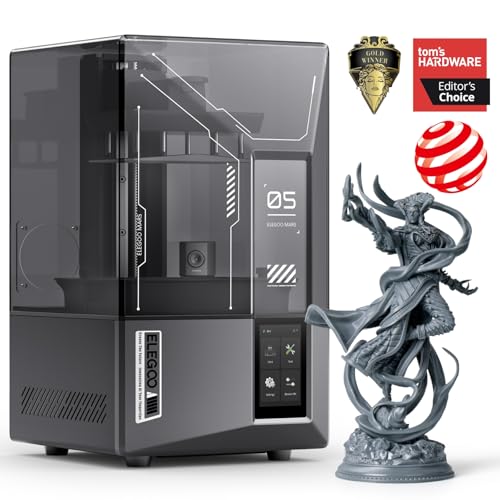
- 9K mono LCD with 18 μm XY resolution
- Up to 150 mm/h with tilt release
- AI monitoring and Wi-Fi cluster printing
Best For: Detailed prototypes and fast repeat printing
Accessible Precision Pick

- 10K mono LCD with 17 μm pixels
- 153.4 × 87 × 165 mm build volume
- Simple four-point leveling and power recovery
Best For: Beginners making detailed prototype parts
Large-Format Detail Leader

- 16K resolution for highly detailed models
- 30 °C smart tank heating
- Auto-leveling and up to 150 mm/h printing
Best For: Large, high-detail prototype workflows
Industrial Resin Specialist

- 14K mono LCD for crisp detail
- Handles resins up to 8,000 cps
- Auto-leveling and AI inspection features
Best For: Advanced users and industrial-resin prototypes
Best for Stable, Detailed Prototyping
UniFormation GK3T 16K Resin Printer

- 16K resolution with 14×19μm pixels
- Built-in heating for cooler environments
- Pre-leveled design and remote monitoring
Best For: Detailed prototypes and repeatable resin printing
Best Value for Fast Precision

- 10K resolution with 17×17μm pixels
- Up to 120mm/h with compatible high-speed resin
- Self-check functions and simple touchscreen UI
Best For: Fast, detailed small-to-medium prototypes
Best for Large Prototype Batches
ELEGOO Jupiter 2 Large 16K Printer

- 302.4 × 161.98 × 300mm build volume
- 16K resolution with enclosed light source
- Auto leveling, tank heating, and resin automation
Best For: Large parts and multi-part prototype batches
Large-Format Prototype Powerhouse

- 18.3L build volume for large parts and batch runs
- 14-inch 12K screen with 24.8μm pixels
- Heated vat and automatic leveling
Best For: Oversized prototypes and high-volume production
High-Throughput Detail Specialist

- 33 × 18.5 × 30cm printing volume
- 43μm resolution from a 15-inch 8K LCD
- Designed for fast, high-volume batches
Best For: Professional prototype studios and production batches
Flexible Dual-Material Prototyping

- Dual-color or dual-material printing
- Automatic leveling and AI monitoring
- Supports resin viscosity up to 8,000 cps
Best For: Creative prototypes using multiple colors or materials
Fast Detail Specialist – ELEGOO Mars 5 Ultra
The ELEGOO Mars 5 Ultra is a strong choice among resin printers for prototypes when you need fine detail, fast turnaround, and monitoring features. Its 9K mono LCD delivers 18 μm XY resolution, while tilt-release printing can reach speeds of up to 150 mm/h.
Best For: Detailed prototypes, small-batch parts, and users who want fast printing with automated oversight.
Pros:
- 9K resolution and 18 μm XY resolution reproduce intricate details.
- Tilt-release technology supports speeds up to 150 mm/h.
- AI camera, residue detection, resin alerts, and leveling-failure alarms help reduce wasted prints.
- Wi-Fi cluster printing supports control of multiple Mars 5 Ultra printers.
Cons:
- AI detection results may vary with the environment, model, and resin type.
- The printer weighs 19.36 pounds and has a relatively large footprint.
For prototype workflows that value speed without giving up surface detail, the Mars 5 Ultra offers a well-rounded feature set. Its monitoring and multi-printer controls are especially useful for repeat production.
Accessible Precision Pick – ANYCUBIC Photon Mono 4
The ANYCUBIC Photon Mono 4 is a practical entry point for resin printers for prototypes, combining a 10K mono LCD with a useful build volume and straightforward setup. Its four-point leveling system is designed to reduce repeated adjustments after the initial leveling.
Best For: Beginners and prototype makers who need detailed parts in a compact, easy-to-use printer.
Pros:
- 10K resolution provides 17 μm pixel size for fine model detail.
- Build volume measures 153.4 × 87 × 165 mm.
- Laser-engraved platform improves adhesion while keeping model removal manageable.
- Power-loss recovery can reduce wasted time and resin.
Cons:
- The Anycubic app is not supported for this model.
- The four-point leveling process still requires an initial manual setup.
The Photon Mono 4 makes a sensible choice when detailed prototype output and approachable operation matter more than advanced automation. Its build area is suitable for many everyday parts and design iterations.
Large-Format Detail Leader – ELEGOO Saturn 4 Ultra 16K
The ELEGOO Saturn 4 Ultra 16K is built for demanding resin printers for prototypes work where exceptional detail, stable resin conditions, and high productivity are priorities. Smart tank heating maintains resin at 30 °C, while automatic leveling and tilt-release printing simplify the workflow.
Best For: High-detail prototypes, larger models, and users running frequent or extended print jobs.
Pros:
- 16K resolution targets smooth surfaces and highly detailed models.
- Smart tank heating maintains resin at 30 °C to support fluidity and layer adhesion.
- Automatic leveling provides a plug-and-play setup.
- AI monitoring, chamber lighting, residue detection, and resin alerts support unattended workflows.
Cons:
- At 35.5 pounds, it is the heaviest printer in this selection.
- AI detection results may vary with the environment, model, and resin type.
Choose the Saturn 4 Ultra 16K when prototype quality and workflow automation justify a larger machine. Its heated tank and automatic leveling are particularly useful for consistent, repeatable printing.
Industrial Resin Specialist – ANYCUBIC Photon P1
The ANYCUBIC Photon P1 stands out among resin printers for prototypes by pairing 14K detail with automatic leveling, AI inspection, and support for high-viscosity industrial resins. Its rigid ball-screw and guide-rail structure is designed to limit vibration during printing.
Best For: Advanced creators working with specialty or industrial resins and demanding fine-detail prototypes.
Pros:
- 14K mono LCD and a 16.8 × 24.8 μm pixel size support crisp details.
- Supports resins with viscosity up to 8,000 cps.
- Factory-calibrated Smart Leveling 3.0 performs automatic checks before printing.
- AI monitoring checks build-plate installation, layer separation, resin level, and vat residue.
Cons:
- Its 29.7-pound weight and large dimensions require substantial workspace.
- The feature set may be more than needed for basic prototype printing.
The Photon P1 is the most specialized option here for prototype makers who plan to use high-viscosity materials. Its combination of mechanical stability, automated checks, and 14K resolution supports a more advanced workflow.
Best for Stable, Detailed Prototyping – UniFormation GK3T 16K Resin Printer
For resin printers for prototypes, the UniFormation GK3T stands out with 16K resolution, a heated resin system, and workflow features designed to make detailed printing more consistent. Factory pre-leveling, remote monitoring, and resin-management features make it especially practical for repeat prototype work.
Best For: Detailed prototypes, intricate models, and users who want a more automated resin-printing workflow.
Pros:
- 16K resolution with 14×19μm pixel size for fine details and smooth surfaces.
- Built-in heating supports resin fluidity in environments down to 0°C/32°F.
- Factory pre-leveling, smart resin feeding, quick-release build plate, and remote monitoring simplify operation.
- Works with compatible wash and cure stations for a streamlined post-processing workflow.
Cons:
- Its 52.8-pound weight and relatively large footprint may require dedicated workspace.
- The advanced feature set may be more than occasional hobby users need.
The GK3T is a strong choice when prototype detail and stable operation matter more than compact size. Its heating and convenience features are particularly useful for users printing regularly or in cooler conditions.
Best Value for Fast Precision – ANYCUBIC Photon Mono 4 Ultra
Among resin printers for prototypes, the ANYCUBIC Photon Mono 4 Ultra combines a 10K monochrome LCD with a COB light source and a stated maximum speed of 120mm/h. Its compact feature set suits prototype makers who want detailed results with straightforward controls and automated checks.
Best For: Detailed small-to-medium prototypes, model makers, and users prioritizing speed and simple operation.
Pros:
- 10K, 9024 × 5120 resolution and 17×17μm pixels support fine prototype detail.
- COB light source with Fresnel lens provides at least 90% light uniformity.
- ACF film and intelligent release algorithms support faster printing, up to 120mm/h with High Speed Resin 2.0.
- 360° self-check functions and an eight-language interface make setup and operation easier.
Cons:
- The notes do not specify its build volume, making capacity harder to assess for larger prototypes.
- Its speed claim depends on using High Speed Resin 2.0.
The Photon Mono 4 Ultra is a practical option for detailed prototypes when speed and user-friendly controls are priorities. Consider a larger-format printer if your projects require substantial build volume.
Best for Large Prototype Batches – ELEGOO Jupiter 2 Large 16K Printer
For resin printers for prototypes that need substantial capacity, the ELEGOO Jupiter 2 offers a 302.4 × 161.98 × 300mm build volume and 16K resolution. Its heated tank, automated resin system, monitoring camera, and safety alerts are designed for larger or repeated print jobs.
Best For: Large prototypes, multiple parts in one print, and production-style resin workflows.
Pros:
- Large build volume supports bigger objects or multiple smaller prototypes in one job.
- 16K resolution with a fully enclosed light source is designed for detailed, uniform exposure.
- Multi-point auto leveling, smart tank heating to 30°C, and automated resin supply support consistent printing.
- Camera monitoring, Wi-Fi, power-loss recovery, and resin-related safety alarms add workflow control.
Cons:
- At 63.8 pounds and nearly 28 inches wide, it requires substantial workspace.
- The large-format design may be excessive for users printing only small prototypes.
- Its feature-rich setup may involve more maintenance than a simpler resin printer.
The Jupiter 2 is the most capable choice here for scaling prototype work across a large build area. It makes the most sense when batch printing, part size, and monitoring features justify its considerable footprint.
Large-Format Prototype Powerhouse – Photon P1 Max
For resin printers for prototypes that need generous capacity, the ANYCUBIC Photon P1 Max combines an 18.3L build volume with a 14-inch 12K monochrome screen. Its heated resin tank and automatic leveling also make it practical for repeatable production in cooler workshop conditions.
Best For: Oversized prototypes and densely packed batch production.
Pros:
- Large 285.5 × 214 × 300mm build volume supports oversized parts and batch runs.
- 14-inch 12K screen with 24.8μm pixels produces fine, smooth detail.
- Heated 1900ml resin tank supports stable flow for higher-viscosity materials.
- Auto-Leveling 3.0 and C7-grade motion components simplify setup and support ±0.01mm repeat positioning.
Cons:
- Its 68.9-pound weight and large footprint require substantial workspace.
- The large-format capacity may be more than small prototype projects need.
The Photon P1 Max is a strong fit when prototype size and throughput matter most. Its automated calibration and temperature-controlled vat help reduce setup uncertainty, while the high-resolution screen preserves detail across larger builds.
High-Throughput Detail Specialist – Sonic Mega 8K S
Among resin printers for prototypes, the phrozen Sonic Mega 8K S stands out for combining a spacious 33 × 18.5 × 30cm build area with 43μm XY resolution. It is designed for professional workflows that prioritize large batches, detailed surfaces, and faster production cycles.
Best For: Professional studios producing detailed prototype batches at scale.
Pros:
- Build plate can accommodate up to 80 1/32-scale miniature models in a reported 90-minute cycle.
- 15-inch 8K monochrome LCD delivers 43μm resolution for sharp edges and complex geometries.
- ACF film and TR300 resin enable printing speeds up to 10 times faster than standard mid-size printers.
- Lift-up lid and built-in metal drip hanger improve access and resin recovery.
Cons:
- The 57.3-pound printer is substantial for smaller workspaces.
- The stated high-speed workflow relies on ACF film and TR300 resin.
The Sonic Mega 8K S makes the most sense when throughput is a core requirement. Its large platform supports batch efficiency without giving up fine detail, while the lift-up lid helps fit the machine into tighter professional work areas.
Flexible Dual-Material Prototyping – Photon P1
For resin printers for prototypes that benefit from material or color experimentation, the ANYCUBIC Photon P1 offers dual-color or dual-material printing. Automatic leveling, AI monitoring, and support for resins up to 8,000 cps add convenience for creative and professional prototype work.
Best For: Small to mid-size prototypes requiring two colors or materials.
Pros:
- Dual-color or dual-material printing expands design and material options.
- Wave Release Technology reduces plate release force by 60% for easier model removal.
- Factory-calibrated Smart Leveling 3.0 reduces manual setup work.
- AI inspection, resin-level monitoring, and residue detection help identify issues early.
Cons:
- The dual-material capability may be unnecessary for single-resin prototype workflows.
- The supplied notes do not specify the printer’s build volume or screen resolution.
The Photon P1 is a practical choice for prototyping where color separation or material variation matters. Its release assistance and monitoring features focus on improving reliability, while high-viscosity compatibility broadens the range of professional resins it can handle.
How We Picked the Best Resin Printers for Prototypes
We evaluated these models around the practical demands of prototyping rather than resolution alone. Key considerations included LCD resolution, XY detail, build volume, printing speed, auto-leveling or other setup aids, print-release design, software support, and the range of available resins. We also considered whether each printer is better suited to small precision parts, repeated batches, presentation models, or larger assemblies.
Specifications can vary by firmware, resin, and slicer settings, so treat headline resolution and speed claims as starting points. Successful prototype production still depends on exposure calibration, support placement, washing, curing, ventilation, and safe resin handling.
Quick Comparison
- Compact detail: ELEGOO Mars 5 Ultra and ANYCUBIC Photon Mono 4 are appropriate for smaller components, enclosures, fixtures, and detailed visual models.
- Mid-size production: ELEGOO Saturn 4 Ultra, ANYCUBIC Photon P1, Photon P1 Ultra, UniFormation GK3T, and the dual-color or dual-material Photon P1 offer more room for batches and larger parts.
- Large-format work: ELEGOO Jupiter 2, ANYCUBIC Photon P1 Max, and Phrozen Sonic Mega 8K are designed for substantial parts, multiple components, or production-oriented workflows.
- Specialized flexibility: The dual-color or dual-material model may suit prototypes that benefit from contrasting materials or colors, while large-volume machines prioritize throughput and part size.
Key Buying Factors for Resin Printers for Prototypes
Resolution and Surface Detail
Higher-resolution monochrome LCDs can produce crisp edges and fine text, but they do not automatically guarantee better parts. Optical uniformity, exposure tuning, resin quality, and support strategy matter just as much. Choose high detail when fit checks, small features, or presentation surfaces are important.
Build Volume and Iteration Speed
Measure your largest expected prototype, including support structures and clearance from the vat. A larger printer can reduce the number of separate jobs, but it also uses more resin and may require more workspace. For repeated small parts, a medium printer with efficient batch layouts can be more productive than an oversized machine.
Reliability and Setup
Auto-leveling, stable vat mounting, dependable release systems, and clear monitoring features can reduce failed prints and setup time. These conveniences are especially valuable for teams that need repeatable results rather than occasional hobby use.
Materials, Cleanup, and Safety
Check whether the printer supports the resins your prototype requires, such as standard, tough, flexible, engineering, or castable formulations. Plan for washing, curing, ventilation, gloves, spill control, and disposal before buying; resin printing is not a clean desktop process.
Who Should Buy Which Resin Printers for Prototypes?
Choose a compact model if you primarily print small mechanical parts, product mockups, miniatures, or fit-check components and want lower initial material use.
Choose a mid-size 14K or 16K model if you need a balance of fine detail, batch capacity, manageable footprint, and everyday usability. This category is the safest starting point for many design studios and engineering teams.
Choose a large-format printer if your prototypes are physically large, you regularly print assemblies, or reducing job count matters more than minimizing machine size. Confirm that your workspace, wash-and-cure equipment, and resin budget can support it.
Choose a multi-material or dual-color option only when that capability supports a real workflow requirement. Otherwise, a simpler single-material printer may offer easier calibration and lower operating complexity.