
Choosing among resin printers for small businesses means balancing detail, speed, build volume, maintenance, and total operating cost. The right machine can help a jewelry maker, model designer, repair shop, or product studio produce consistent parts without overbuying industrial equipment.
Our roundup compares 10 current options, including compact desktop printers, high-resolution production models, fast machines, and larger-format systems. Use the guide below to match printer capabilities with your workload, workspace, and budget.
Best 10 Resin Printers for Small Businesses Picks for 2026
Fast Detail Specialist
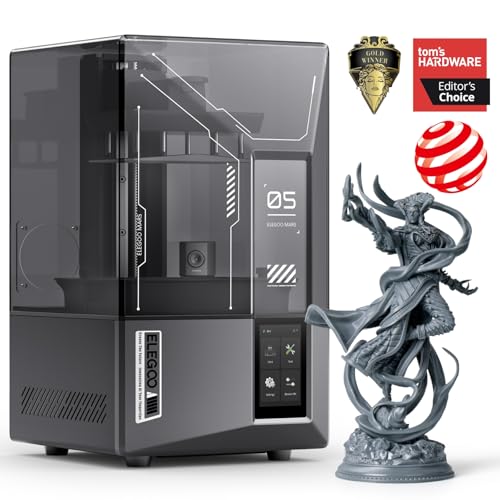
- 9K mono LCD with 18 μm XY resolution
- Up to 150 mm/h with tilt release
- AI monitoring and Wi-Fi cluster printing
Best For: Detailed, fast small-business production
High-Throughput Precision Pick

- 14K LCD with 16.8 × 24.8 μm XY resolution
- Up to 170 mm/h with high-speed resin
- Temperature control and automatic resin handling
Best For: Fast, highly detailed professional printing
Large-Format Production Choice

- 16K detail across a larger build area
- Automatic heated resin tank
- AI monitoring, auto-leveling, and cluster printing
Best For: Larger detailed models and repeatable production
Multi-Material Workflow Pick

- Dual-color and dual-material printing
- Automatic leveling and AI inspection
- Handles resins up to 8,000 cps
Best For: Creative and specialized multi-material parts
Best for High-Speed Precision
Reflex RS Turbo Resin 3D Printer

- High-contrast amber screen for detailed, faster curing
- Automated slicing, supports, and leveling
- Real-time failure detection with diagnostic reports
Best For: Small businesses prioritizing precise, repeatable production
Best for Easy 16K Workflow
UniFormation GK3T Resin 3D Printer

- 16K resolution for intricate models and prototypes
- Factory pre-leveling and smart resin handling
- Heating and remote monitoring for easier operation
Best For: Small teams seeking detailed prints with simple workflow controls
Best Compact Value for Detail

- 10K LCD with 17×17µm pixels for fine detail
- COB light source with at least 90% uniformity
- Up to 120mm/h with high-speed resin 2.0
Best For: Small businesses needing detailed desktop production and simple controls
Precision Production Pick

- 566:1 contrast ratio and ±2 μm repeat positioning claim
- One-click slicing, auto-leveling, and automated supports
- Force monitoring can pause prints and generate diagnostics
Best For: Detailed production parts and precision-focused small-business workflows
Automated Workflow Pick

- 16K mono LCD with 14 × 19 μm pixel size
- Up to 170 mm/h speed and 211.68 × 118.37 × 200 mm build volume
- Heated, RFID-enabled resin management with fixed build plate
Best For: High-resolution business printing with streamlined material handling
High-Volume Batch Pick

- 18.3-liter build volume for large parts or dense batches
- 14-inch 12K screen with 24.8 × 24.8 μm pixels
- Heated 1,900 ml tank and Auto-Leveling 3.0
Best For: Large prototypes and high-volume batch production
Fast Detail Specialist – ELEGOO Mars 5 Ultra
For small businesses seeking resin printers for small businesses, the ELEGOO Mars 5 Ultra combines detailed output, fast printing, and workflow automation in a compact desktop design. Its 9K mono LCD delivers 18 μm XY resolution, while tilt-release technology supports speeds up to 150 mm/h.
Best For: Small businesses producing detailed prototypes, models, and short production runs that benefit from fast printing and multi-printer control.
Pros:
- 9K resolution and 18 μm XY resolution reproduce fine details.
- Up to 150 mm/h printing with fast and slow modes.
- AI camera, residue detection, resin-shortage alerts, and leveling-failure alarms help monitor jobs.
- Wi-Fi cluster printing allows control of multiple printers from one device.
Cons:
- AI detection performance can vary with the environment, model, and resin type.
- Its 7-inch build interface may be less suitable for larger models than a larger-format printer.
The Mars 5 Ultra is a practical choice when detail, speed, and scalable printer management matter more than maximum build volume.
High-Throughput Precision Pick – ANYCUBIC Photon Mono M7 PRO
The ANYCUBIC Photon Mono M7 PRO is a strong option for small businesses needing resin printers for small businesses with high detail and production efficiency. Its 14K monochrome LCD supports 16.8 × 24.8 μm XY resolution, while printing speeds reach 170 mm/h with high-speed resin.
Best For: Professional users prioritizing fine detail, fast output, and reduced hands-on resin management.
Pros:
- 14K resolution can reproduce very fine features, including holes as small as 0.3 mm.
- Prints up to 170 mm/h with high-speed resin and 130 mm/h with standard resin.
- Temperature-controlled resin vat helps maintain suitable resin conditions.
- Auto-fill and one-key resin recycling simplify material handling.
Cons:
- The highest stated speed depends on high-speed resin and a 0.1 mm layer test.
- Its 33.3-pound weight and larger footprint require a dedicated workspace.
With high resolution, automated resin handling, and multiple startup checks, the M7 PRO is built for businesses that value repeatable throughput and detailed parts.
Large-Format Production Choice – ELEGOO Saturn 4 Ultra 16K
Businesses comparing resin printers for small businesses may prefer the ELEGOO Saturn 4 Ultra 16K when larger, highly detailed models are part of the workflow. Its 16K screen offers 14 × 19 μm resolution across an 8.33 × 4.66 × 8.66-inch print area, with heated resin management and up to 150 mm/h printing.
Best For: Small businesses producing larger intricate models, prototypes, or batches that benefit from high resolution and automated setup.
Pros:
- 16K resolution and a comparatively large build area support detailed larger models.
- Automatic heated resin tank helps maintain printing conditions below 25°C.
- AI camera with integrated light supports monitoring and time-lapse recording.
- Automatic leveling, startup self-checks, power-on resume, Wi-Fi transfer, and cluster printing streamline operation.
Cons:
- At 35.4 pounds, it needs a sturdy, dedicated workspace.
- The larger footprint may be excessive for businesses printing only small parts.
The Saturn 4 Ultra 16K is a capable production-oriented option when build size, detail, temperature management, and repeatable operation are priorities.
Multi-Material Workflow Pick – ANYCUBIC Photon P1
The ANYCUBIC Photon P1 stands out among resin printers for small businesses by supporting dual-color or dual-material printing. Its factory-calibrated automatic leveling, AI monitoring, and compatibility with resins up to 8,000 cps make it suited to creative and professional applications.
Best For: Businesses making creative, multi-color, multi-material, or specialized resin parts while seeking simplified setup.
Pros:
- Dual-color or dual-material printing expands design possibilities and can reduce resin use on small models.
- Wave Release Technology reduces release force by 60% for easier model removal.
- Smart Leveling 3.0 performs automatic checks and provides four-corner pressure feedback.
- Supports ultra-high-viscosity resins up to 8,000 cps, with pre-configured Anycubic resin settings.
Cons:
- At 39 pounds, it is the heaviest option in this roundup.
- Its dual-material capability may be unnecessary for single-color production workflows.
- The supplied notes do not state a print resolution or maximum print speed.
The Photon P1 is most compelling when material flexibility and reduced setup work are more valuable than headline speed or resolution specifications.
Best for High-Speed Precision – Reflex RS Turbo Resin 3D Printer
For small businesses that need resin printers for small businesses with dependable detail and faster production, the Reflex RS Turbo emphasizes precision, automated preparation, and print-failure detection. Its high-contrast amber screen, automated leveling, and process controls make it suited to repeatable professional workflows.
Best For: Small businesses producing detailed prototypes, models, and repeatable resin prints.
Pros:
- High-contrast amber screen is designed for crisp details, dimensional accuracy, and faster curing.
- One-click slicing can repair common model defects and generate supports automatically.
- Force sensors can detect resin residue, pause jobs, and provide diagnostic reports.
- C5 ball-screw Z-axis and calibrated LCD support repeatable positioning and consistent exposure.
Cons:
- At 50.6 pounds, it is relatively heavy for a desktop printer.
- The advanced process-control features may be more than occasional users need.
The Reflex RS Turbo is a strong choice when production consistency, automation, and precise motion matter more than a lightweight setup. Its professional support and diagnostic features may also help businesses reduce troubleshooting time.
Best for Easy 16K Workflow – UniFormation GK3T Resin 3D Printer
The UniFormation GK3T is one of the more approachable resin printers for small businesses, combining a 16K screen with factory pre-leveling and workflow-focused features. Smart resin handling, heating, remote monitoring, and compatibility with wash-and-cure equipment can simplify regular production.
Best For: Small teams that want highly detailed prints with a streamlined, beginner-friendly workflow.
Pros:
- 15120×6230 resolution and 14×19µm pixels are designed for fine detail and smooth surfaces.
- Factory pre-leveling, quick-release build plate, and anti-drip platform simplify setup and cleanup.
- Built-in heating supports resin fluidity in temperatures as low as 0°C/32°F.
- App and software support remote control, progress monitoring, and timelapse photography.
Cons:
- The 52.8-pound design requires a sturdy, dedicated workspace.
- Some workflow benefits depend on compatible wash-and-cure stations and software.
Choose the GK3T if ease of use and detailed output are equally important. Its pre-leveled design and temperature management can reduce routine setup issues, while remote monitoring is useful for a small business managing jobs around other work.
Best Compact Value for Detail – ANYCUBIC Photon Mono 4 Ultra
For small businesses seeking resin printers for small businesses without moving to a much larger machine, the ANYCUBIC Photon Mono 4 Ultra offers a 10K screen, COB light source, and speed-oriented release system. Its self-check features and straightforward touchscreen are useful for businesses that want detailed models with a relatively simple interface.
Best For: Small businesses making detailed models, prototypes, and small-batch parts in a compact desktop setup.
Pros:
- 7-inch 10K LCD with 17×17µm pixels is built for fine model detail.
- COB light source and Fresnel lens provide at least 90% light uniformity.
- ACF film and intelligent release algorithms support faster printing, up to 120mm/h with high-speed resin 2.0.
- 360° self-check functions and an eight-language touchscreen simplify operation.
Cons:
- Its listed features emphasize precision and convenience rather than integrated heating or remote monitoring.
- The 15 × 15 × 27-inch dimensions may require more vertical clearance than expected.
The Photon Mono 4 Ultra is a practical fit when detailed output and a user-friendly control system are priorities. Its advertised speed is tied to high-speed resin 2.0, so material choice should be part of the production planning.
Precision Production Pick – Reflex RS
For small businesses that prioritize repeatable detail and production efficiency, the Reflex RS is one of the more precision-focused resin printers for small businesses. Its high-contrast screen, industrial-style Z-axis, automated preparation tools, and print-monitoring features are designed to reduce setup and failure-related interruptions.
Best For: Small businesses producing detailed parts, prototypes, or repeat batches where precision, automation, and process monitoring matter.
Pros:
- 566:1 contrast ratio and claimed ±2 μm repeat positioning accuracy support crisp, consistent prints.
- One-click slicing can repair common model defects and generate supports automatically.
- Force sensors can detect resin residue, pause jobs, and produce diagnostic reports.
- Adaptive process packages and dynamic motion control target faster, more consistent workflows.
Cons:
- Its 50.6-pound weight and 15 × 23 × 15-inch dimensions require a sturdy, dedicated workspace.
- The feature set may be more extensive than necessary for occasional or low-volume printing.
The Reflex RS stands out when failed prints and dimensional inconsistency are costly. Its automation and monitoring tools may help a small production operation, although buyers should plan for the printer’s substantial footprint and weight.
Automated Workflow Pick – Creality Halot-X1 Combo
The Creality Halot-X1 Combo is a practical choice among resin printers for small businesses that want high resolution with material-handling automation. Its 16K screen, fixed build plate, heated resin management, and RFID-based parameter loading are aimed at making repeat jobs easier to run.
Best For: Small print shops and product teams seeking high-resolution output, faster production, and simplified resin preparation.
Pros:
- 10.1-inch 16K mono LCD offers 14 × 19 μm pixel size for highly detailed prints.
- Print speeds are listed up to 170 mm/h, with a 211.68 × 118.37 × 200 mm build volume.
- Heating, RFID parameter recognition, laser detection, and weight monitoring streamline resin management.
- The fixed build plate eliminates leveling, while dual rails and lead screws support 0.01 mm positioning precision.
Cons:
- The build volume is smaller than that of the large-format Anycubic option in this roundup.
- Its automated resin system and proprietary workflow may be more equipment than simple users need.
For businesses balancing detail, throughput, and ease of operation, the Halot-X1 Combo offers a well-integrated workflow. The automated resin features are especially useful when multiple jobs or materials need to be managed consistently.
High-Volume Batch Pick – ANYCUBIC Photon P1 Max
The ANYCUBIC Photon P1 Max is built for businesses that need to produce large parts or many smaller parts in one cycle. Its 18.3-liter build volume, heated 1,900 ml resin tank, and auto-leveling system make it a compelling large-format option among resin printers for small businesses.
Best For: Small businesses running oversized prototypes or dense batch jobs that benefit from a large build area and temperature-controlled resin.
Pros:
- 285.5 × 214 × 300 mm build volume supports large prototypes and high-volume batch production.
- 14-inch 12K monochrome screen with 24.8 × 24.8 μm pixels targets smooth, detailed surfaces.
- Temperature-controlled 1,900 ml resin tank can maintain temperatures up to 35°C.
- Auto-Leveling 3.0 includes factory calibration, self-checks, and real-time force feedback.
Cons:
- Its 20.08 × 20.87 × 29.53-inch dimensions require significant workspace.
- At 68.9 pounds, it is less convenient to move than a compact desktop printer.
- The large resin capacity may be excessive for occasional or small-format jobs.
The Photon P1 Max makes the most sense when per-cycle capacity is a business priority. It combines a large working area with heated resin management and automated leveling, but its size and weight call for a permanent workshop location.
How We Picked These Resin Printers for Small Businesses
We focused on features that matter in real small-business workflows: resolution, print speed, build volume, ease of setup, reliability, automation, material compatibility, and likely maintenance demands. The selection includes compact machines for limited workspaces, high-resolution printers for detailed models, and larger systems for batch production.
Marketing specifications can vary by material, layer height, exposure settings, and test conditions, so treat advertised speed as a ceiling rather than a guaranteed everyday result. Consistent output, dependable leveling, effective software, and accessible replacement parts are often more valuable than a single headline specification.
Quick Comparison
Compact printers such as the ELEGOO Mars 5 Ultra and Anycubic Photon Mono 4 Ultra suit businesses producing small, highly detailed pieces. Larger models, including the ELEGOO Saturn 4 Ultra, Creality Halot-X1 Combo, and Anycubic Photon P1 Max, are better for batch printing or bigger parts.
For advanced resolution, consider 14K or 16K models such as the Anycubic Photon Mono M7 PRO, ELEGOO Saturn 4 Ultra, UniFormation GK3T, or Creality Halot-X1 Combo. The Anycubic Photon P1 adds dual-color or dual-material capability, while Reflex and other industrial-leaning options may appeal to buyers prioritizing precision and production stability.
Key Buying Factors for Resin Printers for Small Businesses
Build Volume and Throughput
Estimate how many parts you need per week and their typical dimensions. A larger build plate can reduce the number of print runs, but it also increases resin use, cleaning time, and the space needed around the printer. For small batches, a compact printer may deliver better value.
Resolution and Surface Detail
Higher pixel counts can improve fine features, text, and miniature surfaces, but resin quality, calibration, orientation, and post-processing also affect results. Choose high resolution when detail directly influences what customers will pay for.
Speed, Reliability, and Automation
Fast printing is useful only when failed prints do not erase the time savings. Look for dependable leveling, exposure controls, monitoring features, and stable slicing software. Automated functions can reduce training time and operator mistakes.
Total Cost and Workspace Needs
Budget for resin, release film, build plates, gloves, washing and curing equipment, ventilation, cleaning supplies, and replacement screens or vats. Resin printers require safe handling and adequate ventilation, particularly in customer-facing or shared workspaces.
Who Should Buy Which Resin Printers for Small Businesses?
Choose a compact 10K model for prototypes, miniatures, dental or jewelry-style detail work, and businesses with limited bench space. Move to a 14K or 16K printer when intricate features and premium surface quality are central to your products. Select a larger-format machine when batch production, taller parts, or fewer print cycles matter most.
Businesses experimenting with multi-color or multi-material workflows should consider the Anycubic Photon P1. Buyers seeking production-focused precision may prefer a Reflex or UniFormation model, provided its ecosystem and support meet their needs. Before ordering, confirm local power requirements, software compatibility, resin support, ventilation arrangements, and the availability of consumables.