
Robot building kits for hobbyists can turn an afternoon project into a genuinely rewarding hands-on build. Whether you want coding practice, mechanical assembly, or a fun remote-control project, the best kits blend challenge with clear instructions and room to grow.
In this roundup, we focus on kits that offer strong value, engaging features, and the right mix of electronics, engineering, and playability for beginners through more experienced builders.
Best 10 Robot Building Kits for Hobbyists Picks for 2026
FPV Smart Beginner Pick
ELEGOO UNO R3 Robot Car Kit V4

- Guided assembly with keyed connectors and illustrated instructions
- FPV camera, line tracking, obstacle avoidance, and app/IR control
- Arduino IDE support for custom coding and experiments
Best For: Beginners and families wanting a guided robot car kit with sensors and coding
Hands-On Mechanical Build

- No-solder wooden build with motors, board, and wiring
- Introduces circuits, motion control, and engineering concepts
- Challenging assembly with a precise tutorial
Best For: Builders who want a mechanical STEM project focused on arms, movement, and problem solving
Tracked FPV Explorer
ELEGOO Conqueror Robot Tank Kit
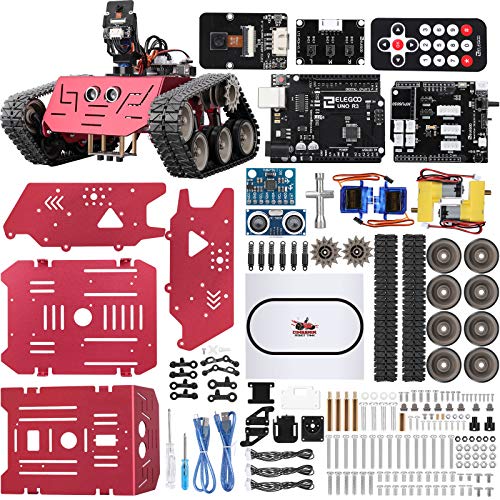
- Stainless-steel tracked chassis with suspension and camera
- Five modes including FPV, obstacle avoidance, line tracking, and auto follow
- Visual programming plus Arduino IDE customization
Best For: Hobbyists who want a rugged tracked robot with navigation modes and coding progression
Open-Source Arm Builder

- Arduino-compatible open-source robot arm platform
- Supports app control, knob control, and sensor expansion
- Includes tutorials and secondary development examples
Best For: Advanced makers who want an expandable Arduino robot arm
3-in-1 Build & Rebuild Set
3-in-1 STEM Robot Building Kit
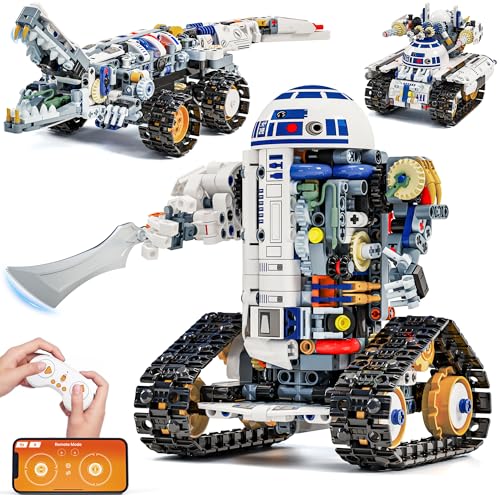
- 3 build options in one kit
- Remote and Bluetooth app control
- Rechargeable battery with up to 45 minutes of play
Best For: Rebuildable STEM play for ages 8+
Modular 4-in-1 Bot

- 4 build styles from one kit
- 5DOF programmable arm with ESP32
- App and IR remote control
Best For: Older kids and teens who want a versatile coding build
Top Pick for Versatile Builds
6-in-1 STEM Robot Kit with App Control

- 6 build options in one 780-piece kit
- Remote and app control with coding modes
- Rechargeable battery and detailed instructions
Best For: Kids who want one kit with multiple robot builds and app control
Best Value RC Set

- 5 build modes with 408 pieces
- Remote and Bluetooth app control
- Easy storage and simple programming
Best For: Families wanting a smaller STEM robot kit with multiple modes
Best Compact Builder
STEM Robot Kit with 3-in-1 Play

- 3 models from 388 pieces
- Includes remote, motor, and rechargeable battery
- Compatible with most standard bricks
Best For: Kids who want a simpler robot kit with expansion potential
FPV Smart Beginner Pick – ELEGOO UNO R3 Robot Car Kit V4
If you’re comparing robot building kits for hobbyists, this ELEGOO robot car is a strong entry point because it blends assembly, coding, and hands-on driving in one guided project. It adds FPV camera viewing, line tracking, obstacle avoidance, and app or IR control, so the finished build has plenty to explore after the first assembly is done.
Best For: Beginners, families, and students who want a guided robot car project with coding and sensor features.
Pros:
- Illustrated tutorial and keyed connectors help reduce wiring mistakes.
- Includes FPV video, line tracking, obstacle avoidance, and auto-follow style driving modes.
- Supports Arduino IDE programming for custom routes and experiments.
- Comes with rechargeable battery and major electronics parts needed for the build.
Cons:
- Recommended for ages 8+ with adult guidance for first-time builders.
- More of a robot car project than a general robotics platform.
- Some features depend on app, camera, and sensor setup.
This is a practical choice if you want a beginner-friendly kit that still leaves room to grow into real coding and robotics experimentation. The combination of guided assembly and expandable software makes it especially useful for STEM learning at home or in clubs.
Hands-On Mechanical Build – DIY Robot Arm Kit
Among robot building kits for hobbyists, this wooden robot arm stands out as a hands-on mechanical project with a clear educational angle. It combines motors, a PCB microcontroller board, and wiring into a no-solder build that introduces circuits, mechanical movement, and problem solving in a compact format.
Best For: Kids, teens, and adults who want a challenging wooden robotics build focused on mechanics and basic circuits.
Pros:
- No soldering required, making assembly more approachable.
- Teaches circuits, mechanical movement, physics, and engineering principles.
- Wooden pieces and precise tutorial create a satisfying build challenge.
- Designed as a giftable STEM project for a wide age range.
Cons:
- Requires 6 AA batteries, which are not included.
- Less advanced in software and coding than Arduino-based kits.
- Assembly may feel demanding for younger or impatient builders.
This kit is a good fit if you want a tactile engineering project rather than a programming-heavy robot. It should appeal to hobbyists who enjoy construction, motion, and the payoff of a working mechanical arm.
Tracked FPV Explorer – ELEGOO Conqueror Robot Tank Kit
If you want robot building kits for hobbyists with a more rugged feel, this tracked tank-style build offers a strong mix of assembly and driving modes. It combines a stainless-steel chassis, camera streaming, sensor-based navigation, and both app and Arduino-based control for a project that can grow with your skills.
Best For: Builders who want a tracked robot with FPV, navigation modes, and room to learn block coding and Arduino.
Pros:
- Metal tracked chassis with suspension gives it a more substantial build.
- Five interactive modes include FPV driving, obstacle avoidance, line tracking, and auto follow.
- Starts with visual programming and can move into Arduino IDE customization.
- Includes camera, sensors, motors, servos, battery, tools, and instructions in one kit.
Cons:
- Recommended for ages 10+, so it is not the easiest beginner option.
- Heavier and larger than simpler robot car kits.
- May be more involved than casual hobbyists want for a first build.
This is a good pick if you want a more advanced rover-style project with lots of play value after assembly. The tracked platform and mixed coding path make it especially appealing for hobbyists who like both building and experimentation.
Open-Source Arm Builder – miniArm 5DOF Smart Robot Arm
For hobbyists searching for robot building kits that lean into programming and secondary development, the miniArm is a compact open-source robot arm built on the Atmega328 platform. It supports Arduino programming, includes tutorials and examples, and leaves room for sensor expansion and control experiments beyond the basic assembly.
Best For: Advanced hobbyists and adult makers who want an open-source robotic arm for Arduino programming and expansion.
Pros:
- Open-source programs and tutorials make it easier to customize.
- Compatible with Arduino programming on the Atmega328 platform.
- Supports app control and knob-based real-time/manual operation.
- Offers expansion ports for sensors like ESP32 Cam, touch, accel, and ultrasonic modules.
Cons:
- Listed for adults and ages 17+, so it is not aimed at younger builders.
- Focused on programming and expansion rather than a simple beginner build.
- Some sensors are only included in the standard kit, not the starter kit.
This kit is best viewed as a maker platform rather than a toy-style project. If you want a robot arm you can program, tune, and expand, it offers a lot of room for experimentation.
3-in-1 Build & Rebuild Set – 3-in-1 STEM Robot Building Kit
If you want robot building kits for hobbyists that offer more than one finished model, this 3-in-1 set is a strong pick. It lets builders create an automotive robot, a track crocodile, or a mechanical tank, and it adds remote and app-based control for hands-on play after assembly.
Best For: Kids, teens, and hobbyists who want a rebuildable STEM robot kit with RC play and beginner-friendly assembly.
Pros:
- Builds 3 different models from one kit, with parts bagged by the main robot build
- Offers 2.4GHz remote control plus Bluetooth app control with Control, Driving, Path, and STEM Coding modes
- Includes a printed step-by-step manual and QR code for app download
- Built-in rechargeable battery supports up to 45 minutes of play per charge
Cons:
- Only one model can be built at a time
- Remote needs 2 AAA batteries, which are not included
- Designed for ages 8+, so it may feel basic for advanced robotics hobbyists
This kit stands out for hobbyists who like to assemble, test, and rebuild without committing to a single robot design. The included app controls and STEM coding mode add extra value beyond simple remote play.
Beginner Spider Bot – ESP8266 Spider Robot Kit
For hobbyists looking at robot building kits for hobbyists with a more coding-focused build, this ESP8266 spider robot is a practical entry point. It combines assembly, app control, and guided lessons, making it useful for learning both construction and programming basics.
Best For: Beginners ages 12+ who want a programmable spider robot with structured lessons and app control.
Pros:
- Includes 8 comprehensive lessons plus paper manual guidance
- Features 6 movement modes and 9 preset actions for varied play
- Uses uniform screws for easier installation
- Type-C charging and rechargeable design support longer play sessions
Cons:
- Flat Top battery is not included
- Best suited to beginners rather than advanced builders
- Assembly and coding focus may be more involved than simple toy robots
This kit is a good match if you want a build that teaches programming as well as robot assembly. The included tutorials and pre-burned program help reduce the learning curve without removing the STEM challenge.
Modular 4-in-1 Bot – 4 in 1 Smart Robot Arm Kit
Among robot building kits for hobbyists, this modular ACEBOTT set is built for builders who want multiple projects in one package. It combines a programmable 5DOF robot arm, tank track expansion, app and remote control, and guided tutorials for a more advanced STEM build.
Best For: Teens and older kids who want a versatile coding kit with robot arm and tank-style builds.
Pros:
- 4-in-1 modular design includes a robot car, tank tracks, and robotic arm expansion
- 5DOF programmable arm and ESP32 controller support hands-on coding practice
- 16 tutorials plus HD assembly videos help guide the build
- IR remote and smartphone app control work indoors and outdoors
Cons:
- Designed for ages 12+, so it may be too advanced for younger builders
- Tutorials and code downloads are accessed through the official ACEBOTT website
- More complex than a basic beginner robot kit
This is the most flexible kit in the group if you want a build that mixes coding, mechanics, and alternate configurations. It should appeal to hobbyists who like a challenge and want a project that grows with their skills.
Top Pick for Versatile Builds – 6-in-1 STEM Robot Kit with App Control
If you want robot building kits for hobbyists that offer variety and active play, this 780-piece set is a strong place to start. It builds six different models, and the app plus remote control options add coding-style play, driving modes, and stunt moves for a more hands-on experience.
Best For: Kids and beginner builders who want one kit with multiple robot modes, remote control, and simple programming features.
Pros:
- 6-in-1 design builds six different robot models, including a space robot and tracked vehicle
- Dual control options with 2.4GHz remote and mobile app
- App includes driving simulation, gravity control, path coding, and STEM programming modes
- 780 pieces, rechargeable battery, and detailed instructions support repeated build-and-rebuild play
Cons:
- Only one model can be built at a time
- Designed for ages 8+, so younger hobbyists may need help
- Focuses on guided builds rather than open-ended custom engineering
This kit stands out if you want an educational robot set that mixes construction, remote control, and introductory coding in one package. The multiple build options make it easier to keep kids engaged over time without buying separate sets.
Best Value RC Set – Opmind 5-in-1 STEM Robot Kit
This is a practical choice among robot building kits for hobbyists who want solid play value without a huge piece count. With 408 pieces, five build options, and both remote and app control, it covers the basics of building, driving, and simple programming in a compact set.
Best For: Families looking for a smaller STEM robot kit with multiple builds, straightforward controls, and easy storage.
Pros:
- 5-in-1 build supports a robot, racing tank, and tracked car variations
- Remote control works in all directions with 360-degree stunt rotation
- App control adds driving, path, gravity sensor, and programming modes
- 408 pieces and easy storage make it less bulky than larger robot sets
Cons:
- Fewer pieces than some larger robot kits
- Uses a simpler design that may appeal more to younger builders
- Best on smooth, flat surfaces for remote play
Overall, this set balances play features and affordability-friendly size, making it a good starter option for kids who want to assemble, drive, and experiment with app features. It is especially appealing if storage space is limited.
Best Compact Builder – STEM Robot Kit with 3-in-1 Play
For shoppers comparing robot building kits for hobbyists, this 388-piece set keeps things focused and straightforward. It transforms into three models—a robot, all-terrain vehicle, and tank—and adds remote control, a motor, and a rechargeable battery for build-and-play sessions.
Best For: Kids who want a simpler 3-in-1 robot kit with clear instructions and room to expand with standard bricks.
Pros:
- 3-in-1 design builds a robot, all-terrain vehicle, or tank
- Includes remote control, motor, rechargeable battery, stickers, and instructions
- Compatible with most standard bricks for added expansion
- Made from ABS material and certified by ASTM and CPSIA
Cons:
- Fewer build options than 5-in-1 or 6-in-1 kits
- Smaller piece count may feel limited for older hobbyists
- Geared more toward guided builds than advanced customization
This kit is a sensible pick if you want an easier entry point into STEM robotics with less complexity and a clear build path. Its compatibility with standard bricks also gives it some flexibility beyond the included models.
How We Picked the Best Robot Building Kits for Hobbyists
We looked for Robot Building Kits for Hobbyists that balance build quality, learning value, and overall fun. Priority went to kits with approachable assembly, useful programming or control options, solid part counts, and good compatibility with common platforms like Arduino or app-based control. We also favored kits that feel rewarding to complete, not just to unbox.
Quick Comparison
At a glance, these kits fall into a few useful groups: beginner-friendly STEM builds, programmable Arduino-based projects, multi-function kits with more than one robot design, and more advanced arms or walking robots. If you want a first kit, choose simpler RC or app-controlled options. If you want a long-term learning project, look for open-source or Arduino-compatible models.
Key Buying Factors for Robot Building Kits for Hobbyists
Skill Level
Match the kit to the builder’s experience. Newer hobbyists usually benefit from clearer instructions, fewer parts, and remote-control functionality. More advanced users may prefer kits with coding, sensors, or open-source expandability.
Build Type
Think about whether you want a car, tank, arm, spider, or multi-configuration kit. The best choice depends on whether you care more about motion, programming, manipulation, or display value.
Control and Programming
Some Robot Building Kits for Hobbyists rely on simple remote controls or app control, while others support Arduino, Scratch, or custom coding. If learning electronics is a priority, pick a kit with broader programming support.
Parts, Durability, and Support
More pieces can mean more creativity, but only if the parts fit well and the instructions are clear. Durable motors, stable frames, and accessible replacement support can make a big difference over time.
Who Should Buy Which Robot Building Kits for Hobbyists?
Choose beginner-focused kits if you want an easy entry into robotics or a gift for a younger builder. Pick Arduino-compatible or multi-DOF arm kits if you want deeper STEM learning and customization. If you’re looking for playful experimentation, go with RC, app-controlled, or multi-mode kits that offer several ways to build and drive.
For most hobbyists, the best option is the one that fits both current skill level and future curiosity. A kit that is fun to assemble and easy to expand will usually deliver the best long-term value.